
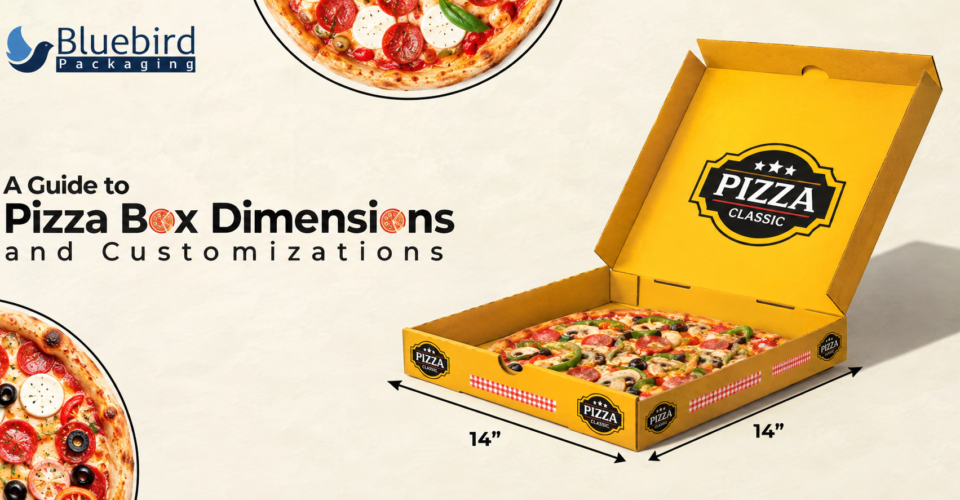
Choosing the right pizza box dimensions matters more than simply finding a container large enough to hold a pizza. The box needs enough room to protect the crust and toppings without leaving so much empty space that the pizza moves around during delivery.
Size also affects material use, storage, stacking, presentation, and delivery performance. A thin-crust personal pizza has very different packaging requirements from a heavily topped 20-inch family pizza.
Restaurants and food businesses can also use custom food boxes to keep packaging consistent across different menu items while selecting a size and structure suitable for each product.
This guide covers common pizza box sizes, measurements for small through family-size pizzas, materials, customization options, and practical factors to consider before ordering packaging.
Pizza Box Dimensions Chart: Standard Sizes at a Glance
There is no single box size that works for every pizza. The pizza diameter, crust type, toppings, and required clearance all influence the final dimensions.
The following pizza box dimensions chart provides a practical starting point.
| Pizza Category | Pizza Diameter | Typical Box Dimensions | Common Use |
|---|---|---|---|
| Personal | 6–8 inches | 8″ x 8″ x 2″ to 10″ x 10″ x 2″ | Individual servings |
| Small | 8–10 inches | 10″ x 10″ x 2″ to 12″ x 12″ x 2″ | Personal or small pizzas |
| Medium | 12 inches | Around 14″ x 14″ x 2–3″ | Couples and small groups |
| Large | 14 inches | Around 16″ x 16″ x 2–3″ | Family orders |
| Extra Large | 16–18 inches | Around 18″ x 18″ x 3″ or larger | Parties and group orders |
| Family Size | 20+ inches | 20″ x 20″ x 3–4″ or custom | Events and large groups |
| Single Slice | Varies | Around 9″ x 10″ x 2″ | Takeaway counters |
These measurements should be treated as general guidance rather than fixed rules. Your actual pizza packaging dimensions should be based on the finished pizza and the structure of the box.
What Is the Difference Between Pizza Size and Pizza Box Size?
Pizza size usually refers to its diameter. A 12-inch pizza, for example, measures approximately 12 inches from one side to the other through the center.
The box should normally be slightly larger.
This clearance provides room for pizza crust protection, makes the pizza easier to place inside the box, and reduces the chance of toppings rubbing against the sidewalls.
When considering pizza box dimensions, pay attention to three measurements:
- Length: The horizontal measurement from one side of the box to the other.
- Width: The measurement across the second side.
- Box depth: The vertical space between the bottom and lid.
The first two measurements accommodate the diameter, while depth becomes particularly important for thick crusts, loaded toppings, and deep-dish pizzas.
Small Pizza Box Dimensions
Personal and small pizzas are popular for individual meals, lunch menus, and takeaway orders. They generally require less material and structural support than larger pizzas.
Typical small pizza box dimensions include:
| Pizza Diameter | Suggested Box Size | Suitable For |
|---|---|---|
| 6 inches | 8″ x 8″ x 2″ | Mini pizzas |
| 8 inches | 10″ x 10″ x 2″ | Personal pizzas |
| 10 inches | 12″ x 12″ x 2″ | Small pizzas |
Small boxes can often be manufactured from lightweight paperboard or suitable food-grade corrugated material, depending on the pizza’s weight and delivery conditions.
Businesses selling pizza alongside appetizers and smaller foods may also use branded snack packaging to create a more consistent presentation across the menu.
Medium Pizza Box Dimensions
Medium pizzas commonly fall around the 12-inch range and are frequently ordered for two or more people. The packaging needs enough clearance to protect the outer crust without creating excessive empty space.
Common medium pizza box dimensions include approximately 14″ x 14″ with a suitable depth for the pizza style.
If you are researching the pizza box size for 12 inch pizza, do not automatically assume that a 12″ x 12″ box is ideal. Measure the finished pizza first and allow appropriate clearance.
| Pizza Diameter | Example Box Size | Recommended Depth |
|---|---|---|
| 11 inches | 12–13 inch box | 2–3 inches |
| 12 inches | Around 14 inch box | 2–3 inches |
| 13 inches | Around 14–15 inch box | 2–3 inches |
A thicker crust or heavily topped pizza may require additional depth even when its diameter remains unchanged.
Large Pizza Box Dimensions
Larger pizzas require greater structural support because their weight is distributed across a wider area. Weak packaging can bend when lifted or lose shape when several orders are stacked.
Typical large pizza box dimensions may range from 16″ x 16″ upward depending on the actual pizza.
For businesses searching for the pizza box size for 14 inch pizza, a box around 16 inches is often considered, subject to the pizza’s actual finished diameter and desired clearance.
Likewise, the appropriate pizza box size for 16 inch pizza may be around 18 inches, although restaurants should test their finished product before placing a bulk packaging order.
| Pizza Diameter | Typical Box Range | Packaging Consideration |
|---|---|---|
| 14 inches | Around 16″ x 16″ | Allow edge clearance |
| 16 inches | Around 18″ x 18″ | Consider stronger board |
| 18 inches | 18″ x 18″ or larger | Check crust and topping clearance |
Large pizzas with heavier toppings may benefit from corrugated pizza boxes, particularly where orders need to travel longer distances.
Pizza Slice Box Dimensions
Not every pizza business sells complete pies. Food courts, convenience stores, events, and takeaway restaurants may sell individual slices.
Typical pizza slice box dimensions depend on the length and width of the slice. A triangular box around 9″ x 10″ x 2″ can work for many standard slices, but larger New York-style slices may require more room.
Triangle-shaped packaging can reduce unnecessary material compared with placing one slice inside a full square pizza box. It also provides a convenient format for customers eating on the go.
For takeaway operations, takeaway pizza boxes should be easy to carry, simple to close, and strong enough to hold their shape until the food is consumed.
Extra-Large and Family Pizza Box Sizes
Family and party pizzas create additional packaging challenges because of their weight and width. These orders often require reinforced materials and greater box thickness than small personal pizzas.
A typical family pizza box size can start around 20″ x 20″, but oversized or specialty pizzas may need completely custom measurements.
| Pizza Diameter | Suggested Starting Box Size | Typical Use |
|---|---|---|
| 18 inches | 18–20 inches | Extra-large orders |
| 20 inches | 20–22 inches | Family pizzas |
| 24 inches | Custom | Party and specialty pizzas |
| 28+ inches | Custom | Oversized promotional pizzas |
For these sizes, corrugated cardboard packaging can provide greater rigidity and stacking support than lightweight alternatives.
Custom Pizza Box Dimensions: When Do You Need Them?
Not every restaurant menu fits neatly into standard pizza box sizes. Specialty pizzas may be rectangular, extra thick, oversized, or sold in unusual portions.
This is where custom pizza box dimensions become useful.
Custom sizing may be appropriate for:
- Deep-dish pizzas
- Stuffed-crust pizzas
- Rectangular pizzas
- Extra-large party pizzas
- Individual slices
- Promotional menu items
- Unusual serving portions
Custom sizing can also reduce excessive empty space. Using a box that is much larger than necessary wastes material and can allow the pizza to move during transport.
Bluebird Packaging offers custom pizza boxes that can be developed around different product sizes, branding requirements, and packaging specifications.
Need Packaging Made Around Your Actual Pizza Size?
Share your pizza dimensions, preferred material, quantity, and packaging requirements with Bluebird Packaging.
How to Measure a Pizza for the Right Box
Accurate pizza size measurement should be completed using the finished product rather than relying only on the advertised menu size.
1. Measure the Pizza Diameter
Measure from one outer edge of the crust to the opposite edge through the center.
Repeat the measurement on a few finished pizzas. Handmade pizzas may vary slightly from one order to another.
2. Allow Appropriate Clearance
Leave enough room so the pizza can be placed inside and removed without crushing the crust.
Around 0.5 to 1 inch of clearance may be useful in many applications, but the appropriate amount depends on the pizza and box construction.
3. Measure the Height
Do not focus exclusively on diameter.
A thin pizza with light toppings needs less vertical space than a stuffed-crust or deep-dish pizza.
4. Consider the Highest Topping
Measure the pizza at its highest point. The lid should not press directly onto cheese, meat, vegetables, or decorative toppings.
5. Test the Physical Sample
Before ordering large quantities or wholesale pizza boxes, test a sample with an actual finished pizza. Check how easily the box closes, whether the crust touches the walls, and whether the pizza moves excessively.
Pizza Box Size Chart by Crust Style
Diameter is only one part of the decision. Crust style can affect the required depth significantly.
This pizza box size chart shows why two pizzas with the same diameter may require different packaging.
| Pizza Style | Typical Depth Requirement | Main Consideration |
|---|---|---|
| Thin crust | Lower depth | Prevent excessive movement |
| Traditional crust | Standard depth | Balance clearance and protection |
| Stuffed crust | Additional depth | Protect raised crust edges |
| Deep dish | Greater depth | Prevent lid contact |
| Heavily topped | Additional clearance | Protect toppings |
Businesses should always test the actual food rather than treating these measurements as universal specifications.
What Materials Are Used for Pizza Boxes?
Packaging material affects strength, printing, presentation, handling, and food contact performance.
Cardboard Pizza Boxes
Cardboard pizza boxes are widely used because they are lightweight, printable, and economical for many applications.
They can work well for personal, small, and medium pizzas where extreme structural strength is not required.
Corrugated Pizza Boxes
Corrugated pizza boxes contain a fluted layer that adds rigidity. This construction can be particularly useful for larger or heavier pizzas.
They are also useful when boxes need to be stacked during delivery.
Kraft Pizza Boxes
Kraft pizza boxes offer a natural appearance that works well with simple or sustainability-focused branding. Kraft surfaces can be combined with custom printing to create a clean, understated presentation.
Food-Grade Materials
Any material intended for direct or indirect food contact should be suitable for its intended application. Using appropriate food grade cardboard and food-compatible printing or coatings should be part of the packaging specification process.
Cardboard vs. Corrugated Pizza Packaging
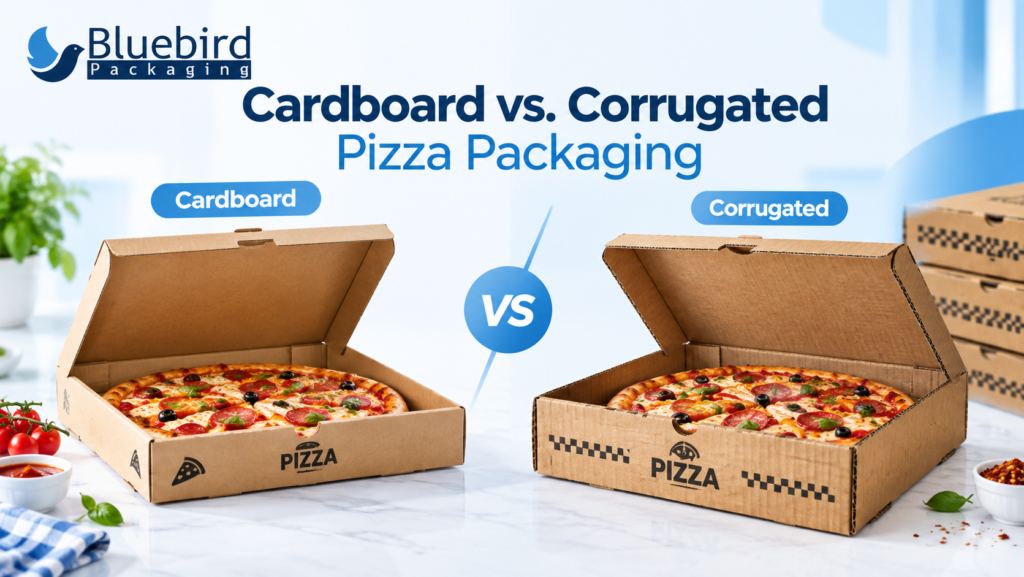
Choosing between standard paperboard and corrugated construction depends largely on the product.
| Feature | Cardboard | Corrugated |
|---|---|---|
| Weight | Lightweight | Heavier |
| Rigidity | Moderate | Higher |
| Printing | Good | Good |
| Large pizzas | Depends on specification | Often better suited |
| Stacking | Moderate | Stronger support |
| Material use | Lower | Higher |
| Typical application | Small/medium pizzas | Large/heavy pizzas |
Neither material is automatically right for every application. The ideal choice depends on size, weight, distance, stacking, and required protection.
Grease Resistance and Food Protection
Pizza naturally contains oils from cheese, sauces, and toppings. Packaging therefore needs to account for grease exposure.
Grease resistant boxes can help reduce visible oil penetration and maintain the appearance and structure of the package. The exact barrier or coating should be selected according to food-contact requirements and disposal goals.
Ventilation also matters. Completely trapping steam may create condensation, while excessive ventilation can allow heat to escape too quickly.
Well-designed pizza delivery boxes therefore need to balance heat, moisture, ventilation, and structural protection.
These factors collectively contribute to better pizza delivery safety and help the product arrive closer to the condition in which it left the restaurant.
Pizza Box Customization Options
Correct sizing protects the food, but packaging customization can turn the same box into a recognizable brand asset.
Pizza Box Printing
Custom pizza box printing can include a logo, brand colors, website, social media details, QR codes, promotional messages, or product information.
Printing the exterior allows restaurants to transform an otherwise plain shipping container into customer-facing marketing material.
Custom Printed Pizza Boxes
Well-designed custom printed pizza boxes can maintain visual consistency across delivery, takeaway, catering, and event orders.
The artwork should remain easy to identify at a glance. Overloading every surface with promotional messages can make packaging feel cluttered.
Branded Pizza Packaging
Branded pizza packaging can use typography, colors, patterns, and illustrations that match the restaurant’s wider visual identity.
If branding is an important goal, read Bluebird Packaging’s guide to using custom food packaging to strengthen brand presentation for additional ideas.
Finishing Options
Depending on the material and food application, brands may consider finishes such as:
- Matte appearance
- Gloss appearance
- Embossed branding
- Debossed details
- Spot design elements
- Custom die-cut structures
The selected finish should complement the material rather than interfere with the functional requirements of food packaging.
How Pizza Box Dimensions Affect Delivery
Poorly selected pizza box dimensions can create problems even when the pizza itself is prepared perfectly.
A box that is too small may press against the crust or toppings. A box that is unnecessarily large gives the pizza more room to slide during transport.
Correct sizing supports:
- Better product stability
- Cleaner presentation
- Easier stacking
- More efficient storage
- Reduced unnecessary material
- Better handling during delivery
Packaging cannot control every delivery condition, but choosing an appropriate structure helps reduce avoidable problems.
Eco Friendly Pizza Boxes and Sustainability
Restaurants looking for eco friendly pizza boxes should consider more than the color or appearance of the material.
Sustainability decisions may include recycled fiber content, material efficiency, printing choices, coatings, and local recycling infrastructure.
Possible sustainable packaging solutions include recyclable fiber-based structures, responsibly sourced paper materials, water-based or suitable lower-impact inks, and right-sized packaging that avoids unnecessary material.
Recyclable pizza boxes should also be designed with end-of-life considerations in mind. Local recycling requirements can vary, particularly when cardboard contains heavy food residue.
Using the correct size can itself support material efficiency. A right-sized box generally requires less board than an unnecessarily oversized one.
Are Pizza Boxes Recyclable?
Many fiber-based pizza boxes may be recyclable, but acceptance depends on the material, coatings, contamination level, and local recycling program.
Light grease staining does not necessarily mean the entire box must always be discarded, but heavily contaminated portions can create problems for some recycling systems.
Customers should follow their local recycling provider’s instructions.
Restaurants interested in sustainability should therefore consider the complete package rather than relying only on a recyclable label.
Factors That Affect the Cost of Custom Pizza Boxes
There is no universal price for customized pizza packaging. Cost depends on the specifications of the order.
| Cost Factor | Why It Matters |
|---|---|
| Dimensions | Larger boxes generally require more material |
| Material | Board type and strength affect cost |
| Quantity | Larger production runs can change unit economics |
| Printing | Artwork and number of print colors affect production |
| Finish | Specialty finishes add manufacturing steps |
| Structure | Custom shapes may require unique tooling |
| Shipping | Larger boxes require more storage and transport space |
Businesses ordering wholesale pizza boxes should compare more than unit price. A lower-cost box that performs poorly during delivery can create additional operational problems.
For businesses with pizza, snacks, desserts, and other menu categories, Bluebird Packaging’s range of food packaging solutions can help maintain a consistent packaging approach.
Planning a Bulk or Custom Pizza Box Order?
Get a packaging quote based on your required size, material, printing, and quantity.
Common Mistakes When Choosing Pizza Box Dimensions
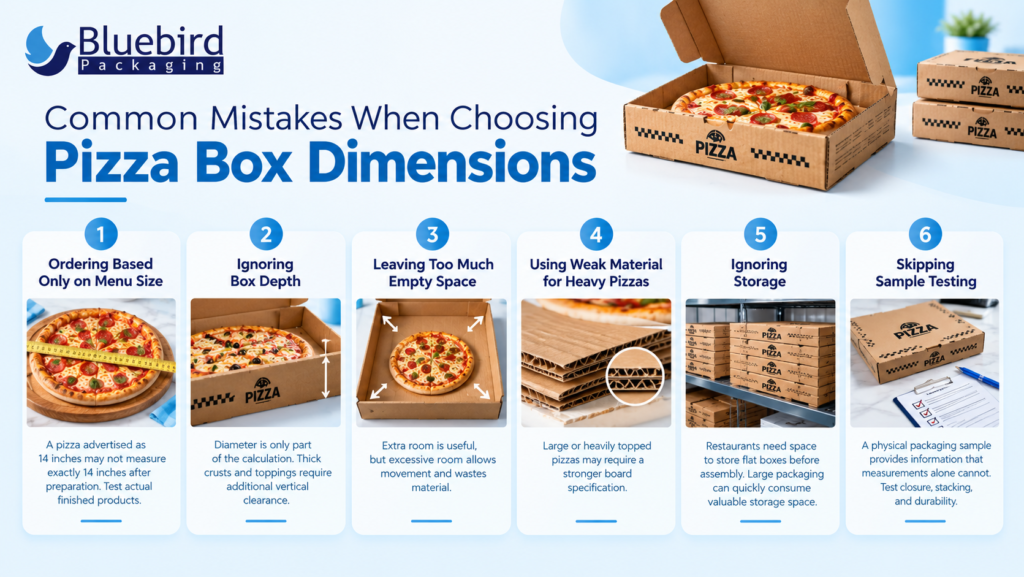
Ordering Based Only on Menu Size
A pizza advertised as 14 inches may not measure exactly 14 inches after preparation. Test actual finished products.
Ignoring Box Depth
Diameter is only part of the calculation. Thick crusts and toppings require additional vertical clearance.
Leaving Too Much Empty Space
Extra room is useful, but excessive room allows movement and wastes material.
Using Weak Material for Heavy Pizzas
Large or heavily topped pizzas may require a stronger board specification.
Ignoring Storage
Restaurants need space to store flat boxes before assembly. Large packaging can quickly consume valuable storage space.
Skipping Sample Testing
A physical packaging sample provides information that measurements alone cannot. Test closure, stacking, handling, and delivery before committing to a large production run.
Building Consistent Packaging Across Your Food Range
Restaurants often sell much more than pizza. Using a consistent visual identity across different food packaging boxes can help customers recognize the brand regardless of what they order.
For example, a pizzeria may use:
- Pizza packaging for main meals
- Custom packaging for candy and sweet products for confectionery or promotional treats
- Snack boxes for sides and takeaway snacks
- Custom popcorn boxes for events, cinemas, promotions, or specialty menu items
Colors, typography, logo placement, and print style can remain consistent even when the structural design changes between products.
This approach creates a connected packaging system instead of treating every box as a separate design.
Frequently Asked Questions
What are standard pizza box dimensions?
Common pizza box dimensions range from compact 8 to 10-inch boxes for personal pizzas to 18, 20, or larger boxes for family pizzas. The final size should be selected according to the actual pizza diameter, crust, toppings, and required clearance.
What size pizza box should I use for a 12-inch pizza?
For a 12-inch pizza, businesses commonly consider a box around 14 inches to provide additional clearance. Test the finished pizza before confirming the packaging specification.
What box works for a 14-inch pizza?
A 14-inch pizza may use a box around 16 inches depending on crust shape and required clearance. Measure several finished pizzas rather than relying only on the advertised size.
What box size works for a 16-inch pizza?
A 16-inch pizza often requires a box around 18 inches. Heavier pizzas may also benefit from stronger corrugated material.
How much clearance should a pizza box have?
Around 0.5 to 1 inch can provide useful clearance in many cases. However, the appropriate amount depends on the pizza’s diameter, crust, shape, and box structure.
What is the best material for pizza boxes?
The best material depends on the application. Lightweight board may work for smaller pizzas, while corrugated construction can provide greater rigidity for large, heavy, or delivery-focused orders.
Can I customize the size of pizza boxes?
Yes. Custom sizing can be used when standard options do not match the diameter, shape, thickness, or presentation requirements of a pizza.
Are custom pizza boxes suitable for branding?
Yes. Boxes can be customized with logos, colors, patterns, promotional messages, and other brand elements, subject to the printing and material specifications selected.
Are pizza boxes recyclable?
Many paper-based boxes may be recyclable when compatible materials are used and contamination is within the limits accepted by the local recycling system. Recycling requirements vary by location.
Why does pizza box depth matter?
Depth prevents the lid from pressing onto the crust or toppings. Deep-dish, stuffed-crust, and heavily topped pizzas generally require more vertical clearance than thin-crust pizzas.
Choose Pizza Box Dimensions That Fit Your Product
The right pizza box dimensions should be based on the actual pizza rather than a generic assumption about small, medium, or large sizing. Measure the diameter, account for the crust and toppings, determine the required depth, and test the packaging with the finished product.
Material matters as well. Cardboard may work well for many standard orders, while corrugated structures can provide additional strength for larger pizzas. Printing and structural customization can then turn functional pizza packaging into packaging that also supports brand recognition.
Bluebird Packaging provides custom pizza packaging solutions for businesses looking to combine sizing, structure, printing, and brand presentation in one package.
Need Help Selecting the Right Pizza Box Size?
Discuss your product dimensions, material requirements, printing preferences, quantity, and packaging goals with Bluebird Packaging.