
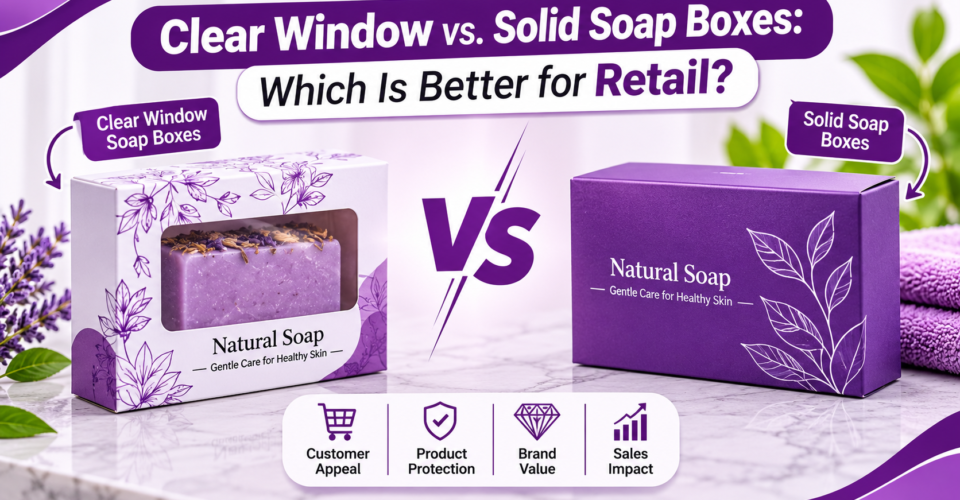
Choosing the right packaging can make a noticeable difference in how customers perceive a soap product on retail shelves. Some brands prefer transparent windows that let shoppers see the soap before purchasing, while others choose fully enclosed boxes that provide more space for branding, product information, and protection.
When comparing window vs solid soap boxes, the best option depends on the type of soap, target customers, retail environment, and brand identity. Clear window soap boxes can showcase the color, texture, and appearance of handmade soap, whereas solid soap packaging boxes offer a larger printable surface and more complete coverage.
Both options can work well for handmade soap businesses, skincare brands, gift shops, and retail stores. The important thing is to understand how each packaging style performs before making a decision.
In this guide, we’ll compare window and solid soap boxes based on product visibility, protection, materials, customization, branding, and retail presentation so you can choose the right packaging for your soap products.
Quick Comparison: Window vs Solid Soap Boxes
| Comparison Factor | Window Soap Boxes | Solid Soap Boxes |
|---|---|---|
| Product Visibility | Customers can see part of the soap | Soap remains fully covered |
| Branding Space | Slightly reduced printable area | Larger uninterrupted printing area |
| Shelf Appeal | Highlights soap color and texture | Creates a clean, branded appearance |
| Product Protection | Depends on window material and construction | Provides more complete surface coverage |
| Customization | Die-cut shapes and printed designs | Wide range of printed designs |
| Material Options | Cardboard, kraft, paperboard with window material | Kraft, cardboard, and paperboard |
| Eco-Friendly Potential | Depends on window material and separability | Often simpler to recycle when made from compatible paperboard |
| Best For | Handmade, decorative, and visually distinctive soaps | Premium, minimalist, and information-rich packaging |
1. What Are Window Soap Boxes?
Window soap boxes are packaging boxes designed with a transparent opening that allows customers to see part of the soap without opening the package. The opening may be created through a die-cut design and left open or covered with a transparent material, depending on the packaging requirements.
These boxes are particularly useful for products where appearance influences purchasing decisions. Handmade soaps, botanical soaps, colorful soap bars, and decorative products can benefit from showing their visual features directly on the retail shelf.
Key Features of Clear Window Soap Boxes
Product visibility: Customers can inspect the soap’s color, pattern, and texture through the window.
Custom window shapes: Die-cut window soap boxes can feature rectangular, square, circular, or custom-shaped openings.
Branding flexibility: Brands can combine printed graphics, logos, product information, and window placement to create distinctive packaging.
Retail presentation: A visible product can help customers understand what they are buying without opening the box.
Common Uses of Window Soap Packaging
Clear window packaging can work particularly well for:
- Handmade and artisan soap bars
- Natural and botanical soaps
- Decorative soaps with unique colors or patterns
- Gift soaps and seasonal collections
- Specialty soaps designed for visual presentation
For example, a handmade soap featuring colorful layers or botanical ingredients may benefit from a window that allows customers to see its appearance. The window becomes part of the product presentation rather than simply a packaging feature.
2. What Are Solid Soap Packaging Boxes?
Solid soap packaging boxes are fully enclosed boxes without transparent windows. They cover the entire soap bar and provide a larger surface for brand messaging, product information, and printed designs.
This packaging style is widely used by skincare brands, handmade soap businesses, and retail manufacturers that want a consistent and fully branded presentation.
Key Features of Solid Soap Boxes
More printing space: The entire exterior can be used for logos, graphics, ingredients, directions, and product details.
Complete visual coverage: The soap remains hidden until the customer opens the package.
Flexible design options: Brands can use custom colors, patterns, typography, illustrations, and finishes.
Product coverage: The enclosed structure covers the soap more completely than an open die-cut window design, although actual protection depends on the board thickness and box construction.
Common Uses of Solid Soap Packaging
Solid cardboard soap boxes are suitable for:
- Premium skincare soap bars
- Minimalist soap collections
- Luxury and gift soap packaging
- Brands with detailed product information
- Retail products requiring consistent packaging across multiple varieties
A solid box can also help create a coordinated product range. For example, a skincare brand selling several soap formulas can use the same box structure while changing colors, graphics, and product details for each variant.
3. Window vs Solid Soap Boxes: 7 Important Differences
Both packaging styles serve the same basic purpose, but they create different experiences for customers and retailers.
3.1 Product Visibility
The biggest difference between window and solid soap boxes is how much of the product customers can see.
Window packaging allows customers to view the soap before purchasing. This can be useful when the product has distinctive colors, patterns, textures, or decorative details.
Solid packaging keeps the product completely covered. Customers instead rely on the product name, images, descriptions, and branding printed on the box.
Which is better? Window packaging is generally more suitable when the soap’s appearance is an important selling point. Solid boxes are a better fit when the brand wants a fully designed exterior or prefers to keep the product concealed.
3.2 Branding and Printing Space
Solid soap boxes offer more uninterrupted surface area for custom printing. Brands can use this space for logos, product descriptions, ingredient information, instructions, and visual designs.
Window soap boxes also offer customization, but the cutout reduces the printable area. The available space depends on the window’s size and placement.
Which is better? Solid boxes provide more room for detailed branding. Window boxes can create a stronger product-focused design when the soap itself is visually appealing.
3.3 Product Protection
Protection depends on the packaging material, thickness, structure, closure, and handling conditions.
Solid cardboard soap boxes cover the entire product surface and can help protect against direct contact, dust, and handling. Window boxes can provide similar structural protection when designed properly, but an open window may expose part of the soap.
A transparent window film can cover the opening, although its protective performance depends on the material and how securely it is attached.
Neither style automatically makes soap waterproof or guarantees protection from heat, humidity, or damage. Brands should select suitable materials and test packaging under their expected storage and shipping conditions.
Which is better? Solid boxes generally offer more complete physical coverage. Window boxes can still provide appropriate retail protection when the opening and window material are carefully designed.
3.4 Shelf Appeal and Customer Experience
Retail shelf appeal is influenced by color, design, packaging quality, product visibility, and how well the packaging communicates the product’s value.
Window packaging lets customers see the actual soap, which can be helpful for handmade products with distinctive appearances.
Solid boxes rely more heavily on printed graphics and brand identity. A well-designed solid box can create a premium, clean, or minimalist appearance without showing the product.
Which is better? Choose window packaging when showing the soap adds value. Choose solid packaging when the printed design and brand presentation should take priority.
3.5 Material Options and Customization
Both packaging styles can be produced using different paper-based materials, including kraft paperboard, cardboard, and other suitable packaging boards.
Window boxes require an additional design consideration: the window opening and, where used, the transparent covering material.
Solid boxes have a simpler enclosed surface, making it easier to apply a consistent printed design across the entire exterior.
Which is better? Solid boxes provide a simpler structure, while window boxes offer more flexibility in how the product is displayed.
3.6 Cost and Production Considerations
The cost of custom soap packaging depends on several factors, including:
- Box dimensions and material thickness
- Order quantity
- Printing colors and coverage
- Die-cutting requirements
- Window material and attachment
- Finishing options
- Packaging structure and assembly
Window soap boxes may involve additional die-cutting and window application, depending on the design. Solid boxes may have a simpler construction, although premium printing, special finishes, or complex structures can also increase their cost.
Which is better? Neither option is always cheaper. Request quotes for both styles using the same dimensions, material, order quantity, and printing requirements before comparing prices.
3.7 Eco-Friendly Packaging Considerations
Sustainability depends on the materials used and how the finished packaging can be collected, sorted, and recycled.
Solid paperboard boxes can be easier to process through paper recycling systems when they are made from compatible materials and do not contain problematic coatings or components.
Window packaging may include a transparent plastic film. Depending on the film and local recycling facilities, that mixed-material construction may need to be separated before recycling or may not be accepted in ordinary paper recycling.
Brands interested in eco-friendly soap packaging can consider minimizing unnecessary materials, selecting suitable paperboard, and asking suppliers about the window material’s composition and end-of-life options.
Which is better? Solid boxes often have an advantage when simple paper-based construction is a priority. Window boxes can still be designed thoughtfully by selecting appropriate materials and avoiding unnecessary components.
4. Best Materials for Window and Solid Soap Boxes
Material selection affects packaging strength, printing quality, appearance, and overall performance. The best material depends on the soap’s weight, box dimensions, design, and intended retail environment.
Kraft Paperboard
Kraft paperboard is a popular choice for handmade and natural soap brands. Its natural appearance works well with botanical illustrations, earthy colors, and minimalist designs.
It can be used for both window and solid soap packaging, depending on the required structure and material specifications.
Cardboard
Cardboard is a versatile option for custom printed soap boxes. It supports different printing styles and can be designed for a wide range of retail products.
Solid cardboard soap boxes are useful when brands need a consistent exterior for logos, product information, and decorative graphics.
Paperboard
Paperboard is available in different thicknesses and finishes. It can be selected according to the product’s weight, box dimensions, and desired presentation.
For window packaging, the paperboard structure must also accommodate the die-cut opening without compromising the box’s strength.
Transparent Window Material
Some soap boxes use a transparent film to cover the die-cut window. This lets customers view the product while keeping the opening covered.
Before selecting a window material, brands should check its composition, attachment method, compatibility with the paperboard, and recycling instructions.
5. Which Soap Boxes Are Better for Different Retail Businesses?
The best packaging style depends on the product and the customers a brand wants to attract.
| Soap Business Type | Recommended Option | Reason |
|---|---|---|
| Handmade Soap Brands | Window or solid | Depends on whether the soap’s appearance is a selling point |
| Natural Soap Brands | Kraft window or solid | Supports a natural visual identity |
| Luxury Skincare Brands | Solid boxes | Provides more room for premium branding |
| Decorative Soap Sellers | Window boxes | Shows colors, patterns, and shapes |
| Gift Soap Collections | Either option | Depends on the gift presentation |
| Minimalist Soap Brands | Solid boxes | Supports clean and simple designs |
| Retail Soap Manufacturers | Either option | Depends on product range and shelf strategy |
For Handmade Soap Businesses
Handmade soap products often have distinctive colors, textures, and patterns. Window packaging can help customers see these details, making it a useful option for visually appealing products.
However, a solid box can be equally effective when the brand uses strong photography, illustrations, or a recognizable visual identity.
For Natural and Organic Soap Brands
Kraft soap packaging can complement natural product positioning through its earthy appearance. Brands can use either a window or a fully enclosed structure.
If a product’s ingredients or appearance are important to customers, a window may help communicate its character. A solid box provides more space for ingredient details and product messaging.
Brands should ensure that any claims such as “organic,” “natural,” or “chemical-free” are accurate and supported.
For Luxury Soap Brands
Solid boxes can create a refined appearance through carefully selected typography, color palettes, embossing, foil details, and other suitable finishes.
Window packaging can also look premium when the opening is intentionally integrated into the design. The right choice depends on the brand’s desired presentation rather than a fixed rule.
6. Custom Window and Solid Soap Packaging Design Ideas
A good soap packaging design should balance product protection, brand recognition, and shelf presentation.
Minimalist Window Design
Use a simple rectangular or circular window with a small logo and limited supporting graphics. This approach works well when the soap’s color and texture should remain the main visual feature.
Kraft Window Soap Boxes
Combine kraft paperboard with a carefully positioned window to create a natural-looking presentation. This style can suit handmade and botanical soap collections.
Branded Solid Soap Boxes
Use custom colors, illustrations, typography, and product information across the box exterior. This gives brands more room to create a consistent identity across multiple soap varieties.
Premium Printed Soap Boxes
Solid packaging can be enhanced with selected finishing options such as matte lamination, embossing, debossing, or foil details. These finishes should match the brand’s visual identity and budget.
Product-Specific Window Shapes
Instead of using a standard rectangular opening, brands can explore custom die-cut shapes that relate to their product or brand identity. The window should remain large enough to show the soap clearly without weakening the packaging structure.
7. How to Choose the Right Soap Packaging for Retail Shelves
Before ordering custom retail soap packaging boxes, consider the following factors.
1. Understand Your Product
Consider the soap’s dimensions, weight, shape, ingredients, appearance, and packaging requirements. A decorative soap may benefit from a window, while a product with detailed branding requirements may work better in a solid box.
2. Identify Your Retail Environment
Think about where the soap will be displayed. Packaging for a boutique gift shop may need a different presentation from products sold in supermarkets or online stores.
3. Decide How Much Product Visibility You Need
If customers need to see the actual soap before purchasing, consider a window. If printed graphics and product information are more important, a solid box may be more suitable.
4. Choose the Appropriate Material
Compare kraft, cardboard, and paperboard options based on strength, printing requirements, appearance, and cost.
5. Review Your Branding Requirements
Make sure the selected packaging structure provides enough space for your logo, product name, ingredients, directions, and other required information.
6. Consider Protection and Storage
Evaluate how the packaging will perform during handling, shelf storage, and transportation. Test the finished box with the actual soap product before placing a large order.
7. Compare Custom Packaging Quotes
Request quotes for both window and solid designs. Compare material specifications, printing, die-cutting, finishing, and order quantities to understand the actual cost difference.
8. Why Custom Soap Packaging Matters for Retail Brands
Custom packaging is more than an outer covering. It helps customers recognize a product, understand its features, and distinguish one brand from another.
A carefully designed soap box can support:
- Brand recognition: Consistent colors, typography, and logos help create a recognizable product range.
- Product communication: Packaging provides space for product names, ingredients, directions, and other relevant information.
- Retail presentation: A well-structured box can make products easier to display and organize.
- Product protection: Suitable materials and box construction help protect soap during handling and storage.
- Product differentiation: Window cutouts, custom printing, and distinctive structures can help products stand out.
For brands exploring different packaging styles, custom soap Packaging boxes can be designed around product dimensions, material preferences, and branding requirements.
9. Frequently Asked Questions
1. What is the difference between window and solid soap boxes?
Window soap boxes include a transparent opening that lets customers see part of the soap. Solid soap boxes are fully enclosed and provide more uninterrupted space for printing and product information.
2. Are clear window soap boxes better for retail?
They can be better when the soap’s appearance is an important selling point. Window packaging helps customers see colors, patterns, and textures before purchasing. However, solid boxes may be more suitable for brands that prioritize full coverage and printed branding.
3. Do window soap boxes help increase product visibility?
Yes. A transparent window makes part of the soap visible without opening the package. This can help customers inspect visually distinctive products on retail shelves.
4. Are solid soap boxes more protective than window boxes?
Solid boxes provide more complete physical coverage because they do not have a window opening. However, protection also depends on board thickness, box construction, and storage conditions. A properly designed window box can still provide suitable retail protection.
5. What material is best for retail soap packaging?
Kraft paperboard, cardboard, and other suitable paperboard materials are common options. The best material depends on the soap’s weight, dimensions, printing requirements, and desired appearance.
6. Can window soap boxes protect handmade soap?
Yes. Window soap boxes can protect handmade soap when they use suitable board, secure closures, and an appropriately designed window. A covered window can help prevent direct contact with the product.
7. Are soap boxes with plastic windows recyclable?
It depends on the window material and local recycling facilities. Some paper recycling systems may require the transparent film to be separated from the box. Check the material specifications and local recycling guidance before making recyclability claims.
8. Can solid soap boxes be customized with printing?
Yes. Solid soap boxes can be customized with logos, product information, colors, illustrations, patterns, and suitable finishing options.
9. Which soap packaging is better for handmade products?
Both styles can work. Window packaging is useful when handmade soap has distinctive colors or textures. Solid packaging is suitable when the brand wants more room for product information and a fully designed exterior.
10. How do I choose the right soap box for retail shelves?
Consider product visibility, branding, material, protection, retail environment, and budget. Compare sample designs and test the packaging with the actual soap before ordering in bulk.
Conclusion: Which Is Better, Window or Solid Soap Boxes?
When comparing window vs solid soap boxes, there is no single option that works best for every retail soap brand.
Window soap boxes are a strong choice when product visibility matters. They allow shoppers to see the soap’s appearance and can make visually distinctive handmade products easier to present.
Solid soap packaging boxes are more suitable when brands need complete product coverage, greater uninterrupted printing space, and a clean, consistent exterior.
The right choice depends on your soap, branding goals, retail environment, and packaging requirements. Consider both designs, compare material and production costs, and test the packaging before placing a large order.
Looking for packaging designed around your soap products? Explore Bluebird Packaging’s custom soap packaging options or request a custom packaging quote to discuss a suitable design for your retail brand.