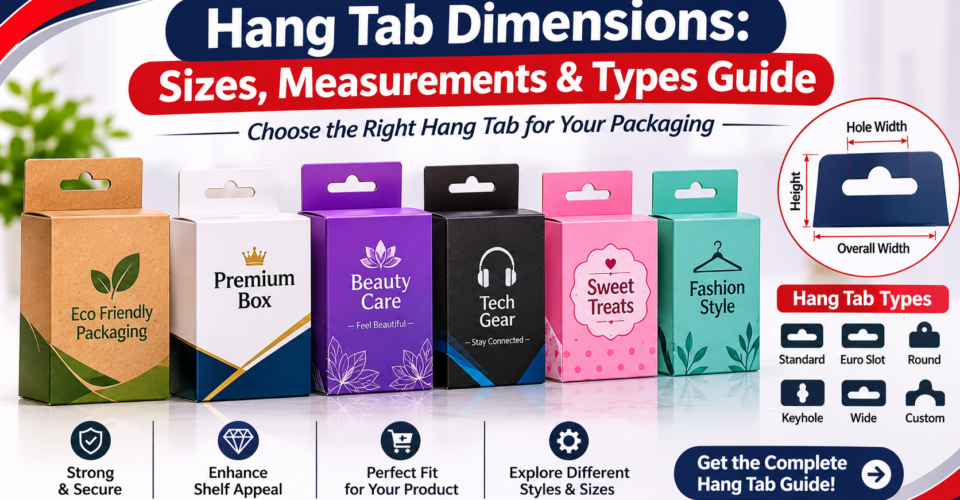
Hang tabs are small but important packaging features that allow products to hang from retail display hooks, pegboards, and other store fixtures. They help retailers display packaged products vertically, improve shelf organization, and make items easier for customers to see and access. However, choosing the right hang tab dimensions is essential for ensuring that packaging fits the display system and supports the product securely.
The correct size depends on several factors, including the overall tab width and height, hole or slot design, packaging material, attachment area, and product weight. A hang tab that is too small may not fit the retail hook, while an incorrectly positioned opening can affect how the package hangs. Insufficient attachment strength may also cause the packaging to tear or become detached.
This guide explains standard hang tab measurements, different hang tab styles, how to measure them accurately, and how to choose suitable dimensions for retail packaging. Whether you need integrated cardboard tabs, adhesive hang tabs, or custom retail display boxes, understanding these measurements will help you make a more informed packaging decision.
What Are Hang Tabs?
Hang tabs are packaging attachments or die-cut extensions designed to suspend products from retail display fixtures. They are commonly found on boxes, cartons, blister packs, bags, and other retail packaging formats.
A hang tab typically includes an opening that fits over a display hook. The tab may be built directly into the packaging or attached separately using an adhesive or mechanical fastening method.
Retailers use hang tabs to organize products vertically, especially when shelf space is limited. They are common in electronics accessories, stationery, cosmetics, small household products, toys, and lightweight consumer goods.
How Do Hang Tabs Work?
A hang tab provides a hanging point above or behind the packaged product. The opening fits over a compatible retail display hook, allowing the package to remain suspended.
For reliable performance, the opening must match the hook, and the tab must have enough material around it to resist tearing. The connection between the tab and the package is equally important because the product’s weight transfers through this area.
Integrated, Adhesive, and Plastic Hang Tabs
Hang tabs are available in several configurations:
- Integrated hang tabs: Die-cut directly into the packaging structure, usually using the same paperboard or cardboard material.
- Adhesive hang tabs: Separate tabs attached to an existing package with a suitable adhesive.
- Plastic hang tabs: Manufactured from plastic materials and attached to packaging where additional strength or a particular display format is required.
The most appropriate option depends on the packaging structure, product weight, display requirements, and manufacturing process.
Why Hang Tab Dimensions Matter
Accurate hang tab measurements affect more than the appearance of a package. They influence how the product fits on retail fixtures, how securely it hangs, and whether the packaging remains in good condition during display.
Compatibility With Retail Display Hooks
The hole or slot must be compatible with the retailer’s display hook. A small opening may not fit the hook, while an oversized or poorly positioned opening may allow the package to move excessively.
Before finalizing the design, identify the type of retail fixture and confirm its hook dimensions.
Product Weight and Packaging Stability
The weight of the packaged product places stress on the hang tab and its attachment area. A lightweight stationery box may require a different construction from a heavier electronic accessory package.
The tab material, thickness, opening design, and connection to the main box all contribute to its performance.
Better Product Visibility
A correctly sized hang tab helps a package sit at an appropriate angle on the display hook. This can improve product visibility and make packaging easier for customers to browse.
Preventing Packaging Damage
Insufficient material around the hole, weak attachment points, or unsuitable board thickness can lead to tearing. Correct measurements and appropriate structural testing help reduce the risk of damage during handling and retail display.
Standard Hang Tab Dimensions and Measurements
There is no single universal size for every hang tab. Standard hang tab sizes vary according to the tab style, display-hook requirements, packaging dimensions, material, and product weight.
Instead of choosing a measurement based only on a general size chart, businesses should identify the display system and confirm the required dimensions with their packaging supplier or retailer.
The main measurements to consider are explained below.
Overall Hang Tab Width and Height
Overall width refers to the horizontal measurement of the tab, while overall height refers to its vertical measurement from the attachment area to the top edge.
These measurements determine how much space the tab occupies and how it integrates with the packaging structure.
A wider tab may provide more room around the opening, while a taller tab may create additional clearance above the package. The final dimensions should be based on the package design and available display space.
Hang Tab Hole Size
The hang tab hole is the opening through which the retail display hook passes. Its dimensions should be selected according to the hook’s shape and size.
For round hole hang tabs, measure the diameter of the opening. For slotted designs, measure both the opening’s width and height.
Avoid assuming that every retail fixture uses the same opening size. Confirm the hook specifications before approving the packaging design.
Hang Tab Slot Dimensions
A slot is an elongated opening designed to accommodate certain display-hook configurations. Its width, height, and shape determine whether it fits the intended fixture.
Euro slots and other slotted designs may look similar, but their exact profiles and dimensions can differ. Use the retailer’s required template or a verified hook measurement when preparing the die line.
Distance Between the Opening and Top Edge
The distance between the hole or slot and the top edge is important because it determines how much material remains above the opening.
Insufficient clearance can weaken the tab and increase the risk of tearing. Adequate spacing should be determined by the material, opening geometry, product load, and structural testing.
Attachment Area and Material Thickness
The attachment area connects the hang tab to the package. It must provide sufficient contact or structural support for the expected load.
For integrated tabs, consider the board thickness, grain direction where relevant, and the amount of material surrounding the die-cut area. For adhesive tabs, consider the adhesive type, bonding surface, and required contact area.
Measurement reminder: Record all dimensions on the packaging dieline and confirm them with the supplier before production. A visual estimate is not a substitute for a verified technical specification.
Different Types of Hang Tabs and Their Dimensions
Different hang tab styles are designed for different retail fixtures and packaging requirements. Their openings and attachment structures influence the measurements needed for a successful design.
Round Hole Hang Tabs
Round hole hang tabs feature a circular opening that fits over a compatible retail display hook.
They are commonly used for lightweight products such as stationery, small accessories, and selected consumer goods.
Important measurements include:
- Overall tab width and height
- Hole diameter
- Distance from the hole to the top edge
- Material thickness
- Attachment area
The hole diameter should be based on the actual hook specification. The material surrounding the hole should also be evaluated to reduce the risk of tearing.
Euro Slot Hang Tabs
Euro slot hang tabs feature an elongated opening with a shaped profile. They are commonly used in retail packaging because the slot can accommodate compatible display hooks.
Their design may include a wider central area and narrower sections, depending on the specific die-cut profile.
When selecting Euro slot dimensions, check:
- Overall slot width
- Slot height
- Shape and profile
- Top-edge clearance
- Compatibility with the display hook
A Euro slot should not be selected solely because it is a familiar retail packaging design. Retailer or fixture specifications should determine the final profile.
Delta Hole Hang Tabs
Delta hole hang tabs use a triangular or angled opening design, depending on the particular construction.
They may be suitable for certain retail display systems and packaging formats. The opening profile must match the intended hook, while the surrounding material must provide adequate support.
Before choosing this style, confirm the required opening geometry and test the finished package on the actual display fixture.
Adhesive Hang Tabs
Adhesive hang tabs are separate components attached to an existing package. They can be useful when the original packaging structure does not include an integrated hanging feature.
Their measurements should account for both the hanging opening and the adhesive contact area.
Important considerations include:
- Overall tab dimensions
- Hole or slot dimensions
- Adhesive coverage
- Surface compatibility
- Product weight
- Application position
Adhesive performance can vary according to the package surface, coating, temperature, humidity, and handling conditions. Testing is recommended before large-scale production.
Integrated Hang Tab Boxes
Integrated hang tab boxes have a hanging feature incorporated into the packaging dieline. The tab is produced as part of the same paperboard or cardboard structure.
This design can provide a neat appearance and eliminate the need for a separate hang tab component.
When designing integrated hang tab packaging, consider the box width and height, tab extension, opening dimensions, board thickness, and structural connection.
Businesses can explore custom retail box designs when planning packaging that needs to support retail display requirements.
How to Measure Hang Tab Dimensions
Accurate measurements help prevent compatibility problems and reduce the need for packaging revisions. Before preparing a dieline, identify the retail fixture and the type of hang tab required.
Follow these steps to measure a hang tab.
Step 1: Measure the Overall Tab Width and Height
Measure the complete tab from its left edge to its right edge to determine the width. Then measure from the attachment area to the highest point of the tab to determine its height.
Record these measurements in millimeters or inches and use the same unit throughout the dieline.
Step 2: Measure the Hole or Slot
For a round hole, measure its diameter.
For a Euro slot or another elongated opening, measure its maximum width and height. If the opening has a shaped profile, record its complete outline rather than relying only on two measurements.
Step 3: Check the Top-Edge Clearance
Measure the distance from the top edge of the tab to the nearest edge of the opening.
This measurement helps determine how much material remains above the hole or slot. The required clearance depends on the opening design, material, and expected load.
Step 4: Measure the Attachment Area
For an adhesive tab, measure the area that will contact the package. For an integrated design, examine the connection between the tab and the main packaging panel.
Check that the attachment area is suitable for the material and expected product weight.
Step 5: Confirm Compatibility With Display Hooks
Compare the opening dimensions and shape with the actual retail display hook.
If possible, test a physical sample on the intended fixture. This helps identify fit or positioning issues before mass production.
Hang Tab Measurement Checklist
| Measurement | What to Record |
|---|---|
| Overall width | Total horizontal tab measurement |
| Overall height | Total vertical tab measurement |
| Hole diameter | Diameter of a round opening |
| Slot width | Maximum horizontal slot measurement |
| Slot height | Maximum vertical slot measurement |
| Top-edge clearance | Distance from opening to top edge |
| Attachment area | Integrated connection or adhesive contact area |
| Material thickness | Thickness of the board or tab material |
How to Choose the Right Hang Tab Size
Selecting the right hang tab size requires balancing retail fixture compatibility, product weight, packaging dimensions, and material strength.
Consider Product Weight
Start by determining the complete packaged weight, not just the weight of the product itself.
The box, inserts, protective materials, and accessories also contribute to the load. A heavier product may require a stronger board, reinforced attachment area, or a different hang tab construction.
Do not rely on a generic weight capacity unless it has been tested for the exact tab, material, adhesive, and package design.
Check Box Dimensions
The hang tab should fit naturally into the packaging structure without interfering with the product or creating unnecessary extensions.
For smaller boxes, an oversized tab may look disproportionate. Larger packages may require a wider or more structurally supported hanging feature.
Identify the Retail Display Hook
Confirm the display hook’s shape, width, and other relevant specifications before selecting a round hole, Euro slot, or delta hole design.
This is one of the most important steps because a structurally strong tab will still be unsuitable if it cannot fit the intended display fixture.
Select Suitable Material Thickness
Paperboard and cardboard are commonly used for integrated hang tab packaging. The appropriate thickness depends on the packaged weight, tab geometry, and box construction.
For adhesive or plastic tabs, review the component’s specifications and test its attachment to the actual packaging surface.
Review Retailer Packaging Requirements
Some retailers provide packaging guidelines that specify acceptable hanging features, opening profiles, or display requirements.
Review these requirements before approving the final dieline. Doing so can help prevent problems during product onboarding and retail display preparation.
Materials Used for Custom Hang Tabs
The material used for a hang tab affects its appearance, strength, flexibility, and compatibility with the packaging structure.
Paperboard and Cardboard
Paperboard and cardboard are common choices for integrated hang tab packaging. They can be die-cut into different shapes and incorporated into custom box designs.
They are suitable for many lightweight and medium-duty retail applications, provided the structure is designed and tested for the intended load.
Explore custom cardboard packaging options for packaging structures that can be adapted to different product and display requirements.
Plastic
Plastic hang tabs may be used when a separate component or a particular level of flexibility is needed.
The appropriate plastic material and thickness depend on the component design and expected load. Businesses should also consider how the plastic tab can be separated from the main packaging during disposal.
Reinforced Adhesive Hang Tabs
Reinforced adhesive tabs can be attached to existing packaging when an integrated hanging feature is not practical.
Their performance depends on the adhesive, package surface, contact area, and environmental conditions. Test the finished assembly rather than relying only on the adhesive component’s advertised specifications.
Corrugated Packaging Applications
Corrugated packaging may be appropriate for certain larger or heavier retail packages. However, the hang tab design must be compatible with the board structure and the expected load.
Businesses should evaluate the complete packaging construction, including the tab, connection area, and box panels.
Common Hang Tab Dimension Mistakes
Incorrect measurements can cause packaging to fit poorly, hang unevenly, or fail during display. Avoid these common design mistakes.
Choosing an Incompatible Slot
Selecting a familiar-looking Euro slot or round hole without checking the actual display hook can lead to compatibility issues. Always confirm the fixture requirements.
Ignoring Product Weight
The packaged product may be heavier than expected once accessories, inserts, and the box are included. Consider the complete package weight when selecting the material and attachment structure.
Using Insufficient Attachment Space
A small attachment area can weaken the connection between the tab and the package. Integrated and adhesive designs both need suitable support.
Overlooking Material Strength
Two tabs with identical external dimensions may perform differently if they use different materials or thicknesses. Consider board construction, adhesive performance, and the shape of the opening.
Not Checking Retail Display Requirements
A design that works with one hook may not work with another. Confirm the intended retail fixture before finalizing the hang tab packaging dimensions.
Skipping Physical Sample Testing
A digital dieline can show the intended dimensions, but a physical sample helps reveal practical issues such as tearing, poor fit, and uneven hanging. Test the complete package before approving a production run.
Frequently Asked Questions About Hang Tab Dimensions
1. What Are Standard Hang Tab Dimensions?
There is no single universal standard for all hang tabs. Dimensions vary according to the tab type, retail display hook, packaging material, product weight, and retailer requirements. Always confirm the required measurements before production.
2. What Size Should a Hang Tab Be?
A hang tab should be large enough to accommodate the intended display hook and provide sufficient material around its opening and attachment area. Its overall width and height should also suit the box dimensions and product weight.
3. How Do You Measure a Hang Tab?
Measure the overall tab width and height, the hole diameter or slot width and height, the distance between the opening and top edge, and the attachment area. Also record the material thickness and verify compatibility with the display hook.
4. What Is the Standard Euro Slot Size?
Euro slot dimensions can vary by design and retail fixture. Rather than assuming one universal size, obtain the retailer’s packaging specification or measure the intended display hook before creating the dieline.
5. What Is the Difference Between a Round Hole and Euro Slot Hang Tab?
A round hole hang tab has a circular opening, while a Euro slot hang tab uses an elongated, shaped opening. Both are designed for hanging retail packaging, but their compatibility depends on the display hook’s design.
6. How Much Weight Can a Hang Tab Hold?
There is no universal weight capacity for every hang tab. Performance depends on material thickness, opening geometry, attachment strength, adhesive quality where applicable, and packaging construction. Test the complete package under realistic conditions before retail use.
7. Can Hang Tab Dimensions Be Customized?
Yes. Custom hang tab dimensions can be developed according to the box size, product weight, retail fixture, material, and branding requirements. The final design should be confirmed through a dieline and physical sample.
8. What Is the Difference Between Adhesive and Integrated Hang Tabs?
An adhesive hang tab is a separate component attached to an existing package. An integrated hang tab is die-cut directly into the packaging structure. The right choice depends on the package design, attachment requirements, and production method.
9. Which Hang Tab Size Is Best for Retail Packaging?
The best size is the one that fits the retailer’s display hook, supports the complete packaged product, and works with the box structure. Confirm the fixture requirements and test the finished package before production.
10. How Do I Choose the Right Hang Tab for My Product Box?
Start with the packaged product’s weight and dimensions. Then identify the retail display hook, choose a compatible opening style, select a suitable material, and verify the attachment structure through sample testing.
Conclusion
Choosing the correct hang tab dimensions is essential for creating retail packaging that fits display hooks, supports the packaged product, and remains secure during handling and merchandising. Overall tab width and height, hole or slot measurements, top-edge clearance, material thickness, and attachment area should all be considered during the design process.
Round hole, Euro slot, delta hole, adhesive, and integrated hang tabs each serve different packaging requirements. The right option depends on the retail fixture, product weight, box structure, and material strength rather than a single universal size.
If you need packaging with a custom hanging feature, explore custom hang tab boxes and custom die-cut packaging options. You can also review custom retail boxes or request a quote to discuss a packaging design that matches your product and retail display requirements.