
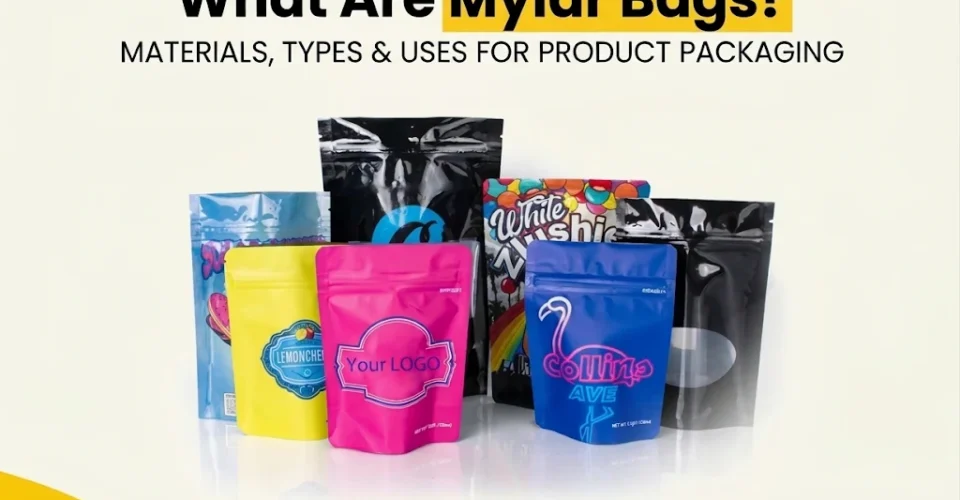
Mylar bags are widely used in flexible packaging because they can provide strong barriers against moisture, oxygen, light, and external contaminants, depending on their material construction. From food storage and snacks to cosmetics, supplements, electronics, and retail products, these packaging bags help protect products while offering flexible options for branding and presentation.
Although the term Mylar bags is often used for different types of shiny or foil-style pouches, not all of them have the same construction. Some use polyester film, others combine metallized film with plastic layers, and certain high-barrier bags contain actual aluminum foil laminated with other materials.
Understanding these differences is important when selecting Mylar bags for product packaging. The right option depends on the product’s sensitivity, required shelf life, storage conditions, sealing method, and packaging design.
In this guide, we’ll explain what Mylar bags are made of, how they are manufactured, the different types available, their benefits, and how businesses can choose suitable packaging for their products.
Quick Overview: Mylar Bags at a Glance
| Feature | Description |
|---|---|
| Main material | BoPET, or biaxially oriented polyethylene terephthalate |
| Common construction | Polyester film, metallized film, plastic laminates, or aluminum foil laminates |
| Main purpose | Product protection and flexible packaging |
| Barrier properties | Can provide moisture, oxygen, and light barriers depending on construction |
| Common styles | Flat pouches, stand-up pouches, zipper bags, and heat-seal bags |
| Common applications | Food, coffee, supplements, cosmetics, and retail products |
| Customization | Printing, sizes, finishes, closures, and other features |
| Important consideration | Select the material structure according to the product and its storage requirements |
1. What Are Mylar Bags?
Mylar bags are flexible packaging bags commonly made using polyester film or multilayer materials that include polyester. The word Mylar is a trademarked name associated with a type of polyester film. In technical packaging discussions, this film is commonly called BoPET, which stands for biaxially oriented polyethylene terephthalate.
BoPET is produced by stretching PET film in two directions. This process improves its strength, dimensional stability, and other physical properties, making it useful in packaging and industrial applications.
Many products marketed as Mylar bags use a combination of materials rather than a single layer of polyester. Depending on the required barrier performance, a bag may include metallized film, aluminum foil, polyethylene, or other sealing and protective layers.
What Are Mylar Bags Used For?
Mylar bags are used to package and protect products that need flexible, lightweight, and sometimes high-barrier packaging.
Common applications include:
- Food products: Snacks, dried foods, coffee, spices, and other suitable food products.
- Supplements: Powders, nutritional products, and certain dry ingredients.
- Cosmetics: Beauty samples, powders, and selected personal-care products.
- Retail products: Small accessories, craft supplies, and consumer goods.
- Electronics: Components that require protection from moisture or static, using specially designed packaging.
- Long-term storage: Certain dry goods when the bag construction, seal, and storage conditions are appropriate.
The exact performance depends on the material layers, thickness, sealing quality, and product requirements. A standard polyester pouch should not automatically be treated as a high-barrier or long-term food-storage bag.
2. What Are Mylar Bags Made Of?
One of the most important questions when choosing Mylar packaging is understanding its material construction. Different film combinations provide different levels of protection, appearance, flexibility, and sealing performance.
BoPET or Polyester Film
BoPET is a strong, lightweight polyester film used in many flexible packaging structures. It offers good tensile strength, dimensional stability, and resistance to many common environmental conditions.
It can be used as a transparent layer or as part of a laminated packaging structure. Polyester film is not the same as aluminum foil, even when it has a shiny metallic appearance.
Metallized Film Packaging
Metallized film is generally made by depositing a very thin layer of metal, commonly aluminum, onto a plastic film surface.
This creates a reflective appearance and can improve barrier properties compared with some uncoated films. Metallized polyester is commonly used in flexible packaging for snacks, confectionery, and other consumer products.
However, metallized film is not equivalent to a solid aluminum foil layer. Its barrier performance depends on the metal coating, film quality, laminate structure, and manufacturing process.
Aluminum Foil Barrier Layers
Some high-barrier Mylar-style packaging bags use actual aluminum foil laminated between plastic layers.
These structures can provide strong barriers against moisture, oxygen, and light when properly manufactured and sealed. They are often considered for products that are sensitive to environmental exposure.
The foil layer also makes the packaging opaque, which can help protect light-sensitive contents.
Polyethylene and Other Sealant Layers
Polyethylene and other suitable polymers are often used as inner layers in flexible packaging. These layers can help provide heat-sealing performance and form the surface that comes into contact with the packaged product.
The sealant layer must be selected according to the product, required sealing temperature, packaging equipment, and applicable food-contact or product-safety requirements.
Common Mylar Bag Material Structures
| Material Structure | Main Characteristics | Typical Applications |
|---|---|---|
| Polyester film | Strong and lightweight | General flexible packaging |
| Metallized polyester | Reflective appearance and improved barrier properties | Snacks and dry products |
| Polyester and polyethylene laminate | Printable outer layer with a heat-sealable inner layer | Retail pouches |
| Foil and plastic laminate | High barrier against light, moisture, and oxygen | Sensitive products and selected food applications |
| Multilayer plastic laminate | Combines different functional properties | Customized flexible packaging |
The best material structure depends on the product’s sensitivity and the level of protection required. Businesses should request technical specifications rather than selecting packaging based on appearance alone.
3. Different Types of Mylar Bags
Mylar packaging bags are available in several shapes, closures, and constructions. Each style is designed for particular packaging and storage requirements.
Flat Mylar Bags
Flat Mylar bags have a simple pouch structure without a bottom gusset. They are useful for lightweight products, small quantities, samples, and items that do not require a standing pouch.
Common applications include:
- Small retail products
- Samples and promotional items
- Dry food portions
- Accessories and craft supplies
Their compact design can make them convenient for storage and shipping.
Stand-Up Mylar Pouches
Stand-up Mylar pouches include a bottom gusset that expands when the bag is filled. This allows the package to stand upright on shelves, making it useful for retail displays.
Stand-up pouches are commonly used for snacks, coffee, dried foods, powders, and other packaged goods.
They can also be customized with printed designs, different finishes, and suitable closure systems.
Resealable Mylar Pouches
Resealable pouches include a zipper or another reusable closure mechanism. Customers can open the package, access the contents, and close it again.
These bags are useful when products are consumed in multiple portions. However, a resealable zipper does not necessarily provide an airtight or high-barrier seal. Products requiring stronger protection may also need an initial heat seal.
Heat Seal Mylar Bags
Heat-sealable Mylar bags are designed to close using controlled heat and pressure. Heat sealing can create a secure package when the correct material structure, equipment settings, and sealing conditions are used.
These bags are common in food packaging, dry goods, and other applications where a sealed package is required.
Clear Mylar Bags
Clear polyester-based bags allow customers to see the packaged product. They can be useful when product visibility is important for retail presentation.
Clear bags may not offer the same light protection as opaque or foil-based structures. Choose them according to the product’s sensitivity and display requirements.
Foil and Metallic Mylar Bags
Foil and metallic pouches offer a reflective appearance and can provide different levels of barrier protection.
It is important to distinguish between metallized film and actual aluminum foil laminate. Both may look metallic, but their barrier properties and construction are different.
Child-Resistant Packaging Bags
Some flexible pouches are designed with child-resistant closures. These packaging formats may be required for certain regulated products, depending on the product category and applicable laws.
A standard zipper pouch is not automatically child-resistant. Businesses should select packaging that has been tested and documented against the relevant requirements for their market.
4. Benefits of Mylar Packaging Bags
Mylar packaging offers several useful properties that make it suitable for different product categories. However, the actual benefits depend on the bag’s construction and intended use.
Protection Against Moisture
Moisture can affect the texture, quality, and shelf life of many products. Certain polyester, metallized, and foil-based laminates can help limit moisture transmission.
This can be important for dry foods, powders, and other products that need controlled storage conditions.
Oxygen Barrier Performance
Oxygen exposure can cause quality changes in sensitive products, including oxidation and flavor deterioration.
High-barrier multilayer packaging can help reduce oxygen transmission. For products requiring additional protection, businesses may also consider suitable sealing systems or oxygen absorbers where appropriate.
Light Protection
Some products are sensitive to light exposure. Opaque and foil-based packaging structures can reduce light reaching the contents.
This may be useful for selected food ingredients, supplements, and other light-sensitive products.
Lightweight and Flexible Construction
Mylar-style pouches are generally lightweight and can be manufactured in different shapes and sizes. Their flexible structure can make them convenient for storage, handling, and transportation.
Custom Printing and Branding
Businesses can use custom printed Mylar bags to display logos, product names, instructions, ingredients, and other required information.
Printing options and finishes depend on the material structure and supplier’s production capabilities. A well-designed pouch can improve shelf presentation while communicating important product details.
Different Closure Options
Mylar pouches can be manufactured with different closure systems, including zippers, heat seals, tear notches, and other opening features.
The right closure depends on whether the product is intended for single use, repeated access, or long-term sealed storage.
5. Mylar Bags for Different Product Packaging Applications
Mylar bags are used across several industries because flexible packaging can be adapted to different product sizes and protection requirements.
Mylar Bags for Food Packaging
Food packaging is one of the most common applications for high-barrier flexible pouches. Depending on the construction and food-contact suitability, these bags may be used for:
- Dried fruits and vegetables
- Nuts and seeds
- Snacks and confectionery
- Coffee and tea
- Spices and seasoning powders
- Dry ingredients
Food-contact compliance is essential. Businesses should confirm that the complete packaging structure, including inks, adhesives, sealants, and any direct-contact layer, is suitable for the intended food and market.
Food Storage Mylar Bags for Long-Term Storage
Certain high-barrier Mylar bags are used for storing dry foods over extended periods. However, the bag alone does not guarantee a particular shelf life.
Long-term storage depends on several factors, including:
- Food type and initial moisture content
- Oxygen and moisture barrier performance
- Seal integrity
- Storage temperature
- Exposure to light
- Suitable use of oxygen absorbers, where appropriate
Only dry products suitable for this storage method should be packaged this way. Mylar bags do not make unsafe or improperly prepared food safe for long-term storage.
Mylar Bags for Coffee and Snacks
Coffee, nuts, chips, and other dry products may benefit from packaging that helps manage moisture and oxygen exposure.
Some coffee pouches also use one-way degassing valves to release gases while limiting outside air from entering. The need for a valve depends on the product and its processing requirements.
Mylar Bags for Cosmetics and Personal Care
Cosmetic powders, samples, bath products, and selected personal-care items can be packaged in flexible pouches.
The material should be compatible with the formulation and meet any relevant safety and regulatory requirements. Product compatibility testing is important, especially when the contents contain oils, solvents, or active ingredients.
For brands exploring other packaging formats, custom cosmetic boxes can provide an additional retail packaging option.
Mylar Bags for Retail Products
Retail businesses may use printed flexible pouches for accessories, craft supplies, small components, and other lightweight products.
A customized pouch can include product details, branding, instructions, and barcodes. The material and closure should be selected according to the product’s protection and presentation requirements.
For products that need a more structured presentation, businesses can also explore custom retail boxes.
6. Custom Mylar Bags: Sizes, Printing and Design Options
Custom Mylar bags allow businesses to select packaging according to their product dimensions, brand identity, and functional requirements.
Custom Sizes and Dimensions
The bag should fit the product without creating unnecessary empty space or putting pressure on the seals.
Before ordering, consider:
- Product length, width, and height
- Product weight and volume
- Required filling space
- Gusset dimensions
- Seal area
- Space needed for opening and closing features
For stand-up pouches, the bottom gusset must be considered when calculating the overall capacity.
Printed Mylar Bags
Printed Mylar bags allow brands to create recognizable packaging and communicate important product information.
Common design elements include:
- Brand logo and colors
- Product name and description
- Product images or illustrations
- Ingredients and nutritional information, where required
- Instructions and warnings
- Barcode and batch details
- Relevant compliance information
Artwork should be prepared according to the supplier’s printing specifications, including bleed, safe areas, color requirements, and file format.
Finishes and Visual Effects
Depending on the material and printing process, businesses may choose from different visual finishes, such as:
- Glossy finishes
- Matte finishes
- Metallic effects
- Transparent windows
- Spot decorative effects
Not every finish is suitable for every flexible packaging structure. Confirm availability and material compatibility with the manufacturer.
Closures and Functional Features
Custom Mylar bags can include different functional features, such as:
- Resealable zipper closures
- Heat-seal areas
- Tear notches
- Hang holes
- Bottom gussets
- Spouts for suitable liquid products
- Degassing valves for selected coffee packaging
Select features based on how customers will open, store, display, and use the product.
7. Mylar Bags vs. Aluminum Foil Bags vs. Vacuum Bags
These packaging terms are often used interchangeably, but they describe different materials or packaging approaches.
| Packaging Type | Construction | Main Characteristics | Common Applications |
|---|---|---|---|
| Mylar-style bags | Polyester or multilayer film structures | Flexible, printable, and available with different barrier properties | Food, retail, and storage |
| Aluminum foil bags | Actual aluminum foil laminated with other materials | Can provide strong light, oxygen, and moisture barriers | Sensitive products and selected food applications |
| Metallized film bags | Plastic film with a thin deposited metal layer | Reflective appearance and improved barrier properties | Snacks and consumer products |
| Vacuum bags | Designed to remove air before sealing | Reduce air inside the package when used with compatible equipment | Food storage and selected industrial products |
Mylar Bags vs. Aluminum Foil Bags
Mylar is commonly associated with polyester film, while aluminum foil bags contain a separate foil layer.
Some Mylar-style pouches use aluminum foil as part of a laminate, but not all do. The difference matters because the barrier performance, flexibility, appearance, and sealing requirements may vary.
Mylar Bags vs. Vacuum Bags
Vacuum packaging is a process in which air is removed from a compatible package before sealing. Vacuum bags are designed to work with that process.
Mylar bags are a type of flexible packaging material or pouch format. Some can be used in vacuum packaging applications if their construction and sealing properties are suitable, but not every Mylar pouch is designed for vacuum sealing.
The best option depends on the product’s storage requirements and the equipment being used.
8. How to Choose the Right Mylar Bag for Your Product
Selecting the right Mylar bag requires more than choosing a size or metallic finish. Businesses should evaluate the product, required barrier properties, packaging process, and customer experience.
Identify the Product’s Protection Requirements
Start by understanding what can affect the product. Does it need protection from moisture, oxygen, light, contamination, or physical damage?
For example, a dry snack may require a different packaging structure from a cosmetic powder or an electronic component.
Select the Correct Material Structure
Ask the supplier for details about the material layers and their performance. If a product needs a strong barrier, do not assume that a shiny metallized pouch will provide the same protection as an aluminum foil laminate.
Choose the Right Bag Style
Consider whether the product needs a flat pouch, stand-up pouch, zipper closure, heat-seal bag, or another structure.
The packaging style should make filling, storage, transportation, and customer use practical.
Confirm Food-Contact and Product Compatibility
For food, cosmetics, supplements, and other regulated applications, confirm that the packaging materials are suitable for the intended contents and destination market.
Request relevant documentation and conduct compatibility testing where needed.
Consider Printing and Branding
Choose artwork that clearly communicates the product’s identity and important information. Make sure the printing method is compatible with the selected film structure.
Test Before Ordering in Bulk
Request samples and evaluate the pouch under realistic conditions. Check its dimensions, sealing performance, appearance, durability, and compatibility with filling equipment.
Testing can help identify problems before committing to a large order.
9. Are Mylar Bags Eco-Friendly and Recyclable?
The environmental impact of Mylar packaging depends on its material composition, manufacturing process, useful life, and disposal options.
Many high-barrier pouches use multiple layers of different materials. These combinations can make recycling more difficult because the layers may not be easy to separate through conventional recycling systems.
Some single-material or specially designed flexible packaging structures may be more compatible with particular recycling programs. However, recyclability should never be assumed from the bag’s appearance or material name alone.
How to Make More Responsible Packaging Choices
Businesses can consider the following steps:
- Choose only the barrier performance the product actually needs.
- Avoid unnecessary layers and decorative components.
- Ask suppliers about material composition and recycling compatibility.
- Check whether suitable collection or recycling programs exist in the target market.
- Use accurate disposal instructions.
- Evaluate alternative packaging materials when they meet the product’s protection requirements.
For products that can use paper-based packaging, options such as kraft boxes, cardboard boxes, and corrugated boxes may be worth comparing.
The best packaging choice balances product protection, material use, customer expectations, and available end-of-life options.
10. Frequently Asked Questions About Mylar Bags
1. What are Mylar bags made of?
Mylar bags commonly use BoPET, a biaxially oriented polyester film, or multilayer structures containing polyester. Some bags also include metallized film, aluminum foil, polyethylene, or other functional layers.
2. What is the difference between Mylar and aluminum foil bags?
Mylar generally refers to polyester film, while aluminum foil bags contain a distinct aluminum foil layer. Some high-barrier pouches combine both materials in a laminate.
3. Are all Mylar bags made with aluminum?
No. Some use polyester film without aluminum, while others use metallized polyester or actual aluminum foil laminated with plastic layers. The material construction should be confirmed with the supplier.
4. What are Mylar bags commonly used for?
They are used for food, coffee, snacks, supplements, cosmetics, retail products, and selected storage applications. The correct bag depends on the product’s protection and compatibility requirements.
5. Do Mylar bags protect products from moisture?
Some Mylar-style bags provide moisture-barrier protection. The level depends on the material structure, thickness, manufacturing quality, and seal integrity.
6. Are Mylar bags suitable for food packaging?
Some Mylar bags are suitable for food packaging when their complete material structure meets the applicable food-contact requirements. Businesses should verify supplier documentation before using them for food.
7. Are Mylar bags heat sealable?
Many Mylar-style pouches are designed for heat sealing, but the correct temperature, pressure, and sealing time depend on the inner sealant layer and packaging equipment.
8. What is the difference between Mylar bags and vacuum bags?
Mylar bags describe a flexible packaging material or pouch structure. Vacuum bags are designed for air removal before sealing. Some Mylar-style bags may work with vacuum systems if they are specifically designed for that application.
9. Can Mylar bags be customized with printing?
Yes. Many Mylar-style packaging bags can be customized with logos, colors, product details, artwork, sizes, and functional features. Available options depend on the supplier and material construction.
10. Are Mylar bags recyclable?
Some may be recyclable through specialized programs, but many multilayer pouches are difficult to process in conventional recycling systems. Check the exact material structure and local recycling guidance.
Conclusion
Mylar bags are versatile flexible packaging options used across food, retail, cosmetics, supplements, and storage applications. Their performance depends on the material construction, which may include polyester film, metallized layers, aluminum foil, and heat-sealable plastics.
When choosing Mylar bags for product packaging, businesses should consider barrier requirements, bag style, sealing method, product compatibility, printing, and disposal options. A pouch that looks suitable may not provide the protection a particular product needs, so reviewing specifications and testing samples is essential.
For businesses comparing flexible packaging with more structured options, Bluebird Packaging offers different packaging formats for retail and product presentation. Explore packaging solutions from Bluebird Packaging or request a custom packaging quote to discuss the right packaging approach for your products.