
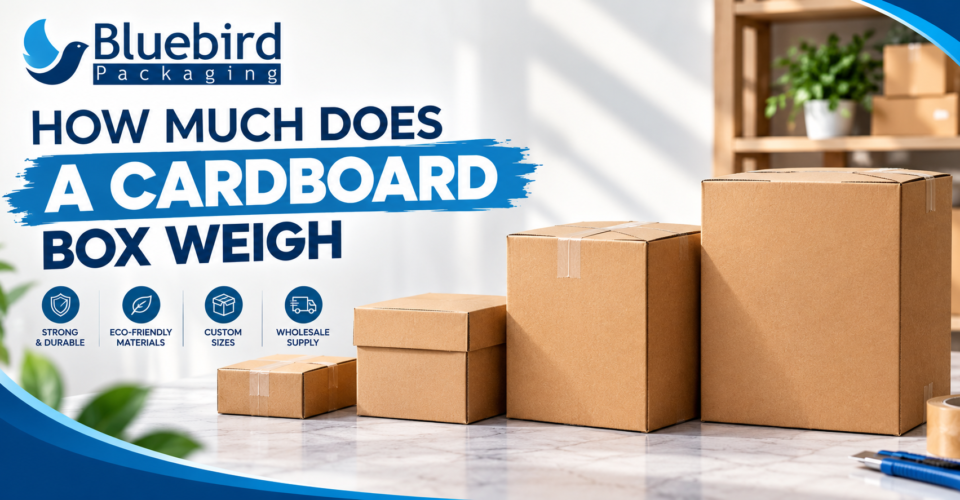
If you regularly ship products, knowing how much does a cardboard box weigh can help you estimate shipping weight, choose suitable packaging, manage storage, and avoid using more material than the product actually needs.
There is no single standard weight for every cardboard box. A small folding carton may weigh only a few ounces, while a large double-wall corrugated shipping box can weigh several pounds. The final cardboard box weight depends on its dimensions, board grade, flute profile, wall construction, thickness, design, and additional packaging features.
Another common source of confusion is dimensional weight. A formula based only on length, width, and height does not tell you the actual physical weight of an empty cardboard box. It estimates the space a shipment occupies for carrier billing purposes.
This guide explains how much does a cardboard box weigh, the factors behind the difference, how pounds, ounces, kilograms, and grams relate, and what businesses should consider when selecting custom cardboard boxes for their products.
How Much Does a Cardboard Box Weigh?
The average cardboard box weight varies considerably according to the type of box being measured. Small lightweight cartons can weigh a few ounces, while medium corrugated shipping cartons may weigh roughly a pound or more. Large and reinforced boxes can weigh several pounds before a product is placed inside.
Instead of relying on one average, it is more useful to classify boxes by size and construction.
| Box Category | Typical Empty Weight Range* | Common Application |
|---|---|---|
| Small lightweight carton | 2–8 oz | Cosmetics, accessories, small retail items |
| Small corrugated box | 4–12 oz | Small eCommerce shipments |
| Medium corrugated box | 0.5–2 lb | General product shipping |
| Large corrugated box | 1.5–5+ lb | Large products and moving |
| Heavy-duty multi-wall box | 3–10+ lb | Heavy or industrial products |
*These are broad practical ranges rather than universal specifications. Actual weight depends on material grade, dimensions, construction, moisture content, and design.
So, if someone asks how much does a cardboard box weigh, the most accurate answer starts with another question: what size and type of cardboard box?
Cardboard Box Weight Chart by Size
A cardboard box weight chart can provide a useful starting point, but dimensions alone cannot determine exact physical weight.
Two boxes measuring 12 × 12 × 12 inches may have very different weights if one is made from single-wall corrugated board and the other uses a heavier double-wall construction. The table below therefore shows practical estimated ranges rather than claiming one fixed weight for each size.
| Example Box Dimensions | General Size | Approx. Empty Weight Range* |
|---|---|---|
| 6″ × 6″ × 6″ | Extra Small | 2–5 oz |
| 8″ × 8″ × 8″ | Small | 3–8 oz |
| 12″ × 12″ × 12″ | Small/Medium | 6–16 oz |
| 16″ × 12″ × 12″ | Medium | 8–24 oz |
| 18″ × 18″ × 18″ | Medium/Large | 1–3 lb |
| 24″ × 18″ × 18″ | Large | 1.5–4+ lb |
| 24″ × 24″ × 24″ | Extra Large | 2–5+ lb |
*Actual weights vary significantly by board specification and box design. Weighing a production sample is the best way to determine exact empty-box weight.
Businesses requiring a specific combination of dimensions, strength, printing, and material can work with Bluebird Packaging to develop packaging around their product rather than relying solely on generic box sizes.
Need Custom Cardboard Packaging?
Develop packaging around your product dimensions, material requirements, printing needs, and desired box weight.
Factors Affecting Cardboard Box Weight
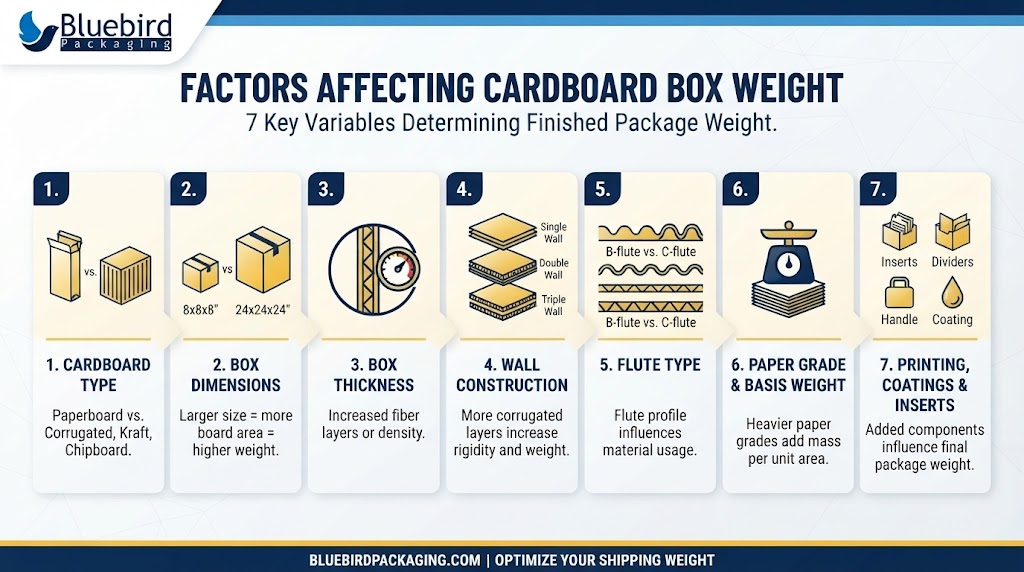
Understanding how much does a cardboard box weigh requires looking beyond its external measurements. Several variables determine how heavy the finished package will be.
1. Cardboard Type
“Cardboard” is an umbrella term used for several paper-based packaging materials.
A thin paperboard carton generally weighs less than a corrugated shipping container of similar external dimensions.
Common materials include:
- Paperboard
- Kraft paper
- Corrugated cardboard
- Chipboard
- Multi-wall corrugated board
The appropriate packaging material depends on product weight, fragility, shipping conditions, presentation, and budget.
2. Box Dimensions
Larger box dimensions generally require more board, which increases physical weight. A 24 × 24 × 24-inch carton has substantially more material than an 8 × 8 × 8-inch box. However, dimensions still cannot tell you the exact weight without knowing the board specification.
3. Box Thickness
Increasing box thickness usually means more fiber or additional layers are being used. A lightweight folding carton and a thick corrugated shipping container can therefore have dramatically different weights even when their length and width are similar.
4. Wall Construction
Corrugated packaging can use different wall structures.
A single wall cardboard box generally consists of one fluted medium positioned between linerboards. It is widely used for everyday shipping applications.
A double wall cardboard box uses additional liner and fluted layers, providing greater rigidity for demanding applications.
A triple wall cardboard box adds even more layers and is generally used where considerably greater structural performance is required. As wall construction increases, the amount of material and usually the empty box weight increase as well.
5. Flute Type
The flute type influences cushioning, stacking characteristics, thickness, print surface, and material usage. Different flute profiles have different heights and numbers of flutes per unit of length. As a result, two corrugated boxes of the same dimensions can have different weights and performance characteristics.
6. Paper Grade and Basis Weight
The weight of the linerboard and medium used to manufacture a corrugated box matters significantly. Heavier paper grades add more material per unit of area. This increases the final corrugated cardboard box weight, although it may also be part of achieving a particular performance requirement.
7. Printing, Coatings, and Inserts
Ink alone may add relatively little, but complex packaging can contain additional components such as:
- Coatings
- Laminations
- Inserts
- Dividers
- Handles
- Reinforcement pieces
- Adhesives
These additions influence the final packaging box weight.
Cardboard Material Weight: Why GSM Matters
One useful way to understand cardboard material weight is GSM, or grams per square meter. GSM describes how much a square meter of a particular paper or board component weighs.
For a simple flat sheet, a basic estimation can be made from its area and GSM:
For example, if a hypothetical sheet covers 0.5 m² and has a basis weight of 400 GSM:
However, a finished corrugated box is more complicated. It may contain several liners, a fluted medium, glue, overlaps, flaps, printing, and other components.
That means a simple GSM calculation can provide an estimate only when you know the actual material specifications and total board area. For production orders, a physical sample or manufacturer specification is generally more reliable than a generic online cardboard box weight calculator.
How Much Does a Cardboard Box Weigh in Pounds?
People asking how much does a cardboard box weigh in pounds are usually trying to estimate either packaging weight or total shipping weight.
A small empty corrugated carton might weigh well under one pound, while a large or reinforced box can weigh several pounds.
If you already know the weight in ounces, convert it to pounds using:
For example:
A box weighing 24 ounces would be:
| Ounces | Pounds |
|---|---|
| 4 oz | 0.25 lb |
| 8 oz | 0.5 lb |
| 16 oz | 1 lb |
| 24 oz | 1.5 lb |
| 32 oz | 2 lb |
| 48 oz | 3 lb |
This conversion is useful when a packaging supplier provides weight in ounces but your carrier or warehouse records weight in pounds.
How Much Does a Cardboard Box Weigh in Ounces?
For smaller cardboard packaging boxes, ounces can be more useful than pounds because the empty package may weigh less than one pound.
For example, if an empty box weighs 0.75 lb:
This unit is especially useful when comparing lightweight cardboard boxes for small eCommerce products where even modest packaging-weight differences can matter across high shipment volumes.
How Much Does a Cardboard Box Weigh in KG?
To understand how much does a cardboard box weigh in kg, first determine the actual box weight and then convert the measurement.
One pound is approximately 0.4536 kilograms.
For example, if a large empty box weighs 3 lb:
| Pounds | Approx. Kilograms |
|---|---|
| 0.5 lb | 0.23 kg |
| 1 lb | 0.45 kg |
| 2 lb | 0.91 kg |
| 3 lb | 1.36 kg |
| 5 lb | 2.27 kg |
| 10 lb | 4.54 kg |
This is a mass conversion. It should not be confused with a carrier’s dimensional-weight formula.
How Much Does a Cardboard Box Weigh in Grams?
For smaller packages, grams provide a more precise measurement.
If you want to know how much does a cardboard box weigh in grams, convert kilograms by multiplying by 1,000:
A 0.5 kg box, for example, weighs:
You can also convert ounces to grams. One ounce is approximately 28.35 grams.
| Ounces | Approx. Grams |
|---|---|
| 4 oz | 113 g |
| 8 oz | 227 g |
| 12 oz | 340 g |
| 16 oz | 454 g |
| 32 oz | 907 g |
These conversions are useful for international packaging specifications where metric units are preferred.
Actual Box Weight vs Dimensional Weight
This distinction is extremely important when estimating shipping costs.
Actual weight is what the package physically weighs when placed on a scale.
Dimensional weight, sometimes called volumetric weight, is a carrier billing measurement based on the amount of space a package occupies.
For example, a very large box containing a lightweight product may weigh only a few pounds physically but occupy considerable space inside a delivery vehicle. Depending on the carrier and service, shipping charges may therefore be based on dimensional rather than actual weight.
This is why calculating length × width × height and dividing by a carrier-specific divisor should not be presented as the physical weight of the cardboard itself.
When performing a box weight calculation, first decide what you actually need:
- Empty cardboard box weight
- Product weight
- Packed shipping weight
- Dimensional weight
- Carrier billable weight
Mixing these measurements can produce unrealistic results.
Small Cardboard Box Weight
The small cardboard box weight can range from only a few ounces upward depending on construction.
Small boxes are commonly used for:
- Cosmetics
- Jewelry
- Small electronics
- Accessories
- Food products
- eCommerce orders
Because the product itself may also be lightweight, unnecessarily heavy packaging can represent a significant percentage of the total shipping weight.
However, reducing weight too aggressively can affect product protection. The goal is to select enough material to protect the item without using unnecessary board.
For products where a natural paper appearance is preferred, kraft boxes can also be considered as part of a broader packaging strategy.
Large Cardboard Box Weight
Large cardboard box weight varies even more because large cartons may use heavier corrugated grades or multi-wall construction.
Large boxes are commonly used for:
- Home goods
- Appliances
- Bulk products
- Moving
- Industrial components
- Multiple-item shipments
A large box may weigh several pounds while empty, particularly when made as heavy duty cardboard boxes.
Large packaging also affects warehouse storage because both flat and assembled cartons occupy more space. Businesses therefore need to consider material weight, storage efficiency, assembly, stacking, and transportation together rather than evaluating box weight alone.
Corrugated Cardboard Box Weight: Single, Double, and Triple Wall
The corrugated cardboard box weight is influenced significantly by its wall construction.
| Construction | Relative Weight | Typical Requirement |
|---|---|---|
| Single Wall | Lighter | Everyday shipping |
| Double Wall | Medium to Heavy | Heavier or more demanding shipments |
| Triple Wall | Heaviest | Industrial/heavy-duty applications |
A single-wall construction may be sufficient for many everyday shipments. Moving to double or triple wall adds material and typically increases weight.
However, choosing packaging should not simply be a matter of selecting the thickest option. The objective is to achieve the required packaging strength without unnecessary material use.
This becomes particularly important for businesses ordering cardboard packaging designed around specific products, where dimensions and board construction can be selected together.
Box Weight vs Box Strength: Are Heavier Boxes Always Stronger?
A common misunderstanding in packaging is that a heavier box is always stronger. In reality, box weight and packaging strength are related but not identical.
A lightweight box can still provide excellent protection when it is designed with the correct material grade, flute structure, and manufacturing process.
The strength of a cardboard box depends on factors such as:
- Board construction
- Paper quality
- Flute type
- Compression strength
- Edge crush resistance
- Box design
- Manufacturing accuracy
For example, a well-designed corrugated box with the right flute type may provide better performance than a heavier box made from a lower-quality material.
When selecting packaging, businesses should focus on achieving the right balance between:
- Weight
- Durability
- Product protection
- Shipping requirements
- Cost efficiency
The goal is not always the heaviest box. The goal is the most suitable box for the product.
Lightweight vs Heavy Duty Cardboard Boxes
Choosing between lightweight and heavy-duty packaging depends on what you are shipping and how much protection your product requires.
Lightweight Cardboard Boxes
Lightweight cardboard boxes are commonly used for products that do not require extreme protection.
They are suitable for:
- Small retail products
- Clothing
- Accessories
- Cosmetics
- Subscription boxes
- Lightweight eCommerce products
Advantages include:
- Lower material usage
- Reduced shipping weight
- Easier handling
- Lower storage requirements
However, lightweight packaging should still provide enough durability to prevent damage during transportation.
Heavy Duty Cardboard Boxes
Heavy duty cardboard boxes are designed for products that require additional structural support.
They are commonly used for:
- Industrial products
- Heavy equipment
- Large shipments
- Fragile products
- Long-distance transportation
Benefits include:
- Higher compression resistance
- Better stacking ability
- Increased protection
- Improved durability
Heavy-duty boxes often use double-wall or triple-wall corrugated construction because additional layers improve strength.
How Box Weight Affects Shipping Costs
The weight of packaging directly influences the total shipping weight, but it is not the only factor carriers consider.
Shipping charges are usually calculated using one of two measurements:
- Actual weight
- Dimensional weight
Actual Shipping Weight
Actual weight refers to the total physical weight measured on a scale.
It includes:
- Product weight
- Packaging weight
- Inserts
- Labels
- Additional materials
For example: A product weighing 4 pounds inside a box weighing 1 pound will have an actual shipping weight of approximately 5 pounds.
Dimensional Weight
Dimensional weight considers the space a package occupies rather than only its physical weight.
A large lightweight package may cost more to ship because it takes up more room in transportation vehicles.
Dimensional weight is calculated using:
The divisor depends on the shipping company and service type.
This is why businesses should consider both:
- Box size
- Box weight
when designing packaging. Reducing unnecessary empty space can lower shipping costs while maintaining product safety.
Ideal Weight of Cardboard Boxes for Shipping
The ideal packaging weight depends on the product being shipped. There is no universal perfect weight because every product has different protection requirements.
A good shipping box should:
- Protect the product
- Minimize unnecessary material
- Reduce shipping expenses
- Support stacking
- Handle transportation conditions
For lightweight products, businesses may prefer thinner board structures. For fragile or expensive products, stronger packaging may be necessary even if it increases the empty box weight.
The right solution is a balance between:
How Warehouse Storage Is Affected by Box Weight and Size
Many businesses focus only on shipping when selecting packaging, but warehouse storage is another important factor.
The weight and size of boxes affect:
- Storage space requirements
- Stacking limits
- Handling processes
- Inventory management
- Transportation preparation
Large heavy boxes require more space and stronger shelving systems.
Flat-packed cardboard boxes are often preferred because they take less room before assembly.
Businesses should consider:
- Box size
- Folded storage dimensions
- Material thickness
- Assembly process
when planning their packaging inventory.
Custom Cardboard Boxes: Choosing the Right Weight for Your Product
Every product has different packaging requirements. A small cosmetic product does not need the same box structure as industrial equipment.
This is where custom cardboard boxes become useful.
Custom packaging allows businesses to select:
- Exact dimensions
- Material type
- Board thickness
- Printing options
- Structural design
- Protective features
Instead of choosing a standard box and adding extra protective material, companies can create packaging specifically designed for their products.
Benefits of customized packaging include:
- Better product fit
- Reduced empty space
- Improved brand presentation
- Efficient material usage
- Better shipping performance
Businesses looking for tailored packaging solutions can explore Bluebird Packaging’s range of custom packaging solutions designed for different industries and product requirements.
Create Packaging Around Your Product
Get the right dimensions, material, structure, printing, and packaging specifications for your product.
Sustainable Cardboard Packaging and Recycling
Sustainability has become an important consideration in packaging decisions. Many businesses are moving toward materials that reduce waste while maintaining product protection.
Sustainable packaging focuses on:
- Responsible material selection
- Reduced unnecessary packaging
- Efficient box design
- Recyclable materials
Cardboard is widely used because it can often be collected and processed through recycling systems.
Benefits of using recyclable cardboard include:
- Reduced waste
- Lower environmental impact
- Better alignment with sustainability goals
Businesses can also consider eco friendly packaging options such as kraft-based materials, recycled fibers, and optimized box sizes.
However, sustainability should not compromise performance. A box must still provide enough strength to protect products during handling and shipping.
Cardboard Box Weight and Kraft Packaging
Kraft paper is a popular packaging material because of its natural appearance and sustainability benefits.
Kraft paper is commonly used for:
- Retail packaging
- Food packaging
- Gift boxes
- Shipping cartons
Kraft packaging can provide a simple, premium appearance while supporting brands that want a more natural visual identity.
For businesses interested in kraft-based packaging options, Bluebird Packaging provides kraft packaging boxes that can be customized according to product needs.
The final weight of kraft packaging depends on:
- Paper thickness
- Box dimensions
- Structural design
- Printing requirements
How to Calculate Cardboard Box Weight More Accurately
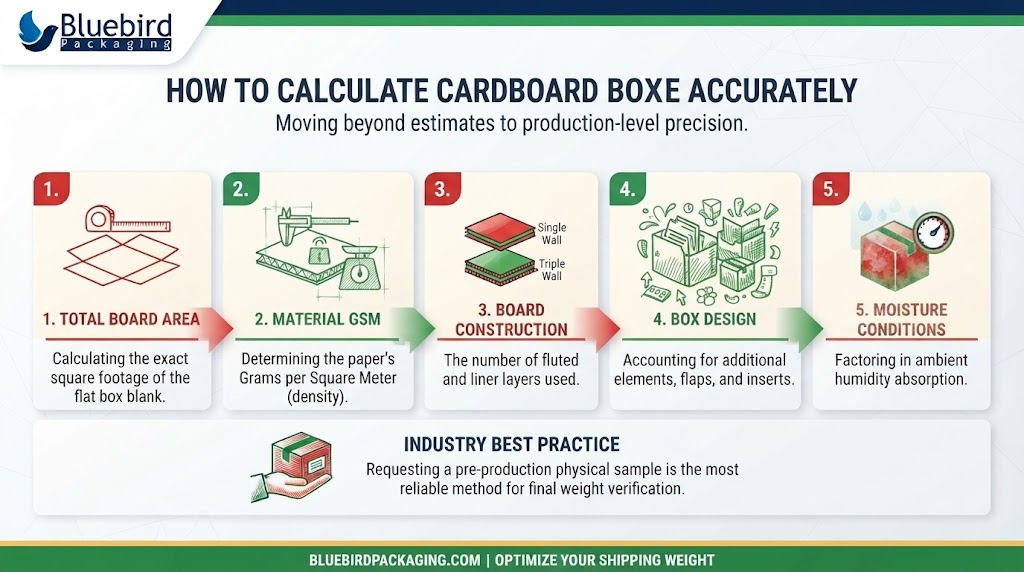
A simple online cardboard box weight calculator can provide estimates, but accurate calculation requires more information.
For a production-level estimate, manufacturers consider:
1. Total Board Area
The amount of material used in the box directly affects weight.
2. Material GSM
Higher GSM usually means heavier paper material.
3. Board Construction
Single-wall, double-wall, and triple-wall structures have different weights.
4. Box Design
Additional flaps, inserts, and structural elements increase material usage.
5. Moisture Conditions
Paper-based materials can absorb moisture, which may slightly affect weight.
For businesses ordering packaging at scale, requesting a production sample is usually the most reliable method.
Cardboard Box Weight for Pallets
The total weight of a pallet depends on:
- Number of boxes
- Individual box weight
- Box size
- Stacking arrangement
- Pallet material
- Wrapping materials
Example:
If a pallet contains:
- 100 boxes
- Each box weighs 1 pound
The boxes alone weigh:
Additional weight comes from:
- Wooden pallet
- Stretch wrap
- Labels
- Protective materials
Large orders require accurate weight planning because pallet weight affects:
- Freight cost
- Warehouse handling
- Transportation limits
Why Accurate Box Weight Matters for Businesses
Knowing the correct packaging box weight helps companies make better decisions.
Shipping Planning
Businesses can estimate delivery costs more effectively.
Inventory Management
Warehouses can organize storage and handling requirements.
Material Selection
Companies can choose the right balance between strength and weight.
Customer Experience
Proper packaging reduces product damage and returns.
Sustainability Goals
Using the right amount of material reduces unnecessary waste.
Frequently Asked Questions
How much does a cardboard box weigh on average?
The average cardboard box weight depends on its size, material, and construction. Small boxes may weigh only a few ounces, while large corrugated boxes can weigh several pounds.
How much does a 12 x 12 x 12 cardboard box weigh?
A 12 x 12 x 12 box weight depends on the board type. A lightweight single-wall corrugated box may weigh less than one pound, while a stronger construction can weigh more.
How much does a cardboard box weigh in pounds?
The weight varies by size and material. Small boxes may weigh under one pound, while larger shipping boxes can weigh several pounds.
How much does a cardboard box weigh in kg?
To convert pounds into kilograms, multiply the weight by 0.4536. For example, a 2-pound box weighs approximately 0.91 kg.
How much does a cardboard box weigh in grams?
One kilogram equals 1,000 grams. A 0.5 kg box would weigh approximately 500 grams.
Are heavier cardboard boxes stronger?
Not always. Strength depends on material quality, flute type, construction, and design rather than weight alone.
What affects corrugated cardboard box weight?
Factors include board thickness, flute type, paper grade, dimensions, and whether the box uses single, double, or triple-wall construction.
What is the difference between actual weight and dimensional weight?
Actual weight is the physical weight measured on a scale. Dimensional weight is based on package size and is often used by shipping carriers to calculate charges.
How can I reduce shipping box weight?
Businesses can reduce packaging weight by:
- Choosing the correct box size
- Avoiding unnecessary material
- Selecting efficient board grades
- Using lightweight but durable structures
Conclusion: Choosing the Right Cardboard Box Weight
Understanding how much does a cardboard box weigh helps businesses choose packaging that protects products without increasing unnecessary shipping costs.
The final weight depends on many factors, including:
- Box size
- Material type
- Box thickness
- Flute structure
- Design requirements
- Product protection needs
A lightweight package is not always better, and a heavier package is not always stronger. The best packaging solution balances durability, cost, sustainability, and performance.
Whether you need standard cartons or fully customized packaging, selecting the right material and structure can improve shipping efficiency and customer satisfaction.
Need Custom Cardboard Packaging?
For customized packaging requirements, discuss the right box design, material, dimensions, and weight specifications for your products with Bluebird Packaging.