
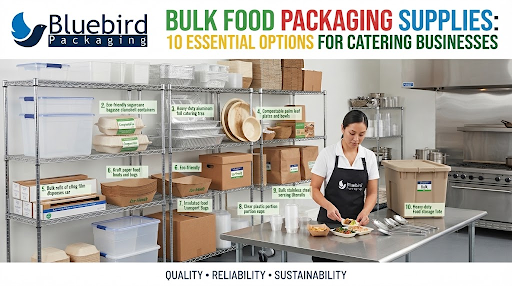
Running a successful catering business requires more than preparing great food. Every meal also needs packaging that protects it during preparation, storage, transportation, and delivery. The right bulk food packaging supplies can help businesses manage large orders while maintaining food quality, presentation, and brand consistency.
Catering companies may need different packaging for hot entrées, fried foods, desserts, sandwiches, sauces, salads, bakery products, and individual meals. Packaging must therefore provide the right combination of structural integrity, heat retention, grease resistance, leak resistance, moisture control, and product protection.
For businesses serving corporate events, weddings, parties, restaurants, food-service operations, and large gatherings, purchasing the right packaging in larger quantities can also simplify catering logistics and inventory planning.
This guide explores 10 important packaging options, material choices, food protection requirements, sustainability considerations, branding opportunities, and practical purchasing strategies for businesses that need dependable food packaging at scale.
What Are Bulk Food Packaging Supplies?
Bulk food packaging supplies include boxes, trays, containers, bags, cups, wraps, lids, and other packaging products purchased in larger quantities for catering, restaurants, bakeries, food manufacturers, and food-delivery businesses.
Common examples include:
- Food boxes
- Food trays
- Takeaway containers
- Pizza boxes
- Burger boxes
- Snack boxes
- Dessert boxes
- Bakery boxes
- Portion cups
- Paper lunch bags
- Sauce containers
- Grease-resistant boxes
- Custom printed packaging
- Catering meal containers
For a catering business, food packaging supplies should be selected according to the food being served rather than simply choosing the cheapest available container.
The correct packaging can help protect food during transportation, reduce handling problems, improve presentation, and create a consistent customer experience.
1. Heavy-Duty Food Trays for Large Catering Orders
Food trays are among the most practical options for large-scale catering because they can accommodate substantial quantities of prepared food.
They can be used for:
- Main courses
- Side dishes
- Appetizers
- Sandwiches
- Pastries
- Desserts
- Buffet foods
- Prepared meals
- Grab-and-go servings
For high-volume catering, tray construction matters. A tray carrying heavy food needs adequate stacking strength and structural support so that it does not collapse during handling.
Businesses should consider tray dimensions, material thickness, weight capacity, closure requirements, and transportation conditions before placing a large order.
What makes a good catering tray?
A suitable tray may need:
- Strong board construction
- Reinforced corners
- Grease protection
- Moisture resistance
- Secure closure
- Appropriate capacity
- Stackability
- Easy handling
Bluebird Packaging can develop packaging around specific product requirements instead of limiting businesses to generic dimensions.
2. Compostable Bagasse Containers
Sustainability is increasingly influencing packaging decisions. Bagasse is a fiber-based material derived from sugarcane fiber, and it is commonly used for certain food containers and takeaway applications.
Bagasse packaging can be considered for:
- Prepared meals
- Side dishes
- Boxed lunches
- Corporate catering
- Takeaway meals
- Individual servings
- Events and gatherings
The material can provide an alternative to some traditional plastic formats while supporting a more environmentally conscious presentation.
Businesses exploring sustainable food packaging should still consider the specific food application, moisture level, temperature, durability, and disposal requirements.
When selecting compostable materials or biodegradable materials, it is important to verify the exact specifications of the product rather than assuming every fiber-based container has identical performance.
3. Grease-Resistant Kraft Food Boxes
Foods containing oils, sauces, and fats require packaging with suitable barrier performance.
Kraft paper is a popular material for many food boxes because it provides a natural appearance and can be customized for different food-service applications. Depending on the construction, poly-coated kraft can provide additional protection against oils and moisture.
Grease-resistant packaging can be useful for:
- Fried appetizers
- Burgers
- Sandwiches
- Pastries
- Snacks
- Finger foods
- Gourmet appetizers
- Takeaway meals
The objective is to reduce grease leakage and keep the outside of the package cleaner during transportation.
For brands focused on natural aesthetics, kraft packaging can also contribute to a more recognizable brand presentation.
4. Custom Pizza and Flatbread Boxes
Pizza, flatbreads, focaccia, and similar baked foods are frequently included in catering menus.
The right box needs to provide enough room for the food without creating unnecessary movement during delivery. Packaging should also consider grease, steam, stacking, and ventilation.
Pizza boxes may be used for:
- Catering events
- Corporate lunches
- Parties
- Restaurants
- Food trucks
- Delivery services
- Appetizer assortments
The dimensions, board construction, printing, closure style, and ventilation can all be customized around the application.
For businesses that need packaging developed specifically around their food products, Bluebird Packaging’s custom food box solutions can be used to explore different packaging possibilities.
5. Tamper-Evident Packaging for Food Delivery
Food security becomes particularly important when meals leave the kitchen and travel to another location.
Tamper-evident packaging can help businesses communicate that the package has remained secure during transportation. Depending on the packaging system, this may involve seals, stickers, closures, or specialized structural designs.
This type of secure food packaging can be useful for:
- Restaurant deliveries
- Catering orders
- Corporate meals
- Prepared food
- Takeaway orders
- Large event deliveries
Customers want confidence that their meals have remained protected throughout the delivery process.
A secure closure can therefore contribute to both food safety and customer confidence.
Avoid the Steam Trap With Fried Foods
One common packaging mistake occurs when hot fried food is placed into packaging that traps excessive steam.
Freshly fried foods release moisture. When steam becomes trapped, condensation can form inside the package. This can lead to soggy food, reduced crispness, and moisture buildup.
For fries, fried chicken, onion rings, fried appetizers, and similar products, businesses should consider packaging with appropriate steam ventilation.
Useful features may include:
- Ventilation openings
- Micro-perforation
- Breathable structures
- Appropriate headspace
- Grease-resistant materials
- Controlled moisture release
The goal is not simply to close the package tightly. The packaging needs to create an appropriate environment for the food inside.
6. Reinforced Food Trays for Events
Large events create unique packaging challenges. Catering teams may need to move dozens or hundreds of filled trays from the kitchen to a vehicle and then from the vehicle to the event location.
This makes reinforced food trays useful for applications such as:
- Weddings
- Corporate events
- Outdoor gatherings
- Buffet service
- Appetizer platters
- Sandwich assortments
- Pastry displays
- Large prepared meals
Strong packaging can reduce the risk of flimsy containers, containers buckling, and damaged food packaging during handling.
Businesses should consider both the empty packaging and the loaded package when evaluating structural integrity.
7. Portion Cups for Sauces and Dressings
Sauces and dressings can create major problems if they leak during transportation.
Portion cups allow catering businesses to separate liquid or semi-liquid ingredients from the primary meal.
They can be used for:
- Salad dressings
- Dipping sauces
- Syrups
- Condiments
- Gravies
- Dessert toppings
- Specialty sauces
The right portion container should provide leak prevention and a secure lid.
Separating sauces from crispy foods can also support better product quality. For example, keeping dressing separate from salad or dipping sauce separate from fries can help prevent premature moisture exposure.
When choosing portion cups, consider:
- Lid fit
- Material
- Portion size
- Temperature compatibility
- Leak resistance
- Stacking
- Transportation requirements
8. Sustainable Paper Lunch Bags
Paper lunch bags are useful for individual meals, corporate lunches, bakery orders, takeaway foods, and event catering.
They can hold combinations of:
- Sandwiches
- Snacks
- Fruit
- Cookies
- Small desserts
- Drinks
- Individual meal boxes
High-GSM paper can be considered when additional strength is required for heavier contents.
Businesses can also customize paper bags with logos, brand colors, website addresses, QR codes, and promotional messaging.
This turns a simple bag into branded packaging that can support brand visibility beyond the original point of sale.
Paper bags can also contribute to an eco-conscious visual identity when paired with appropriate recyclable materials and responsible disposal practices.
9. Insulated Packaging for Temperature Control
Temperature is one of the most important factors in food transportation.
Food may experience temperature changes depending on:
- Delivery distance
- Transportation time
- Outdoor conditions
- Holding time
- Container construction
- Packaging material
Insulated food packaging can provide an additional layer of protection for certain hot or cold applications.
Businesses may also consider heat-retaining containers or other thermal solutions when transporting meals that need additional temperature protection.
Important concepts include:
- Thermal performance
- Heat retention
- Heat resistance
- Temperature control
- Poor heat retention
- Food arriving cold
- Transportation time
- Transit protection
Packaging is only one part of safe food transportation, so businesses should also follow appropriate food-handling and temperature-management procedures.
10. Grease-Resistant Snack and Dessert Boxes
Snack and dessert products require packaging that protects the product while also supporting attractive presentation.
Common applications include:
- Cookies
- Brownies
- Donuts
- Cupcakes
- Pastries
- Chocolates
- Mini desserts
- Gourmet snacks
- Party treats
- Finger foods
For bakeries and dessert brands, packaging is often part of the product presentation itself.
Grease-resistant packaging can help with oily or buttery foods, while appropriate board construction can provide protection against crushing during transportation.
Businesses can also use custom packaging to create a consistent appearance across multiple product lines.
For more bakery-focused applications, businesses can explore Bluebird’s broader packaging options through custom food packaging solutions.
Food Packaging Materials: Which Option Should You Choose?
There is no single material that works equally well for every food application.
Different materials provide different combinations of strength, appearance, temperature performance, moisture resistance, and sustainability.
Businesses should evaluate the actual food, serving conditions, transportation requirements, and disposal expectations before selecting a material.
Food Packaging Supplies for Catering Businesses: What to Consider
Choosing packaging involves more than selecting a box size.
Businesses should evaluate the following factors.
1. Food Type
Is the food:
- Hot?
- Cold?
- Greasy?
- Moist?
- Dry?
- Fragile?
- Crispy?
- Liquid?
- Sauce-heavy?
Each characteristic can influence the packaging choice.
2. Product Dimensions
Measure the food accurately before ordering.
Packaging that is too small can crush products, while oversized packaging can allow excessive movement.
3. Delivery Distance
Long-distance delivery requires more consideration than local pickup.
Transportation conditions may affect:
- Product movement
- Temperature
- Moisture
- Structural performance
- Package appearance
4. Stacking Requirements
Catering orders often involve multiple packages transported together.
Proper stacking strength can help prevent poor stacking, crushed packaging, and product damage.
5. Customer Experience
Packaging should be practical but also visually appealing.
A well-designed package contributes to professional presentation, product presentation, and the overall customer experience.
Custom Food Packaging for Stronger Brand Presentation
Food packaging can serve two purposes: protecting the product and communicating the brand.
With custom food packaging, businesses can create boxes and containers that reflect their identity through:
- Logos
- Brand colors
- Typography
- Product information
- QR codes
- Website details
- Social media handles
- Promotional messaging
- Custom graphics
This can turn ordinary packaging into a marketing touchpoint.
A consistent packaging system can improve brand presentation while helping customers recognize the business across different products and locations.
For more ideas about how packaging can support your identity, read Bluebird’s guide on how custom food packaging can strengthen brand presentation.
Custom printing can also make packaging more Instagrammable, especially for premium catering, bakery, dessert, and event businesses where customers frequently photograph food before eating it.
In this way, packaging can become a brand ambassador, extending the business’s visual identity beyond the original purchase.
Bulk Packaging and Inventory Management
For businesses that regularly use the same packaging formats, bulk purchasing can simplify procurement and help maintain a consistent supply.
However, ordering large quantities requires careful inventory planning.
Storage Space
Packaging must be stored without crushing, bending, moisture exposure, or contamination.
Bulk Procurement
Businesses should compare expected usage with order quantities before committing to large purchases.
Cost Per Unit
A lower cost per unit may be attractive, but businesses should also consider shipping, storage, handling, and unused inventory.
Capital Investment
Large orders require greater upfront capital investment, so purchasing should align with expected demand.
JIC Inventory
JIC inventory means keeping extra stock available just in case demand increases or an unexpected supply issue occurs.
JIT Inventory
JIT inventory focuses on ordering closer to the time packaging is needed, which can reduce storage requirements but may increase the risk of emergency purchasing.
A balanced strategy can help businesses maintain essential packaging without filling valuable storage space with slow-moving products.
How to Control Food Packaging Costs
Packaging costs should be evaluated as part of the entire operation.
The lowest-priced container is not automatically the most cost-effective option.
Businesses should consider:
- Unit price
- Shipping
- Storage
- Labor
- Product damage
- Packaging failure
- Replacement requirements
- Food waste
- Customer complaints
- Printing requirements
- Assembly time
For example, a stronger box may have a higher purchase price but provide better transit protection and reduce the risk of damaged deliveries.
Likewise, standardizing frequently used sizes can simplify inventory while allowing businesses to maintain a practical packaging range.
The goal should be efficient packaging performance rather than simply choosing the lowest upfront price.
Food Safety and Packaging Checklist
Before ordering bulk food packaging supplies, catering businesses should verify that the selected packaging is suitable for the intended application.
Food-grade packaging and food-safe packaging should always be selected according to the intended use and supplier specifications.
Packaging by Food Type
The best packaging strategy starts with the food itself.
This approach helps businesses create a practical packaging system instead of forcing every product into the same container.
Sustainable Food Packaging Options
Many businesses are exploring eco-friendly packaging and materials that can support sustainability goals.
Potential options may include:
- Kraft paper
- Paperboard
- Bagasse
- Fiber-based packaging
- Recyclable packaging
- Compostable packaging
- Reduced-material packaging
- Appropriate plastic alternatives
The term sustainable packaging should be considered in context. Businesses need to look at the entire packaging application, including manufacturing, transportation, product protection, use, and disposal.
Environmental impact can also be influenced by food waste. Packaging that adequately protects a meal and prevents damage may help avoid unnecessary product waste.
Brands targeting eco-conscious customers can communicate responsible packaging choices through their packaging design and product messaging without compromising the functional requirements of the food.
Common Problems With Poor Food Packaging
Choosing inappropriate packaging can create several problems.
Food Arriving Cold
Insufficient insulation or unsuitable packaging can contribute to heat loss during transportation.
Soggy Food
Trapped steam and inadequate ventilation can affect crispy foods.
Leaking Containers
Poor closure systems can cause sauces, dressings, and liquids to leak.
Flimsy Containers
Weak structures can collapse under heavier food loads.
Grease Leakage
Food oils can pass through unsuitable paper or board.
Steam Buildup
Excessive steam can create condensation inside closed packaging.
Moisture Buildup
Moisture can affect texture and packaging strength.
Damaged Deliveries
Poor packaging design can increase the risk of damaged food during transportation.
Packaging Failure
Packaging that does not match the product can create problems throughout the delivery process.
The right packaging solution should be selected around the actual food and operating conditions.
Why Branded Food Packaging Matters
Catering businesses often compete on more than food quality. Presentation, consistency, and recognition can also influence how customers experience the brand.
Branded packaging can provide opportunities to display:
- Logos
- Brand colors
- Taglines
- Websites
- QR codes
- Contact information
- Social media details
- Promotional offers
Printed packaging can also support a more consistent identity across food boxes, bags, trays, and other packaging formats.
For businesses serving corporate events, weddings, restaurants, bakeries, and premium food orders, consistent printed packaging can contribute to a more polished presentation.
Frequently Asked Questions About Bulk Food Packaging Supplies
What are bulk food packaging supplies?
They are food boxes, trays, containers, bags, cups, lids, wraps, and other packaging products purchased in larger quantities for catering, restaurant, bakery, takeaway, and food-delivery operations.
What food packaging supplies do catering businesses need?
Typical requirements include food trays, meal containers, food boxes, pizza boxes, bakery boxes, snack packaging, portion cups, paper bags, dessert packaging, and specialized solutions for hot, cold, greasy, or liquid foods.
What is the best packaging for catering?
The best option depends on the menu, portion size, temperature, moisture level, grease content, delivery distance, stacking requirements, and presentation goals.
What packaging keeps food hot during delivery?
Heat-retaining containers, insulated packaging, and suitable thermal solutions can help reduce heat loss. Proper food-handling and temperature-control procedures are also essential.
What packaging prevents fried food from becoming soggy?
Packaging with appropriate ventilation can help release steam and reduce condensation. Vented structures and inadequate ventilation should be considered when selecting packaging for crispy foods.
Is kraft paper good for food packaging?
Kraft paper can be suitable for many food applications when the specific material and construction meet the requirements of the food. Greasy or moist foods may require an appropriate barrier.
What is bagasse packaging?
Bagasse packaging is produced from sugarcane fiber and is commonly used for certain food containers and takeaway applications. It can be considered when businesses are exploring fiber-based packaging.
Can food packaging be customized?
Yes. Depending on the packaging format, businesses can customize dimensions, structures, materials, printing, finishes, windows, and other features.
Can businesses order wholesale food packaging?
Yes. Wholesale food packaging can be useful for restaurants, caterers, bakeries, food brands, and other businesses with recurring packaging requirements.
How can catering businesses reduce packaging costs?
Businesses can evaluate cost per unit, shipping, storage, packaging waste, product damage, labor, and inventory turnover rather than focusing only on the initial price.
What is the difference between bulk packaging and custom packaging?
Bulk packaging refers primarily to purchasing packaging in larger quantities, while custom packaging focuses on creating packaging around specific dimensions, branding, materials, structures, or product requirements. Businesses can use both approaches together.
Where can businesses get custom food boxes?
Businesses can work with packaging manufacturers or suppliers that offer custom dimensions, materials, printing, and production quantities. Bluebird Packaging provides custom packaging solutions for businesses looking to develop packaging around their products and branding.
Final Thoughts on Choosing Food Packaging for Catering
The right bulk food packaging supplies should protect food, support efficient transportation, maintain presentation, and fit the operational needs of the business.
Catering companies should evaluate packaging according to their menu rather than choosing every package solely by price. Hot entrées, fried foods, desserts, sauces, sandwiches, bakery products, and large catering meals can all require different packaging characteristics.
The right combination of materials, dimensions, structures, closures, printing, and protective features can help create a more reliable packaging system.
For businesses that need packaging developed around specific products and brand requirements, Bluebird Packaging can help turn those requirements into a practical custom solution.
If you are comparing packaging sizes, materials, printing options, or order quantities, visit Bluebird Packaging to explore available solutions.
When you’re ready to discuss your packaging requirements
Request a custom quote with your desired dimensions, material, quantity, printing, and finishing requirements.
You can also contact Bluebird Packaging for assistance with your custom packaging project.