
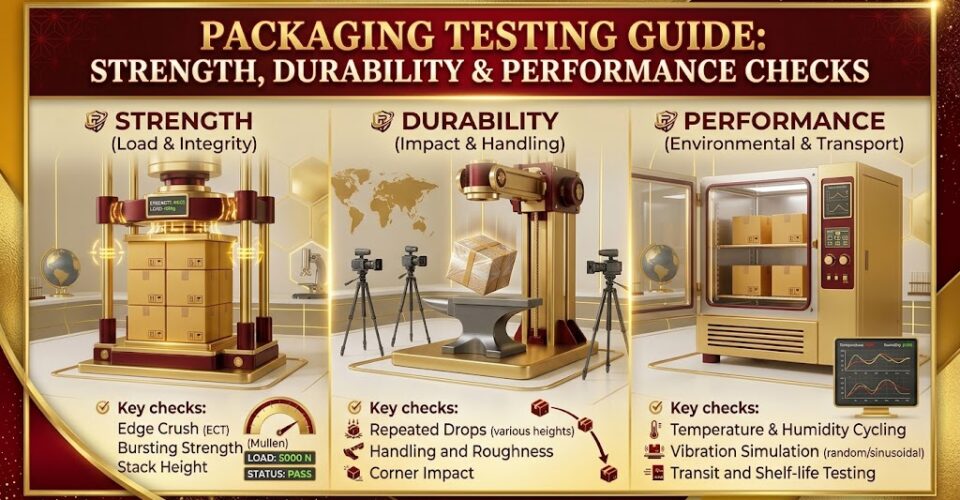
Packaging testing helps businesses determine whether a package can protect its contents during handling, storage, transportation, and everyday use. A box may look strong but still fail under stacking pressure, repeated handling, moisture exposure, or sudden impacts. Testing helps identify weaknesses before products reach customers.
Whether you ship e-commerce orders, retail products, food items, cosmetics, or fragile goods, an appropriate testing plan can reduce avoidable damage, improve packaging consistency, and support better customer experiences.
This guide explains the most common packaging tests, what they measure, how to select the right materials, and when to seek professional testing. The appropriate test method depends on the product, package design, shipping environment, and applicable industry requirements.
What Is Packaging Testing?
Packaging testing is the process of evaluating a package’s ability to meet defined performance requirements. These may include structural strength, resistance to impact, protection from environmental conditions, closure performance, and suitability for transportation.
Testing may be performed on the packaging material, the empty package, or the complete packaged product. The goal is to check whether the packaging performs as expected under realistic or standardized conditions.
For an overview of how testing fits into the production workflow, review the packaging process and how packaging is made.
Why Is Packaging Testing Important?
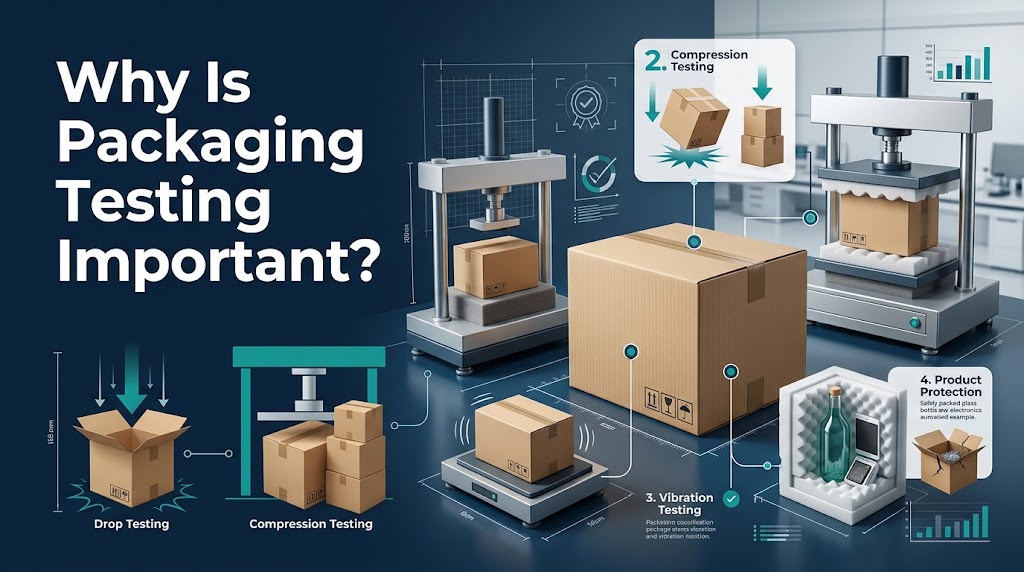
A suitable testing plan can help businesses evaluate packaging performance before committing to large production runs or shipping products to customers. It also gives packaging teams a clearer basis for comparing designs and materials.
- Identify weak points before shipping or launch.
- Compare packaging materials and designs.
- Reduce product damage and returns.
- Check whether a box withstands expected stacking and handling.
- Improve quality control between production batches.
- Confirm that packaging meets relevant customer or regulatory requirements.
- Make evidence-based decisions about material use and package design.
Testing does not guarantee that damage will never occur. It provides evidence about performance under the conditions tested and helps teams make informed improvements.
Common Types of Packaging Tests
Different tests evaluate different risks. A package intended for heavy warehouse stacking needs a different assessment from a lightweight mailer carrying a fragile item. Choosing the right testing method starts with understanding how the product will be packed, stored, and transported.
The exact method, conditioning, sample size, and acceptance criteria should be chosen according to the packaging specification and the relevant test standard.
1. Compression Testing
Compression testing measures how a package responds to a controlled compressive force. It is especially relevant when cartons are stacked during storage or transportation.
A test may reveal whether a box buckles, deforms, or loses its ability to protect the product under load. Results depend on factors such as board grade, box dimensions, flute construction, moisture, and how the box is assembled.
To improve compression performance:
- Select an appropriate board grade for the expected load.
- Avoid oversized boxes that leave products unsupported.
- Consider internal supports when contents can shift.
- Confirm that stacking conditions match real warehouse use.
- Evaluate the assembled package, not only a flat sheet of material.
2. Drop and Impact Testing
Drop testing evaluates how a packaged product responds to falls or impacts. Depending on the method, a package may be dropped onto specified faces, edges, or corners.
This is useful for parcels that pass through multiple handling points. However, a test result only reflects the conditions and procedure used; it does not reproduce every possible real-world accident.
Improve impact protection by selecting an appropriate outer box, using suitable cushioning, securing the product, and limiting unnecessary movement. Learn more about protective packaging and product protection packaging.
3. Vibration Testing
Vibration testing evaluates how packaging and its contents respond to repeated movement. During transportation, vibration can loosen closures, cause abrasion, shift products, or damage delicate components.
A useful vibration test should reflect the expected distribution environment and the product’s sensitivity. It may also be combined with other tests when the package faces several risks during shipment.
For shipping operations, review the principles of shipping packaging and packaging for shipping.
4. Edge Crush and Burst Testing
Corrugated packaging is often assessed using board-strength tests such as edge crush and burst testing. These tests measure different properties, so their results should not be treated as interchangeable.
- Edge crush testing: Evaluates resistance to compression applied to the edge of a corrugated board sample.
- Burst testing: Evaluates resistance to pressure that causes the material to rupture under the specified method.
Neither result alone predicts the complete performance of every finished box. Box dimensions, construction, moisture, closures, and handling conditions also affect performance.
Businesses comparing paper-based materials can explore corrugated packaging and cardboard packaging to understand common material applications.
5. Moisture, Humidity, and Environmental Testing
Paper-based packaging can lose strength or change shape when exposed to moisture. Environmental testing helps determine how packaging performs under specified temperature or humidity conditions.
Consider this testing when packages will be stored in humid environments, transported through changing climates, or used for moisture-sensitive products. A moisture-resistant coating or liner may help in some applications, but the complete package still needs to suit the intended conditions.
6. Fit, Insert, and Closure Testing
A package should hold its contents securely without applying unnecessary pressure. A poor fit can allow movement, while an overly tight fit can damage the product or make packing difficult.
Check the following:
- Product fit and clearance.
- Insert alignment and retention.
- Closure security during handling.
- Ease of opening and closing where reuse is intended.
- Consistency of dimensions across samples.
- Protection of delicate corners, edges, or surfaces.
Internal supports can improve stability when properly designed. Related guidance includes packaging inserts, box inserts, and packaging dividers.
How to Build a Packaging Testing Plan
A practical test plan starts with the product and its real-world journey rather than choosing tests at random. Define the risks first, then select appropriate methods and establish clear criteria for evaluating results.
- Define the risks. Identify likely impacts, stacking loads, moisture exposure, vibration, and handling conditions.
- Document the package. Record materials, dimensions, closures, inserts, product weight, and assembly instructions.
- Choose relevant test methods. Use methods appropriate to the package and distribution environment.
- Set acceptance criteria. Define what counts as a pass or failure before testing starts.
- Prepare representative samples. Use production-representative packaging and products whenever possible.
- Record the results. Document test conditions, observed damage, measurements, and deviations.
- Make controlled improvements. Change one or more design variables, then repeat the relevant tests.
- Monitor production quality. Reassess when materials, suppliers, dimensions, or manufacturing processes change.
For ongoing consistency, connect test results with a documented packaging quality control process.
Which Packaging Types May Need Testing?
The tests depend on the product and distribution method. Different packaging formats face different risks, from stacking pressure and transit impacts to closure failure and surface damage.
- Corrugated shipping cartons: Compression, drop, vibration, and dimensional checks.
- Retail cartons: Structural integrity, closure performance, shelf presentation, and product fit.
- Food packaging: Material suitability, closure integrity, product protection, and any applicable food-contact requirements.
- Rigid gift boxes: Surface protection, corner strength, lid fit, and resistance to handling damage.
- E-commerce mailers: Impact protection, closure performance, and resistance to handling and transit conditions.
For possible packaging formats, compare corrugated boxes, cardboard boxes, mailer boxes, rigid boxes, and custom food boxes. The best choice depends on the product’s dimensions, weight, fragility, and handling environment—not simply on the box style.
Common Packaging Testing Mistakes
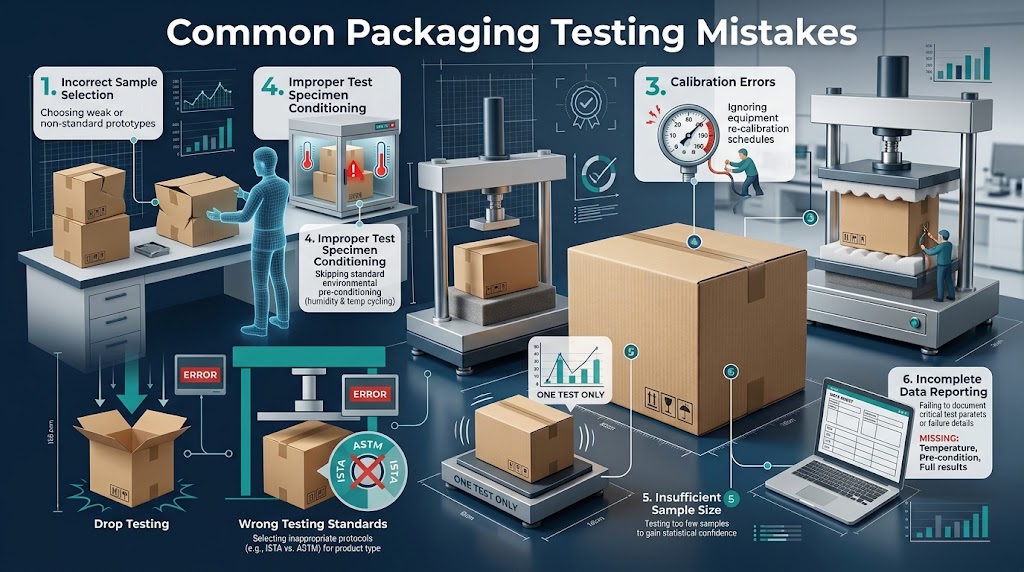
- Testing a sample that differs from the production package.
- Choosing a test without identifying the real distribution risks.
- Treating one strength measurement as proof of overall package performance.
- Failing to record test conditions and acceptance criteria.
- Ignoring the effects of moisture, product weight, or box dimensions.
- Making design changes without retesting.
- Assuming that passing a test guarantees protection in every shipping scenario.
Looking for Packaging That Fits Your Product?
Discuss your product dimensions, material preferences, protection requirements, and custom packaging goals with Bluebird Packaging to help identify a suitable packaging solution.
Frequently Asked Questions
What is the purpose of packaging testing?
It evaluates whether packaging meets defined requirements for protection, strength, durability, and performance during intended handling, storage, and transportation.
What is the difference between drop testing and compression testing?
Drop testing evaluates the response to impacts from falls. Compression testing evaluates resistance to a compressive load, such as pressure from stacked packages.
Which test is best for shipping boxes?
There is no single best test for every shipping box. The right selection depends on product fragility, package construction, shipment method, and the risks expected in the distribution environment.
How often should packaging be tested?
Testing may be needed during initial design, after significant material or structural changes, when quality problems arise, or as part of a defined quality program. The schedule should reflect risk and customer requirements.
Can packaging testing reduce shipping damage?
It can help identify weaknesses and guide improvements, which may reduce damage. Actual results also depend on packing practices, carrier handling, and conditions that may not be represented in the test.
Does every package need laboratory testing?
Not every package requires the same level of laboratory testing. Low-risk applications may use documented fit and quality checks, while higher-risk, regulated, or customer-specified applications may require formal testing by a qualified facility.
Final Thoughts
Packaging testing is a practical way to evaluate whether a package is suitable for its intended use. By identifying the likely risks, selecting relevant test methods, documenting results, and checking improvements, businesses can make more informed packaging decisions.
Start with the product, the distribution environment, and clear acceptance criteria. If you are developing a custom package, visit Bluebird Packaging or use the quote form to discuss your packaging requirements.