

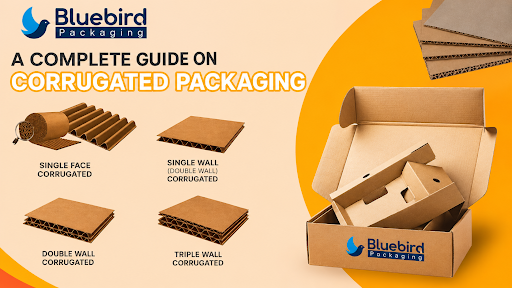
Corrugated packaging is made from paper-based board that combines flat liner sheets with a wavy inner layer called fluting. This construction gives the material rigidity, cushioning, and resistance to handling and stacking forces while keeping it relatively lightweight.
It is widely used for shipping cartons, e-commerce orders, warehouse storage, retail-ready packaging, and protective packaging for fragile or heavy products. The right design depends on product weight, dimensions, shipping conditions, stacking requirements, and presentation needs.
Businesses can choose from different board constructions, flute profiles, box styles, and printing options. For example, corrugated boxes designed for shipping and product protection may be suitable for transport, while a custom-printed box can also support brand recognition.
How Corrugated Packaging Is Made: Understanding the Layers
Corrugated board typically combines flat linerboard with a fluted paper medium. These layers work together to create a structure that is stronger and more rigid than a comparable flat sheet of paper.
1. Outer Linerboard
The outer liner forms the visible surface of the box. It provides a printable area for logos, product information, handling instructions, and other graphics. It also contributes to the board’s strength and resistance to everyday handling.
The outer surface can be selected according to the required appearance, print quality, and intended application.
2. Fluted Medium
The fluted medium is the wavy layer between the flat liners. Its arched structure helps maintain separation between the liners, contributes to rigidity, and provides cushioning against certain impacts.
Different flute profiles offer different balances of thickness, cushioning, printability, and structural performance.
3. Inner Linerboard
The inner liner forms the inside surface of the board. It helps support the fluted structure and creates a surface facing the packaged product.
The quality and construction of the inner and outer liners, along with the fluting, affect the performance of the finished board. For a broader overview of materials used in different packaging applications, businesses should consider both material composition and product requirements.
Types of Corrugated Board by Wall Construction
Corrugated packaging comes in different wall constructions. The number of liners and fluted layers influences thickness and performance, but the actual strength also depends on paper grades, flute profiles, box dimensions, and manufacturing quality.
Single-Wall Corrugated Packaging
Single-wall board is a common choice for everyday shipping and distribution. It combines two flat liners with one fluted medium, creating a practical balance of weight, protection, and cost for many products.
It can work well for e-commerce parcels, consumer goods, and general-purpose cartons when the selected board grade suits the load and transit conditions.
Double-Wall Corrugated Packaging
Double-wall board uses two fluted layers separated by an additional liner. This construction can provide greater rigidity and load-bearing performance than comparable single-wall board.
It may be appropriate for heavier products, longer shipping routes, or packages that face more demanding stacking and handling conditions. However, the correct specification should be based on testing and the complete shipping environment rather than wall count alone.
Triple-Wall Corrugated Packaging
Triple-wall board contains three fluted layers and four liners. It is used for certain heavy-duty applications where substantial structural support is needed, such as selected industrial goods and bulk shipments.
It is not necessary for every heavy product. The packaging design, product weight, dimensions, stacking conditions, and transport method should determine whether this construction is justified.
Corrugated Flute Types and Their Applications
Flutes differ in height, spacing, cushioning characteristics, and suitability for printing or converting. Common profiles include A, B, C, E, and F. Exact specifications vary by board and manufacturer.
Flute selection should consider the complete board construction rather than the letter alone. Paper grades, liner weights, box design, and production quality can change how a finished package performs.
For example, a brand requiring a compact printed box may prioritize a thinner flute and print appearance, while a distribution business may prioritize stacking performance and protection during transit.
How Strong Is Corrugated Packaging?
Corrugated packaging can provide effective protection when its board grade and box design match the intended application. However, there is no single strength rating that applies to every corrugated box.
Several factors influence performance:
- Paper grades: The properties of the liners and fluted medium affect the finished board.
- Flute profile: Flute size and geometry influence cushioning, rigidity, and printability.
- Wall construction: Single-, double-, and triple-wall boards offer different structural characteristics.
- Box dimensions: Large boxes may need a different specification from smaller boxes carrying the same product weight.
- Stacking conditions: Warehouse height, storage duration, and load distribution affect compression requirements.
- Moisture and handling: Humidity, exposure to water, and rough handling can affect paper-based packaging performance.
Understanding ECT and Box Compression
Two common terms used in corrugated packaging testing are:
- Edge Crush Test (ECT): Measures the resistance of a sample of corrugated board to compression applied to its edge. It is commonly used when assessing stacking-related performance.
- Box Compression Test (BCT): Measures how much compressive force a complete box can withstand under specified test conditions.
These tests measure different things and should not be treated as interchangeable. Actual performance also depends on box design, storage conditions, loading, and how the package is handled.
Businesses shipping valuable or fragile goods should consider protective packaging methods that help reduce product movement and damage alongside the strength of the outer box.
Common Corrugated Packaging Styles
The same corrugated material can be converted into different box structures. The best style depends on how products are packed, accessed, displayed, and transported.
1. Regular shipping cartons
Standard shipping cartons are widely used for warehousing, distribution, and parcel delivery. Their dimensions and board strength should match the product and shipping conditions.
For everyday transit requirements, cardboard boxes in practical sizes and styles are a useful starting point.
2. Mailer boxes
Mailer boxes are designed for products sent directly to customers. Their folding structure and closure can help create an organized opening experience while keeping the contents contained.
They are often used by subscription businesses, online retailers, and direct-to-consumer brands. Explore custom mailer boxes for online orders when product presentation matters alongside delivery.
3. Heavy-duty shipping boxes
These boxes are specified for more demanding loads or handling conditions. The required strength depends on the packaged product, shipping route, stacking load, and protective materials used inside.
A suitable box should protect the contents without using unnecessarily heavy board.
4. Corrugated display packaging
Display packaging can organize products and make them accessible in retail settings. The structure may include a front opening, product compartments, or branded panels.
For retail presentation, display boxes designed for counters and product visibility can combine practical organization with branding.
5. Kraft-style corrugated boxes
Kraft-faced boxes offer a natural paper appearance and are often used for shipping and straightforward branded packaging. Their suitability still depends on the board grade and intended use.
Businesses can compare kraft boxes with a natural paper-based appearance when selecting a look for their packaging.
The choice between corrugated and non-corrugated packaging depends on how much structure and cushioning the product needs. This comparison of cardboard and corrugated boxes can help clarify the difference between common packaging terms.
Corrugated Packaging for Different Industries
E-Commerce and Online Retail
E-commerce packaging must withstand handling across fulfillment centers, delivery networks, and customer doorsteps. Box dimensions, board strength, closure style, and internal cushioning all contribute to the final result.
A correctly sized carton can help limit unnecessary movement and reduce wasted space. Businesses can also review packaging considerations for e-commerce orders when planning packaging for products sold online.
Food and Beverage Distribution
Corrugated cartons are often used as outer packaging for transporting packaged food and beverage products. Their suitability depends on product weight, distribution conditions, and any moisture or temperature requirements.
When the package is intended to contact food directly, the materials and construction must meet the relevant food-contact requirements. Corrugated outer cartons should not automatically be treated as direct food-contact packaging.
Electronics and Fragile Products
Electronic goods, glass products, and other fragile items may need a combination of an appropriate outer carton and internal protection. Inserts can help hold products in place, while dividers can separate multiple components.
The correct solution depends on the product’s fragility, weight, dimensions, and the expected handling conditions.
Industrial and Wholesale Shipments
Wholesale and industrial businesses often ship products in bulk. Packaging needs may include stacking strength, repeatable dimensions, warehouse efficiency, and protection during transport.
Before selecting a board specification, consider the full journey from storage to final delivery. Testing a sample package under representative conditions can reveal problems that a material description alone will not.
Inserts, Dividers, and Internal Protection
A strong outer box cannot prevent every type of product damage. Items may shift, collide, or press against one another inside the carton if the internal layout is poorly designed.
Depending on the product, internal packaging may include:
- Corrugated inserts that hold an item in place.
- Dividers that separate several products within one carton.
- Folded supports that prevent movement.
- Cushioning materials selected for the product’s fragility.
- Compartments for accessories or separate components.
For multi-item shipments, packaging inserts that help secure products inside a box may improve organization. For products that need individual separation, packaging dividers for keeping items apart during transit may also be useful.
Internal protection should be designed as part of the complete package rather than added as an afterthought.
How to Choose the Right Corrugated Packaging
Choosing a suitable box begins with the product and the conditions it will face. A package intended for a short local delivery may need a different specification from one shipped internationally or stored under a heavy load.
Step 1: Measure the product accurately
Record length, width, and height. Account for protective wrapping, inserts, and accessories. Use the correct internal dimensions when calculating the space available for the product.
This method for measuring a box accurately can help reduce sizing mistakes.
Step 2: Evaluate weight and fragility
Consider the weight of the product and whether it can be crushed, scratched, or broken. Determine whether the package needs additional cushioning or internal supports.
Step 3: Assess storage and shipping conditions
Consider stacking height, warehouse storage, handling, moisture exposure, and delivery distance. These conditions help determine the required board construction and box design.
Step 4: Decide on printing and appearance
Select logo placement, artwork, brand colors, and any optional finishes. Keep critical information legible and ensure the design works with the box’s folds, seams, and closures.
Step 5: Confirm specifications and test samples
Review the proposed dimensions, board construction, printing, and quantity. Where practical, test a sample under conditions similar to the intended shipping and storage environment.
Businesses comparing available dimensions can consult standard box sizes for common packaging needs and this packaging size guide for choosing suitable dimensions.
Printing and Customization Options
Corrugated packaging can be left plain or customized with brand graphics, product details, handling information, and promotional artwork. The best printing approach depends on the board surface, order quantity, artwork complexity, and budget.
Common customization choices include:
- Printed logos and brand colors.
- Product descriptions and handling instructions.
- Shipping and identification labels.
- Custom die-cut structures.
- Printed retail-ready packaging.
- Selected surface finishes, where compatible with the board.
The artwork should be checked against the box dieline so that important text and graphics do not fall across folds, cut lines, or glued areas. Review print proofs before approving a production run.
For branded cartons, packaging printing options for logos and product artwork can help businesses understand the available approaches. Specialty treatments may also be considered, but their cost and effect on recycling should be assessed before they are selected.
What Affects Corrugated Packaging Costs?
The price of corrugated packaging depends on the full specification rather than just the box dimensions. The main factors include:
| Factor | Potential impact on cost |
|---|---|
| Board grade and paper quality | Stronger or specialty board may cost more |
| Box dimensions | Larger cartons generally use more material |
| Wall construction | Additional layers can increase material use |
| Structural complexity | Die-cut shapes and custom closures may require extra production work |
| Printing | Artwork coverage and print requirements affect pricing |
| Finishes | Specialty treatments can add processing costs |
| Order quantity | Unit pricing may vary with production volume |
| Delivery requirements | Shipping method and destination affect total cost |
Avoid selecting the thickest or strongest board automatically. A specification that is unnecessarily heavy may increase material and freight costs without providing a meaningful benefit for the product.
For a more detailed breakdown, review the factors that influence custom packaging prices. When comparing supplier quotes, provide the same dimensions, quantity, construction, printing requirements, and delivery details.
Is Corrugated Packaging Recyclable?
Corrugated packaging is commonly collected for paper recycling where local programs accept it. Its recyclability depends on factors such as contamination, coatings, mixed materials, and the rules of the local recycling service.
The U.S. Environmental Protection Agency provides information about containers and packaging, including corrugated boxes and material recovery. The EPA’s published figures on corrugated-box recycling refer to 2018 data, so they should not be interpreted as current recycling rates.
Businesses can make more informed packaging decisions by:
- Using only as much material as the product requires.
- Considering recycled-content board where suitable and available.
- Keeping recyclable cardboard clean and dry.
- Avoiding unnecessary mixed-material components when practical.
- Checking local rules before making recyclability claims.
- Testing packaging designs to balance protection with material use.
For additional information, see sustainable packaging approaches for businesses and how packaging recycling fits into material recovery.
Common Corrugated Packaging Mistakes to Avoid
Even a well-manufactured box can fail to protect a product if the specification or packing method is unsuitable.
- Choosing a box based only on appearance: The box must meet the product’s protection requirements, not just its branding goals.
- Ignoring internal dimensions: A poorly sized carton can leave too little room for protection or too much room for movement.
- Overlooking stacking conditions: Storage and transit loads can affect the required board strength.
- Skipping sample testing: A sample can reveal structural, fit, and packing problems before a large order is produced.
- Using excessive material: Stronger board is not always necessary; the specification should match the application.
- Forgetting internal protection: Inserts or dividers may be necessary for fragile and multi-item products.
- Assuming every coated box is readily recyclable: Check material composition and local recycling acceptance before making environmental claims.
A reliable specification balances product safety, box performance, packing efficiency, and total cost.
Frequently Asked Questions About Corrugated Packaging
1. What is corrugated packaging used for?
Corrugated packaging is used for shipping, storage, distribution, e-commerce, and selected retail applications. Its layered structure provides rigidity and cushioning, making it useful for a wide range of products.
2. What are the three main layers of corrugated board?
Typical single-wall corrugated board has an outer liner, a fluted paper medium, and an inner liner. The liners form the flat surfaces, while the fluted layer contributes to rigidity and cushioning.
3. What is the difference between single-wall and double-wall corrugated boxes?
Single-wall board has one fluted layer between two liners. Double-wall board has two fluted layers and three liners. Double-wall construction can provide greater structural performance, but the correct choice depends on the product and shipping conditions.
4. Which flute type is best for shipping?
There is no single best flute for every shipment. C-flute is commonly used for general shipping, while other flute profiles may be selected for cushioning, print quality, or compact packaging. Board grades and box design also affect performance.
5. How do I know what strength corrugated box I need?
Start with product weight, dimensions, fragility, stacking requirements, and shipping conditions. A packaging supplier can help select a board specification, and testing can help verify whether the complete box meets the intended requirements.
6. Can corrugated boxes be custom printed?
Yes. Corrugated boxes can be customized with logos, brand colors, product information, and other artwork, depending on the material and printing process. Artwork should be reviewed against the box design before production.
7. Is corrugated packaging suitable for e-commerce?
Yes. It is widely used for e-commerce shipments. The appropriate construction depends on the product, parcel handling conditions, required protection, and whether internal inserts or cushioning are needed.
8. Can corrugated packaging be recycled?
Many corrugated boxes can be recycled through paper and cardboard collection programs. Acceptance may depend on local facilities and the presence of food residue, coatings, or other materials. Check local recycling instructions for the specific package.
9. Does a thicker corrugated box always provide better protection?
No. Thickness alone does not determine the complete box’s performance. Paper grades, flute profile, wall construction, box dimensions, internal protection, and handling conditions all matter.
10. What information is needed for a corrugated packaging quote?
Provide product dimensions and weight, quantity, intended use, required protection, printing preferences, and delivery details. If the required board grade is unknown, explain how the product will be stored and shipped so the supplier can help determine suitable options.
Find the Right Corrugated Packaging for Your Products
Corrugated packaging works best when its layers, flute profile, box dimensions, and internal protection match the product’s real-world requirements. A well-chosen specification can support safe handling, practical storage, effective shipping, and a professional presentation without adding unnecessary material.
Bluebird Packaging offers custom box options for businesses that need packaging designed around product dimensions, branding, and intended use. Share your specifications to discuss suitable box styles and printing requirements.
Ready to Plan Your Next Packaging Order?
Share your product measurements, quantity, and packaging requirements to discuss suitable corrugated packaging options.





2 Comments
[…] you want to understand the material, read our guide to corrugated packaging and learn more about the different materials used in […]
[…] bundles, electronics, retail replenishment, and many other applications. Businesses can explore corrugated packaging to understand how its construction differs from other paper-based […]