Choosing the right dropper bottle size is important for brands selling essential oils, facial serums, skincare products, cosmetic oils, and liquid supplements. A bottle that is too small may not provide enough product for customers, while a larger container can increase material costs and affect product presentation. The right size also determines which packaging box will fit securely around the bottle.
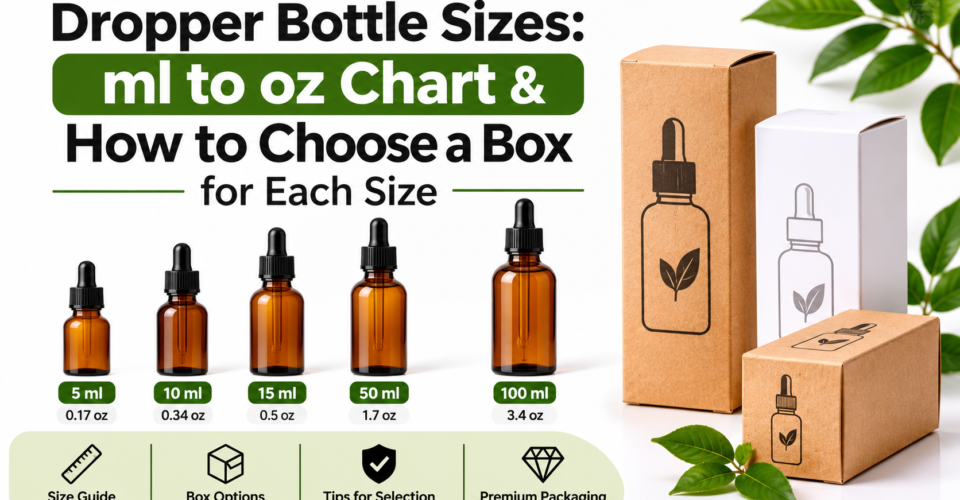
Dropper bottle sizes commonly range from 5ml to 100ml, with 10ml and 30ml options frequently used for essential oils and skincare products. However, bottle capacity alone does not determine its physical dimensions. The height, diameter, shoulder shape, dropper cap, and pipette assembly can vary between manufacturers.
This guide compares common dropper bottle capacities in milliliters and fluid ounces, explains typical bottle dimensions, and shows how to choose suitable packaging for each size.
Quick Overview: Dropper Bottle Sizes
| Bottle Capacity | Approx. US Fluid Ounces | Common Applications |
|---|---|---|
| 5ml | 0.17 oz | Essential oil samples and travel products |
| 10ml | 0.34 oz | Essential oils and small cosmetic products |
| 15ml | 0.51 oz | Essential oils and skincare formulations |
| 30ml | 1.01 oz | Facial serums and cosmetic oils |
| 50ml | 1.69 oz | Skincare oils and larger serum products |
| 60ml | 2.03 oz | Hair oils and liquid formulations |
| 100ml | 3.38 oz | Larger cosmetic and wellness products |
Note: Fluid-ounce values are rounded US liquid measurements. Bottle dimensions are not standardized and should be confirmed with the actual bottle supplier before ordering custom packaging.
1. Understanding Dropper Bottle Sizes in ml and oz
Dropper bottles are generally measured by their liquid capacity, which indicates how much product the container can hold. Manufacturers commonly use milliliters (ml), while some brands and markets also use fluid ounces (fl oz).
Understanding both measurements makes it easier to compare bottle options, select product quantities, and communicate packaging specifications.
Milliliters vs. Fluid Ounces
A milliliter is a metric unit of volume, while a US fluid ounce is an imperial unit commonly used for liquid products.
The basic conversion is:
- 1 US fluid ounce = approximately 29.57ml
- 1ml = approximately 0.0338 US fluid ounces
- 30ml = approximately 1.01 US fluid ounces
- 60ml = approximately 2.03 US fluid ounces
For packaging and product labeling, always distinguish between fluid ounces and ounces by weight. They measure different things.
Dropper Bottle Size Chart: ml to oz Conversion
| Milliliters (ml) | US Fluid Ounces (fl oz) | Approximate Size |
|---|---|---|
| 5ml | 0.17 fl oz | Very small |
| 10ml | 0.34 fl oz | Small |
| 15ml | 0.51 fl oz | Small |
| 20ml | 0.68 fl oz | Small-medium |
| 30ml | 1.01 fl oz | Medium |
| 40ml | 1.35 fl oz | Medium |
| 50ml | 1.69 fl oz | Medium-large |
| 60ml | 2.03 fl oz | Large |
| 100ml | 3.38 fl oz | Extra-large |
This conversion chart is useful when comparing supplier catalogs or preparing product specifications for different markets.
2. Common Dropper Bottle Sizes and Their Uses
Different bottle capacities are suitable for different product types. A small bottle may be ideal for concentrated essential oils, while a larger bottle can provide more product for daily skincare or haircare routines.
5ml Dropper Bottle
A 5ml dropper bottle is one of the smallest options available. It is commonly used for essential oil samples, concentrated formulations, trial products, and travel-size liquids.
Its compact size makes it convenient for sampling programs and product sets. However, the small container requires careful packaging because it can move around inside an oversized box.
Packaging consideration: Use a compact box with a fitted insert or holder to keep the bottle upright and prevent movement.
10ml Dropper Bottle
A 10ml dropper bottle is popular for essential oils, fragrance oils, and concentrated liquid products. It provides more product than a sample container while remaining small enough for travel and compact storage.
Many essential oil brands use this capacity for individual oils and small product collections.
Packaging consideration: A small carton with a secure insert can protect the glass container and keep the dropper assembly in position.
15ml Dropper Bottle
A 15ml dropper bottle offers additional capacity while maintaining a relatively compact format. It can be used for essential oils, facial treatments, and specialty cosmetic formulations.
Brands may choose this size when they want to offer a product quantity between a sample-size container and a standard serum bottle.
Packaging consideration: Measure the complete bottle, including the dropper cap, before deciding on the carton height.
30ml Dropper Bottle
The 30ml dropper bottle is a common choice for facial serums, skincare oils, vitamin-based formulations, and cosmetic treatments. It is approximately equivalent to 1 US fluid ounce.
This capacity offers a practical balance between product quantity, portability, and retail presentation. Glass versions are frequently used for premium skincare products.
Packaging consideration: Choose a box that accommodates the bottle’s widest point and full dropper height. A fitted insert can help keep the glass bottle stable during shipping and retail handling.
50ml Dropper Bottle
A 50ml dropper bottle provides more product than a standard 30ml container. It may be suitable for facial oils, haircare formulations, and products intended for more regular use.
Because the bottle may be wider or taller than smaller options, its packaging needs to be measured independently rather than scaled up using capacity alone.
Packaging consideration: Consider a stronger carton structure and a suitable insert, especially when the bottle is made of glass.
60ml Dropper Bottle
A 60ml dropper bottle holds approximately 2.03 US fluid ounces. It is used for larger cosmetic and liquid products, including certain hair oils and skincare formulations.
The bottle’s dimensions can vary considerably depending on its shape and closure design.
Packaging consideration: Check the bottle’s diameter, shoulder profile, and dropper assembly. The packaging should provide enough room for protective material without allowing excessive movement.
100ml Dropper Bottle
A 100ml dropper bottle is a larger option for products that require greater liquid capacity. It may be used for cosmetic oils, hair treatments, and other liquid formulations.
Larger glass bottles can be heavier and may need more substantial protection than small essential oil containers.
Packaging consideration: Select a carton with appropriate board strength and a well-fitted insert. Test the finished packaging under realistic handling and shipping conditions.
3. Glass Dropper Bottle Dimensions: Height and Diameter
Bottle capacity tells you how much liquid a container holds, but it does not tell you exactly how much space the bottle occupies.
Two 30ml dropper bottles can have different heights and widths because of variations in glass thickness, shoulder design, base shape, and dropper closures.
Approximate Glass Dropper Bottle Dimensions
The following table provides illustrative dimension ranges for common bottle capacities. These are planning estimates, not universal industry standards.
| Capacity | Approx. Height | Approx. Body Diameter |
|---|---|---|
| 5ml | 50–65mm | 16–22mm |
| 10ml | 55–75mm | 18–25mm |
| 15ml | 65–85mm | 20–28mm |
| 30ml | 80–105mm | 28–35mm |
| 50ml | 90–115mm | 32–40mm |
| 60ml | 95–125mm | 35–45mm |
| 100ml | 110–145mm | 40–50mm |
Important: These ranges are approximate and may not include every bottle style. Always obtain the manufacturer’s technical drawing or measure a physical sample before finalizing box dimensions.
What Affects Dropper Bottle Dimensions?
Several design details can change the physical size of a bottle:
- Bottle shape: Round, cylindrical, square, and oval bottles have different space requirements.
- Glass thickness: Thicker glass can increase the external diameter and overall weight.
- Shoulder design: Rounded or sloped shoulders change the bottle’s profile.
- Dropper cap: The cap and bulb may extend above the bottle neck.
- Pipette length: The glass or plastic pipette must fit inside the bottle without interfering with its base.
- Closure type: Different neck finishes and closures can affect the overall dimensions.
For this reason, packaging should be designed around the complete assembled bottle rather than the liquid capacity alone.
4. How to Measure a Dropper Bottle Correctly
Accurate measurements help prevent packaging problems such as loose bottles, crushed cartons, difficult insertion, and excessive empty space.
Before ordering custom packaging, measure the actual bottle and its complete dropper assembly.
Step 1: Measure the Total Height
Place the assembled bottle upright on a flat surface. Measure from the bottom of the glass base to the highest point of the dropper bulb or cap.
This measurement determines the minimum internal height required for the packaging.
Step 2: Measure the Widest Diameter
Measure across the widest part of the bottle body. If the bottle has an unusual shape, measure its width and depth separately.
For a square or rectangular bottle, record both dimensions instead of treating it as a round container.
Step 3: Measure the Neck and Closure
Check the neck diameter and the dimensions of the dropper cap. The closure may be wider than the glass neck and can affect how the bottle fits inside an insert.
Step 4: Check the Base
Measure the bottle’s base diameter or width. This is especially important when designing a fitted insert or compartment that holds the bottle upright.
Step 5: Record All Measurements
Create a simple specification sheet before contacting a packaging supplier.
| Measurement | What to Record |
|---|---|
| Total height | Base to top of assembled dropper |
| Body width | Widest point of the bottle |
| Body depth | Front-to-back measurement, if applicable |
| Base dimensions | Width or diameter of the bottom |
| Neck dimensions | Neck width and closure details |
| Bottle weight | Weight of the filled or empty bottle, as required |
Use millimeters or inches consistently and confirm whether the supplier is asking for internal or external box dimensions.
5. How to Choose a Box for Each Dropper Bottle Size
Selecting the correct packaging box is essential for protecting glass bottles and presenting cosmetic products professionally.
A box should fit the bottle securely, provide enough room for any protective insert, and support the product’s weight during handling and transportation.
Packaging for 5ml and 10ml Dropper Bottles
Small bottles are often used in essential oil collections, samples, and travel-size products. Their compact dimensions make them suitable for small cartons and multi-bottle packaging.
Consider:
- Compact box dimensions.
- Individual bottle compartments for product sets.
- Paperboard inserts or suitable protective holders.
- Enough clearance to insert and remove the bottle easily.
For multiple bottles, measure the complete arrangement rather than calculating the box size from one bottle alone.
Packaging for 15ml and 30ml Dropper Bottles
These sizes are commonly associated with essential oils and skincare products. Packaging may need to balance product protection with a premium retail appearance.
Consider:
- A carton sized to the complete bottle dimensions.
- A fitted insert to prevent movement.
- Sufficient board strength for the bottle’s weight.
- Space for branding, product information, and labeling.
A well-designed cosmetic carton can help create a consistent presentation across a skincare range.
Packaging for 50ml and 60ml Dropper Bottles
Larger bottles may need more internal space and stronger support, particularly when made of glass.
Consider:
- A suitable box structure for the filled bottle weight.
- An insert that supports the base and limits movement.
- Adequate clearance around the dropper cap.
- Protective packaging for shipping and storage.
Packaging for 100ml Dropper Bottles
A 100ml bottle can be significantly heavier and larger than a small essential oil container. Packaging should be selected based on actual dimensions, weight, and distribution conditions.
Consider a stronger carton and a fitted insert that helps prevent the bottle from shifting. For shipping, test the complete packed product to check whether it can withstand normal handling.
Dropper Bottle Packaging Comparison
| Bottle Size | Packaging Priority | Suggested Packaging Approach |
|---|---|---|
| 5ml | Compact fit | Small carton with a secure holder |
| 10ml | Stability | Fitted paperboard insert |
| 15ml | Bottle and cap clearance | Custom-sized carton |
| 30ml | Retail presentation and protection | Cosmetic carton with insert |
| 50ml | Support and protection | Stronger carton with fitted insert |
| 60ml | Stability during handling | Custom carton with suitable support |
| 100ml | Weight and shipping protection | Strong carton and protective insert |
6. How to Calculate Dropper Bottle Box Dimensions
Once the bottle has been measured, you can estimate the internal box dimensions.
The most important point is to account for the bottle, insert, and necessary clearance together.
Internal Box Width
For a round bottle placed in an insert, the internal width must accommodate the bottle’s widest diameter plus the space required by the insert and fit tolerance.
Internal Box Depth
The internal depth should provide enough room for the bottle’s diameter or front-to-back measurement, along with the insert structure and appropriate clearance.
Internal Box Height
The internal height must accommodate the complete assembled bottle, including the dropper bulb or cap, and any top and bottom protective components.
Example: Box Sizing for a 30ml Dropper Bottle
Suppose a 30ml bottle measures:
- Total height: 95mm
- Body diameter: 32mm
- Insert thickness around the bottle: 3mm per side
- Additional fitting clearance: 2mm per side
A preliminary internal box width and depth could be estimated as:
32mm + 6mm insert allowance + 4mm clearance = 42mm
The height must be calculated separately using the bottle’s full height and the insert’s top and bottom requirements.
This is only a planning example. The final dimensions depend on the insert design, carton structure, folding allowance, and the packaging supplier’s specifications.
Important: Do not automatically add the same allowance to every bottle. A loose fit can allow glass to move, while a tight fit can make the product difficult to insert or remove.
7. Best Materials for Dropper Bottle Packaging Boxes
The right packaging material depends on the bottle’s weight, intended use, retail positioning, and shipping requirements.
Cardboard Packaging
Cardboard is a common option for cosmetic and skincare packaging. It can support printed branding, product information, and different finishing treatments.
It may be suitable for lightweight and medium-weight dropper bottles when the carton structure and insert provide adequate support.
Explore custom cosmetic boxes for packaging designed around skincare and beauty products.
Kraft Packaging
Kraft paperboard offers a natural appearance and can be considered for brands that prefer a simple, understated packaging style.
It may work well for essential oils, organic-inspired skincare ranges, and products with minimal branding. Material strength and surface suitability should still be checked before production.
Corrugated Packaging
Corrugated board has a fluted structure that provides additional cushioning and strength. It is commonly used for shipping and transporting products that need more protection.
For heavier glass bottles or multi-item shipments, corrugated packaging may be considered as an outer protective box. The correct board grade depends on the packed product’s weight and shipping conditions.
Custom Inserts
An insert helps hold a dropper bottle in position and can reduce movement inside the carton.
Depending on the design, inserts may be made from paperboard, molded pulp, foam, or other suitable materials. Consider the product’s fragility, presentation requirements, and end-of-life material considerations when selecting one.
8. Design Tips for Custom Dropper Bottle Boxes
Packaging needs to protect the bottle, but it also plays an important role in how customers perceive a cosmetic or essential oil brand.
A good design balances product fit, brand identity, usability, and practical manufacturing requirements.
Use a Secure Bottle Holder
A fitted insert can help keep the bottle upright and reduce movement. For glass containers, test the insert with the actual filled bottle before approving a large production run.
Keep Product Information Readable
Include essential product details such as:
- Product name.
- Net contents.
- Ingredient information, where applicable.
- Directions for use.
- Manufacturer or brand details.
- Required warnings and regulatory information.
Check the applicable labeling requirements for the product and the markets where it will be sold.
Choose Finishes That Match Your Brand
Different finishes can create different visual effects:
- Matte lamination: A soft, understated appearance.
- Gloss lamination: A reflective surface that enhances visual contrast.
- Foil stamping: Metallic accents for selected design elements.
- Embossing: Raised details that add texture.
- Spot UV: A glossy highlight on selected areas.
Choose finishes based on the desired presentation, budget, material compatibility, and product positioning.
Match the Box to the Product Range
If a brand sells several bottle sizes, a consistent packaging design can help create a recognizable product family. Each carton should still be measured and customized for its specific bottle.
For example, a 10ml essential oil and a 30ml facial serum may share brand colors and typography but require different internal dimensions and inserts.
9. Common Mistakes When Choosing Dropper Bottle Packaging
Even a well-designed carton can cause problems if the bottle measurements or packaging requirements are incorrect.
Avoid these common mistakes:
Choosing a box based only on bottle capacity: Two bottles with the same capacity may have different external dimensions. Always measure the actual container.
Ignoring the dropper cap: Measuring only the glass body can result in a box that is too short for the assembled bottle.
Forgetting the insert: Inserts occupy internal space. Their thickness and shape must be included in the box calculation.
Using a loose-fitting carton: Excessive movement can increase the risk of damage during transportation.
Selecting weak packaging: A carton that cannot support the filled bottle may become crushed or damaged during handling.
Skipping packaging tests: Test the actual filled bottle, insert, and finished carton together before approving production.
10. Frequently Asked Questions About Dropper Bottle Sizes
1. What are the standard dropper bottle sizes?
Common dropper bottle capacities include 5ml, 10ml, 15ml, 30ml, 50ml, 60ml, and 100ml. The most suitable option depends on the product type, intended usage, and brand requirements.
2. What size is a 30ml dropper bottle in ounces?
A 30ml dropper bottle holds approximately 1.01 US fluid ounces. It is commonly described as a 1 oz bottle, although the exact conversion is slightly more than one fluid ounce.
3. How many ounces are in a 10ml dropper bottle?
A 10ml dropper bottle holds approximately 0.34 US fluid ounces. It is a small size often used for essential oils and concentrated liquid products.
4. What is the most common dropper bottle size?
A 30ml bottle is a common choice for facial serums and skincare oils, while 10ml bottles are frequently used for essential oils. The most popular capacity varies by product category and brand.
5. How tall is a standard 1 oz dropper bottle?
A 1 oz bottle generally refers to a capacity of approximately 30ml. Its height varies by manufacturer and design, but an illustrative planning range is around 80–105mm. Measure the assembled bottle, including its dropper cap, before ordering a box.
6. What is the difference between 15ml and 30ml dropper bottles?
A 15ml bottle holds half the liquid capacity of a 30ml bottle. Both may be used for essential oils and skincare products, but the 30ml option offers more product and may require a larger carton.
7. How do you measure a glass dropper bottle?
Measure the complete assembled bottle from its base to the top of the dropper cap. Then measure the widest body diameter, base, and neck or closure dimensions. Record the measurements in millimeters or inches.
8. What size box do I need for a 30ml dropper bottle?
The correct box depends on the bottle’s actual height, diameter, dropper cap, and insert design. A bottle with a 95mm total height and 32mm body diameter may use a preliminary internal width and depth of around 42mm with a suitable insert allowance, but the final dimensions should be confirmed through a packaging sample.
9. How much extra space should a dropper bottle box have?
There is no universal clearance measurement. The required space depends on the insert material, bottle shape, carton construction, and how easily the bottle needs to be inserted and removed. The goal is a secure fit without excessive pressure or movement.
10. What is the best packaging for glass dropper bottles?
The best packaging combines a suitable carton structure with an insert that holds the bottle securely. Cardboard cartons may suit retail presentation, while corrugated outer packaging can provide additional protection during shipping. The final choice depends on bottle weight and distribution conditions.
Conclusion
Choosing the right dropper bottle sizes involves more than comparing milliliters and fluid ounces. Brands also need to consider bottle height, diameter, closure design, product use, and the packaging required to protect the container.
Small 5ml and 10ml bottles may need compact cartons, while 30ml and 50ml containers often require carefully fitted cosmetic packaging. Larger 60ml and 100ml bottles may need stronger structures and additional support, especially when made of glass.
Before ordering packaging, measure the complete assembled bottle, account for the insert, and test the finished box with the actual product.
For customized cosmetic packaging, explore Bluebird Packaging’s cosmetic box options or request a quote. Share your bottle dimensions and packaging requirements to help determine a suitable box structure for your product range.