

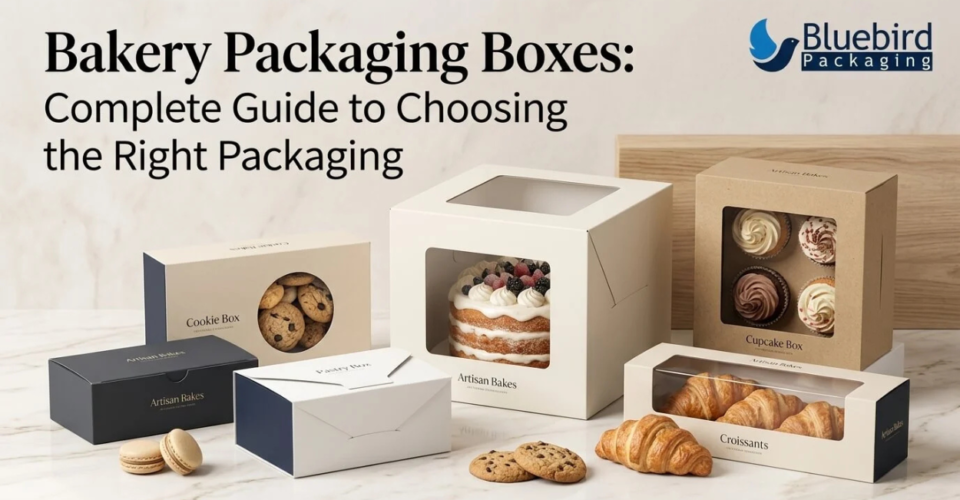
The right packaging for bakery products is more than just putting the baked goods in a box. Packaging must be designed to fit correctly the product and protect it, while also ensuring food safety. The requirements for a cookie box are different from those of a cupcake box, cake or pastry box and if you’re shipping – likewise. The package for dry cookies might not work for freshly-glazed donuts or decorated celebration cakes. The guide will explain how to select bakery packaging boxes depending on the product type, material used, size, structure protection, presentation and sustainability requirements.
What Are Bakery Packaging Boxes?
Bakery packaging boxes are food-packaging containers designed to store, protect, present, and transport baked products such as cakes, cupcakes, cookies, donuts, pastries, brownies, macarons, pies, and other bakery items. Depending on the product and intended use, bakery boxes can be made from different types of paperboard or corrugated materials and can include features such as:
- Windows for product visibility
- Inserts and dividers
- Locking or tuck closures
- Handles
- Grease-resistant surfaces
- Custom printing
- Different sizes and depths
- Protective inner structures
- Recyclable or kraft materials
The best bakery box is therefore not necessarily the thickest or most expensive option. It is the one that matches the product, handling conditions, presentation requirements, and brand needs.
Why Is Bakery Packaging Important?
Bakery packaging performs several jobs at the same time.
1. It Protects Baked Products
Bakery products can be fragile. During transport, frosting can get damaged, macarons may crack and cakes decorated with decorations can move. The right size box will reduce the amount of unnecessary movement, and provide a stable environment.
2. It Supports Product Presentation
Packaging is often the first physical interaction a customer has with a bakery product.
A clean, well-structured box can make a product feel more professional and gift-worthy, while a poorly fitted box can make even a high-quality product look less appealing.
3. It Helps With Transportation
Bakery products may be carried by customers, delivered locally, or shipped through a courier network.
Packaging requirements change depending on the distance and handling conditions. A box designed for counter service may not provide the same protection required for long-distance shipping.
4. It Communicates Your Brand
Packaging can carry your:
- Logo
- Brand name
- Colors
- Website
- Contact information
- Social media details
- Product information
- QR codes
- Brand messaging
This turns the package into another customer touchpoint.
What Types of Bakery Packaging Boxes Are Available?
There is no single bakery box that works for every product. Different baked goods require different structures and features.
1. Cake Boxes
Cake boxes are designed to accommodate products that require additional height, stability, and protection.
They can be used for:
- Birthday cakes
- Wedding cakes
- Celebration cakes
- Sheet cakes
- Cheesecakes
- Specialty cakes
When choosing a cake box, consider the cake diameter, height, weight, decoration, cake board, and transportation distance.
For decorated cakes, the interior height is particularly important because the lid should not come into contact with frosting or decorations.
2. Cupcake Boxes
Cupcakes require packaging that prevents them from tipping, sliding, or touching each other.
For multiple cupcakes, inserts can create individual spaces for each product.
A suitable cupcake box may include:
- Individual cavities
- Cupcake inserts
- Window panels
- Secure closures
- Carrying handles
The number of cupcakes and their size should be considered before selecting the box dimensions.
3. Cookie Boxes
Cookies are generally easier to package than decorated cakes, but they still need protection against crushing, moisture, and movement.
Cookie packaging can include:
- Kraft boxes
- Printed paperboard boxes
- Window boxes
- Gift boxes
- Tray-and-sleeve structures
For premium cookie assortments, internal trays or dividers can help separate different products and improve presentation.
4. Donut Boxes
Donuts can create packaging challenges because of their shape, toppings, fillings, and glaze.
A donut box should provide enough internal space to prevent toppings from rubbing against the lid.
For products with glaze or icing, packaging should also be considered in relation to:
- Grease
- Moisture
- Ventilation
- Product height
- Product spacing
A window can also be useful when visual presentation is an important part of the purchase decision.
5. Pastry Boxes
Pastries include croissants and other delicate baked products such as cinnamon rolls, puff pastry, and danishes. Packaging should allow enough space to prevent the product from being crushed and also to stop it moving too much. Ventilation is also important for some bakery products because heat and moisture trapped in the product can affect its texture.
6. Macaron and Delicate Dessert Boxes
Macarons and similar delicate products need additional attention because they can easily move or break.
Dividers, trays, inserts, and snug internal structures can help keep individual pieces separated.
For premium products, a tray-and-sleeve or specialty presentation box can combine protection with a more refined unboxing experience.
How Do You Choose the Right Bakery Packaging Box?
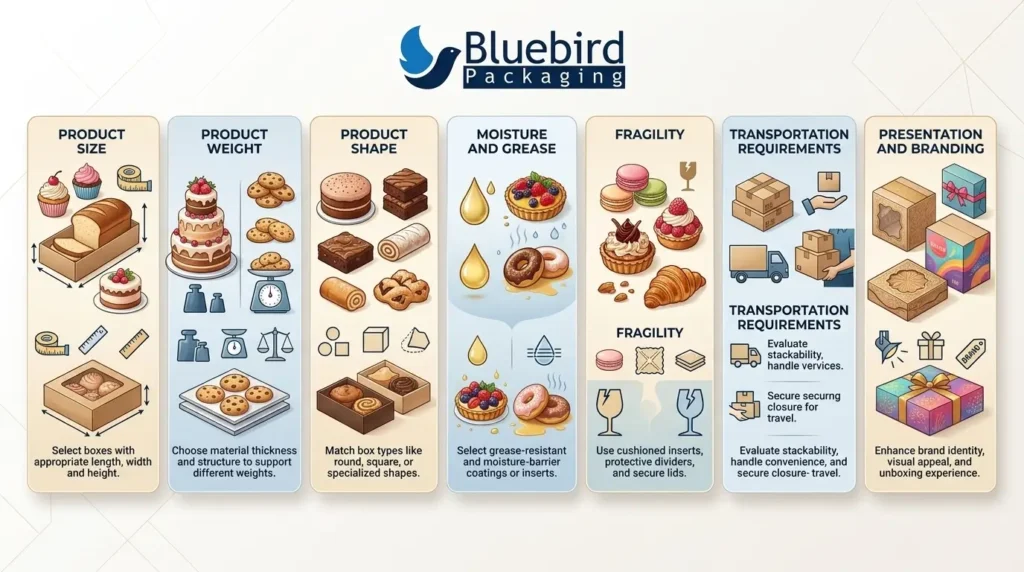
Choosing the right packaging becomes much easier when you evaluate the product first.
Consider these seven factors:
- Product size
- Product weight
- Product shape
- Moisture and grease
- Fragility
- Transportation requirements
- Presentation and branding
Let’s look at each one.
1. Start With the Product Dimensions
One of the biggest bakery packaging mistakes is selecting a box based only on the product’s length and width.
You also need to consider height.
For example, a decorated cake may fit inside a box horizontally but still require additional clearance above the frosting.
Measure:
- Length
- Width
- Height
- Product weight
- Cake board or tray dimensions
- Additional clearance required
The goal is to create enough room for protection without leaving excessive empty space.
2. Match the Box to Product Weight
A lightweight cookie assortment and a multi-layer cake do not place the same demands on packaging.
Heavier products require packaging with sufficient structural strength.
When evaluating a box, consider:
- Board thickness
- Box construction
- Bottom strength
- Folding structure
- Product weight
- Carrying requirements
The box should remain stable when the product is lifted and transported.
3. Consider Moisture and Grease
Moisture and grease can affect both the bakery product and the packaging.
Products such as:
- Croissants
- Donuts
- Pastries
- Butter-rich baked goods
- Glazed products
may require packaging designed to better handle grease or moisture.
This is one reason food-grade and appropriate food-contact packaging materials matter when selecting bakery packaging.
What Materials Are Used for Bakery Packaging Boxes?
Different bakery boxes use different paper-based materials and constructions.
The appropriate choice depends on the product and application.
Kraft Paperboard
Kraft packaging is popular with bakeries that want a natural or minimalist appearance.
It can work particularly well for:
- Cookies
- Bread
- Pastries
- Artisan bakery products
- Takeaway products
Kraft packaging can also complement brands that emphasize a natural or sustainable visual identity.
However, the appearance of a material should not be the only consideration. The actual packaging specification should match the product and intended use.
White Paperboard
White paperboard provides a clean surface for printed graphics and branding.
It is useful when a bakery wants:
- Bright colors
- Detailed printing
- Clean branding
- Product information
- Premium presentation
For visually driven bakery products, a printable white surface can provide strong design flexibility.
Corrugated Packaging
Corrugated packaging provides additional structural protection and is particularly useful when products need to withstand greater handling or shipping conditions.
It can be considered for:
- Larger bakery products
- Heavier products
- Shipping applications
- Products requiring additional structural protection
The appropriate corrugated construction depends on the product and shipping requirements.
Bakery Packaging Material Comparison
| Material | Common Applications | Main Advantage | Consideration |
|---|---|---|---|
| Kraft paperboard | Cookies, pastries, artisan products | Natural appearance | May not suit every premium print requirement |
| White paperboard | Cakes, cupcakes, branded products | Excellent printing surface | Structure must match product weight |
| Corrugated | Shipping and heavier products | Greater structural protection | May require a different presentation approach |
| Recycled paper-based board | Various bakery applications | Supports sustainability goals | Specification should match food-contact requirements |
The best material is the one that balances protection, product requirements, presentation, and intended use.
What Size Bakery Box Do You Need?
There is no universal bakery box size.
The correct dimensions depend on the actual product.
For example, when packaging a cake, consider:
Box length × box width × internal height
For cupcakes, also consider the size and depth of the insert.
For cookies and pastries, consider how many pieces will be placed inside and whether they need dividers.
A simple sizing rule:
Measure the finished product first, then select a box that provides adequate protection and clearance without creating excessive empty space.
This is especially important for decorated products.
A box that is too small can damage the product.
A box that is too large can allow excessive movement.
Should Bakery Boxes Have Windows?
A bakery box with a window allows customers to see the product without opening the package.
Windows can be particularly useful for visually attractive products such as:
- Cookies
- Cupcakes
- Donuts
- Brownies
- Macarons
- Pastries
- Decorated desserts
The main advantage is product visibility.
For retail environments, this can make it easier for customers to see the product before purchasing.
However, a window is not automatically the best choice for every bakery product. The box should still provide the appropriate protection and presentation for the product.
Are Kraft Bakery Boxes Eco-Friendly?
Kraft and paper-based bakery packaging can support sustainability goals, but the word “eco-friendly” should not be treated as a blanket claim.
Sustainability depends on factors such as:
- Material composition
- Recycled content
- Responsible sourcing
- Coatings
- Printing
- Packaging construction
- Local recycling infrastructure
- End-of-life disposal
For this reason, businesses should evaluate the complete packaging specification rather than choosing a material based solely on its appearance.
What Should You Look For?
When sustainability is important to your bakery, ask:
- Is the material recyclable?
- Does it contain recycled content?
- Are coatings necessary?
- Is the packaging designed for its intended disposal method?
- Can unnecessary material be reduced?
- Is the box appropriately sized?
Good packaging design can reduce unnecessary material while still protecting the product.
How Does Packaging Protect Baked Goods?
Good bakery packaging works as a protection system.
It can help reduce:
Physical Damage
A properly structured box can help reduce crushing, shifting, and impact.
Product Movement
Inserts and correctly sized packaging can keep products in place.
Surface Damage
Adequate internal clearance can prevent lids from touching icing, frosting, or decorations.
Contamination Risk
Appropriate food-contact packaging helps maintain a suitable barrier between the product and external handling conditions.
Shipping Damage
For products transported through delivery networks, stronger packaging construction may be necessary.
What Is the Best Bakery Packaging for Shipping?
The best packaging for shipping depends on the product, distance, handling conditions, and shipping method.
A box designed for local customer pickup may not be sufficient for long-distance delivery.
For shipping applications, consider:
- Structural strength
- Product movement
- Internal protection
- Outer shipping carton requirements
- Cushioning where necessary
- Box dimensions
- Weight
- Courier handling
For fragile products, the packaging system may involve both primary bakery packaging and secondary shipping protection.
This distinction is important.
The attractive bakery box that the customer sees is not always the same component responsible for surviving the entire shipping process.
Bakery Packaging for Fresh and Moist Products
Fresh bakery products can release moisture after baking.
If moisture becomes trapped inside packaging, it can affect the texture of some products.
For example, a crispy pastry may lose some of its desired texture if excess moisture accumulates inside a poorly ventilated package.
This is why packaging decisions should consider:
- Product temperature
- Moisture content
- Freshness requirements
- Ventilation
- Holding time
- Transportation conditions
There is no single ventilation strategy that works for every bakery product.
The packaging should be selected according to the specific product.
How Can Bakery Packaging Improve Branding?
Packaging can become an extension of your bakery’s visual identity.
A branded bakery box can communicate:
- Who made the product
- What the brand represents
- Where customers can reorder
- How the product should be handled
- What makes the bakery different
Branding elements may include:
- Logo
- Brand colors
- Typography
- Website
- Social media handles
- QR codes
- Product messaging
- Thank-you messages
The objective should not be to place as much information as possible on the box.
Instead, create a clear visual hierarchy so the important information is easy to recognize.
Custom Printed Bakery Boxes vs Plain Boxes
Both plain and custom printed bakery packaging can serve a purpose.
Plain Bakery Boxes
Plain packaging can be suitable for:
- Cost-conscious businesses
- Temporary packaging
- Test products
- Businesses using labels or stickers
- Simple brand identities
Custom Printed Bakery Boxes
Custom printed boxes provide more opportunities for:
- Brand recognition
- Consistent visual identity
- Product information
- Marketing messages
- QR codes
- Premium presentation
For growing bakeries, custom packaging can become particularly valuable when brand recognition is an important part of the customer experience.
What Printing and Finishing Options Are Available?
Depending on the packaging material and supplier, bakery boxes can incorporate different printing and finishing techniques.
Common options may include:
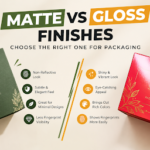
Matte Finish
Creates a softer, understated appearance.
Gloss Finish
Provides a brighter and more reflective appearance.
Foil Effects
Can be used to create metallic-looking details for premium packaging.
Spot UV
Can highlight specific areas such as a logo or design element.
Embossing
Creates a raised physical effect.
Debossing
Creates an impressed effect in the packaging surface.
The right finish depends on the brand identity and packaging budget. More finishing does not automatically mean better packaging.
What can you do to make bakery packaging more sustainable?
It isn’t enough to choose brown packaging for your bakery. It is more beneficial to assess the packaging system as a whole.
Reducing Unnecessary Materials
When packaging is too large for the product, it will not be functional.
Select the Right Materials
Choose materials according to the intended product rather than just appearance.
Recycling
If the packaging is recyclable, it should be.
Don’t Use Unnecessary Parts
Consider whether an extra layer, insert or coating is needed.
The actual product design
The use of a well-fitted box will reduce the amount of unnecessary materials while enhancing product protection.
What are the different types of packaging for bakery products?
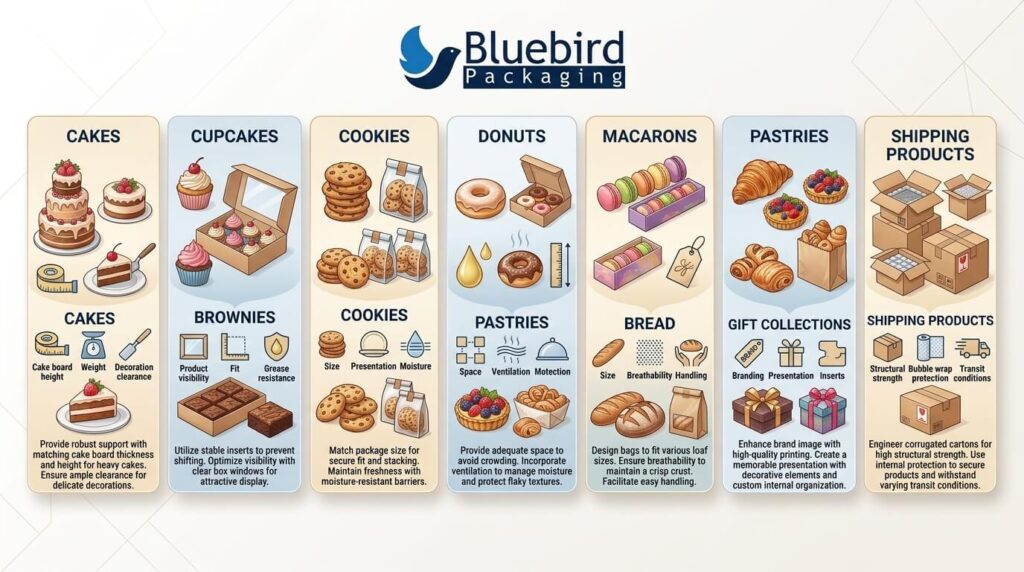
This is where you can start:
| Bakery Products | Packing Considerations |
|---|---|
| Cakes | Cake board height, weight, and decoration clearance |
| Cupcakes | Stability, inserts and visibility |
| Cookie | Size, stacking, presentation, moisture |
| Donuts | Grease, glazing, height |
| Macarons | Individual separation, stability, presentation |
| Brownies | Product visibility, fit, and grease resistance |
| Pastries | Space, ventilation, moisture, protection |
| Bread | Size, breathability and handling |
| Gift Collections | Branding, presentation, inserts |
| Shipping products | Strength of the structure, protection from within, and transit conditions |
It is more important to choose the product first than just choosing an attractive package.
Avoid common packaging mistakes in bakery
When the packaging is chosen without regard to the product, even good packaging may fail.
The Wrong Size
The product can be damaged if it is too small.
A size that is too large may allow for excessive movement.
The second mistake is to ignore the product height
It is common to see this with cupcakes and decorated cakes.
Choose Appearance over Protection
Even a beautiful box must perform the basic function of packaging.
The fourth mistake is to forget about moisture and grease
Packaging for some bakery products is different from packaging of dry goods.
Use the same box for everything
Packaging requirements for different products can vary.
The 6th Mistake: Neglecting Transportation
The packaging for the counter may not work for delivery by courier.
Food Contact Requirements: Mistake No. 7
The packaging used to surround food must be chosen with the appropriate requirements for food contact in mind.
Make sustainability claims without checking the specifications
Depending on the packaging and disposal requirements, terms such as compostable or biodegradable can be used.
Checklist for Bakery Packaging
Ask yourself these questions before selecting the next box for your bakery.
Buy the Product
- What is the product I am packaging?
- How big is it?
- What is the weight of this item?
- Does it have a fragile feel?
- Is it a frosting, glaze or filling?
Box
- The box is the right size.
- Is it tall enough?
- Do you need inserts and dividers for your product?
- Is the structure able to support the product in its entirety?
Materials
- Does the material suit the intended application?
- Is the packaging required to be resistant to grease and moisture?
- Does it meet the requirements for food contact?
Order Now
- Does the product get picked up in your area?
- Does it deliver locally?
- Is it shipped via a carrier?
- Do you need to ship it with additional protection?
Branding
- Is it better to have a plain box or a printed one?
- Is it necessary to have a window on the front?
- Does a high-end finish increase value?
- Is it possible to include brand information on the packaging?
The Sustainability of the Economy
- Is the material recyclable?
- Can I recycle my content?
- The box is it unnecessarily big?
- Do you really need additional packaging?
FAQs about Bakery Boxes
What is the best type of packaging for baking products?
What is the best packaging for your bakery products? Cookies and paperboard boxes work well for cookies, while tall boxes are best for cakes.
What is the best material for packaging bakery products?
No one material is best for all bakery products. All of these materials are suitable depending on weight, humidity, appearance, transportation, and other requirements.
How big should my bakery boxes be?
Before choosing a container, measure the length, width and height of your finished product. Packaging should allow enough space to move the product freely without damaging it.
Do bakery boxes that have windows make a good choice?
When product visibility is crucial, yes, they can be very useful. These windows are ideal for products that have a high visual appeal, such as pastries, cookies, cupcakes and donuts.
Which packaging works best to ship bakery products?
The shipping packaging chosen should take into account the fragility of the product, its weight, size and distance as well as any expected handling. Shipping packages for fragile products should be stronger and include internal protection.
Can kraft boxes be recycled?
Recyclability depends on specific materials, coatings and construction as well as local recycling facilities. Check the packaging specifications.
What can packaging do to improve your brand?
Custom packaging for bakery products can help reinforce the brand through consistency in colors, fonts, messages, logos and more. This can improve customer satisfaction.
Are cupcakes required to have inserts?
Inserts for multiple cupcakes help to keep cupcakes separate and can reduce the movement of cupcakes during transportation.
Do bakery boxes need ventilation?
It depends on what you are baking. The packaging should reflect the moisture content, temperature requirements, and freshness of the baked good.
Before ordering custom-made bakery boxes, what should I keep in mind?
Before placing your order, consider the dimensions of the product, its weight, packaging, print, quantity, delivery, budget and sustainability.
Last Thoughts on Choosing Bakery Packaging That Works
Bakery packaging boxes are designed to do much more than just hold baked goods. The combination should be a good mix of fit, protection, suitability for food contact, presentation, transport performance, branding and practicality.Begin with the actual product, not the packaging. Consider its weight, moisture content, fragility and decoration. Take into consideration its size, weight, fragility and decoration. Select the structure and material that will provide you with the best protection.
After the functionality is solved, the design of the package should be considered. A simple container can be transformed into an integral part of a customer’s experience with custom printing, window finishes, inserts and branding details.
If you have multiple products to sell, it may be better for your bakery to use a system of packaging rather than one box.
Bluebird Packaging offers a variety of packaging options for bakery boxes. These include solutions to meet the needs of different products and sizes.



2 Comments
[…] looking for complete packaging guidance can also explore this detailed bakery packaging guide to understand different materials, styles, and selection […]
[…] more about selecting suitable packaging materials, sizes, and designs can explore this detailed bakery packaging boxes complete guide to make better packaging […]