
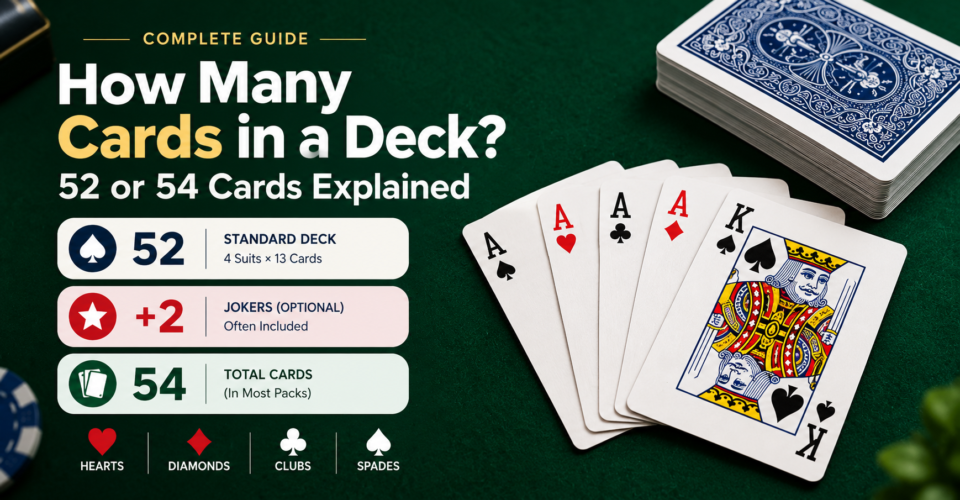
A standard deck of playing cards contains 52 cards, divided into four suits: hearts, diamonds, clubs, and spades. Each suit contains 13 cards. Many retail packs also include two jokers, bringing the usual total to 54 cards. However, jokers are extra cards rather than part of the standard 52-card deck, and some packs contain additional advertising or instruction cards.
Whether you are learning a card game, checking a new deck, or planning packaging for a custom card product, understanding the standard card count makes it easier to choose the right format.
Quick Answer: How Many Cards Are in a Deck?
| Deck detail | Number of cards |
|---|---|
| Standard playing card deck | 52 |
| Standard deck with two jokers | 54 |
| Suits in a standard deck | 4 |
| Cards in each suit | 13 |
| Face cards | 12 |
| Aces | 4 |
| Number cards from 2 through 10 | 36 |
| Red cards | 26 |
| Black cards | 26 |
The key difference: 52 refers to the standard playing cards. A pack containing 52 cards and two jokers usually has 54 cards in total.
How Many Cards Are in a Standard Deck?
A standard deck contains 52 playing cards. Each card belongs to one of four suits, and every suit follows the same sequence: ace, 2 through 10, jack, queen, and king.
The calculation is straightforward:
4 suits × 13 cards per suit = 52 cards
This is the familiar French-suited deck used for games such as poker, blackjack, bridge, and many other traditional card games. Individual games may remove certain cards, add jokers, or combine multiple decks, so the number of cards in play can differ.
For a quick overview of common types of packaging, remember that the number of cards in a deck and the number of pieces supplied in a retail package are two different things.
How Many Cards Are in Each Suit?
There are 13 cards in each suit of a standard deck. The four suits are hearts, diamonds, clubs, and spades.
| Suit | Symbol | Color | Cards |
|---|---|---|---|
| Hearts | ♥ | Red | 13 |
| Diamonds | ♦ | Red | 13 |
| Clubs | ♣ | Black | 13 |
| Spades | ♠ | Black | 13 |
| Total | 52 |
Each suit contains an ace, nine number cards from 2 through 10, and three face cards: jack, queen, and king.
This repeated structure makes the deck easy to count and sort. If you are checking a deck for missing cards, separate the cards by suit and verify that each pile contains all 13 ranks.
How Many Face Cards, Aces, and Number Cards Are in a Deck?
A standard deck contains 12 face cards, four aces, and 36 number cards.
| Card category | Cards per suit | Total |
|---|---|---|
| Jacks | 1 | 4 |
| Queens | 1 | 4 |
| Kings | 1 | 4 |
| All face cards | 3 | 12 |
| Aces | 1 | 4 |
| Number cards, 2–10 | 9 | 36 |
| Total | 13 | 52 |
Are aces face cards?
No. Aces are not counted as face cards in the standard classification. Face cards are jacks, queens, and kings.
An ace has a special role in many games. For example, it can count as one or eleven in blackjack, depending on the hand, and it can rank high or low in certain poker sequences.
How many of each rank are in a deck?
There are four cards of each rank: one in every suit. A standard deck therefore has four kings, four queens, four jacks, four aces, and four of every number from 2 through 10.
How many red and black cards are in a deck?
There are 26 red cards and 26 black cards.
- Red: 13 hearts and 13 diamonds.
- Black: 13 clubs and 13 spades.
Each color contains two suits, and each suit contains 13 cards.
Are There 52 or 54 Cards in a Deck?
Both numbers can be correct, depending on what you are counting.
A standard deck contains 52 playing cards. Many manufacturers include two jokers in the retail pack, making 54 cards altogether.
| What you are counting | Typical count |
|---|---|
| Standard playing cards only | 52 |
| Playing cards plus two jokers | 54 |
| Playing cards, two jokers, and one extra card | 55 |
| Playing cards, two jokers, and two extra cards | 56 |
The last two examples are possible when a manufacturer includes advertising cards, instructions, or other inserts. These extras are not part of the standard playing deck.
How many jokers are in a deck?
Two jokers are commonly included, although the exact number depends on the manufacturer and the intended game. Some decks contain one joker or none.
Jokers can be used as wild cards in certain games, but many popular games set them aside before play begins. Always check the rules for the specific game rather than assuming that jokers are included.
How Many Cards Are in a Poker Deck?
A conventional poker deck contains 52 cards, with the jokers removed. It uses the same four suits and 13 ranks as a standard playing card deck.
The term “poker deck” usually describes the deck format and intended use, not a completely different card count.
| Poker format | Typical cards used | Important detail |
|---|---|---|
| Texas Hold’em | 52 | Jokers are normally excluded |
| Omaha | 52 | Uses the standard deck |
| Five-card draw | 52 | Players receive five cards each |
| Short Deck Hold’em | 36 | Cards 2, 3, 4, and 5 are removed from each suit |
Short Deck Hold’em is a notable exception because it removes 16 cards from the regular deck, leaving the 6s through aces in all four suits.
The number of cards dealt to a player is different from the number of cards in the deck. For example, Texas Hold’em gives each player two private cards and uses five community cards shared by the players. The deck still contains 52 cards at the start.
How Many Cards Do Other Card Games Use?
Not every card game uses all 52 cards. Some use a reduced deck, while others combine multiple decks or use a completely different card system.
| Game or deck | Typical card count | How it differs |
|---|---|---|
| Standard playing cards | 52 | Four suits of 13 cards |
| Standard pack with two jokers | 54 | Includes two extra jokers |
| Euchre | 24 | Commonly uses 9, 10, jack, queen, king, and ace of each suit |
| Pinochle | 48 | Common 48-card version uses two copies of 9 through ace in each suit |
| Piquet | 32 | Uses cards 7 through ace in each suit |
| French Tarot | 78 | Includes four suits, trumps, and an excuse card |
| Canasta | 108 | Commonly uses two standard decks plus four jokers |
| Classic UNO | 108 | Uses a dedicated game-card system, not a standard playing deck |
Counts can vary by edition, region, or house rules. For commercial products, confirm the exact edition before designing packaging or printing instructions.
How many cards are in an UNO deck?
The classic UNO deck contains 108 cards. Newer editions and special versions may include additional or different cards, so check the product edition when an exact count matters.
How many cards are in a tarot deck?
A common French Tarot deck contains 78 cards: 56 suited cards and 22 trumps, including the excuse card. Tarot systems and regional editions can vary, so not every deck labelled “tarot” will necessarily follow this exact structure.
How Many Cards Does Each Player Get?
The number of cards dealt to each player depends on the game. A deck may contain 52 cards even when only a small portion is dealt to each person.
| Game | Typical starting deal | Notes |
|---|---|---|
| Texas Hold’em | 2 private cards per player | Five community cards are revealed during play |
| Five-card draw | 5 cards per player | Players may exchange cards under the rules |
| Blackjack | 2 cards per player | The dealer also receives an initial hand |
| Gin rummy | 10 cards per player in a two-player game | Deal sizes can change with player count |
| Bridge | 13 cards per player | Four players receive the full 52-card deck |
| Hearts | 13 cards per player in a four-player game | The entire deck is dealt |
These are common examples, not universal rules for every variation. If you are learning a game, use the rules for the version you are playing.
Why Does a Deck of Cards Have 52 Cards?
There is no reliable evidence that a single inventor deliberately chose 52 cards for one specific reason. The four-suit, 52-card structure has historical roots that predate modern playing cards.
The International Playing-Card Society describes a surviving Mamluk card pack from before 1500 that was reconstructed as a 52-card deck with four suits. Its suit symbols differed from today’s hearts, diamonds, clubs, and spades. You can read more in the Society’s history of early Middle Eastern playing cards.
Modern French-suited decks developed through a long history of regional designs and card-making traditions. The standard 52-card structure became familiar across many games, but other regional decks still use different suit systems and card counts.
You may also hear that 52 cards represent the 52 weeks of a year or that the four suits represent the four seasons. These are popular interpretations, but they should not be presented as established historical explanations for the deck’s design.
Playing Card Sizes: Poker vs. Bridge
A standard deck’s card count does not determine its width and height. Poker-size and bridge-size cards have similar heights, but bridge cards are narrower.
| Card format | Common dimensions | Typical use |
|---|---|---|
| Poker size | 2.5 × 3.5 inches (63.5 × 88.9 mm) | Poker, many general-purpose decks, and card games |
| Bridge size | 2.25 × 3.5 inches (57.15 × 88.9 mm) | Bridge and games where narrower cards are useful |
| Mini cards | Varies by manufacturer | Compact games, travel decks, and small-format products |
| Tarot cards | Commonly around 2.75 × 4.75 inches, but varies | Tarot and oracle decks |
These are common reference sizes, not a guarantee that every manufacturer uses identical dimensions. Some suppliers use slightly different metric cuts, so confirm the finished card size before preparing artwork or ordering packaging.
For product packaging projects, reviewing packaging materials can help you understand the material options available for different box applications.
How Thick Is a Deck of Playing Cards?
Deck thickness depends on the number of cards, the stock thickness, coatings, and manufacturing tolerances.
Two decks with 52 cards can have different finished thicknesses if one uses thicker stock, a textured finish, or plastic cards while the other uses thinner paper-based stock.
For a packaging project, measure the actual finished deck instead of relying only on an estimated thickness. If the cards will be supplied with sleeves, a booklet, or additional inserts, measure the complete set as it will be packed.
This is especially important for custom boxes: a box that fits the cards without sleeves may be too tight once sleeves are added.
How to Measure a Deck for a Custom Playing Card Box
The best box dimensions come from the actual finished deck, not just the number of cards. Card count is a useful starting point, but the deck’s footprint and stack thickness determine the fit.
Step 1: Confirm the number of cards
Determine whether the package contains 52 playing cards, 54 cards including two jokers, or a larger set with instructions, promotional cards, or other components.
Step 2: Measure the card width and height
Measure one finished card using a ruler or caliper. Record the width and height in inches or millimeters, and check the dimensions against the manufacturer’s specifications if available.
Step 3: Measure the complete stack
Square the deck on a flat surface and measure its thickness. Include the actual card stock and finish. If customers will store the cards in sleeves, measure the sleeved deck as well.
Step 4: Decide what else goes inside the box
A card deck may need space for a rulebook, a score sheet, a divider, or a small accessory. These components affect the box’s internal dimensions.
Step 5: Allow suitable clearance
The cards should slide in and out without excessive force, but the box should not be so large that the deck moves around unnecessarily. Ask your packaging supplier to confirm the internal dimensions and recommended clearance for the chosen structure and material.
Step 6: Review a prototype or sample
Before approving a large order, check that the finished deck fits, the closure works properly, and the cards can be removed without damaging the box.
For broader guidance on custom box sizes, focus on the finished product dimensions and the internal space required rather than choosing a box based on a generic size chart alone.
What Type of Box Is Best for Playing Cards?
The right box depends on the product’s purpose, budget, presentation, and distribution method. A basic retail deck has different needs from a premium collector deck or a multi-deck gift set.
| Packaging type | Best suited for | Main consideration |
|---|---|---|
| Folding carton or tuck box | Standard single-deck packaging | Compact structure and easy opening |
| Custom sleeve | An outer wrap or additional branded presentation | Must fit the underlying box accurately |
| Rigid box | Premium decks, gift sets, and collector products | More substantial presentation and structure |
| Display box | Retail counters or multiple-deck presentation | Must support visibility and convenient access |
| Mailer box | Shipping a deck alongside other items | Consider transit protection and internal movement |
Explore Bluebird Packaging’s cardboard box options, custom rigid boxes, retail packaging, and mailer boxes to compare general packaging formats. These are broader packaging categories; confirm the required dimensions and structure for your particular card product with the supplier.
For retail presentation, a display box may be appropriate when several decks need to be presented together. For products that need a more substantial gift-style presentation, explore luxury rigid packaging and discuss the finished deck dimensions before selecting a design.
How to Design Custom Playing Card Packaging
A well-designed box needs to fit the deck, communicate the product, and work in its intended selling environment. The design process should begin with practical requirements rather than artwork alone.
Choose the right box structure
Decide whether the product needs a tuck-style carton, an outer sleeve, a rigid presentation box, or a larger box for multiple decks and accessories.
Plan the artwork
The box may include the game name, brand logo, deck description, age guidance where applicable, instructions, barcode, and other product information. Place important content on panels where customers can read it easily.
Check colors and print quality
Confirm that the artwork uses the correct production template and color settings. Review small text, fine lines, and the logo at the actual printed size.
Consider finishes carefully
Matte or gloss coatings, foil, embossing, and other finishes can change the appearance and feel of a package. Select finishes that suit the brand and budget, and check whether they affect the structure or fit.
Request a proof before production
Review the artwork, dieline, dimensions, and any physical sample before approving production. A proof helps identify layout or sizing issues while changes are still possible.
Bluebird Packaging offers custom packaging solutions across multiple product categories. If you are exploring a new box concept, the company’s packaging design guide and custom packaging options can help you plan the next steps.
Packaging Considerations for Card Games and Small Brands
For a small business developing a card game, educational deck, promotional card set, or branded playing cards, packaging decisions affect more than appearance.
Before ordering, consider:
- Quantity: How many decks will you need for the first production run?
- Product fit: Will the box hold the finished cards securely?
- Branding: Does the design communicate the game or product clearly?
- Retail requirements: Will the product hang on a fixture, sit on a shelf, or be displayed on a counter?
- Shipping: Does the package need an outer shipping carton or additional protective material?
- Storage: Can the finished boxes be stored without crushing or damaging them?
- Cost: Are the material, printing, finishing, and quantity appropriate for the available budget?
If you are comparing materials or planning a broader product launch, Bluebird’s guides to product packaging, packaging design, and packaging for small businesses provide related information.
A packaging supplier can help review the dimensions and structure, but the final specification should be approved against the actual finished cards and any included components.
Common Myths About the Number of Cards in a Deck
| Myth | Fact |
|---|---|
| Every deck has 54 cards. | A standard playing deck has 52 cards; two jokers are often added to the pack. |
| Aces are face cards. | The standard face cards are jacks, queens, and kings. |
| Every poker game uses a different deck. | Most conventional poker games use the standard 52-card deck. |
| Every game uses all 52 cards. | Some games remove cards or use several decks. |
| All playing cards have the same dimensions. | Card sizes vary by format and manufacturer. |
| The box can be sized from card count alone. | Finished width, height, thickness, and extra components determine the required internal dimensions. |
Frequently Asked Questions
How many cards are in a standard deck?
A standard deck has 52 playing cards, with four suits containing 13 cards each.
Does a deck of cards have 52 or 54 cards?
The standard deck has 52 playing cards. A retail pack with two jokers usually contains 54 cards in total.
How many jokers are in a deck of cards?
Two jokers are common, but the number varies by pack. Some decks include one joker or none.
How many suits are in a standard deck?
There are four suits: hearts, diamonds, clubs, and spades.
How many cards are in each suit?
Each suit has 13 cards: an ace, cards numbered 2 through 10, a jack, a queen, and a king.
How many face cards are in a deck?
There are 12 face cards: four jacks, four queens, and four kings.
Is an ace a face card?
No. An ace is counted separately from the jack, queen, and king.
How many red and black cards are in a deck?
A standard deck has 26 red cards and 26 black cards. Hearts and diamonds are red; clubs and spades are black.
How many cards are in a poker deck?
A conventional poker deck contains 52 cards, normally without jokers. Short Deck Hold’em uses 36 cards.
What is the difference between poker-size and bridge-size cards?
Poker-size cards are commonly 2.5 × 3.5 inches, while bridge-size cards are commonly 2.25 × 3.5 inches. Bridge cards are narrower, but the exact dimensions should be confirmed with the manufacturer.
What size box fits a standard deck of cards?
There is no single internal box size that fits every deck. Measure the finished card width, height, and stack thickness, then allow appropriate clearance for the selected packaging structure.
How thick is a 52-card deck?
Thickness varies with card stock, coatings, and manufacturing tolerances. Measure the actual finished deck instead of relying on a universal estimate.
What type of box is best for playing cards?
A tuck box is common for a standard single deck. A sleeve can add an outer branded layer, while a rigid box may suit premium decks and gift sets. The best option depends on fit, protection, presentation, and budget.
How do you measure a deck for custom packaging?
Measure one card’s width and height, then measure the complete stack’s thickness. Include sleeves, booklets, or accessories if they will be packed inside, and confirm the proposed internal dimensions before production.
Final Takeaway
A standard deck of playing cards contains 52 cards: four suits of 13 cards each. There are 12 face cards, four aces, 36 number cards, 26 red cards, and 26 black cards. Add two jokers and the usual retail pack contains 54 cards, although some packs include additional inserts.
If you are developing a card game or branded deck, measure the finished cards and any accessories before selecting packaging. The right box should fit the product, support the intended presentation, and work for storage, retail, or shipping.
For general custom packaging options, visit Bluebird Packaging or request a packaging quote with your product dimensions, quantity, material preferences, and artwork requirements.