

Product packaging does more than hold a product. It protects items during storage and shipping, communicates brand identity, provides important product information, and shapes the customer experience. For businesses selling in retail stores, through e-commerce websites, or across wholesale channels, the right packaging can support product presentation while meeting practical requirements.
The best product packaging balances protection, appearance, functionality, production cost, and the way customers receive and use the product. A lightweight folding carton may work well for cosmetics, a corrugated box may be better for shipping, and a rigid box may suit a premium gift set. Each option serves a different purpose.
This guide explains product packaging types, materials, custom box options, printing, design considerations, sustainability, and cost factors. It also outlines how small businesses and growing brands can choose packaging that fits their products and business goals.
Quick Answer: What Is Product Packaging?
Product packaging is the material, structure, and design used to contain, protect, identify, and present a product. It can include primary packaging that directly holds the product, secondary packaging that groups or presents products, and tertiary packaging used for shipping and bulk distribution.
Effective product packaging combines the right material and box structure with suitable printing, labeling, and protective features. Businesses should choose packaging based on product dimensions, weight, fragility, storage conditions, sales channel, brand identity, and budget.
For businesses seeking customized boxes, the best starting point is to define the product’s protection requirements and desired customer experience before selecting materials, artwork, and finishes.
What Is Product Packaging?
Product packaging is the physical package and its visual and functional elements. It can include a box, carton, container, pouch, bottle, wrap, label, insert, or combination of components designed for a particular product.
Packaging serves several connected purposes:
- Protection: Helps reduce damage, contamination, scratches, and other risks during handling, storage, and distribution.
- Presentation: Makes the product easier to recognize and can improve its appearance on retail shelves or when delivered to customers.
- Brand communication: Uses logos, colors, typography, images, and messaging to establish a consistent brand identity.
- Product information: Displays details such as product name, size, instructions, ingredients, warnings, and other information where applicable.
- Logistics: Helps businesses organize, stack, store, pack, and ship products efficiently.
- Customer experience: Makes products easier to open, use, store, gift, or reorder.
For example, a skincare product may have a bottle as its immediate container, a printed paperboard carton for retail presentation, and a corrugated shipping box for online orders. Each layer performs a different function.
Product packaging should therefore be planned as part of the product experience—not simply added at the end of manufacturing.
Why Is Product Packaging Important for Businesses?
Packaging connects product protection, branding, and logistics. A well-planned package can help businesses communicate product value while making fulfillment more consistent.
1. Protects Products During Handling and Shipping
Packaging helps shield products from external pressure, movement, abrasion, and other handling risks. The amount of protection required depends on the product itself.
A lightweight accessory may need a simple carton, while a fragile glass container may require a fitted insert and a stronger outer box. Heavy or irregularly shaped products may need additional structural support.
Protective packaging should keep the item appropriately positioned without using unnecessary material. For more guidance, explore protective packaging.
2. Strengthens Brand Identity
Custom packaging gives businesses a physical way to communicate their brand. Consistent logos, colors, typography, and graphic elements can make products recognizable across different sales channels.
A business can use the same visual identity across several box sizes or packaging formats without making every package identical. This helps create a coordinated product line as the business grows.
Explore branded packaging for ideas on using packaging to support brand recognition.
3. Improves Retail Product Presentation
Retail packaging often competes for attention alongside similar products. Clear product information, readable typography, a suitable color palette, and a well-designed structure can help customers understand what they are buying.
Packaging should also fit the product’s position in the market. A basic everyday item may need straightforward packaging, while a premium gift or specialty product may benefit from more detailed presentation.
4. Supports the E-Commerce Experience
Online shoppers may first see the product on a screen, but they experience the physical package when the order arrives. The package should protect the contents, be practical to open, and reflect the brand’s identity.
Businesses can use branded mailer boxes, suitable inserts, printed messages, or information cards to create a more cohesive delivery experience.
See our guide to e-commerce packaging for more ideas.
5. Helps Manage Packaging and Fulfillment Costs
A package that is too large may use unnecessary material or increase shipping volume. A package that is too weak may expose the product to damage. Both situations can create avoidable costs.
The goal is to select a structure that protects the item while supporting efficient packing, storage, and shipping. Businesses should compare the total cost of packaging—not just the price of the material.
What Are the Main Types of Product Packaging?
Product packaging can be classified by its role in the packaging system or by its physical format. Understanding both classifications makes it easier to choose the right solution.
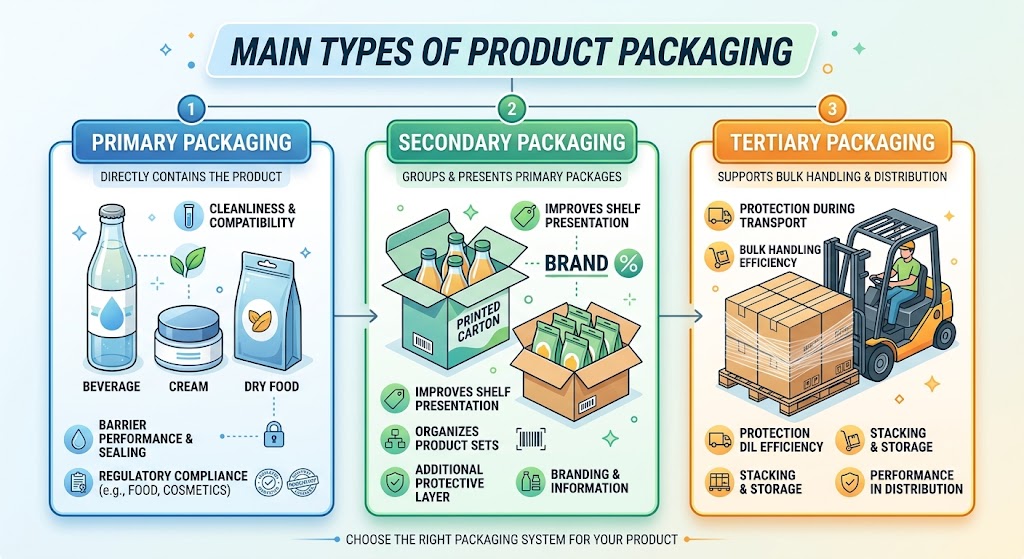
Primary Packaging
Primary packaging directly contains or contacts the product. Examples include a bottle for a beverage, a jar for a cosmetic product, a pouch for a dry food, or a container for a personal care item.
This packaging may need to meet product-specific requirements for cleanliness, compatibility, barrier performance, sealing, or labeling. When packaging directly contacts food, cosmetics, or other regulated products, businesses should verify the applicable material and regulatory requirements.
Secondary Packaging
Secondary packaging surrounds, groups, or presents one or more primary packages. A printed carton around a bottle or a box containing several individually packaged products are common examples.
Secondary packaging can improve shelf presentation, help organize product sets, and provide an additional protective layer. It is also a useful place for branding and product information.
Tertiary Packaging
Tertiary packaging supports storage, bulk handling, and distribution. Shipping cartons, larger transport boxes, pallets, and stretch wrap are examples used in distribution systems.
Its main priorities are typically protection, handling efficiency, stacking, and transport. Branding may still be included, but the package’s performance during distribution is especially important.
Product Packaging vs. Shipping Packaging
Product packaging and shipping packaging are related, but they do not always perform the same job.
| Consideration | Product packaging | Shipping packaging |
|---|---|---|
| Primary purpose | Contain, identify, and present the product | Protect products during distribution |
| Common formats | Folding cartons, product boxes, containers | Corrugated boxes, mailers, protective outer packaging |
| Design priorities | Brand identity, product information, presentation | Strength, fit, handling, shipping efficiency |
| Printing | Often used for product branding | May be branded or primarily functional |
| Protection | Depends on the product and selling environment | Must account for the shipping journey |
Many businesses use both. A printed retail carton can sit inside a corrugated shipping box with a suitable insert or cushioning system.
Popular Product Packaging Boxes and Formats
The right format depends on the product’s size, weight, fragility, selling environment, and desired presentation. These are common options for businesses that use custom packaging boxes.
1. Folding Cartons
Folding cartons are typically made from paperboard and shipped flat before assembly. They are widely used for products that need a printed retail package without the structure of a heavy shipping box.
Common applications include cosmetics, personal care items, small accessories, packaged goods, and specialty retail products.
Best for: Lightweight products, shelf presentation, detailed graphics, and efficient storage before assembly.
2. Corrugated Boxes
Corrugated boxes use a fluted paper layer between flat linerboards. This construction can provide stiffness and cushioning while remaining relatively lightweight.
They are commonly used for e-commerce shipments, wholesale orders, protective outer packaging, and products that need stronger structural support.
Best for: Shipping, fulfillment, heavier products, and packages that require additional structural protection.
Explore corrugated packaging and custom corrugated boxes.
3. Mailer Boxes
Mailer boxes are commonly used for e-commerce orders, subscription products, promotional kits, and direct-to-consumer deliveries. Corrugated mailers can combine product protection with a branded unboxing experience.
Their structure should be selected according to the product’s weight and shipping conditions. Fragile contents may still require inserts or cushioning.
Best for: Online stores, subscription kits, promotional packages, and branded product deliveries.
See custom mailer boxes.
4. Rigid Boxes
Rigid boxes use a firm board structure that holds its shape. They are often selected for premium gifts, jewelry, electronics accessories, luxury cosmetics, and products that benefit from a substantial presentation.
They can incorporate decorative wraps, inserts, specialty finishes, and carefully designed closures. However, they often require more storage space and may cost more than folding cartons.
Best for: Premium products, gifting, and high-end presentation.
Explore custom rigid boxes and rigid gift boxes.
5. Kraft Boxes
Kraft packaging is associated with a natural paper appearance and can be used for a variety of product boxes, mailers, bags, and wraps. Kraft can support minimalist branding or a more rustic visual style.
Printing results depend on the stock color, surface, inks, and design. A brown kraft surface will not reproduce colors in exactly the same way as a white background.
Best for: Natural-looking packaging, selected retail products, handmade goods, and businesses seeking a simple visual style.
Browse kraft boxes.
6. Die-Cut and Specialty Boxes
Die-cut packaging is shaped using a cutting die to create a specific outline, closure, window, tab, or structural feature. Specialty designs can help a product fit securely or create a distinctive presentation.
The design should still be practical to manufacture, assemble, fill, and transport. Complex structures may add production costs, so businesses should compare their functional value against the additional expense.
Best for: Unusual product shapes, custom closures, product visibility, and distinctive retail presentation.
How to Choose the Right Product Packaging Materials
Packaging materials affect structural performance, print quality, appearance, weight, and end-of-life options. The material should be selected according to what the package needs to do.
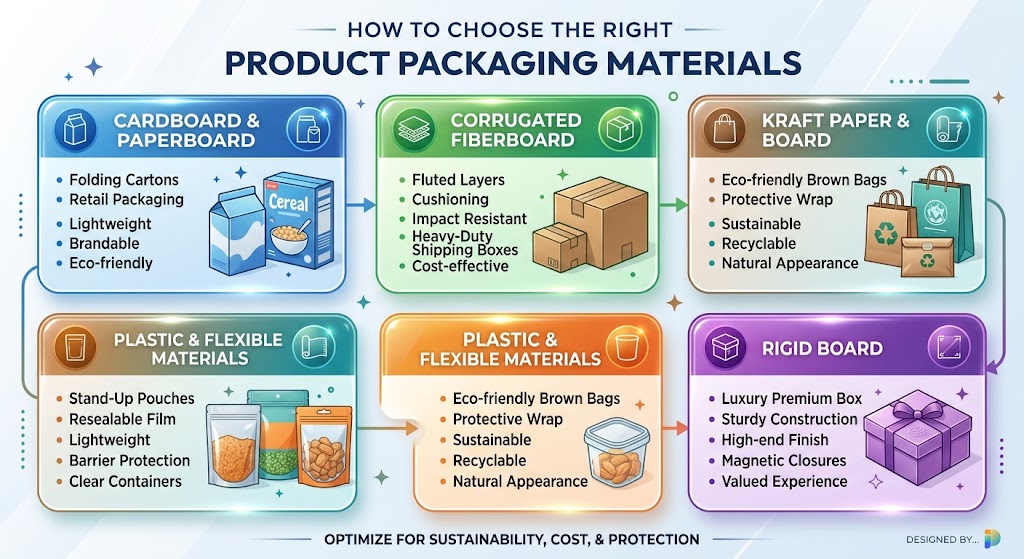
Cardboard and Paperboard
Paperboard is commonly used for folding cartons and retail boxes because it can be cut, creased, folded, and printed. The exact performance depends on the grade, thickness, coating, and structural design.
The word “cardboard” is also used broadly in everyday language, so businesses should confirm the actual material specification when strength or product protection is important.
Corrugated Fiberboard
Corrugated board contains a fluted layer between flat liners. Its construction can provide more stiffness and cushioning than a comparable solid sheet of paperboard.
The appropriate construction depends on product weight, box dimensions, stacking requirements, and shipping conditions.
Kraft Paper and Board
Kraft materials can provide a natural appearance and are available in different grades and constructions. They may be used for boxes, bags, wraps, and corrugated liners.
The surface color affects printing, and coatings or other additions may affect recyclability. Confirm the complete package specification rather than making assumptions from its appearance.
Plastic and Flexible Materials
Plastic packaging includes rigid containers, bags, films, and flexible pouches. Different polymers offer different properties, including flexibility, moisture resistance, clarity, and barrier performance.
These materials may be appropriate when the product requires specific sealing or protection. Recycling availability varies by material, package construction, and local infrastructure.
Rigid Board
Rigid board is used for setup boxes that retain their shape. It can support a premium presentation through decorative paper wraps, specialty finishes, and fitted inserts.
It may be a good fit when presentation is a priority, but storage volume and total delivered cost should also be considered.
For more detail, see our guide to packaging materials.
Custom Product Packaging: What Can You Customize?
Custom product packaging lets a business adapt the box’s dimensions, structure, materials, artwork, and finishing to its product and brand.
Customization should begin with the product’s functional requirements. The design can then be developed to support appearance and branding without compromising fit, protection, or manufacturability.
Custom Sizes and Dimensions
The box should accommodate the product and any required inserts, cushioning, closures, or protective layers. A package that is too tight can make filling difficult, while excessive empty space can increase material use and allow movement.
Measure the product carefully and specify whether dimensions refer to the inside or outside of the box. This is particularly important for products with irregular shapes or delicate components.
Custom Box Structures
Different box structures suit different purposes. Folding cartons can be appropriate for lightweight retail items, corrugated mailers for many e-commerce orders, and rigid boxes for premium presentation.
Specialty structures may include tuck closures, sleeves, trays, windows, or other features. Choose the structure based on how the package will be filled, opened, displayed, stored, and shipped.
Custom Inserts and Dividers
Inserts and dividers help keep products organized and can reduce movement inside a box. They may be useful for fragile products, multi-item gift sets, bottles, accessories, or products with several components.
The insert should match the product’s dimensions and protection requirements. Its material should also be compatible with the main package and the intended use.
Learn more about packaging inserts and packaging dividers.
Custom Printing and Packaging Artwork
Custom printed packaging can include a logo, brand colors, product name, graphics, instructions, and other required information. The artwork should be readable at the final printed size and designed around the panels, folds, seams, and closures of the box.
Before approving production, check the artwork against the correct dieline and confirm that critical text, barcodes, and logos will not fall into folds or cut areas.
Explore custom printed packaging and packaging artwork.
Packaging Finishes
Finishes can change how a package looks and feels. Depending on the material and production method, options may include matte or gloss coatings, lamination, foil stamping, embossing, debossing, and spot UV.
Finishing should support the brand’s positioning and the package’s intended use. It can add cost and may affect recyclability, so it is worth evaluating whether each effect contributes meaningful value.
See our guide to packaging finishes.
Product Packaging Design: A Step-by-Step Process
A practical packaging design process helps businesses coordinate branding, material selection, product fit, printing, and production requirements before ordering in bulk.
Step 1: Define the Product and Target Customer
Start with the product itself. Record its dimensions, weight, shape, fragility, and any special handling or storage requirements.
Then consider who will buy it and where it will be sold. A product sold in a retail store may need clear shelf-facing information, while a direct-to-consumer product may need an outer shipping package and a thoughtful unboxing experience.
Step 2: Select the Packaging Format
Choose a format that matches the product and its selling environment. Compare folding cartons, corrugated boxes, mailers, rigid boxes, and specialty structures.
The format should be practical to fill, store, transport, and open. Avoid adding complex features unless they improve protection, usability, or presentation.
Step 3: Choose Materials and Protection Features
Select materials based on the required structural performance and appearance. Determine whether the product needs an insert, divider, protective wrap, window, or other component.
For fragile or valuable products, evaluate the complete packed package rather than testing the box alone.
Step 4: Create the Artwork and Brand System
Apply the logo, colors, typography, and product information in a consistent way. Make sure required information is legible and placed appropriately on the package.
If several products share one brand, consider developing a packaging system with common visual elements and product-specific variations.
Step 5: Review the Dieline and Printing Requirements
A dieline shows the cutting, folding, and assembly layout of a package. Use the correct dieline to prepare artwork and review panel placement, bleed, safe areas, folds, and glue zones.
Confirm the print method, color requirements, and finishing options with the packaging provider before finalizing production files.
Step 6: Evaluate a Sample or Prototype
When available, a sample or prototype can help verify dimensions, assembly, appearance, and fit. Test how easily the package opens and whether the product remains secure.
For shipping applications, consider realistic handling and transit risks. A visually successful sample is not automatically proof that a package will withstand every distribution environment.
Step 7: Confirm Quantity, Cost, and Delivery Requirements
Before placing an order, confirm the quantity, unit specifications, artwork approval, finishing requirements, production schedule, shipping destination, and quotation terms.
Clear specifications reduce misunderstandings and help businesses compare suppliers on a consistent basis.
Product Packaging for Retail and E-Commerce
Retail packaging and e-commerce packaging often share branding goals, but they may have different functional requirements.
Retail Product Packaging
Retail packaging needs to communicate the product clearly and fit its selling environment. Important considerations include shelf visibility, product information, display orientation, dimensions, and compatibility with retail handling.
A printed paperboard carton may work well for a lightweight consumer product, while a window or display feature may be useful when visibility is important.
Explore custom retail boxes for retail-focused packaging applications.
E-Commerce Product Packaging
E-commerce packages need to protect products through packing, sorting, transport, and delivery. The outer box should be appropriate for the product’s weight, dimensions, fragility, and shipping route.
A brand can use a printed product carton inside a corrugated shipper or choose a branded mailer that serves as both the delivery package and the presentation layer.
Right-sizing the box and selecting suitable inserts can help reduce unnecessary movement and excess packaging material.
Wholesale Product Packaging
Wholesale packaging often involves larger quantities, multiple units per shipment, or repeated orders. Businesses should consider unit consistency, stacking, storage, packing speed, and transport efficiency.
The best structure depends on the products and distribution requirements. A retail-ready carton may need an additional shipping layer when moving through a wholesale supply chain.
When comparing bulk options, review the complete quotation, specifications, and delivery terms rather than comparing unit prices without context.
Product Packaging for Small Businesses
Small businesses do not always need an elaborate packaging system. They need a package that protects the product, communicates the brand, fits the budget, and can be managed consistently as orders grow.
Start with the Essentials
Prioritize the elements that make the biggest difference:
- A suitable box or packaging format.
- Correct dimensions and fit.
- A clear logo and readable product information.
- Appropriate protection for storage and delivery.
- Consistent colors and typography.
- Practical packing and storage requirements.
Add decorative finishes or specialty features when they serve a clear purpose.
Use Consistent Branding Across Products
A small business can create a recognizable packaging family by using the same logo, typography, colors, and graphic style across different sizes.
The boxes can have different dimensions and structures while still looking like part of the same brand.
Compare Standard and Custom Options
Standard packaging with a branded label or insert may be useful for a limited launch or a product with simple requirements. Custom packaging can be a better fit when dimensions, presentation, protection, or brand differentiation require a more tailored structure.
Compare the total costs of both approaches, including printing, assembly, shipping, storage, and any additional packaging components.
Plan for Growth
If you expect to introduce new product sizes or variations, define which elements should remain consistent and which may change. This can make it easier to extend the packaging system without redesigning every component from scratch.
How Much Does Custom Product Packaging Cost?
There is no single price for custom product packaging. Cost depends on the packaging structure, material, dimensions, printing, finishes, quantity, inserts, production requirements, and shipping arrangements.
The most useful approach is to compare quotations using the same specifications.
| Cost factor | How it can affect the quotation |
|---|---|
| Material and board grade | Influences structural performance and material use |
| Box dimensions | Affects material consumption, storage, and shipping volume |
| Structure and die-cutting | Complex shapes or closures may require additional tooling or production steps |
| Printing | Artwork coverage, colors, print process, and quantity can affect cost |
| Finishes | Foil, embossing, lamination, and specialty effects can add expense |
| Order quantity | Unit economics depend on setup costs, production scale, and supplier terms |
| Inserts and components | Additional pieces increase material and assembly requirements |
| Shipping and delivery | Package dimensions, weight, destination, and shipping method affect the delivered cost |
To make a useful comparison, ask each supplier to confirm the material specification, dimensions, print and finish details, quantity, setup costs, production timing, and delivery terms.
A lower unit price is not necessarily the better option if the package does not protect the product or requires expensive additional components.
Sustainable Product Packaging: What Businesses Should Consider
Sustainable packaging decisions should consider the full package and its intended end-of-life route. Material choice matters, but so do packaging weight, product protection, recycled content, reuse potential, coatings, adhesives, and local recycling infrastructure.
Paper-based packaging may be appropriate for many products, while other products may need materials with specific barrier or durability properties. Avoid assuming that one material is always the best environmental choice in every application.
When evaluating options, ask:
- Can the package use less material without compromising protection?
- Is recycled content available for the required specification?
- Can customers separate different packaging components?
- Are suitable recycling or composting facilities available to the intended market?
- Do coatings, windows, adhesives, or laminates affect disposal options?
- Are environmental claims supported by reliable evidence?
The U.S. Federal Trade Commission provides guidance on environmental marketing claims, including claims about recyclability, compostability, and recycled content. Businesses should avoid broad, unqualified environmental claims and use clear, substantiated descriptions of the package’s actual attributes. See the FTC’s Green Guides summary.
For more guidance, explore sustainable packaging and recyclable packaging.
Common Product Packaging Mistakes to Avoid
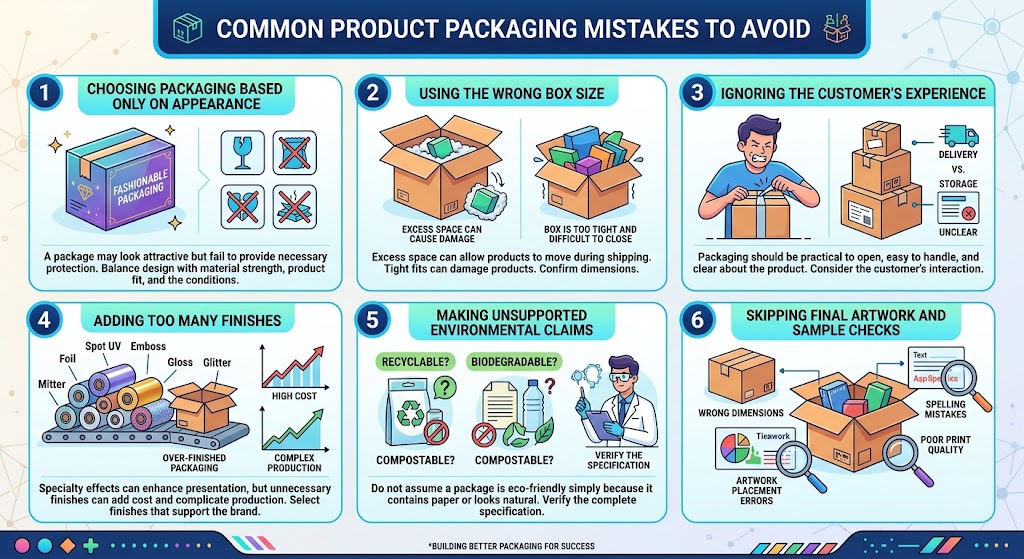
Choosing Packaging Based Only on Appearance
A package may look attractive but fail to provide the necessary protection. Balance design with material strength, product fit, and the conditions the package will encounter.
Using the Wrong Box Size
Excess space can allow products to move during shipping, while a box that is too tight can make packing difficult or damage the product. Confirm the dimensions and the space required for inserts or cushioning.
Ignoring the Customer’s Experience
Packaging should be practical to open, easy to handle, and clear about the product. Consider the customer’s interaction with the package from delivery through storage and use.
Adding Too Many Finishes
Specialty effects can enhance presentation, but unnecessary finishes can add cost and complicate production. Select finishes that support the brand and suit the material.
Making Unsupported Environmental Claims
Do not assume a package is recyclable, biodegradable, compostable, or eco-friendly simply because it contains paper or has a natural appearance. Verify the complete specification and qualify claims where necessary.
Skipping Final Artwork and Sample Checks
Errors in dimensions, artwork placement, color, or assembly can be costly when discovered after a large order. Review the dieline, artwork, specifications, and sample where available before authorizing production.
How to Choose a Product Packaging Supplier
A suitable product packaging supplier should understand the product’s requirements and be able to communicate clearly about specifications, materials, artwork, production, and delivery.
When evaluating a supplier, consider the following:
Packaging options: Can the supplier support the box style, material, dimensions, and customization you need?
Specification guidance: Can the team help you understand the practical trade-offs between structure, protection, presentation, and cost?
Artwork review: Is there a process for checking artwork against the correct dieline and print requirements?
Quotation clarity: Does the quote clearly describe the specifications, quantity, finishes, setup costs, and delivery terms?
Quality review: Can you review a sample or prototype when appropriate, and are production requirements documented?
Communication and timing: Are approval steps, expected timelines, and delivery arrangements clearly explained?
Scalability: Can the supplier support future orders or product variations if your business grows?
Avoid choosing solely on the lowest quoted price. Compare suppliers against the same requirements and consider whether the proposed package meets your actual needs.
Order Custom Product Packaging from Bluebird Packaging
The right packaging starts with a clear understanding of your product, brand, and business requirements. Whether you need lightweight retail cartons, corrugated shipping boxes, branded mailers, or premium rigid packaging, the structure and materials should match how the product will be presented, stored, and delivered.
Bluebird Packaging offers custom packaging options for a range of industries and product applications, including food, bakery, cosmetics, retail, soap, and premium products. Businesses can explore box styles, dimensions, materials, printing, artwork, and finishing options according to their project requirements.
Before requesting a quote, prepare the product dimensions, approximate quantity, preferred box style, artwork, and any special protection or presentation needs.
Ready to discuss your project? Request a custom packaging quote and provide your specifications so the packaging requirements can be reviewed.
Frequently Asked Questions About Product Packaging
What is product packaging used for?
Product packaging is used to contain, protect, identify, and present products. It can also communicate branding and product information, support storage and shipping, and improve the customer’s experience.
What are the main types of product packaging?
The three common packaging levels are primary, secondary, and tertiary packaging. Common physical formats include folding cartons, corrugated boxes, mailer boxes, rigid boxes, pouches, bottles, and specialty packaging structures.
What is the best product packaging for a small business?
The best option depends on the product, budget, order volume, and sales channel. A small business may use a printed folding carton for a lightweight retail item, a corrugated mailer for an online order, or a rigid box for a premium gift.
What is the difference between product packaging and shipping packaging?
Product packaging primarily contains, identifies, and presents the product. Shipping packaging is designed to protect the product during distribution. Some packages perform both functions, while other businesses use a product box inside a separate shipping carton.
Can I order custom product packaging with my logo?
Many packaging formats can be customized with logos, brand colors, graphics, and product information. The available printing and finishing options depend on the material, structure, production process, and supplier.
What materials are used for custom product packaging boxes?
Common materials include paperboard, corrugated fiberboard, kraft paper and board, and rigid board. Plastic, glass, metal, and flexible materials are also used for products with specific protection or barrier requirements.
Is custom product packaging expensive?
The cost depends on material, size, box structure, printing, finishes, quantity, inserts, and shipping. Comparing quotations based on the same specifications helps businesses assess the cost more accurately.
What is the best packaging for e-commerce products?
The best option depends on product weight, fragility, dimensions, and shipping conditions. Corrugated mailer or shipping boxes are common choices, and fragile products may need inserts or additional cushioning.
How can I make product packaging more sustainable?
Consider reducing unnecessary material, selecting suitable recycled content, designing for reuse where practical, and checking local recycling options. Verify the package’s complete construction before making environmental claims.
What should I provide when requesting a product packaging quote?
Share the product dimensions, weight, intended use, packaging style, quantity, artwork, preferred material, printing and finishing requirements, delivery destination, and target timeline. The more complete the specifications, the easier it is to compare options.
Can product packaging be customized for wholesale orders?
Yes, packaging can be specified for larger quantities and recurring orders. Businesses should confirm dimensions, materials, printing, finishes, quantity, production requirements, and delivery terms before placing a wholesale order.
How do I know whether my packaging will protect my product during shipping?
Evaluate the package based on product weight, fragility, dimensions, handling risks, and shipping conditions. Where appropriate, review a sample and test the complete packed product rather than relying on appearance alone.
Final Thoughts
Product packaging is a combination of structure, materials, protection, design, and branding. The right choice helps a business present its product clearly while meeting practical requirements for storage, handling, shipping, and customer use.
Start by identifying the product’s needs, then choose the appropriate format, material, dimensions, printing, and protective features. Compare the full cost and review the final specifications before production.
For businesses developing a new package or improving an existing one, custom product packaging can help create a more consistent brand experience while fitting the needs of the product and the way it reaches customers.




2 Comments
[…] For a packaging overview, see our guide to product packaging and its role. […]
[…] your product, container, and intended customer. If you are exploring the wider world of product packaging, remember that the label and the package should work together rather than compete for […]