Knowing how to measure a shipping box correctly can help you select suitable packaging, protect your products, and avoid unexpected shipping charges. Whether you are shipping a small retail order, sending products to customers, or preparing bulk shipments, accurate box measurements are essential for choosing the right package.
However, measuring a box is not always as simple as using a measuring tape on three sides. You need to understand the difference between internal and external dimensions, identify the correct length, width, and height, and know which measurements a shipping carrier uses to calculate delivery costs.
For example, a box may have enough internal space for your product but larger external dimensions because of its corrugated walls. Similarly, an oversized package containing a lightweight product may cost more to ship because of dimensional weight pricing.
This guide explains how to measure a shipping box step by step, how to calculate box volume and dimensional weight, and how to choose the right dimensions for domestic and international shipping.
Quick Answer: How Do You Measure a Shipping Box?
To measure a shipping box, use a measuring tape or ruler to determine its length, width, and height.
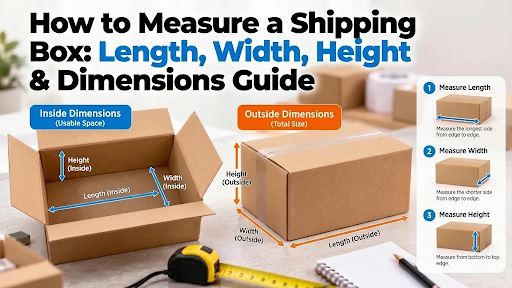
For shipping purposes, measure the outside of the fully packed and sealed package:
- Length: The longest side of the package.
- Width: The second-longest side.
- Height: The remaining side.
Record the measurements in this order: Length × Width × Height (L × W × H).
For example, if a packed box measures 16 inches long, 12 inches wide, and 10 inches high, its shipping dimensions are 16 × 12 × 10 inches.
Remember that internal dimensions are used to check whether your product fits inside a box, while external dimensions are generally needed for carrier shipping calculations.
What Tools Do You Need to Measure a Shipping Box?
You do not need specialized equipment to measure a standard cardboard shipping box. A few basic tools are enough to obtain accurate measurements.
| Measuring Tool | Purpose |
|---|---|
| Measuring tape | Measures length, width, and height |
| Rigid ruler | Measures smaller boxes and precise edges |
| Digital caliper | Checks smaller dimensions and material thickness |
| Weighing scale | Measures the packed parcel’s actual weight |
| Pen and measurement sheet | Records dimensions for shipping labels |
| Calculator | Calculates box volume and dimensional weight |
A flexible measuring tape is useful for larger packages, while a rigid ruler can make it easier to measure small cartons. For shipping estimates, always use the unit required by your carrier, such as inches or centimeters.
What Are Length, Width and Height in Box Measurements?
Length, width, and height describe the three main dimensions of a rectangular box. Understanding their correct order is essential because shipping labels and carrier pricing systems use these measurements to identify package size.
1. Length (L)
Length is generally the longest side of the shipping package. Place the box on a flat surface and identify the longest horizontal edge.
For example, if the three sides measure 16, 12, and 10 inches, the length is 16 inches.
2. Width (W)
Width is the second-longest side. Rotate the box and measure the next longest horizontal edge.
In the example above, the width is 12 inches.
3. Height (H)
Height is the remaining dimension, measured from the bottom of the box to its top.
In the example, the height is 10 inches.
Example: Understanding L × W × H
| Dimension | Measurement | Meaning |
|---|---|---|
| Length | 16 inches | Longest side |
| Width | 12 inches | Second-longest side |
| Height | 10 inches | Remaining side |
| Final dimensions | 16 × 12 × 10 inches | Shipping measurement order |
Important: Box manufacturers sometimes describe a carton using its opening dimensions followed by its depth. Shipping carriers generally identify the longest side as the length. When ordering custom boxes, confirm the manufacturer’s dimension convention so the specifications are not confused with shipping-label measurements.
For more help understanding package measurements, see our guide to box dimensions and common measurement terms.
How to Measure a Shipping Box Step by Step
The following method helps you measure a standard cardboard shipping box accurately before creating a shipping label.
Step 1: Prepare the Package
If you are measuring a box for an actual shipment, pack it first. Place the product inside, add the required protective material, close the flaps, and seal the box.
This matters because packing materials or product pressure can slightly change the final package shape. Shipping carriers measure the parcel they receive, not necessarily the empty carton.
If you are choosing a box before packing, measure the empty box separately to understand its dimensions and available internal space.
Step 2: Measure the Length
Place the box on a flat surface. Identify the longest side and measure from one outer edge to the opposite outer edge.
Keep the tape straight and avoid measuring diagonally. If the package has bulging panels, measure across the widest external points.
Step 3: Measure the Width
Rotate the package and measure the second-longest side.
Keep the measuring tape level and measure from the outside edge of one panel to the outside edge of the opposite panel.
Step 4: Measure the Height
Measure the remaining side vertically, from the bottom of the package to the top of the closed and sealed box.
If the box has bulging flaps or an uneven top, use the maximum external height.
Step 5: Record the Measurements
Write the three measurements in the correct order:
Length × Width × Height
For example:
- Length: 16 inches
- Width: 12 inches
- Height: 10 inches
- Shipping dimensions: 16 × 12 × 10 inches
Step 6: Check the Carrier’s Rounding Rules
Some carriers require measurements to be rounded up to the next whole inch or centimeter for particular services. Others may use different rules depending on the service and destination.
Do not assume every carrier follows the same measurement or rounding policy. Check the applicable shipping service guide before submitting the package dimensions.
For a carrier-specific example, see the UPS shipping dimensions and weight guide.
Internal vs. External Box Dimensions: Which Should You Measure?
One of the most common packaging mistakes is confusing internal and external box dimensions.
Both measurements are important, but they serve different purposes.
What Are Internal Box Dimensions?
Internal dimensions describe the usable space inside the box. They help you determine whether a product, protective insert, or other packing material will fit.
For example, if a product measures 12 × 8 × 6 inches, the internal box dimensions must provide sufficient room for the product and any cushioning required.
Internal measurements are particularly important when ordering custom packaging because a box that is too tight can make packing difficult or damage the product.
What Are External Box Dimensions?
External dimensions describe the complete outside size of the box, including its walls and closed flaps.
Shipping carriers generally use these measurements to calculate package size, dimensional weight, and applicable size-related charges.
The external dimensions are usually larger than the internal dimensions because cardboard or corrugated board takes up space.
Internal vs. External Dimensions Comparison
| Feature | Internal Dimensions | External Dimensions |
|---|---|---|
| Measurement location | Inside the box | Outside the box |
| Main purpose | Product fit | Shipping and package size |
| Includes board thickness | No | Yes |
| Includes outside bulges | No | Yes |
| Useful for custom packaging | Yes | Yes |
| Used for carrier measurements | Generally no | Generally yes |
Why Does Corrugated Board Thickness Matter?
Corrugated cardboard contains layers of paper that provide structure and protection. Depending on the flute profile, board grade, and wall construction, the material thickness changes the available internal space and final external dimensions.
For example, a single-wall box and a double-wall box designed around the same internal dimensions may have different external dimensions.
This is why businesses should confirm whether a box supplier is quoting internal or external measurements before ordering.
Learn more about cardboard versus corrugated boxes and how their constructions differ.
How to Calculate Shipping Box Dimensions and Volume
Once you know the length, width, and height, you can calculate the box’s approximate volume.
The formula is:
Box Volume = Length × Width × Height
For example, consider a box measuring:
- Length = 16 inches
- Width = 12 inches
- Height = 10 inches
Calculation:
16 × 12 × 10 = 1,920 cubic inches
Result: The box volume is 1,920 cubic inches.
Box Volume Calculation in Centimeters
If your measurements are in centimeters, use the same formula:
Box Volume = Length (cm) × Width (cm) × Height (cm)
For example:
40 × 30 × 25 = 30,000 cubic centimeters (cm³)
Volume helps you compare package sizes, plan storage space, and calculate dimensional weight when required.
Why Is Box Volume Important?
Box volume is useful for:
- Estimating the amount of space a shipment occupies.
- Comparing different box sizes.
- Planning warehouse storage.
- Selecting appropriate outer cartons.
- Calculating dimensional or volumetric weight.
- Reducing unnecessary packaging space.
However, volume alone does not tell you whether a product will fit. The product’s actual shape, orientation, and required cushioning must also be considered.
What Is Dimensional Weight in Shipping?
Dimensional weight, also called DIM weight or volumetric weight, is a pricing method that considers the amount of space a package occupies rather than relying only on its actual weight.
This matters because a large, lightweight package can take up more space in a delivery vehicle or aircraft than a small, heavy package.
For example, a box filled with lightweight cushions may weigh less than a compact box filled with metal components. However, the larger box may receive a higher dimensional weight.
Many major shipping carriers use dimensional weight for eligible services. The exact rules, divisors, rounding methods, and eligibility conditions vary by carrier and shipping route.
How to Calculate Dimensional Weight for a Box
A commonly used U.S. carrier calculation is:
Dimensional Weight (lb) = Length × Width × Height ÷ DIM Divisor
Suppose your box measures:
- Length = 16 inches
- Width = 12 inches
- Height = 10 inches
- DIM divisor = 139
Calculation:
16 × 12 × 10 = 1,920 cubic inches
1,920 ÷ 139 = 13.81 lb
Rounded up, the dimensional weight is approximately 14 lb under a rule that rounds the result up to the next whole pound.
The applicable divisor and rounding method must be confirmed with your carrier. For example, UPS lists different divisors for certain U.S. rate types, while FedEx publishes its own service-specific dimensional-weight guidance.
Dimensional Weight Example in Centimeters
For some international shipping services, a common volumetric-weight calculation uses cubic centimeters divided by 5,000:
Volumetric Weight (kg) = Length × Width × Height ÷ 5,000
Using the earlier metric example:
40 × 30 × 25 = 30,000 cm³
30,000 ÷ 5,000 = 6 kg
This is an illustrative calculation, not a universal international shipping rule. The carrier’s actual divisor and rounding policy should always be checked.
Actual Weight vs. Dimensional Weight
| Type | What It Measures |
|---|---|
| Actual weight | The physical weight of the packed parcel |
| Dimensional weight | The space occupied by the parcel, converted into a weight equivalent |
| Billable weight | The weight used by the carrier to calculate charges under its applicable pricing rules |
Where the carrier applies dimensional-weight pricing, the billable weight is commonly based on whichever is greater: actual weight or dimensional weight. Service-specific exceptions and minimum charges may apply.
For further details, read FedEx’s explanation of dimensional weight and the UPS guide to shipping dimensions and weight.
Does Shipping Box Size Affect Delivery Costs?
Yes. Shipping box size can affect delivery costs because carriers may charge for the space a parcel occupies, not just its actual weight.
An oversized package can result in a higher dimensional weight, additional handling fees, or other size-related charges, depending on the carrier and service.
For example, a lightweight product shipped in a 20 × 16 × 14-inch box may have a higher dimensional weight than the same product packed in a properly fitted 12 × 10 × 8-inch box.
How to Reduce Shipping Costs Through Better Box Sizing
Consider the following practices:
- Choose the right box size: Avoid unnecessarily large cartons.
- Measure the packed parcel: Record its final external dimensions.
- Use suitable protective materials: Protect the product without adding excessive bulk.
- Select appropriate corrugated construction: Use a box strength suitable for the product’s weight and shipping conditions.
- Review dimensional weight: Estimate the billable weight before selecting a shipping service.
- Test the package: Check whether the product remains secure during handling and transportation.
Right-sizing packaging can reduce wasted material and unnecessary shipping volume. However, do not reduce the box size so much that the product loses adequate protection.
For more information about the relationship between packaging choices and expenses, read our guide to packaging costs and pricing factors.
Standard Shipping Box Sizes: How to Choose the Right Dimensions
Standard shipping box sizes vary by supplier, product category, and intended use. A suitable size should provide enough room for the product and any protective materials without creating excessive empty space.
Here are examples of common planning dimensions:
| Example Box Size | Potential Applications |
|---|---|
| 6 × 4 × 4 inches | Small accessories and compact products |
| 8 × 6 × 4 inches | Small retail orders |
| 10 × 8 × 6 inches | General ecommerce products |
| 12 × 10 × 8 inches | Medium-sized retail goods |
| 14 × 12 × 10 inches | Larger products and bundled orders |
| 16 × 12 × 12 inches | Multiple products or larger items |
| 18 × 14 × 12 inches | Bulkier products and larger shipments |
These are illustrative size options, not universal carrier-approved standards. Always check your carrier’s current size and weight restrictions.
What Size Shipping Box Should You Choose?
Start with the product’s maximum dimensions. Then account for the protective material, inserts, dividers, and any space required for safe packing.
For example, fragile products may need additional cushioning on several sides, while durable products may require less internal protection.
If you regularly ship different products, consider creating a small range of standard box sizes instead of using one oversized carton for every order.
Explore our guide to standard box sizes and learn how to select dimensions for different packaging applications.
How to Measure a Corrugated Shipping Box
Corrugated boxes are commonly used for ecommerce shipments, wholesale orders, retail distribution, and product transportation. Their construction makes them suitable for many shipping applications, but accurate measurements are still important.
When measuring a corrugated shipping box:
- Confirm whether the listed size is internal or external.
- Measure the box with its flaps in the intended closed position.
- Check the widest external points.
- Account for board thickness when planning product fit.
- Confirm the box’s construction and strength for the product’s weight.
- Test the packed box before using it for repeated shipments.
A box’s dimensions and board strength are separate specifications. A larger box is not automatically stronger, and a thicker board does not automatically mean the package is suitable for every shipping condition.
For businesses that need durable outer packaging, explore Corrugated Boxes and our guide to corrugated packaging applications.
How to Measure a Box for International Shipping
International shipping requires careful attention to package dimensions because carriers may use dimensional weight, maximum size limits, and country-specific handling rules.
A measurement that is accepted for one domestic service may not be suitable for an international service.
Before booking an international shipment:
- Measure the packed box’s external length, width, and height.
- Record the measurements in the unit required by the carrier.
- Check the applicable dimensional or volumetric weight divisor.
- Review maximum length and combined size restrictions.
- Confirm the permitted actual weight.
- Check whether the destination country has additional shipping or customs requirements.
- Use the carrier’s current service guide or shipping calculator.
Why Do International Carriers Use Volumetric Weight?
International air shipments have limited cargo space. Volumetric weight helps carriers account for large packages that occupy significant space despite being lightweight.
For some services, the calculation uses cubic centimeters divided by a volumetric factor such as 5,000. Other carriers, routes, or services may use different factors.
Never use a single divisor for every international shipment. Check the actual carrier and service before estimating the final shipping charge.
For ecommerce businesses, our guide to packaging for shipping provides additional guidance on selecting packaging for products that travel through delivery networks.
Common Shipping Box Measurement Mistakes to Avoid
Even a small measurement error can affect shipping estimates, package fit, and carrier charges.
Avoid these common mistakes:
1. Measuring Internal Dimensions Instead of External Dimensions
Internal dimensions are useful for checking product fit, but carriers generally need the external size of the package.
2. Recording Dimensions in the Wrong Order
Write the measurements as length × width × height. Confirm which side is the longest before recording the dimensions.
3. Measuring an Empty Box for a Packed Shipment
A packed parcel may bulge or change shape because of its contents and protective materials. Measure the final package whenever possible.
4. Ignoring Corrugated Board Thickness
A box’s external dimensions are larger than its internal dimensions. Always confirm which measurements the supplier has provided.
5. Measuring Diagonally
Measure each side along its actual edge. Diagonal measurements do not represent standard box length, width, or height.
6. Forgetting to Check Rounding Rules
Different carriers and services may require different rounding practices. Follow the current instructions for your selected shipping service.
7. Using an Oversized Box
Excessive empty space can increase package volume and dimensional weight. Choose a box that fits the product and its required protection.
8. Ignoring Carrier Size Limits
A package may exceed a carrier’s maximum dimensions or trigger additional charges even when its actual weight is low.
9. Confusing Box Volume with Dimensional Weight
Volume is measured in cubic inches or cubic centimeters. Dimensional weight converts that volume into a weight equivalent using a carrier-specific divisor.
10. Failing to Weigh the Final Package
Dimensions alone cannot determine the final billable weight. Weigh the sealed package and compare its actual weight with dimensional weight when applicable.
How to Select Custom Shipping Box Dimensions for Your Business
Businesses that ship products regularly may benefit from custom shipping box dimensions instead of relying entirely on standard cartons.
Custom packaging can be designed around the product’s size, protective requirements, packing process, and shipping needs.
Consider these factors before selecting custom dimensions:
Product dimensions: Measure the product at its widest, longest, and tallest points.
Protective space: Account for bubble cushioning, paper padding, inserts, dividers, or other protective materials.
Box construction: Select suitable corrugated board based on the product’s weight, fragility, and shipping conditions.
Packing efficiency: Consider how quickly employees can pack and seal the box.
Storage requirements: Check whether the box dimensions work with warehouse shelves, pallets, and storage areas.
Shipping costs: Estimate external package dimensions and dimensional weight for the intended carrier services.
Brand presentation: Decide whether the outer box should include custom printing, a logo, or other brand elements.
A well-designed shipping box should protect the product while making storage, packing, and transportation more efficient.
Explore custom box sizes and learn about the custom packaging production timeline when planning a new packaging project.
For additional packaging options, explore Corrugated Boxes, Cardboard Boxes, and Mailer Boxes.
Frequently Asked Questions About Shipping Box Measurements
1. How do you measure a shipping box?
Measure the external length, width, and height of the packed and sealed package. Length is the longest side, width is the second-longest side, and height is the remaining side. Record the dimensions in L × W × H order.
2. What comes first in box dimensions: length, width, or height?
The standard shipping measurement order is length × width × height. The length is generally the longest side, the width is the second-longest side, and height is the remaining dimension.
3. Do you measure a box from the inside or outside?
For checking product fit, use internal dimensions. For shipping calculations, use external dimensions because they represent the space occupied by the complete package. Always check the carrier’s instructions for the specific service.
4. How do you measure the length of a cardboard box?
Place the box on a flat surface and identify its longest side. Measure from one outside edge to the opposite outside edge using a measuring tape or ruler. For shipping, measure the final packed package.
5. How do you calculate the volume of a shipping box?
Multiply the length by the width and height. For example, a box measuring 16 × 12 × 10 inches has a volume of 1,920 cubic inches.
6. Does shipping box size affect delivery costs?
Yes. Some carriers calculate shipping charges using dimensional weight as well as actual weight. Larger packages can therefore cost more to ship even when they contain lightweight products. Additional size-related fees may also apply.
7. What tools do you need to measure a shipping box?
A measuring tape or ruler is generally sufficient for measuring a standard box. You may also need a weighing scale to measure the packed parcel’s actual weight and a calculator to estimate volume or dimensional weight.
8. How do you measure a box for international shipping?
Measure the external dimensions of the packed box and record length, width, and height in the carrier’s required unit. Then check the destination service’s volumetric-weight divisor, rounding rules, and maximum size and weight limits.
9. What is dimensional weight in shipping?
Dimensional weight is a calculation that converts the space occupied by a package into a weight equivalent. Carriers use it for eligible services when determining billable weight. The formula and divisor vary by carrier, service, and destination.
10. How much extra space should you leave inside a shipping box?
There is no single allowance for every product. The required space depends on the product’s fragility, shape, and protective materials. Leave enough room for appropriate cushioning and inserts while preventing the product from moving excessively inside the box.
11. How do you measure a box with a tape measure?
Place the box on a level surface and measure each side along its outside edge. Identify the longest side first, then measure the second-longest side and the remaining height. Keep the tape straight and record the results in L × W × H order.
Conclusion: Measure Your Shipping Box Correctly Before Dispatch
Learning how to measure a shipping box correctly helps you select suitable packaging, calculate shipping estimates, and reduce avoidable measurement errors. The key is to understand the difference between internal and external dimensions, identify the correct length, width, and height, and use the carrier’s applicable rules for dimensional weight and package limits.
For shipping labels, measure the external dimensions of the final packed parcel. For custom packaging, use internal measurements to ensure the product and protective materials fit comfortably. Check the box construction, carrier requirements, and shipping destination before approving the final size.
If your business needs packaging designed around specific products, compare suitable corrugated, cardboard, and mailer formats. Share your product dimensions, shipping requirements, and order quantity through our Request a Quote page to discuss a suitable custom packaging solution.
Need help choosing the right shipping box? Provide your product measurements and packaging requirements through our custom packaging quote form so the appropriate box dimensions and construction can be discussed before production.
References
- UPS: Shipping Dimensions and Weight
- FedEx: What Is Dimensional Weight?
- USPS: Postage Verification and Package Measurements
- Shopify: Understanding Shipment Packaging and Weights
- Box & Wrap: Measuring Guide for Shipping Boxes
Carrier measurement policies, dimensional-weight divisors, rounding requirements, size limits, and surcharges can change. Confirm the latest requirements with the carrier and service you intend to use before shipping.