

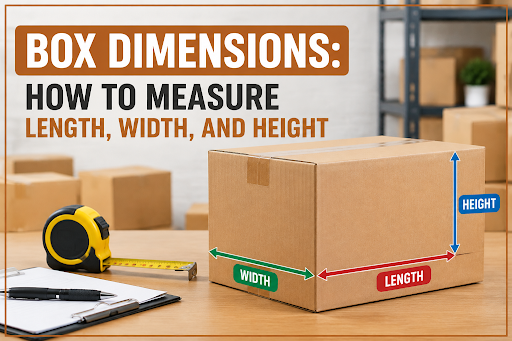
Box dimensions describe the length, width, and height of a box and help determine whether a product will fit, how much space the package occupies, and how it can be stored or shipped. To measure a rectangular box, use a ruler or tape measure and record its length, width, and height in a consistent unit, such as inches or centimeters. For packaging, it is also important to know whether the measurements refer to the inside or outside of the box.
Choosing the right box dimensions helps businesses protect products, reduce unnecessary empty space, organize inventory, and plan shipping more effectively. A box that is too small may damage the product or prevent the package from closing properly. A box that is too large may require extra protective material and occupy more space during transportation.
This guide explains how to measure box dimensions, understand length, width, and height, calculate box volume, compare internal and external measurements, and choose suitable packaging for different products.
Quick Answer: What Are Box Dimensions?
Box dimensions are the measurements of a box, usually expressed as length × width × height (L × W × H). Length and width describe the base of the box, while height describes the distance from the base to the top.
For example, a box measuring 12 × 8 × 6 inches is 12 inches long, 8 inches wide, and 6 inches high, following the stated measurement order.
Before using a box size, check these details:
- Measurement order: Confirm which number represents length, width, and height.
- Measurement type: Determine whether the dimensions are internal or external.
- Units: Make sure the measurements use inches, centimeters, or another consistent unit.
- Product fit: Allow suitable space for the product, inserts, and protective materials.
- Shipping requirements: Consider the carrier’s dimensional-weight rules and size limits where applicable.
If you need to measure a box for a product or shipment, start with the dimensions that matter for the task. Internal measurements help determine whether a product fits, while external measurements help establish the package’s overall size.
What Do Length, Width, and Height Mean?
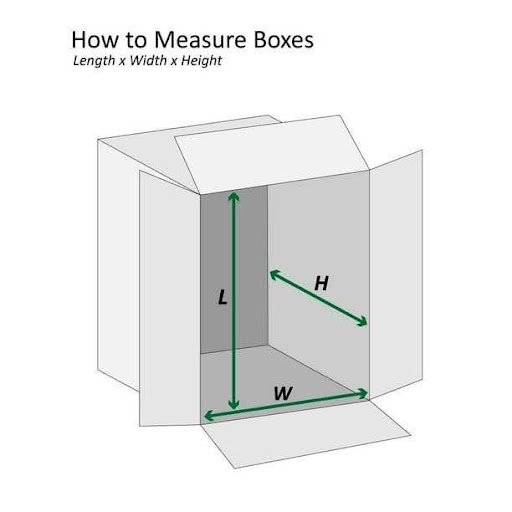
Length, width, and height are the three basic measurements used to describe a rectangular box. Although suppliers commonly list dimensions as length × width × height, the exact convention should always be confirmed, especially when ordering custom packaging.
Length
Length is commonly the measurement of the longest side of the box’s base. It usually runs from one end of the base to the opposite end.
For example, if a rectangular box has a base measuring 12 inches by 8 inches, the 12-inch side would typically be treated as the length.
Width
Width is the other measurement across the base. In the same example, the 8-inch side would typically be the width.
Length and width are both measured across the base, but the orientation may depend on the box design and the supplier’s measurement convention.
Height
Height measures the vertical distance from the bottom of the box to its top when the box is positioned in its intended orientation.
For a box with a base of 12 × 8 inches and a height of 6 inches, the full dimensions would be 12 × 8 × 6 inches.
Important: Not every box has an obvious orientation. For a sleeve, pillow box, display structure, or unusually shaped package, ask the packaging supplier to confirm the intended measurement order before production.
How to Measure Box Dimensions Step by Step
To measure box dimensions correctly, place the box on a flat surface, identify its intended orientation, and measure length, width, and height consistently. If the box is intended to hold a product, measure the usable internal space as well as the external size when necessary.
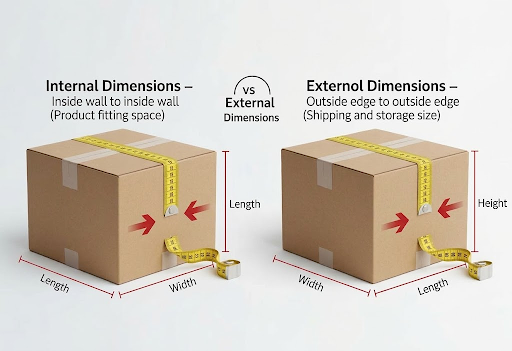
Follow these steps:
- Position the box correctly. Place it on a flat surface with its base resting evenly.
- Measure the length. Measure from one end of the base to the opposite end.
- Measure the width. Measure across the other side of the base.
- Measure the height. Measure from the bottom to the top.
- Record the units. Write each measurement in inches or centimeters.
- Identify the measurement type. Label the measurements as internal or external.
- Check the results. Repeat any measurement that seems inconsistent, and account for flaps or unusual structures if relevant.
For example, a box might have internal dimensions of 12 × 8 × 6 inches and external dimensions of 12.5 × 8.5 × 6.5 inches. These figures are illustrative; actual differences depend on the material thickness and construction.
For a more detailed measurement walkthrough, see how to measure a box.
Tips for More Accurate Measurements
- Use a rigid ruler or tape measure that is easy to read.
- Measure along the relevant edges rather than diagonally.
- Keep the measuring tool straight and aligned with the edge.
- Avoid compressing or bending flexible packaging while measuring.
- For boxes with lids, flaps, or closures, confirm which parts are included in the supplier’s dimensions.
- Measure several samples if box dimensions vary from one unit to another.
- When ordering custom packaging, confirm the final dimensions with the supplier before approving production.
Internal vs. External Box Dimensions
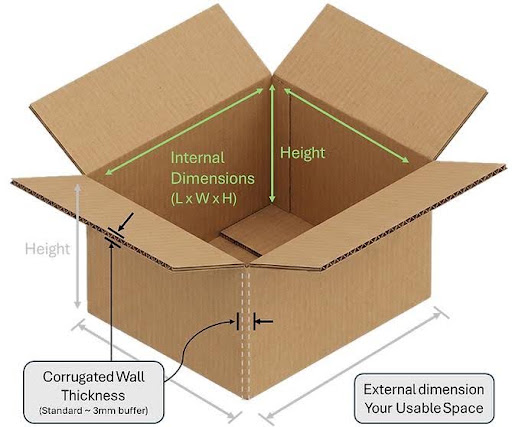
Internal box dimensions describe the usable space inside the box, while external dimensions describe the space occupied by the box itself. Both are important, but they answer different questions.
Internal Dimensions
Internal dimensions are measured inside the box. They help determine whether the product, insert, or other contents will fit.
Use internal measurements when:
- Checking whether a product fits into a carton.
- Designing protective inserts or dividers.
- Planning space for multiple items.
- Comparing the usable capacity of different box designs.
- Specifying a custom box around a product.
For example, a product measuring 10 × 6 × 4 inches may not fit into a box with the same internal dimensions if it requires cushioning, an insert, or room for a closure. The product and protective components need to fit within the actual usable space.
External Dimensions
External dimensions are measured across the outside of the assembled box. They are important for storage, shelf planning, pallet arrangements, and shipping calculations.
Use external measurements when:
- Estimating how much space a packed box will occupy.
- Checking whether cartons fit into a larger container.
- Planning warehouse storage.
- Comparing package size with a carrier’s size limits.
- Estimating dimensional weight where the carrier’s rules use external measurements.
Why Are the Measurements Different?
The material used to make a box has thickness. The construction may also include folds, flaps, seams, lids, or other components that affect its final outside size.
A corrugated shipping carton and a thin paperboard carton with the same nominal internal dimensions may therefore have different external dimensions.
When ordering packaging, state clearly whether the required dimensions are internal or external. This reduces the risk of receiving a box that does not fit the product or the intended shipping space.
How to Calculate Box Volume
The volume of a rectangular box is calculated by multiplying its length by its width and height. The result represents the three-dimensional space enclosed by those measurements.
The formula is:
\[ \text{Volume}=\text{Length}\times\text{Width}\times\text{Height} \]
For example, consider a box measuring 12 inches long, 8 inches wide, and 6 inches high.
12 × 8 × 6 = 576 cubic inches
The box has a calculated volume of 576 cubic inches using those dimensions.
Volume can help compare box sizes and estimate capacity, but it does not guarantee that a specific product will fit. The product’s shape, orientation, clearances, and internal structure all matter.
Volume in Cubic Centimeters
If all dimensions are measured in centimeters, the result is cubic centimeters.
For example, a box measuring 30 × 20 × 15 centimeters has a volume of:
30 × 20 × 15 = 9,000 cm³
Do not mix inches and centimeters in the same calculation. Convert all measurements to one unit first.
When Is Box Volume Useful?
Box volume is useful for:
- Comparing the capacity of different rectangular boxes.
- Estimating the space available for products.
- Planning storage and warehouse layouts.
- Comparing packaging sizes.
- Supporting shipping calculations when required by a carrier.
For a product that has an irregular shape, a box’s volume alone is not enough to determine fit. The internal length, width, and height must also accommodate the product’s actual dimensions and orientation.
How Much Extra Space Should a Box Have?
A box should provide enough room for the product, any protective materials, and the intended closure without allowing excessive movement. The amount of clearance depends on the product’s fragility, shape, weight, packaging method, and shipping conditions.
There is no universal clearance measurement for every product. A lightweight, durable item may need little additional space, while a fragile glass product may require a fitted insert or cushioning around multiple sides.
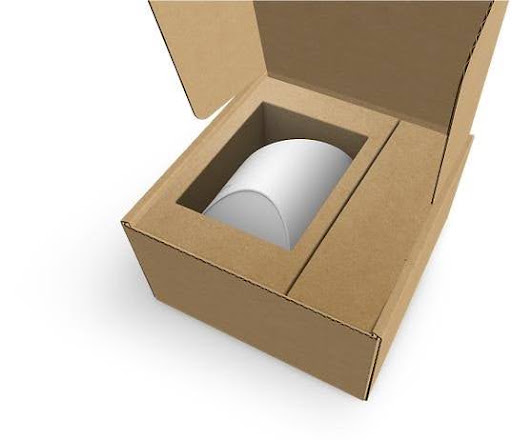
Consider these factors when choosing clearance:
- Product dimensions: Measure the widest, longest, and tallest points of the product.
- Protective materials: Account for foam, paper cushioning, dividers, or other components.
- Product movement: Avoid unnecessary movement that could cause rubbing, tangling, or impact.
- Closure space: Make sure the lid, flaps, or locking tabs can close correctly.
- Assembly requirements: Allow for the actual structure of the box and any folded components.
- Shipping conditions: Consider handling and the need for cushioning based on the product’s fragility.
A practical approach is to test the product inside a sample box. Check that it can be inserted and removed comfortably, the closure works, and the contents remain properly positioned when the package is moved.
Standard Box Dimensions and Common Box Sizes
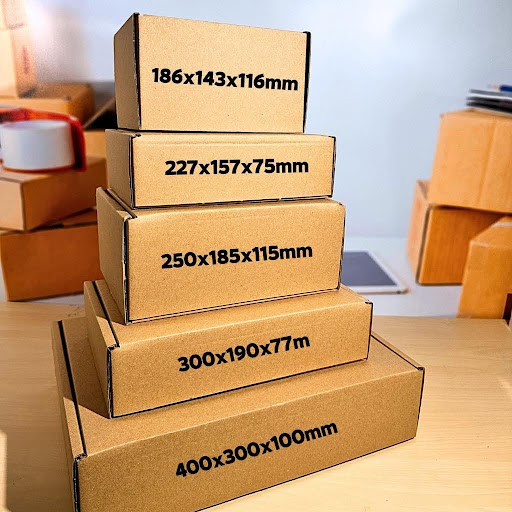
Standard box dimensions vary by supplier, industry, and intended use. There is no single set of standard dimensions that applies to every cardboard box, mailer, retail carton, or shipping container.
Common box sizes are often selected around typical products or shipping needs. Businesses may also use a range of stock sizes to accommodate different products without commissioning a new custom box for every item.
For example, a small box might be suitable for compact accessories, a medium box may accommodate several retail products, and a larger carton may be used to consolidate multiple items for shipping. These descriptions are general; actual dimensions should be measured and confirmed before use.
When comparing common sizes, consider:
- The internal space needed for the product.
- The outside dimensions that affect storage and transportation.
- The strength and material of the box.
- The type and amount of protective packaging.
- Whether the box will be shipped individually or as part of a larger shipment.
For more guidance, explore standard box sizes and the packaging size guide.
How Box Dimensions Affect Shipping Costs
Box dimensions can affect shipping costs because carriers may consider package size, actual weight, dimensional weight, destination, and service type when calculating charges. The exact calculation and limits vary by carrier and shipping service.
Dimensional weight is a way of accounting for the space a package occupies during transportation. A large, lightweight box may be charged based on dimensional weight rather than its actual weight, depending on the carrier’s rules.
A common form of dimensional-weight calculation is:
Dimensional Weight = (L × W × H) ÷ Dimensional Divisor
The divisor and units depend on the carrier and service. Confirm the applicable rules before using this formula to estimate a shipment’s charges.
How to Avoid Unnecessarily Large Shipping Boxes
Businesses can often improve packaging efficiency by reviewing the size of their boxes and the protective materials they use.
- Measure the product and any required insert.
- Select a box that accommodates the product and protection without excessive unused space.
- Check the assembled external dimensions.
- Compare the package size with the carrier’s requirements.
- Test the package to make sure reducing its size does not compromise protection.
Do not choose the smallest possible box at the expense of product safety. A damaged product, unsuitable fit, or package that cannot close correctly may create additional costs.
For more context, review shipping packaging considerations and packaging for shipping.
Choosing the Right Box Material for Your Dimensions
The material and construction of a box affect its thickness, strength, weight, printability, and usable internal space. When comparing box dimensions, consider the material as well as the numbers.
Corrugated Boxes
Corrugated boxes use fluted board between liner sheets. They are commonly used for shipping and storage, but the board grade and box construction should be appropriate for the product’s weight and handling requirements.
If you need packaging for shipping or distribution, compare the available corrugated boxes and confirm whether the listed dimensions are internal or external.
Cardboard and Paperboard Boxes
Paperboard cartons are often used for retail products and lightweight packaging. Since board thickness and box construction affect the final dimensions, a nominal size should not be assumed to represent the usable internal space.
Businesses can compare cardboard boxes when selecting packaging for products that require a defined shape and printed presentation.
For a clearer explanation of the material terminology and structural differences, see cardboard vs. corrugated boxes.
Mailer Boxes
Mailer boxes are used for many e-commerce shipments, subscription products, and promotional kits. The design may include integrated flaps and tabs, so internal dimensions should be checked after accounting for the actual structure.
Explore mailer boxes when choosing a box for direct-to-customer orders.
Kraft Boxes
Kraft boxes may be suitable for retail products, gifts, and other applications where a paper-based appearance is preferred. Confirm the material grade and construction based on the product and intended use.
See kraft boxes when comparing paper-based packaging formats.
Die-Cut Boxes
Die-cut packaging is formed using a cut pattern designed for a particular structure. It can support unusual shapes, display features, and specialized product fits. The dimensions should be reviewed against the final assembled structure, not only the flat layout.
Consider die-cut boxes for products that need a more tailored packaging design.
How to Measure Custom Box Dimensions Before Ordering
Custom packaging should be specified with enough detail for the supplier to understand the required size, material, structure, and intended use.
Before requesting a quote, prepare the following information:
| Specification | What to provide |
|---|---|
| Product dimensions | Length, width, and height of the product |
| Required box dimensions | State internal or external measurements |
| Units | Inches or centimeters |
| Product weight | Approximate weight of the packaged contents |
| Material | Preferred board or material, if known |
| Box style | For example, mailer, folding carton, rigid box, or shipping carton |
| Inserts | Required compartments, supports, or cushioning |
| Printing | Logo, colors, artwork, and printed surfaces |
| Quantity | Estimated order quantity |
| Intended use | Retail display, storage, gifting, or shipping |
If you do not know which material or structure is best, provide the product measurements and explain how the package will be used. The supplier can then help clarify the available options.
For custom sizing, see custom box sizes. You can also review custom packaging cost guidance to understand the factors that may affect the quotation.
Why Samples Matter
A drawing or measurement list is useful, but it does not always reveal how the finished box will behave. A sample can help confirm whether the product fits, the closure works, the insert is positioned correctly, and the box is practical to assemble.
For shipping applications, test the complete package with the product and protective materials inside. This helps verify that the chosen dimensions work in practice rather than only on paper.
Common Box Measurement Mistakes to Avoid
Small measurement errors can lead to packaging that does not fit the product or does not meet shipping requirements. These are some of the most common mistakes to avoid.
Confusing Internal and External Measurements
A box’s external dimensions include its material thickness and overall construction, while internal dimensions describe the usable space. Mixing them up can result in a box that is too small or larger than expected.
How to avoid it: Label every specification as internal or external and confirm the supplier’s convention.
Recording Dimensions in the Wrong Order
A size written as 12 × 8 × 6 may be interpreted differently if the measurement order is not specified.
How to avoid it: State “length × width × height” and include units.
Measuring a Box While It Is Distorted
A soft or damaged box may not retain its intended shape. Measuring it while compressed or bent can produce misleading results.
How to avoid it: Measure a properly assembled box on a flat surface.
Forgetting the Product Insert
A box that fits the product alone may not fit the product once an insert or protective material is added.
How to avoid it: Measure the complete arrangement, including any components that occupy internal space.
Using Volume as the Only Fit Test
Two boxes can have the same volume but different shapes. A long product may fit one box but not another with the same volume.
How to avoid it: Check length, width, and height individually, then confirm the product’s orientation.
Ignoring External Shipping Size
A product may fit comfortably inside a box, but the outside dimensions can still affect storage and shipping.
How to avoid it: Record both internal and external measurements when planning packaging for delivery.
Frequently Asked Questions About Box Dimensions
1. What is the correct order for box dimensions?
Box dimensions are commonly written as length × width × height (L × W × H). However, conventions can vary, so confirm the measurement order with the supplier, especially for custom packaging.
2. How do I measure a box?
Place the box on a flat surface, measure the length and width across its base, and measure the height from the bottom to the top. Record the units and identify whether you are measuring the inside or outside.
3. What is the difference between internal and external box dimensions?
Internal dimensions measure the usable space inside the box. External dimensions measure the package’s outside size, including the material thickness and construction.
4. How do I calculate the volume of a box?
Multiply the length by the width by the height. If the measurements are in inches, the volume is in cubic inches; if they are in centimeters, it is in cubic centimeters.
5. How much extra space should I leave in a box?
There is no universal clearance amount. The required space depends on the product’s dimensions, fragility, insert, protective materials, and shipping conditions. Test the complete packaging arrangement before production or shipping.
6. Do box dimensions affect shipping costs?
Yes. Depending on the carrier and service, package dimensions may affect dimensional weight, shipping charges, and size eligibility. Check the carrier’s current rules and measure the assembled package accurately.
7. Are box dimensions measured from the inside or outside?
They can be measured either way. Internal dimensions are generally used to check product fit, while external dimensions are important for storage, transportation, and shipping calculations. Always confirm which type a supplier lists.
8. How do I choose the right custom box size?
Measure the product, account for inserts and protection, identify the intended use, and confirm the required internal and external dimensions. Review a sample when practical to verify fit and closure.
9. Can I use the same box size for different products?
Yes, if all the products fit safely and the box performs its intended function. However, products with different dimensions, weights, or fragility may require different boxes or inserts.
10. What information should I provide when ordering custom boxes?
Provide the product’s dimensions and weight, required box size, material preference, structure, quantity, printing requirements, inserts, and intended use. Clearly state whether the requested dimensions are internal or external.
Conclusion: Measure Box Dimensions Before Choosing Your Packaging
Accurate box dimensions help businesses choose packaging that fits the product, protects the contents, uses space appropriately, and supports efficient storage and shipping. The essential measurements are length, width, and height, but it is equally important to distinguish internal dimensions from external dimensions.
Before ordering boxes, measure the product, account for inserts and protective materials, confirm the measurement order, and consider the package’s final external size. For custom packaging, reviewing a sample can help verify that the design works as intended.
Bluebird Packaging provides packaging options for businesses evaluating different box styles and sizes. If you need a custom solution, request a packaging quote and include your product dimensions, quantity, preferred material, and intended use.






3 Comments
[…] For a more detailed measurement process, see our box dimensions guide. […]
[…] creating your design, learn how box dimensions are measured and confirm whether the required dimensions refer to the inside or outside of the finished […]
[…] guide to other package and product measurements, see Bluebird Packaging’s article on box dimensions and sizing, and remember that a box’s dimensions describe the container—not the card […]