
Biodegradable packaging is packaging made from materials that can be broken down by microorganisms under suitable environmental conditions. Depending on its composition and disposal environment, it may decompose into simpler substances such as water, carbon dioxide, mineral compounds, and biomass. Common examples include paper, untreated cardboard, certain plant-fiber materials, and specially designed biodegradable plastics.
However, biodegradable does not automatically mean compostable, recyclable, plastic-free, or harmless in every environment. The material, coatings, inks, adhesives, local waste-management facilities, and conditions after disposal all affect its environmental performance.
For businesses, choosing biodegradable packaging involves more than selecting a material with an environmentally appealing label. The packaging must protect the product, meet food or retail requirements where applicable, communicate the brand accurately, and have a realistic end-of-life route.
This guide explains how biodegradable packaging works, which materials businesses can consider, how it compares with compostable and recyclable alternatives, and how to select packaging that balances product protection, presentation, cost, and environmental goals.
Quick Answer: What Is Biodegradable Packaging?
Biodegradable packaging is packaging that microorganisms can break down under appropriate conditions over time. The speed and extent of that process depend on the packaging material, temperature, moisture, oxygen availability, microbial activity, and disposal environment.
Examples include certain paper-based packages, untreated cardboard, molded plant-fiber packaging, and plastics engineered to biodegrade under specified conditions. Not every paper package or plant-based plastic is automatically biodegradable in every setting, and some materials require industrial treatment rather than ordinary outdoor exposure.
Businesses considering biodegradable options should check:
- Material composition: What are the box, coating, adhesive, ink, and other components made from?
- Performance: Can the package protect the product during storage, handling, and shipping?
- Disposal route: Is the package suitable for recycling, home composting, industrial composting, or another documented treatment process?
- Evidence: Are environmental claims supported by relevant test results or certifications?
- Practicality: Can the business source the packaging reliably at a workable cost and minimum order quantity?
A useful starting point is to understand the different types of packaging and how each material serves a particular purpose.
What Does Biodegradable Mean in Packaging?
Biodegradation is the process through which microorganisms, such as bacteria and fungi, break down materials into simpler substances. For packaging, whether this happens and how quickly it happens depends on the material and the environment in which it is placed.
For example, untreated paper exposed to moisture and biological activity may break down differently from a multilayer package containing plastic film, synthetic adhesive, and a protective coating. Both might look paper-based, but their complete compositions can lead to different disposal outcomes.
The word biodegradable alone does not provide a universal decomposition timeline. It does not mean that a package will disappear immediately, that it can be safely thrown into a garden, or that it will break down effectively in a landfill, river, or ocean.
The European Environment Agency explains that the biodegradation of plastics depends on the conditions they encounter, while home composting and industrial composting environments differ significantly. Some materials may degrade slowly or incompletely outside their intended conditions.
What happens during biodegradation?
The process generally involves several stages:
- Exposure: The material encounters moisture, oxygen or other relevant environmental conditions.
- Initial breakdown: Physical and chemical processes may weaken or fragment the material.
- Microbial activity: Microorganisms act on material components they can use or break down.
- Conversion: Depending on the material and conditions, biodegradation can produce simpler substances and biomass.
- End point: The extent of decomposition depends on the relevant environment and the material’s properties.
Physical fragmentation is not the same as complete biodegradation. A plastic package breaking into smaller pieces does not, by itself, prove that those pieces have fully biodegraded.
Is all paper packaging biodegradable?
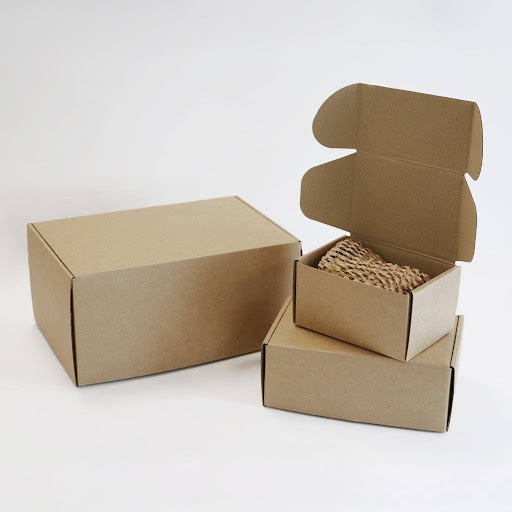
Paper and untreated cardboard are generally biodegradable because their primary fibers are derived from cellulose. However, the performance of a finished package depends on what else it contains.
A paperboard carton with a water-resistant coating, plastic window, laminated layer, or complex adhesive may not behave like plain paper in a composting or recycling system. Its suitability for disposal should be evaluated as a complete package, not just by looking at its outer surface.
For a broader understanding of fiber-based options, see Bluebird Packaging’s guide to paper packaging.
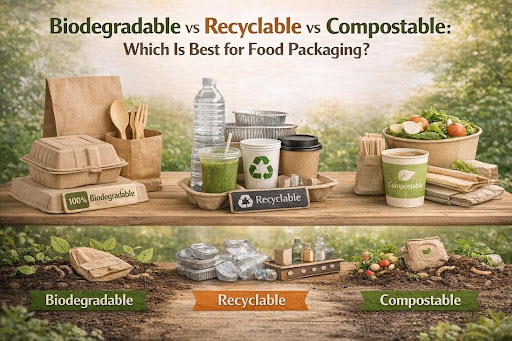
Biodegradable vs. Compostable vs. Recyclable Packaging
These terms describe different material characteristics and disposal pathways. They should not be treated as interchangeable.
| Term | What it means | Important consideration |
|---|---|---|
| Biodegradable | Microorganisms can break down the material under suitable conditions. | The environment and time required matter. |
| Compostable | The material meets specified requirements for breaking down into usable compost under defined conditions. | It may require a home or industrial composting system. |
| Recyclable | The material can be collected and processed into usable material through a suitable recycling system. | Local facilities and material design determine practical recyclability. |
| Bio-based | Some or all of the material comes from biological or renewable feedstocks. | Bio-based origin does not prove biodegradability or compostability. |
| Recycled-content | The material contains recovered material that has been reprocessed. | The percentage and type of recycled content should be stated accurately. |
A package can be bio-based without being biodegradable. Conversely, some biodegradable plastics are made partly or entirely from fossil-based feedstocks. Likewise, a biodegradable package may not be recyclable through a particular local system.
Why the difference matters
Imagine a business purchasing a plant-based plastic mailer. The material’s plant origin does not automatically mean that it will compost in a home compost pile. If it is certified only for industrial composting, the customer may need access to a suitable facility and the facility must accept that product.
Now consider a plain paperboard shipping box. It may be a candidate for paper recycling if it is clean and accepted locally. Its most practical environmental route may therefore be recycling rather than composting.
The best disposal option is determined by the complete package and the waste-management system available to the customer—not by a single environmental label.
For more context, read about sustainable packaging and recyclable packaging.
Common Types of Biodegradable Packaging Materials
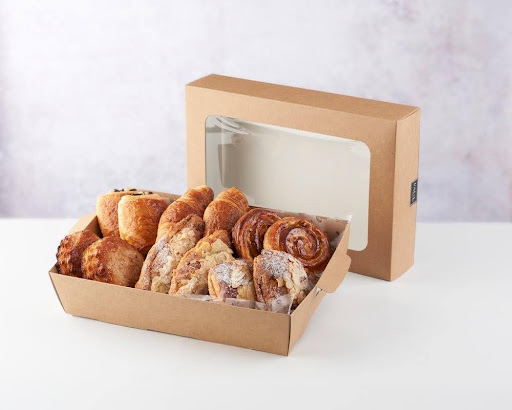
Different materials serve different functions. A lightweight carton used for soap has different requirements from a shipping box carrying a fragile product or a food container exposed to grease and moisture.
The following are common material categories businesses may evaluate when exploring biodegradable or more environmentally considerate packaging.
1. Paper and paperboard
Paper and paperboard are widely used for cartons, sleeves, retail boxes, labels, and lightweight product packaging. Their main structural component is cellulose fiber, which can biodegrade under suitable conditions.
Potential advantages include printability, folding flexibility, broad applications, and compatibility with established paper-recycling systems when the package meets local requirements.
Examples include:
- Folding cartons for cosmetics and personal care products
- Paper sleeves for bars of soap
- Paperboard gift boxes
- Lightweight retail packaging
- Printed cartons for small consumer products
The key consideration is the finished construction. A plastic laminate, foil layer, window, or specialized coating can change the package’s recycling or composting suitability.
2. Corrugated cardboard
Corrugated packaging consists of linerboard and a fluted middle layer. This structure gives a box strength and cushioning while keeping it relatively lightweight.
It is commonly used for shipping, ecommerce, wholesale distribution, and storage. Corrugated cardboard is fiber-based, but its environmental performance still depends on fiber sourcing, recycled content, contamination, coatings, and end-of-life handling.
Businesses can evaluate corrugated boxes when they need stronger packaging for shipping or transportation.
Corrugated packaging is not necessarily the best choice for every product. Small retail items may need a thinner carton, while moisture-sensitive products may require additional protection. Any barrier treatment should be considered before making biodegradability or recyclability claims.
3. Kraft paper and kraft-based packaging
Kraft paper is produced through a pulping process that yields strong paper fibers. It is frequently used for bags, wraps, mailers, cartons, and packaging with a natural-looking appearance.
Its brown color is not proof that it is untreated or biodegradable in every disposal environment. Inks, coatings, adhesives, and added films still matter.
Kraft packaging can work well for brands seeking a simple visual style for candles, handmade products, soaps, gifts, and small retail items. Businesses can review kraft boxes when comparing suitable structures.
Learn more about this material in the guide to kraft packaging.
4. Molded fiber and pulp packaging
Molded fiber packaging is formed from fibrous materials into shapes that can hold or cushion products. It is used for protective inserts, trays, and certain food-service or consumer-product applications.
Potential uses include:
- Protective inserts for fragile goods
- Trays for selected food products
- Protective cushioning for electronics and household products
- Separators that reduce movement inside a shipping box
The material’s composition and any additives or coatings must be checked. A molded-fiber component should not be assumed to be home-compostable or suitable for every local recycling stream simply because it resembles paper pulp.
5. Plant-based packaging materials
Plant-based packaging can be made partly from resources such as corn, sugarcane, or other biological feedstocks. Depending on the chemistry and manufacturing process, these feedstocks may be used to produce paper fibers, bioplastics, or other packaging components.
The critical distinction is between where a material comes from and how it behaves after use. Plant-based origin alone does not establish biodegradability, compostability, or a lower overall environmental impact.
Ask suppliers to identify the actual material, its composition, its tested disposal conditions, and any relevant certification rather than relying on terms such as “natural” or “plant-powered.”
6. Biodegradable plastics
Some plastics are designed to biodegrade under specified conditions. Their performance varies by polymer type, product design, and environment.
A plastic labeled biodegradable may need particular temperature, moisture, oxygen, and microbial conditions. It should not automatically be placed in a home compost pile, a recycling bin, or the natural environment without confirming the appropriate route.
If a business is considering biodegradable plastic for a particular application, it should request evidence for the finished product and the exact disposal conditions being claimed.
7. Paper-based protective packaging
Paper cushioning, crumpled paper, paper wraps, and paper inserts can replace some types of plastic protective material. They can be useful for ecommerce parcels, gifts, and products that need separation or surface protection.
However, protection must come first. A package that allows products to break during shipping may create more waste through damaged goods, returns, and replacements.
Explore protective packaging and packaging inserts when evaluating how to secure products while reducing unnecessary materials.
Benefits of Biodegradable Packaging for Businesses
Biodegradable packaging may support a company’s environmental goals when the material is appropriate for the product and the claimed disposal pathway is realistic. Its benefits should be evaluated in context rather than assumed from the label alone.
1. Supports material-conscious packaging choices
Choosing paper-based or other suitable alternatives can help a business reduce its dependence on certain conventional plastic components. For example, a brand may use a paperboard carton instead of a rigid plastic outer sleeve when the carton offers sufficient protection and presentation.
The right decision depends on the entire package, including inserts, coatings, closures, and protective components.
2. Can support brand positioning
Packaging is often part of a customer’s first physical interaction with a product. A clearly designed paper package can communicate simplicity, care, and material transparency.
Brands should avoid vague environmental promises, however. Specific statements about the material or verified disposal route are more informative than a general claim that the entire package is “100% eco-friendly.”
3. Offers flexible branding opportunities
Paper-based materials can support printed logos, product information, instructions, colors, and graphic design. Depending on the substrate and finish, businesses may create a natural visual identity or a premium retail presentation.
The appropriate printing method and finish should be chosen with both performance and end-of-life considerations in mind.
4. Can fit a variety of product categories
Paperboard and corrugated materials are available in different strengths, shapes, and thicknesses. That makes them candidates for applications ranging from small retail cartons to larger shipping boxes.
For example, a skincare brand might choose a paperboard carton, while a business shipping multiple products may use a corrugated outer box with paper cushioning.
5. May help simplify packaging components
A well-designed package can reduce unnecessary layers, fillers, and oversized structures. Sometimes the most useful improvement is not changing every material but removing excess packaging while preserving protection.
This approach connects material selection with packaging design and practical product requirements.
6. Encourages clearer disposal communication
When a company identifies the material and provides accurate disposal instructions, customers have a better chance of handling the package correctly. Clear instructions are particularly important when components have different disposal requirements.
The benefit depends on truthful labeling and the availability of suitable waste-management services.
Disadvantages and Limitations of Biodegradable Packaging
Biodegradable packaging is not a universal solution. Businesses should consider the following limitations before changing materials.
Decomposition is not always fast
There is no single decomposition timeline that applies to all biodegradable packaging. The same material may behave differently in an active composting facility, a home compost pile, a dry environment, or a landfill.
Avoid promising that a package will disappear within a specific number of days or months unless the claim is supported by evidence that applies to the exact product and disposal conditions.
Some materials need specialized facilities
Certain compostable materials require industrial composting conditions. If a local facility does not accept the material, the customer may not be able to use the intended disposal route.
A business should confirm local acceptance before printing instructions such as “place in compost” on a package.
Moisture and barrier performance can be challenging
Paper and fiber-based packages may need additional design features when products contain liquids, oils, or moisture-sensitive ingredients. Protective treatments can affect disposal compatibility, so the entire package needs to be assessed.
The solution may be a suitable material combination rather than an entirely untreated package.
Pricing and supply can vary
Material price depends on specification, dimensions, printing, quantity, finish, supplier capacity, and manufacturing requirements. Some specialized materials may cost more or be less readily available than common packaging options.
Businesses should compare the total cost of the packaging system rather than judging it only by the price of an individual box.
Environmental claims can be misleading
Words such as “green,” “natural,” and “biodegradable” can create expectations that the product may not satisfy. The US Federal Trade Commission’s environmental marketing guidance stresses the importance of substantiating claims and qualifying them when needed.
A responsible business should describe what is actually known about the material and its disposal conditions.
Where Businesses Can Use Biodegradable Packaging
The best material depends on the product, its distribution route, and the level of protection it requires. The following examples illustrate common applications.
Ecommerce and shipping
Shipping packaging must withstand handling, stacking, and movement in transit. Corrugated boxes, paper cushioning, and appropriately designed paper mailers may suit many shipments.
A lightweight product may fit in a paper mailer, while a fragile or heavier item may need a stronger outer carton and internal protection. See mailer boxes for a packaging structure that can support product presentation and shipping needs.
For shipping decisions, also consider the practical guidance in shipping packaging.
Food and bakery businesses
Food packaging may need to manage grease, moisture, heat, leakage, and food-contact requirements. A paper-based appearance does not automatically mean that a package is suitable for direct food contact or compostable after use.
Restaurants, bakeries, and food brands should verify that the chosen material is appropriate for the specific food and operating conditions.
Relevant options to explore include custom food boxes, custom bakery boxes, and bakery boxes. Confirm material specifications and any required food-contact documentation before ordering.
Cosmetics and personal care
Cosmetics and personal care products often use cartons to protect containers, display product information, and maintain a consistent brand identity. Paperboard packaging can be a useful option for soaps, skincare products, and some cosmetic items.
However, the carton must be suitable for the product’s weight, fragility, storage conditions, and presentation requirements. If the package includes a plastic window or laminated surface, that component should be considered in the disposal assessment.
Brands can explore custom cosmetic boxes and custom soap boxes while confirming the material and finish specifications for their needs.
Retail and gift packaging
Retail packaging may need to balance shelf appearance, structural strength, and customer experience. Paperboard cartons, sleeves, and kraft-style boxes can support a range of printed and unprinted designs.
Gift packaging may also use inserts, ribbons, laminations, or decorative finishes. These additions can change how easily the complete package can be recycled or composted.
For retail applications, compare options in custom retail boxes and consider whether the design can achieve the required presentation with fewer material layers.
Small businesses and handmade products
Small brands often need packaging that looks professional without creating unnecessary complexity. A simple paperboard carton, kraft-style box, or paper wrap may be suitable for candles, handmade soap, accessories, and other lightweight products.
The best option depends on the product dimensions, required protection, printing quantity, and budget. A smaller, well-fitted box can reduce wasted space and filler, provided it still protects the item.
How to Choose the Right Biodegradable Packaging
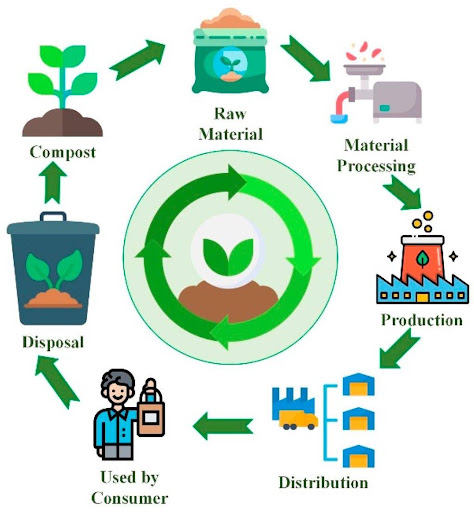
Selecting packaging is a product-design decision as well as a material decision. Use this process to compare options systematically.
Step 1: Define what the package must do
Write down the essential requirements before choosing a material.
Consider:
- Product weight and dimensions
- Fragility and risk of damage
- Exposure to moisture, grease, heat, or cold
- Storage and shipping conditions
- Shelf display and branding needs
- Required labels, instructions, or warnings
- Applicable food-contact or product regulations
A material that works for a dry retail product may not be appropriate for a wet or oily product.
Step 2: Identify the complete material composition
Ask what the package contains—not just what its main panel is made from.
Check for coatings, films, windows, adhesives, inks, lamination, closures, and protective inserts. If the package uses multiple materials, ask whether those components can be separated and what disposal route applies to each one.
For a broader comparison, review packaging materials and packaging material types.
Step 3: Confirm the intended end-of-life route
Decide whether the package is intended for paper recycling, home composting, industrial composting, or another disposal method. Then confirm that the package’s specifications and local facilities support that route.
Do not assume that all biodegradable plastics belong in a composting system or that all paper-based packages are accepted by every recycler.
Step 4: Request supporting documentation
If a supplier makes biodegradability or compostability claims, ask for relevant test reports, certification details, and clear information about the conditions covered by the evidence.
Confirm that the documentation applies to the finished packaging product, including relevant coatings and additives, rather than only to a raw material.
Step 5: Test protection and usability
Before placing a large order, evaluate a sample under realistic conditions. Check fit, closure, stacking, abrasion, moisture exposure, shipping handling, and the customer experience.
For shipping packages, conduct appropriate packing and transit tests. For food applications, verify the material’s suitability for the intended contact conditions.
Step 6: Compare the total cost
The total cost may include the unit price, printing, tooling, inserts, shipping, storage, waste, and potential product damage.
A correctly sized package may reduce unnecessary material and shipping volume. But downsizing should not compromise protection or increase product damage.
Businesses can use this process alongside a practical packaging cost guide.
Step 7: Communicate claims accurately
Describe the package’s verified attributes clearly. If it is made from paperboard, say so. If it is certified for industrial composting, specify that route and any relevant conditions.
Avoid broad statements such as “harmless to nature” or “disappears anywhere” unless the claim can be substantiated in the specific context. The FTC advises businesses to support environmental marketing claims with competent and reliable evidence.
Biodegradable Packaging vs. Traditional Plastic Packaging
The choice between biodegradable packaging and conventional plastic packaging depends on the product’s needs and what happens to the package after use. Neither category should be judged solely by its name.
| Consideration | Paper-based or fiber packaging | Conventional plastic packaging |
|---|---|---|
| Material source | Usually plant-derived fiber | Often fossil-derived polymers, though compositions vary |
| Typical strengths | Printability, folding, cartons, cushioning | Moisture resistance, flexibility, and durability, depending on polymer |
| Disposal options | May be recyclable or biodegradable if its construction and local systems allow | May be recyclable where compatible collection and processing exist |
| Common limitations | Can be affected by moisture; coatings may complicate disposal | Can persist in the environment when mismanaged |
| Best selection criteria | Protection, fiber sourcing, coatings, and local recovery routes | Product protection, polymer type, recyclability, and local recovery routes |
This is a general comparison, not a claim that one material is always environmentally superior. A meaningful assessment considers the product’s full lifecycle, including material sourcing, manufacturing, transportation, product damage, reuse, and end-of-life management.
For example, replacing a protective package with a weaker alternative could increase damage and waste. Conversely, using excessive plastic layers where a simple paperboard carton would work may create avoidable material use. The goal is to choose the lowest-impact practical design that still performs reliably.
Businesses comparing box structures can also review cardboard boxes and the differences explained in their material specifications before making a final decision.
How to Make Biodegradable Packaging More Effective
Material choice is only one part of responsible packaging. Good design can help a business avoid waste while preserving the quality and safety of the product.
Reduce unnecessary packaging
Start by reviewing whether every layer serves a real function. Oversized boxes, excessive filler, duplicate sleeves, and unnecessary decorative components can increase material use.
Removing a layer is not always the right decision, particularly when it protects a fragile product. Instead, assess the purpose of each component and retain what is needed for reliable performance.
Choose an appropriate box size
Packaging should fit the product with enough clearance for any protective inserts or cushioning. Too much empty space may require extra filler and can allow the product to move during transit. A box that is too tight can make packing difficult or damage the product.
Measure the product, consider its orientation, and allow space for protective components before finalizing dimensions.
Keep material combinations practical
A package made from one compatible material may be easier to sort than a structure with permanently bonded layers of paper, plastic, and foil. Where performance allows, consider designs that use fewer material types or make components easier to separate.
The correct approach depends on the package’s function and the local recycling or composting system.
Consider reuse where appropriate
Some packaging is designed for one-time use; other structures may be sturdy enough for customers or businesses to reuse. Reuse can be a useful design consideration when the box remains functional and customers have a reason to keep it.
Do not assume that a package is reusable just because it is thick or rigid. It should be designed to withstand the intended number of uses and be practical to store and handle.
Provide clear disposal information
Customers should not need to guess whether a package belongs in recycling, compost, or general waste. Use clear instructions that match the material and the services available in the market where the product is sold.
Where different components require different disposal routes, explain the distinction. Avoid placing a composting instruction on the whole package if only one component meets the relevant requirements.
How to Avoid Misleading Biodegradable Packaging Claims
Environmental claims can influence purchasing decisions, so businesses should make them carefully. The US Federal Trade Commission’s Green Guides explain that marketers should not use broad, unqualified environmental claims that imply benefits they cannot substantiate. Claims about biodegradability and compostability need appropriate evidence and qualifications.
Before describing packaging as biodegradable, ask the following questions:
- What exactly is biodegradable? Is it the box, a coating, a label, a bag, or only one ingredient?
- Under which conditions? Does the claim apply to soil, water, home composting, industrial composting, or another specified environment?
- How long does the process take? Is the timeline supported by relevant testing?
- What remains after breakdown? Is there evidence for the stated end result?
- Does the claim apply to the complete package? Have inks, adhesives, windows, and other components been considered?
- Can customers access the required disposal route? Is a suitable collection or processing facility available?
Examples of clearer environmental language
| Avoid vague wording | Prefer specific, supportable wording |
|---|---|
| “Completely green packaging” | Identify the actual material or verified environmental attribute. |
| “Disappears naturally anywhere” | State the tested conditions and limitations, if supported by evidence. |
| “100% compostable” without qualification | Explain the certified scope and whether home or industrial composting is required. |
| “Plant-based, so it biodegrades” | Describe the material’s plant-based content separately from verified biodegradation performance. |
| “Recyclable everywhere” | Explain the material’s recyclability and any relevant local limitations. |
The right wording depends on the available evidence and applicable rules in each market. Businesses selling internationally should not assume that one environmental claim is appropriate in every jurisdiction.
How to Order Custom Packaging With Environmental Goals in Mind
Custom packaging can help businesses match a box to a product’s dimensions, protection needs, and branding. The important point is to define the requirements before choosing a material or printing an environmental claim.
Use this checklist when preparing a packaging request:
- Product name, dimensions, and approximate weight
- Intended use: retail display, storage, shipping, gifting, or food service
- Required material and preferred alternatives
- Moisture, grease, temperature, or handling requirements
- Printing, colors, logos, and finishing preferences
- Inserts, windows, adhesives, or other additional components
- Target order quantity and budget
- Desired disposal route and supporting documentation needed
- Sample or prototype requirements before production
A supplier can then evaluate which structures may meet the technical requirements. The finished specification should identify the actual material and any limitations on its environmental claims.
Bluebird Packaging offers packaging options for different product categories and branding requirements. Businesses can start at the Bluebird Packaging homepage to explore relevant solutions and product pages.
When you are ready to discuss dimensions, materials, printing, and order requirements, you can request a custom packaging quote. Include your intended use and any verified environmental requirements so the packaging options can be evaluated appropriately.
Frequently Asked Questions About Biodegradable Packaging
1. What is biodegradable packaging in simple terms?
Biodegradable packaging is packaging that microorganisms can break down under suitable conditions. How quickly it decomposes and how completely it breaks down depend on the material, its construction, and the environment where it is disposed of.
2. Is biodegradable packaging better for the environment?
It can be beneficial in some applications, but it is not automatically better in every situation. Material sourcing, manufacturing, transport, product protection, disposal infrastructure, and actual end-of-life behavior all matter. The best option is the one that meets the product’s requirements and has a credible environmental benefit in its intended use.
3. What materials are used for biodegradable packaging?
Materials may include paper, untreated cardboard, paperboard, molded plant fibers, and certain plastics designed to biodegrade under specific conditions. The complete package—including coatings, adhesives, inks, and added layers—must be assessed before making a claim.
4. What is the difference between biodegradable and compostable packaging?
Biodegradable describes a material’s ability to be broken down by biological processes under suitable conditions. Compostable packaging must meet additional requirements for breaking down into usable compost under defined conditions. Some compostable products require industrial facilities and are not suitable for home composting.
5. How long does biodegradable packaging take to break down?
There is no universal timeline. Decomposition depends on material composition, temperature, moisture, oxygen, microorganisms, and the disposal environment. A specific time estimate should only be used when it is supported by relevant testing for the material and conditions being described.
6. Is cardboard biodegradable?
Untreated cardboard is primarily made from cellulose fibers and can biodegrade under suitable conditions. However, coatings, plastic laminates, adhesives, contamination, and other added components may change the package’s disposal suitability. Clean cardboard may also be recyclable where local collection systems accept it.
7. Can biodegradable packaging go in the recycling bin?
Not always. The correct route depends on the material and the local recycling system. Some fiber-based packaging may be recyclable, while certain biodegradable plastics may contaminate conventional recycling streams. Check the product’s instructions and local waste-management guidance before disposing of it.
8. Is biodegradable plastic made from plants?
Not necessarily. Some biodegradable plastics are made from plant-based feedstocks, while others can be produced from fossil-based feedstocks. Plant-based origin and biodegradability describe different properties, so one should not be assumed from the other.
9. Is biodegradable packaging suitable for food?
Some paper-based and other biodegradable materials can be suitable for particular food applications, but suitability must be confirmed for the intended food and conditions. Businesses should check food-contact compliance, grease and moisture resistance, heat tolerance, and the package’s disposal characteristics.
10. How can a business choose biodegradable packaging?
Start with the product’s protection and presentation needs, identify the complete material composition, confirm a realistic disposal route, and request relevant testing or certification. Test samples before ordering and use only environmental claims that can be substantiated.
Conclusion: Choose Packaging That Performs and Has a Clear End-of-Life Route
Biodegradable packaging can be a useful option for businesses seeking to make more informed material choices. Paper, cardboard, molded fiber, and certain specially designed plastics each have different characteristics, advantages, and limitations. Their suitability depends on the product, package construction, performance requirements, and conditions after disposal.
The most responsible approach is to look beyond the label. Check the complete material composition, test packaging for its intended use, confirm available recycling or composting routes, and communicate environmental claims precisely. Reducing unnecessary components and choosing an appropriately sized package can also help improve packaging efficiency without sacrificing product protection.
Bluebird Packaging can help businesses explore custom packaging structures, materials, and branding options for different applications. Review the available solutions and submit your requirements through the packaging quote form to discuss an option that fits your product and business needs.