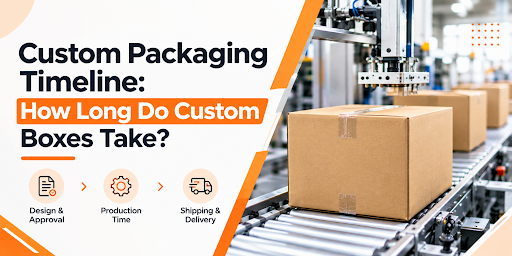
If you are ordering custom packaging for a new product, retail launch, or ecommerce business, one of the first questions is: How long does custom packaging take from the first quote to delivery?
For planning purposes, a straightforward custom box project may take a few weeks from finalizing specifications to receiving the finished packaging. A more complex order involving structural design, physical samples, premium finishes, large production quantities, or international freight can take considerably longer. The exact schedule depends on the packaging style, artwork readiness, production method, supplier capacity, and delivery destination.
Bluebird Packaging’s website lists a typical standard production turnaround of approximately 10–12 working days, with actual timing varying by specifications, quantity, printing, finishing, and complexity. That is a production estimate—not a guarantee of the entire process from first inquiry to delivery.
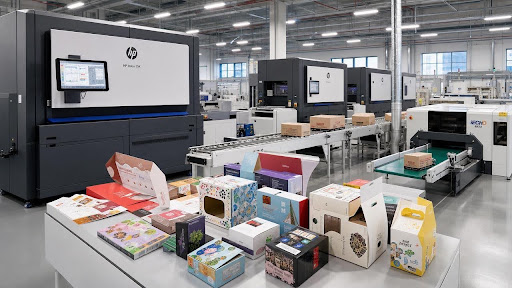
This guide breaks down the custom packaging timeline stage by stage, explains what can delay an order, and shows how US businesses can plan packaging purchases around a product launch without relying on unrealistic delivery promises.
Quick Answer: What Is the Typical Custom Packaging Timeline?
Custom packaging lead time is the total time required to prepare, approve, manufacture, inspect, and deliver packaging. It is not always the same as production time. A supplier may quote a production window that starts only after artwork and proofs have been approved, while sampling and shipping are counted separately.
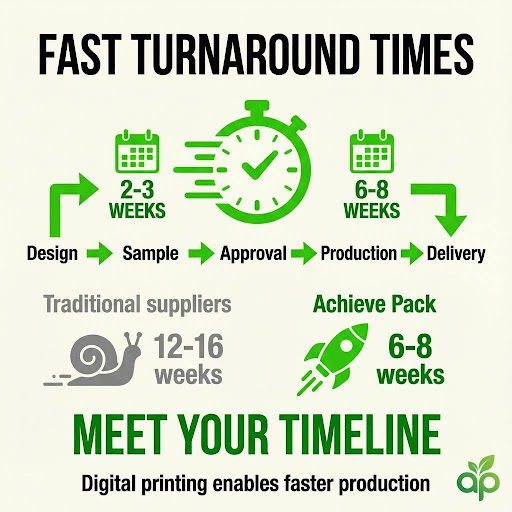
Use the ranges below as a planning guide, not as guaranteed industry-wide deadlines. Your supplier should confirm the schedule for your exact order.
| Project stage | Planning allowance | What happens |
|---|---|---|
| Requirements and quotation | A few business days, depending on project details | Confirm box style, dimensions, quantity, material, and budget |
| Dieline and artwork | Several business days or longer | Prepare the structural layout and print artwork |
| Digital proof and revisions | Depends on feedback and revision rounds | Check layout, colors, text, and panel placement |
| Physical sample, if needed | Several business days to multiple weeks | Produce and review a sample |
| Bulk production | Often around 2–4 weeks for planning, but varies widely | Print, cut, fold, glue, assemble, and finish |
| Quality checks and dispatch | Allow additional time | Inspect, pack, and prepare the order for shipment |
| Shipping and delivery | Depends on origin, destination, and shipping method | Transport packaging to your facility |
These stages can overlap in some workflows, while others must be completed sequentially. Complex projects or overseas manufacturing may require a longer schedule. Recent packaging lead-time guides likewise distinguish between production after approval and the full quote-to-delivery timeline.
The most important question to ask a packaging supplier is: “Does this delivery estimate begin at order placement, artwork approval, sample approval, or the start of production—and does it include shipping?”
That one clarification helps you compare quotes accurately and avoid planning your launch around a production estimate that excludes several earlier or later stages.
What Does Custom Packaging Lead Time Include?
Custom packaging lead time covers the work needed to turn an idea into finished packaging. Depending on the supplier and project, it may include specification confirmation, structural design, artwork preparation, proofing, sampling, manufacturing, quality control, and transportation.
For example, an ecommerce company ordering branded mailer boxes might need to approve the box dimensions, provide its logo, review a digital proof, approve a sample, and then wait for manufacturing and delivery. A company ordering a premium rigid gift box with foil, a custom insert, and multiple components may need additional design, sampling, and production steps.
It helps to separate these three terms:
- Design and approval time: The period required to finalize dimensions, artwork, structure, and proofs.
- Production time: The period required to manufacture the approved packaging.
- Total lead time: The complete period from project kickoff—or another agreed starting point—until the packaging arrives.
When comparing packaging suppliers, make sure each quote uses the same starting and ending points. One supplier might quote production only, while another provides an estimated delivery date that includes shipping.
Custom Packaging Timeline: Stage-by-Stage Breakdown
1. Requirements, Specifications, and Quotation
The first stage is defining exactly what you need. The more complete your brief, the easier it is for a packaging supplier to evaluate the project and provide a useful quote.
Prepare the following information:
- Product type and weight
- Product dimensions and any fragile or sensitive areas
- Desired packaging style
- Internal box dimensions and required product clearance
- Material and board thickness, if known
- Printing requirements, including inside or outside printing
- Finishes such as matte lamination, foil, embossing, or spot UV
- Estimated quantity and delivery ZIP code
- Target in-hand date
A quote may take longer when the packaging structure is unusual, the product requires a protective insert, or the material and finishing specifications are not yet clear.
For a more accurate estimate, use Bluebird Packaging’s custom packaging quote form. It asks for project details such as box style, size, quantity, material, printing, and finishing requirements.
2. Structural Design and Dieline Preparation
A dieline is the flat template that identifies where a package is cut, scored, folded, and glued. It helps the designer and manufacturer understand how the flat printed sheet will become a three-dimensional package.
If your supplier already has a suitable structure, this stage may be relatively straightforward. A custom shape, special locking mechanism, window, insert, or multi-part box may require more development and review.
The design also needs to fit the product properly. A box that is too tight can make packing difficult or damage the product; a box that is too loose may allow excessive movement during transit.
Before approving the structure, review the custom box size guide and confirm whether the dimensions refer to the inside or outside of the finished box.
For shipping products, the structure may need to provide additional protection. For example, a product shipped through a parcel network may need stronger walls or cushioning compared with a box used only to display an item on a retail shelf.
3. Artwork Preparation and Digital Proofing
Once the structure is defined, the artwork must be prepared for the selected packaging format. This includes the logo, typography, product information, colors, graphics, and any legally required text.
A digital proof allows you to review the design before production. Depending on the workflow, it may show a flat layout, a three-dimensional mockup, or both.
Check these details carefully:
- Is the logo positioned correctly on each panel?
- Are text and important graphics clear of folds, cuts, and glue areas?
- Are product names, ingredients, barcodes, and other details correct?
- Are the colors and finishes represented as intended?
- Is the artwork suitable for the selected material and printing method?
- Does the assembled box look right from every important viewing angle?
The artwork approval timeline depends heavily on how quickly your team reviews proofs and supplies consolidated feedback. Several rounds of small revisions can add days to the project.
For ideas on improving the visual presentation, see Bluebird’s guide to packaging design. It is often more efficient to resolve branding and layout decisions before production starts than to request changes after printing has begun.
4. Physical Sampling and Prototype Approval
A physical sample is a real or representative version of the packaging that lets you evaluate its size, structure, assembly, and appearance before committing to a full order.
Sampling is especially useful when:
- The product is fragile, heavy, or unusually shaped.
- The box includes a fitted insert or custom opening.
- The packaging uses rigid board or specialty finishes.
- Color matching is important to your brand.
- The packaging will be used for a major product launch.
- You need to test the packaging with the actual product.
Not every project needs a physical sample. A simple reorder using an already approved design may not require the same development process as a first-time custom structure. Your supplier can advise whether a digital proof, a structural sample, or a printed pre-production sample is appropriate.
Build in time for shipping the sample to your team, testing it, collecting feedback, and requesting any changes. If the first sample does not fit the product or meet your expectations, the revised sample may add another production and review cycle.
5. Bulk Manufacturing and Printing
Bulk production normally begins after the required specifications, artwork, proof, and other approvals have been completed. The manufacturer then schedules the order and carries out the necessary production processes.
Depending on the package, manufacturing may include printing, laminating, die-cutting, scoring, folding, gluing, assembling, applying special finishes, and preparing inserts.
A simple printed carton may follow a more straightforward process than a luxury rigid box with multiple components. Production also depends on the order quantity, availability of the chosen materials, machine capacity, and the supplier’s current workload.
Bluebird Packaging describes its standard turnaround as approximately 10–12 working days, subject to the requirements and complexity of the order. Always ask whether the estimate begins after final approval and whether it includes quality control or dispatch.
6. Quality Control, Packing, and Dispatch
Once manufacturing is complete, the order should be checked against the approved specifications. Depending on the project, checks may cover print appearance, dimensions, construction, finish, assembly, and overall consistency.
The finished packaging is then packed for transport. The time required depends on order size, how the packaging is bundled or palletized, and the arrangements for dispatch.
For a large order, ask whether the supplier will share dispatch confirmation, tracking information, or a delivery estimate. If your launch depends on receiving the entire order by a specific date, clarify whether delivery is expected as one shipment or in multiple consignments.
7. Shipping and Final Delivery
Shipping is a separate part of the custom packaging timeline unless your supplier explicitly includes it in the quoted turnaround.
Delivery time can vary according to:
- The shipping origin and destination
- Ground, air, ocean, or other transport methods
- Package size, shipment weight, and pallet requirements
- Carrier schedules and seasonal demand
- Customs clearance for international shipments
- Weather, disruptions, or other events outside the supplier’s control
For US businesses, domestic delivery may be relatively straightforward, while internationally manufactured packaging can require additional transit and customs time. Confirm the delivery method and estimated arrival date before placing the order.
Do not schedule a product launch based only on the expected day manufacturing finishes. Plan around the date the packaging needs to be physically available at your facility, including time for unloading, inspection, and filling the boxes with products.
How Long Does Custom Packaging Take by Box Type?
The packaging style affects the production process, but the style alone does not determine the delivery date. A simple structure with approved artwork may move faster than a complex package with several components, specialty finishes, or a new design.
The table below gives broad planning guidance. These are illustrative planning ranges, not promised turnaround times. Ask the manufacturer to confirm the schedule for your specifications and destination.
| Packaging type | What can affect the timeline? | Planning advice |
|---|---|---|
| Folding cartons | Board selection, print setup, die-cutting, quantity, and finishes | Finalize artwork and dimensions early |
| Corrugated shipping boxes | Box strength, flute selection, printing, size, and order volume | Confirm product weight and shipping requirements |
| Mailer boxes | Structural design, inside printing, inserts, and assembly | Test how the product fits before bulk production |
| Rigid boxes | Wrapped board, inserts, specialty paper, and premium finishes | Allow extra time for samples and complex construction |
| Retail display boxes | Display structure, product loading, stability, and print details | Test the display with the actual products |
| Food and bakery boxes | Material suitability, coatings, windows, and product requirements | Confirm the intended food-contact use with the supplier |
For product-specific options, explore Bluebird Packaging’s cardboard box options, corrugated boxes, and custom mailer boxes. For premium presentation, compare rigid box options. Retail displays and food packaging can have different structural and material requirements, so choose the format according to how the product will be sold, handled, and shipped.
Folding Cartons and Product Boxes
Folding cartons are commonly used for retail products such as cosmetics, personal care items, small consumer goods, and certain food products. Their timeline depends on the board, printed artwork, cutting and folding requirements, and finishing options.
If your project uses a conventional carton style and the artwork is ready, the process may be more straightforward than developing a new structure. Special coatings, metallic foil, embossing, or a custom insert can add more production steps.
Corrugated Boxes and Shipping Packaging
Corrugated packaging is designed with a fluted layer between liner sheets, providing structure and cushioning for many shipping applications. Box dimensions, board strength, printing, and the need for dividers or inserts can influence production planning.
If you are deciding between packaging materials, Bluebird’s guides to corrugated packaging and cardboard packaging explain useful differences. For a broader overview of options, read about packaging materials.
Rigid Boxes and Premium Packaging
Rigid boxes often use thicker board wrapped with printed or decorative paper. Some designs include magnetic closures, separate lids, custom inserts, or specialty finishes. These elements can make the design and assembly process more involved than a simple folding carton.
For premium product presentation, review Bluebird’s custom rigid boxes and decide early whether you need a physical sample. Confirm how the supplier will validate the dimensions, inserts, and finished appearance before the full run.
Ecommerce and Subscription Packaging
Ecommerce packaging must fit the product while withstanding handling and transportation. A custom mailer, shipping carton, or branded unboxing package may require testing for fit, closure, and protection.
Businesses planning recurring shipments should consider both the first order and future replenishment. A well-defined design and approved specification can make repeat orders easier to plan, although material availability and supplier capacity can still affect the schedule.
Explore ecommerce packaging and the guide to product packaging to align your package with the product, customer experience, and fulfillment process.
8 Factors That Affect Custom Packaging Production Time
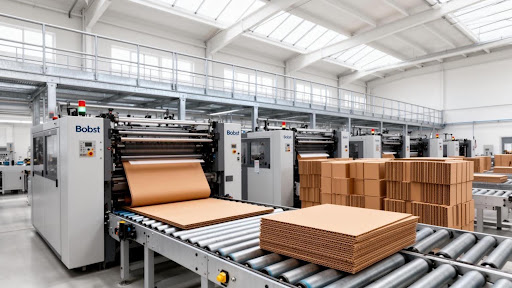
A reliable custom packaging timeline accounts for the details that can speed up or slow down an order. Some factors are under your control, such as how quickly you approve artwork. Others, including material availability and manufacturing capacity, depend on the supplier and wider production conditions.
1. Packaging Design Complexity
A straightforward box design may require fewer structural decisions than a package with unusual dimensions, multiple panels, windows, inserts, or a special opening mechanism.
How to reduce delays: Share the product dimensions, weight, reference images, and intended use at the beginning. Ask the supplier to identify any structural questions before finalizing the quote.
2. Artwork Readiness and Approval Speed
Incomplete artwork and repeated proof revisions can delay production even when the factory has capacity available. Incorrect text, missing assets, low-resolution graphics, or inconsistent dimensions may require additional prepress work.
How to reduce delays: Assign one person to coordinate feedback, check all copy before submitting artwork, and return consolidated comments promptly. Do not approve a proof until the design has been checked carefully.
3. Material Availability
The selected board, paper, finish, or specialty component may not always be immediately available. Less common materials or specific color and texture requirements may need sourcing.
How to reduce delays: Ask the supplier to confirm material availability when requesting the quote. If the timeline is tight, discuss suitable alternatives before approving the specifications.
4. Printing Method and Finishing
Printing methods have different setup requirements. The overall schedule can also be affected by lamination, foil stamping, embossing, debossing, window patching, or other finishing operations.
How to reduce delays: Choose finishes that support your design goals without adding unnecessary complexity. If a premium finish is essential, make that clear at the quote stage rather than introducing it after approval.
5. Order Quantity and Production Capacity
Large quantities may need longer production runs, additional handling, or a more detailed quality-control process. A supplier’s current workload can also influence when your order enters production.
How to reduce delays: Share your realistic quantity and required date early. If you need packaging in stages, ask whether a partial shipment is practical and how it affects cost and scheduling.
6. Physical Samples and Revision Rounds
Samples help identify fit, construction, and appearance issues before bulk manufacturing. However, producing, shipping, reviewing, and revising a sample adds time to the project.
How to reduce delays: Decide in advance who will approve the sample and what must be tested. Use a clear checklist covering product fit, closure, printing, finishes, and assembly.
7. Shipping Method and Delivery Location
The finished order may be ready on schedule but still arrive late if transportation takes longer than expected. International shipments can involve customs clearance and additional handling.
How to reduce delays: Request a delivery estimate that reflects your actual destination. For critical deadlines, ask about available shipping methods, tracking, and contingency options.
8. Seasonal Demand and Holidays
Packaging demand may rise ahead of major retail events, holiday promotions, and peak ecommerce periods. Suppliers and carriers can become busier, reducing flexibility.
How to reduce delays: Plan seasonal packaging earlier than an ordinary reorder. Confirm supplier cutoffs and holiday schedules rather than assuming the usual turnaround will remain unchanged.
How to Speed Up a Custom Packaging Order
If you have a firm product launch date, you may not be able to shorten every stage. You can, however, reduce avoidable delays by making decisions early and giving the supplier a complete brief.
Use this checklist before submitting your order:
- Finalize the product dimensions and packaging quantity.
- Select a suitable box style and material.
- Prepare a complete logo and artwork package.
- Confirm printing, finishes, and insert requirements.
- Ask for a written timeline that separates design, sampling, production, and shipping.
- Assign one decision-maker for proofs and sample approval.
- Review proofs promptly and send consolidated feedback.
- Confirm material availability and production capacity.
- Ask whether rush production is available for your exact order.
- Keep a buffer between the estimated delivery date and your launch.
A rush option may shorten production for eligible products, but it does not automatically eliminate design, sample, or shipping time. Never assume a supplier can meet a deadline until the schedule has been confirmed in writing.
For a practical look at how quantity and specifications influence cost, see Bluebird’s custom packaging cost guide. Simplifying the structure or finish may help with both budget and timing, but the best option depends on your product and brand requirements.
How to Plan a Custom Packaging Timeline for a Product Launch
The safest way to schedule packaging is to work backward from the date you need the finished boxes in hand—not simply the date you want manufacturing to begin.
For example, suppose a US skincare brand plans to launch a product on a specific date. It needs printed cartons, protective inserts, and enough time to pack the finished products. Instead of requesting packaging just before launch, the team should build a schedule with clear milestones.
| Milestone | What to confirm |
|---|---|
| Launch date established | When must the packaging be available at the fulfillment location? |
| Supplier and specifications confirmed | Are the structure, dimensions, quantity, and materials finalized? |
| Artwork submitted | Are all logos, text, and graphics ready for review? |
| Proof approved | Has the designated decision-maker approved the final version? |
| Sample approved, if required | Has the physical sample been checked against the product? |
| Production scheduled | Has the supplier confirmed the estimated completion date? |
| Shipping arranged | Is there a realistic delivery estimate for the destination? |
| Receiving and packing buffer | Is there time to inspect the order and pack the products? |
The milestones may overlap depending on the supplier’s workflow, but the principle is the same: each stage needs an owner and a deadline.
How Far in Advance Should You Order Packaging?
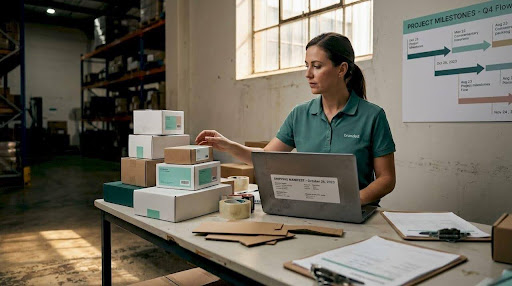
There is no single lead time that works for every packaging project. A simple reorder with approved artwork may require less planning than a first-time package with a custom structure, physical sampling, and international transportation.
As a practical starting point, begin discussions several weeks before you need standard custom packaging. For complex packaging, new product launches, major seasonal campaigns, or international orders, allow a longer planning window and confirm each stage directly with your supplier.
Use these factors to determine how much buffer to include:
- First-time order: Allow time to establish the structure, prepare artwork, and review proofs.
- New physical sample: Include production, delivery, and evaluation time.
- Premium or multi-part packaging: Ask whether the structure or finish requires additional processes.
- Overseas manufacturing: Include freight, customs, and possible transit variability.
- Peak season: Confirm capacity early and avoid leaving approval until the last minute.
- Critical launch date: Agree on a written schedule and keep contingency time.
If you are a growing brand, the guide to packaging for small businesses can help you think through packaging needs as your order volumes change.
How to Choose Packaging That Fits Your Timeline and Budget
The fastest packaging option is not necessarily the best choice. Your packaging must protect the product, meet the brand’s requirements, and arrive at a cost and schedule that make business sense.
Consider these trade-offs before approving a project:
| Decision | Potential benefit | What to check |
|---|---|---|
| Standard box structure | May reduce structural development | Confirm product fit and protection |
| Fewer specialty finishes | May simplify production | Make sure the design still meets brand expectations |
| Artwork finalized early | Reduces avoidable revision delays | Confirm all text and graphics before proof approval |
| Suitable local or domestic production | May reduce transportation time for some orders | Compare capacity, total cost, and delivery estimates |
| Reordering an approved design | Can reduce repeated design decisions | Confirm the existing specifications are still suitable |
| Sustainable material choice | Can support packaging goals | Check material availability and the supplier’s claims |
Sustainability requirements should also be part of the original brief rather than an afterthought. If recycled or other environmentally preferable materials matter to your business, discuss the available options early. Bluebird’s guide to sustainable packaging provides additional background.
For retail products, consider whether your packaging needs to stand out on shelves or communicate product information clearly. Bluebird’s custom retail boxes may be relevant when presentation and branding are important. For food-related projects, review custom food boxes and confirm that the proposed materials and construction suit the intended use.
Questions to Ask Your Packaging Supplier Before Ordering
A clear conversation with the supplier helps prevent misunderstandings about delivery dates. Before placing an order, ask the following questions.
1. When does the production clock start?
Confirm whether production starts at order placement, payment, artwork approval, sample approval, or another milestone.
2. Does the quoted timeline include shipping?
Ask for separate estimates for manufacturing, dispatch, and transportation if they are not included in one total delivery estimate.
3. Is a physical sample necessary?
Find out whether the project can proceed using a digital proof or whether the structure, material, or finish should be tested physically.
4. What could delay this particular order?
Ask about material sourcing, custom tooling, finishing steps, production capacity, and the current schedule.
5. Is rush production available?
Confirm eligibility, additional costs, the earliest realistic dispatch date, and whether expedited shipping is also available.
6. What happens if the sample or proof needs changes?
Understand whether revisions require a new sample, how the revised schedule will be calculated, and who must approve the final version.
7. Can the order be delivered in stages?
For some projects, a partial delivery may help meet an early requirement. Confirm feasibility and costs before assuming split shipments are possible.
Bluebird Packaging can help review project requirements and discuss suitable packaging options. Share the box style, dimensions, quantity, material, print requirements, and deadline through the custom packaging quote page so the team can assess your needs.
Frequently Asked Questions About Custom Packaging Timelines
1. How long does custom packaging take to produce?
The timeline depends on the package design, materials, quantity, printing, finishes, and supplier capacity. A straightforward order may take a few weeks to plan and complete, while complex projects or international shipments can take longer. Ask for a written estimate covering each stage.
2. How many days does it take to manufacture custom boxes?
Manufacturing can take days to several weeks, depending on the box structure and production requirements. Bluebird Packaging lists a typical standard production turnaround of approximately 10–12 working days, but the actual timeline varies by order. Confirm whether sampling, quality checks, and shipping are included.
3. How long does custom box printing take?
Printing time depends on the print method, order quantity, artwork readiness, and finishing requirements. Printing is only one part of the schedule; cutting, folding, gluing, inspection, and shipping may also be required before the boxes arrive.
4. How long does packaging sampling take?
Sampling can take several business days or longer, depending on whether you need a structural sample, printed sample, custom insert, or premium finish. Include time for the sample to reach you, be evaluated, and be revised if necessary.
5. Does custom packaging include design and approval time?
Not always. Some suppliers quote production time only after the final proof has been approved. Ask whether structural design, artwork preparation, revisions, physical sampling, and shipping are included in the quoted timeline.
6. What factors affect custom packaging lead times?
The main factors include design complexity, artwork revisions, material availability, printing method, specialty finishes, order quantity, production capacity, sampling, and shipping. Seasonal demand and international customs may also affect delivery.
7. Can I get custom boxes made faster?
Sometimes. Suppliers may offer rush production for selected products and quantities. Availability depends on the manufacturing schedule, materials, and project requirements. Ask for a confirmed rush timeline and check whether faster shipping is also needed.
8. How long does custom packaging shipping take?
Shipping time depends on the shipping origin, delivery address, transportation method, shipment size, and any customs requirements. Request a separate shipping estimate and plan around the expected arrival date rather than the manufacturing completion date.
9. What can delay a custom packaging order?
Common causes include incomplete artwork, late proof approval, repeated design changes, unavailable materials, sample revisions, complex finishes, busy production schedules, and transportation delays. Providing complete specifications and timely feedback helps reduce avoidable hold-ups.
10. When should I order packaging before a product launch?
Start planning several weeks ahead for a straightforward project, and allow more time for new structures, physical samples, specialty finishes, large orders, or international freight. Work backward from the date you need the boxes in hand and ask the supplier to confirm a project-specific schedule.
Conclusion: Plan Your Custom Packaging Timeline Before You Order
A successful custom packaging project depends on more than the time needed to print and manufacture a box. The full custom packaging timeline can include quotation, structural design, artwork preparation, proof approval, sampling, production, quality checks, and delivery.
To keep your project on schedule, finalize the specifications early, review proofs promptly, confirm material availability, and request a timeline that separates manufacturing from shipping. If you are planning a product launch, build in a buffer so an unexpected revision or delivery delay does not disrupt your launch date.
Bluebird Packaging offers custom packaging options for businesses that need branded boxes for retail, ecommerce, and other product applications. Explore the Bluebird Packaging website or contact the packaging team to discuss your requirements. You can also request a custom packaging quote with your preferred dimensions, quantity, material, finishes, and target delivery date.
The earlier you confirm your specifications and schedule, the easier it is to plan packaging around your product launch with fewer avoidable surprises.
Planning Your Custom Packaging Order?
Share your packaging style, dimensions, quantity, material, finishes, and target delivery date to discuss options for your project.