
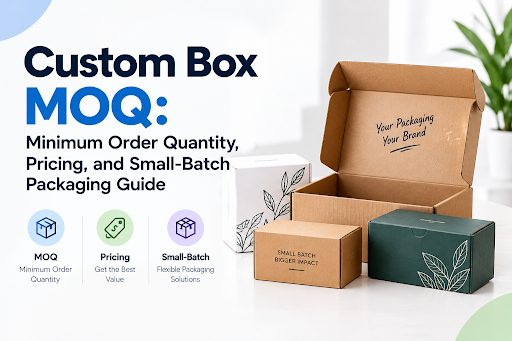
Quick answer: Custom box MOQ stands for custom box minimum order quantity—the smallest number of custom packaging boxes a supplier will accept in one order. The minimum depends on the box style, dimensions, material, printing method, finishes, and production process. Some suppliers offer small-batch orders, while others require larger quantities for specialized packaging. Before ordering, compare the minimum quantity, total order cost, cost per box, setup fees, and storage requirements.
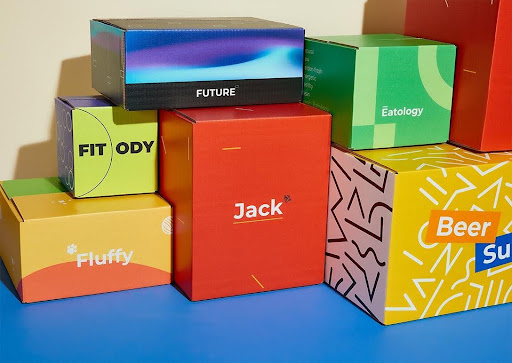
If you run a small business, launch new products, or manage packaging for an established brand, understanding MOQ can help you avoid ordering too many boxes or paying more than necessary. This guide explains how packaging minimums work, what affects pricing, and how to choose a quantity that fits your business.
Table of Contents
- What Is Custom Box MOQ?
- What Is the Minimum Order Quantity for Custom Boxes?
- How MOQ Affects Custom Box Pricing
- What Affects the Minimum Order Quantity?
- How Many Custom Boxes Should a Small Business Order?
- How to Order Custom Boxes With a Low MOQ
- Low MOQ vs. Bulk Custom Packaging
- How to Reduce Custom Packaging Costs
- Frequently Asked Questions
What Is Custom Box MOQ?
Custom box MOQ is the minimum number of boxes a packaging supplier requires you to purchase in a single order. For example, if a supplier sets an MOQ of 100 boxes, you generally need to order at least 100 units to meet that supplier’s minimum requirement.
MOQ is important because producing custom packaging involves more than the cost of cardboard and ink. A manufacturer may need to prepare artwork, create or configure printing plates, set up equipment, cut materials, apply finishes, and inspect the finished boxes. These activities can involve fixed costs regardless of the order size.
The minimum quantity varies between suppliers and products. A simple folding carton may have different production requirements from a rigid gift box, a corrugated shipping box, or a package with foil stamping and a custom insert.
Custom box MOQ example
Imagine your business needs custom printed boxes for a skincare product. Three suppliers offer the following hypothetical order options:
| Order option | Quantity | Cost per box | Total box cost |
|---|---|---|---|
| Small batch | 100 | 2.50 | |
| Medium order | 500 | 1.40 | |
| Bulk order | 1,000 | 1.10 |
These figures are examples, not actual supplier quotes. They illustrate how the cost per box can decrease as quantity increases, even though the total amount you pay becomes larger.
The cheapest unit price is not always the best business decision. If you only need 150 boxes, ordering 1,000 may tie up cash and require storage for packaging you will not use for months.
Before requesting quotes, understand the different types of packaging and choose a structure that suits your product, budget, and distribution needs.
What Is the Minimum Order Quantity for Custom Boxes?
There is no universal minimum order quantity for custom boxes. Each supplier sets its own requirements based on the packaging structure, materials, equipment, printing method, and production economics.
A supplier may accept small orders for straightforward custom cartons but require higher quantities for complex packaging or specialized finishes. Even within the same company, the minimum can vary by product.
Here are some general considerations when comparing order quantities:
- Small-batch orders: Useful for product launches, market testing, limited editions, and businesses with lower packaging demand.
- Medium-sized orders: Suitable for products with established sales and relatively predictable demand.
- Bulk orders: Often more economical per unit when sales are consistent and the business has sufficient storage and working capital.
These categories are planning examples rather than industry-wide MOQ standards. Always confirm the actual minimum with the supplier.
Does Bluebird Packaging offer low-MOQ custom boxes?
Bluebird Packaging’s custom packaging quote page lists a minimum order quantity starting at 100 units. Confirm the current minimum for your chosen box style, material, dimensions, and finishes before placing an order.
This can be useful for businesses that want branded packaging without immediately committing to a very large production run. The final quote should clarify the accepted quantity, available customization options, production requirements, and total cost.
For a clearer understanding of the supplier side of the process, see this guide to choosing a packaging manufacturer.
How MOQ Affects Custom Box Pricing
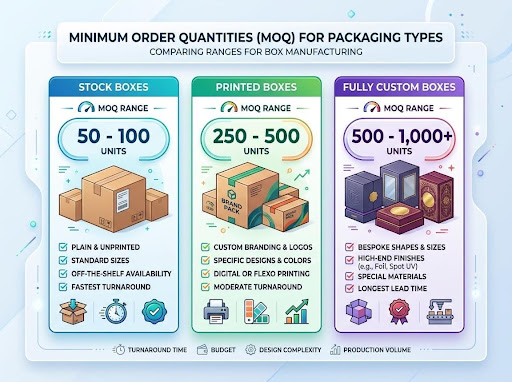
MOQ affects packaging economics because fixed production expenses are spread across the number of boxes produced. When a manufacturer produces more units in one run, the setup cost per box may decrease.
However, increasing quantity does not guarantee a lower total cost or a better return. Material prices, print coverage, finishing, shipping, storage, and waste can all affect the final result.
1. Setup costs
Custom packaging may require artwork preparation, printing setup, cutting dies, tooling, or machine adjustments. If these costs remain relatively stable across different quantities, ordering more units can reduce the setup cost allocated to each box.
For example, a $200 setup cost spread across 100 boxes equals $2 per box. Spread across 500 boxes, the same setup cost equals $0.40 per box.
This is a simplified calculation. It excludes materials, labor, finishing, freight, and other charges.
2. Printing method
The printing process can influence the economics of small orders.
- Digital printing can be suitable for shorter runs because it may require less setup than traditional plate-based printing.
- Offset printing can become economical at larger quantities, depending on the equipment, design, and job specifications.
- Specialty printing and finishes such as foil stamping, embossing, and spot UV may introduce additional setup requirements.
Not every supplier offers every process at every quantity. Ask which printing method is recommended for your order rather than assuming one method is always cheaper.
For more detail on print production, explore offset vs. digital printing for packaging.
3. Material and box construction
A straightforward paperboard carton can have a different production cost from a heavy-duty shipping box or a premium rigid box. The amount and type of material, structural complexity, and assembly process all matter.
For example:
- A lightweight retail carton may be suitable for a small consumer product.
- A corrugated box may be more appropriate for products that need shipping protection.
- A rigid box may suit premium gifts or products that require a more substantial presentation.
Explore packaging materials before deciding which structure best fits your product and budget.
4. Customization and finishing
Additional customization can affect both the price and minimum quantity. Potential requirements include:
- Full-color printing
- Inside and outside printing
- Matte or gloss lamination
- Foil stamping
- Embossing or debossing
- Spot UV
- Die-cut windows
- Custom inserts and dividers
Choose finishes based on what the customer needs to see, feel, or experience. More decoration is not automatically better packaging.
5. Freight and storage
A larger order may lower the unit production price but increase freight, handling, and storage expenses. This matters particularly when boxes are bulky or your business has limited warehouse space.
Compare the landed cost, not just the quoted box price. Depending on the quote, landed cost may include packaging, setup, freight, duties where applicable, and other order-related charges.
For a broader budgeting framework, read Bluebird Packaging’s custom packaging cost guide.
What Affects the Minimum Order Quantity?
Several variables influence the MOQ a supplier can offer. Understanding them helps you ask better questions and compare quotes accurately.
Box style and structure
Packaging construction is one of the most important factors. A basic folding carton may require different tooling and production steps from a complex box with a locking mechanism or fitted insert.
For example, a standard cardboard box may have different production requirements from a corrugated box.
Premium structures may require additional materials and assembly. Businesses evaluating gift or presentation packaging can explore custom rigid boxes to understand the options available for a more substantial package.
Box dimensions
Larger boxes typically use more material, while unusual dimensions may change how efficiently the boxes fit on a production sheet or cutting layout.
Provide accurate dimensions and explain whether they are internal or external. This helps the supplier determine material usage and identify a practical structure.
Artwork complexity
A simple logo and a few colors may be easier to prepare than detailed artwork covering several panels. Special finishes, variable designs, and multiple versions can add production complexity.
If you have not finalized your artwork, ask whether the supplier can review it before the order is confirmed. You can also learn about effective packaging design before submitting your files.
Material selection
Paperboard, kraft paper, and corrugated board serve different purposes. The best choice depends on product weight, handling, shelf presentation, shipping conditions, and your budget.
A product intended for retail display may need different packaging from an item shipped directly to a customer. See cardboard packaging and corrugated packaging for an overview of these material options.
Order frequency
A business that orders packaging regularly may be able to plan production more efficiently than a business placing a one-time order. However, recurring orders do not automatically guarantee a lower MOQ; supplier terms and product specifications still apply.
If you expect steady demand, ask whether repeat orders can use the same approved artwork and specifications, and whether that would reduce setup costs.
How Many Custom Boxes Should a Small Business Order?
A small business should order enough custom boxes to cover expected sales during its replenishment period, with a reasonable buffer for demand fluctuations, damaged packaging, and promotional activity. It should avoid ordering far more than it can realistically use.
The right quantity depends on sales velocity, lead time, storage capacity, cash flow, and how quickly packaging may need to change.
A simple way to estimate your order quantity
Use this formula as a planning starting point:
Suppose your business sells 200 products per month, expects packaging replenishment to take one month, and wants 50 extra boxes as safety stock. You already have 30 usable boxes in inventory.
Your estimated requirement is:
This is an inventory-planning example, not a supplier MOQ. If the supplier’s minimum is 100 units, an order of 220 may be feasible. If the minimum is 500, you would need to compare the economics of ordering more, choosing another supplier, or selecting a different production option.
Questions to ask before choosing a quantity
- How many products do we expect to sell each month?
- How long will it take to reorder the packaging?
- Are we likely to change the logo, product size, ingredients, or required label information?
- Can we store the packaging safely?
- How much working capital can we allocate to inventory?
- Does the supplier offer a suitable quantity for our launch or test run?
Businesses launching a new product may benefit from reviewing options for packaging for small businesses before committing to a large production run.
How to Order Custom Boxes With a Low MOQ
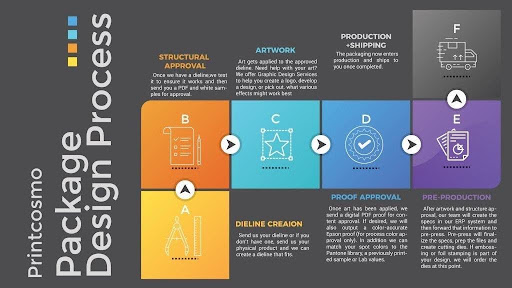
You do not necessarily need to abandon custom packaging just because you have a limited budget. The key is to simplify the order where possible and ask suppliers which specifications are available at lower quantities.
Step 1: Define the packaging requirement
Start with the product’s dimensions, weight, fragility, and intended use. Decide whether the box is mainly for retail presentation, shipping protection, gifting, or a combination of these purposes.
For ecommerce shipments, custom mailer boxes may be worth considering. Products sold in stores may require a different design or a display-ready structure.
Step 2: Keep the first design practical
For an initial order, consider using one box structure and one core design across the product range where appropriate. Avoid unnecessary structural complexity and finishes unless they deliver clear value.
A simpler specification may make it easier to compare quotes and identify suitable production options.
Step 3: Request a quote with complete specifications
Provide the supplier with:
- Box style and dimensions
- Material preference
- Printing requirements
- Finish and insert requirements
- Requested quantity
- Shipping destination and preferred delivery date
- Artwork or reference images, if available
You can submit these details through Bluebird Packaging’s custom packaging quote form. Ask the supplier to confirm the actual MOQ for the chosen configuration.
Step 4: Review the proof and specifications
Before approving production, check dimensions, artwork placement, colors, folds, glue areas, and any relevant product information. Request a physical sample or production proof when appropriate and available.
A small mistake in a box’s dimensions or artwork can affect the usability of the entire run, so do not skip the approval stage just to save time.
Step 5: Compare the complete quote
Ask each supplier to break down the quote where possible. Compare the unit price, setup charges, tooling, shipping, taxes, production timeline, and any costs associated with reordering.
The lowest advertised price may not represent the lowest total cost for your business.
Low MOQ vs. Bulk Custom Packaging
Low-MOQ and bulk orders serve different business needs. Low-MOQ packaging prioritizes flexibility and limits the amount of inventory purchased upfront, while bulk production may offer better unit economics when demand is predictable.
| Factor | Low-MOQ order | Bulk order |
|---|---|---|
| Initial cash requirement | Usually lower | Usually higher |
| Cost per box | May be higher | May be lower |
| Inventory commitment | Smaller | Larger |
| Storage requirements | Generally lower | Generally higher |
| Design flexibility | Helpful for testing new designs | Best when specifications are stable |
| Risk of obsolete packaging | Often lower | Can be higher if branding or product details change |
| Best suited to | Startups, testing, limited runs | Established products with predictable demand |
Neither option is automatically better. The best choice balances per-unit pricing with inventory risk and cash flow.
When low MOQ makes sense
Consider a smaller order when you are:
- Testing a new product or market
- Launching a seasonal or limited-edition product
- Updating branding
- Selling products with uncertain demand
- Working with restricted storage or working capital
When bulk production makes sense
A larger run may be worth evaluating when you have stable demand, an approved design, sufficient storage, and a reasonable forecast of how quickly the boxes will be used.
If you sell products through ecommerce, also consider the shipping method and customer experience. Our guide to ecommerce packaging explains how packaging choices relate to online orders and delivery.
How to Reduce Custom Packaging Costs
Reducing packaging costs is not simply a matter of choosing the lowest-priced box. The goal is to meet your protection and branding requirements without paying for unnecessary material, decoration, or unused inventory.
1. Choose the right box dimensions
Oversized packaging can waste material and create additional void space that must be filled. Undersized packaging can damage the product or prevent the box from closing correctly.
Measure the product carefully and account for inserts or protective materials where necessary. The goal is a practical fit, not the smallest possible box regardless of protection.
2. Standardize box styles where possible
If several products can safely use the same packaging structure, standardization may simplify purchasing and inventory management. You might vary labels or artwork while keeping the underlying structure consistent, depending on the supplier’s capabilities.
Do not force different products into one box size if doing so compromises fit or protection.
3. Limit unnecessary finishes
Premium finishes can improve appearance, but not every product needs foil, embossing, or multiple decorative effects. Prioritize the elements that matter most to your target customer.
For retail products, a clear brand identity and appropriate structure may deliver more value than adding every available finish.
4. Compare quantities using total cost
Request quotes at more than one quantity when possible. Compare the total investment as well as the price per unit, and estimate how long each quantity will last at your expected sales rate.
A larger order is only economical if the savings outweigh the costs and risks of holding inventory.
5. Plan repeat orders early
Waiting until you have almost no packaging left can force rushed decisions. Forecast demand and allow enough time for artwork approval, production, shipping, and inspection.
If your product range or branding changes often, factor that uncertainty into your order quantity rather than buying in bulk solely for a lower unit price.
6. Consider material efficiency and sustainability
Select packaging materials based on the product’s needs and the actual disposal or recycling options available to customers. Avoid unnecessary layers and excess material, while maintaining adequate protection.
Learn more about sustainable packaging and how material decisions can support more responsible packaging choices.
Does Box Style Affect MOQ?
Yes. Box style can influence the minimum order quantity because different structures require different materials, tooling, production steps, and finishing processes. The exact effect depends on the supplier and the order specifications.
Here are some common packaging styles and when to consider them:
Folding cartons and cardboard boxes
Often used for lightweight retail products, cosmetics, and consumer goods. Review the available cardboard box options and confirm which construction is appropriate for your product.
Corrugated shipping boxes
Useful when a package needs more structural protection during handling and transit. Choose the board and construction based on product weight, shipping conditions, and required protection.
Rigid boxes
Often selected for premium gifts, presentation packaging, and products where the unboxing experience matters. Their construction and finishes can differ from standard folding cartons.
Display packaging
Designed to present products on counters or retail shelves. Explore display box options if visibility and product organization are important.
Ask your supplier which structures can be produced at your required quantity and whether changing the style or finish would affect the minimum.
What Should You Compare When Choosing a Custom Box Supplier?
A suitable packaging supplier should meet your quantity requirements while delivering the quality, fit, and service your business needs. MOQ is one part of the decision—not the only one.
Use this checklist when comparing suppliers:
- Minimum order: Is the MOQ clearly stated for your exact box style?
- Total price: Are setup, tooling, freight, and other charges explained?
- Material quality: Is the material suitable for the product’s weight and intended use?
- Customization: Can the supplier accommodate your dimensions, printing, and finishes?
- Artwork support: Can the team review your files and flag potential production problems?
- Proofing: Can you approve a sample or proof before the full order?
- Lead time: Does the estimated timeline work for your launch or replenishment schedule?
- Reordering: Can the supplier retain or reuse approved specifications for future orders?
- Communication: Are questions about specifications, pricing, and delivery answered clearly?
Before making a decision, review the supplier’s product range, request a detailed quote, and ask for clarification on anything that could affect your final cost.
If you want to explore custom packaging for retail products, you can review Bluebird Packaging’s custom retail boxes or browse the Bluebird Packaging website to identify a suitable starting point.
Frequently Asked Questions
1. What does MOQ mean for custom boxes?
MOQ means minimum order quantity. It is the smallest number of custom boxes a supplier will accept for a particular order or packaging specification.
2. What is the minimum order quantity for custom boxes?
There is no universal MOQ for all custom boxes. The minimum varies by supplier, box structure, material, printing method, finishing requirements, and production process. Ask for the minimum applicable to your exact design.
3. Can I order custom boxes in small quantities?
Yes, some packaging suppliers offer small-batch custom box orders. Availability depends on the packaging type and production setup. Ask about low-MOQ options and compare the total cost with larger production runs.
4. Why do packaging suppliers have minimum order quantities?
Suppliers may need to cover setup, tooling, artwork preparation, material purchasing, machine preparation, and production costs. A minimum quantity helps make the manufacturing process economically viable.
5. Does a higher MOQ reduce the cost per box?
Often, but not always. Fixed setup costs can be spread across more units, potentially reducing the price per box. Material prices, finishing, freight, and other factors also affect the final cost.
6. How does printing affect custom box MOQ?
Printing method and design complexity can affect production setup and unit economics. Digital printing may suit some short runs, while offset printing may be more economical for certain larger runs. Ask the supplier to recommend a process for your quantity and artwork.
7. Are low-MOQ custom boxes more expensive?
They may cost more per box because setup and production costs are spread across fewer units. However, a smaller order can reduce upfront spending, storage needs, and the risk of unused or outdated packaging.
8. Can startups order custom packaging in small batches?
Yes, depending on the supplier’s minimum requirements. Startups should estimate near-term demand, compare small-batch pricing, and avoid ordering more packaging than they can reasonably use.
9. How many boxes should a small business order?
Estimate sales during the time it takes to replenish packaging, add a reasonable safety buffer, and subtract usable inventory. Then compare that amount with the supplier’s MOQ, storage capacity, and budget.
10. How can I reduce the cost of a custom box order?
Compare multiple quantities, choose practical dimensions, simplify unnecessary finishes, standardize box structures where suitable, and review the full landed cost. Do not choose a larger order solely because it offers a lower unit price.
11. Can I get custom boxes without a minimum order?
Some suppliers may offer no-minimum or very-low-minimum options for certain products, but availability and pricing vary. Confirm whether the supplier’s terms apply to genuinely custom-printed boxes or only to stock packaging.
12. What information do I need to request a custom packaging quote?
Prepare the product dimensions, desired box style, material preference, artwork, quantity, finishes, delivery destination, and target date. If you are unsure about a specification, ask the supplier for recommendations before approving production.
Final Takeaway: Choose a Custom Box MOQ That Fits Your Business
The right custom box MOQ is the quantity that balances production costs, packaging quality, inventory needs, and cash flow. Small orders can offer flexibility for launches and product testing, while bulk orders may reduce the cost per box when demand is stable.
Before committing, compare multiple quantities, confirm all setup and shipping charges, review the artwork and specifications, and make sure you can use the packaging before it becomes outdated.
If you’re ready to explore custom packaging, request a quote from Bluebird Packaging with your box style, dimensions, material preferences, and estimated quantity. The team can help you determine the available options for your project.
Need Custom Boxes for Your Business?
Share your required quantity, box dimensions, material, and printing preferences to explore suitable custom packaging options.