
Choosing the right soap packaging is not just about appearance. The box must fit the soap, protect it during handling, communicate your brand identity, and make a strong impression on retail shelves. Two popular options are pillow boxes and tuck end boxes, but they serve different packaging needs.
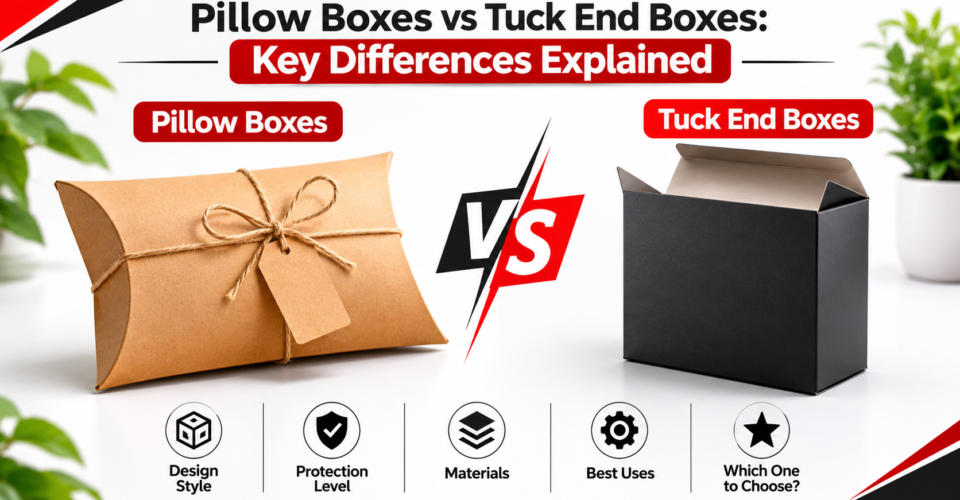
The main difference between pillow boxes and tuck end boxes is their structure and closure design. Pillow boxes have a curved, pillow-shaped body with folded end flaps, making them suitable for lightweight soaps and gift-style presentation. Tuck end boxes have a rectangular structure with flaps that fold into the box, providing a more traditional retail appearance, better stacking potential, and greater flexibility for product sizing.
For handmade soap brands, the right choice depends on soap dimensions, weight, protection requirements, display preferences, and budget. Bluebird Packaging offers customized packaging options that help businesses match box structures with their products and branding requirements.
Quick Answer: Pillow Boxes vs Tuck End Boxes
| Comparison | Pillow Boxes | Tuck End Soap Boxes |
|---|---|---|
| Structure | Curved, pillow-shaped design | Rectangular box structure |
| Closure | Curved folding end flaps | Tuck-in top and bottom flaps |
| Appearance | Decorative and gift-oriented | Traditional and retail-focused |
| Product Fit | Best for lightweight, compact soaps | Suitable for different soap sizes and shapes |
| Protection | Basic protection for lightweight products | Generally better enclosure and structural support |
| Storage | May be less efficient to stack | Easier to stack and store |
| Customization | Printing, colors, finishes, and sizes | Printing, inserts, windows, and structural variations |
| Best For | Small handmade soaps, favors, and gift sets | Everyday soap bars, retail shelves, and branded products |
Quick takeaway: Choose pillow boxes when presentation and gift appeal are your priorities. Choose tuck end soap boxes when you need a conventional retail structure, more sizing flexibility, and practical product protection.
1. What Are Pillow Boxes for Soap Packaging?
Pillow boxes are packaging containers recognized by their curved, pillow-like shape. Instead of having four conventional rectangular walls, they feature a central body with curved folding panels at both ends. These panels fold inward to close the package.
Their distinctive appearance makes them popular for gift packaging, promotional products, accessories, and lightweight retail items. For soap brands, pillow box packaging can create a clean, attractive presentation without requiring a conventional rectangular carton.
Key Features of Pillow Box Packaging Design
Pillow boxes have several characteristics that distinguish them from traditional soap cartons:
- Curved structure: The rounded body creates a distinctive appearance.
- Folded end closures: Curved flaps fold inward to secure the product.
- Compact construction: The design can work well for lightweight products.
- Decorative presentation: Its unusual shape can make a product feel more suitable for gifting.
- Custom printing: Brands can add logos, product details, colors, and other design elements.
Are Pillow Boxes Suitable for Handmade Soap?
Yes. Pillow boxes can work for handmade soaps when the dimensions, weight, and product shape are suitable. They are particularly useful for smaller soap bars, guest soaps, sample products, and gift sets.
However, the curved structure may not accommodate every soap size. A thick or heavy soap bar may require a different structure or additional support. Brands should also consider whether the soap needs ventilation or moisture management, especially if it is freshly made or not fully cured.
Explore custom pillow soap boxes for a packaging style designed around a distinctive pillow-shaped presentation.
2. What Are Tuck End Soap Boxes?
Tuck end soap boxes are rectangular cartons with folding flaps that tuck into the box to close it. They are widely used for retail products because their structure provides a familiar, organized appearance and can be customized for different product dimensions.
Unlike pillow boxes, tuck end cartons have defined panels, edges, and a more conventional box shape. This makes them suitable for soap brands that want consistent packaging across multiple product sizes and collections.
Main Features of Tuck End Box Packaging
- Rectangular structure: Creates a conventional retail packaging shape.
- Tuck-in closures: Folding flaps secure the top and bottom.
- Flexible dimensions: Width, height, and depth can be adjusted to fit different soap bars.
- Branding space: Multiple flat panels provide room for logos, ingredients, directions, and product information.
- Stackable design: The rectangular structure is generally easier to arrange on shelves and in storage.
Straight Tuck End vs Reverse Tuck End Boxes
Two common closure styles are straight tuck end and reverse tuck end boxes.
Straight tuck end boxes (STE): The top and bottom closure flaps tuck in the same direction. This design can create a clean front-facing presentation because the primary opening edges can be positioned away from the main display panel.
Reverse tuck end boxes (RTE): The top and bottom closure flaps tuck in opposite directions. This is a common carton structure that can be practical for many lightweight retail products.
Both styles can be adapted for soap packaging. The choice depends on the desired opening direction, display requirements, carton dimensions, and manufacturing specifications.
3. Pillow Boxes vs Tuck End Boxes: 7 Key Differences
Understanding the structural and functional differences makes it easier to select the right soap packaging box style.
1. Shape and Structure
Pillow boxes have a curved profile that creates a distinctive appearance. Their rounded shape can make a simple soap product look more decorative.
Tuck end boxes use a rectangular structure with flat panels and defined edges. This conventional shape provides a familiar retail appearance and makes it easier to organize products in rows.
Best choice: Pillow boxes for a distinctive presentation; tuck end boxes for conventional retail packaging.
2. Closure and Assembly
Pillow boxes use curved folding panels at both ends. The panels are folded inward to close the package, and their shape gives the box its characteristic appearance.
Tuck end cartons use flaps that fold into the box. Depending on the construction, the closures may provide a more secure and consistent enclosure.
Both structures can be supplied as flat packaging for assembly, but the exact assembly experience depends on the design, material thickness, and manufacturing quality.
Best choice: Tuck end boxes for a conventional carton closure; pillow boxes for a decorative folded design.
3. Product Protection
Product protection depends on material thickness, box dimensions, closure design, and how the product is handled.
Pillow boxes can protect lightweight soaps from dust, surface contact, and minor handling. However, their curved construction may not offer the same enclosure and stacking stability as a rectangular carton.
Tuck end boxes generally provide more defined panels around the product. This makes them a practical choice when soap bars need a more structured enclosure during retail handling and storage.
Neither design should be treated as waterproof or as a substitute for a suitable product wrap when moisture protection is required.
Best choice: Tuck end boxes for everyday retail handling and more structured enclosure.
4. Branding and Customization
Both packaging styles offer customization opportunities, but the available design space differs.
Pillow boxes have a curved central surface that can display a logo, short brand message, or decorative artwork. Their shape can itself become part of the brand experience.
Tuck end boxes offer several flat panels. These provide more predictable areas for branding, ingredients, product descriptions, usage instructions, and regulatory information.
Options for both styles may include:
- Custom colors and printed artwork
- Brand logos and product names
- Matte or gloss finishes
- Foil stamping
- Embossing and debossing
- Custom dimensions and material selections
Best choice: Tuck end boxes for detailed product information; pillow boxes for compact, decorative branding.
5. Storage and Shelf Display
Pillow boxes have a curved body, which can make them less convenient to stack and align than conventional rectangular cartons. Their unusual shape can still help them stand out in gift displays and promotional arrangements.
Tuck end boxes have flat surfaces and straight edges, making them easier to arrange in retail shelves, storage cartons, and product collections.
For soap brands selling through supermarkets, beauty stores, and other organized retail environments, shelf consistency can be an important consideration.
Best choice: Tuck end boxes for organized retail displays; pillow boxes for gift-focused presentation.
6. Material and Cost Considerations
Both structures can be produced using different paperboard and cardboard materials. Kraft and other paper-based stocks may be suitable depending on the required strength, print quality, and appearance.
The cost of either style depends on several factors:
- Box dimensions
- Material type and thickness
- Printing coverage and number of colors
- Finishing treatments
- Order quantity
- Structural complexity
Pillow boxes are not automatically cheaper than tuck end boxes. Their curved structure may use material differently, while tuck end cartons may offer efficient production for certain dimensions and quantities.
Best choice: Compare quotations using the same dimensions, material, print specifications, finish, and order quantity.
7. Product Suitability
Pillow boxes are generally better suited to compact, lightweight soaps and products where presentation is a priority.
Tuck end soap boxes are more adaptable to a wider range of rectangular soap bars and can provide more room for product information.
For example, a handmade soap brand selling small guest soaps may prefer pillow boxes for gift sets. A brand selling several everyday soap varieties may choose tuck end cartons to maintain consistent packaging across its product line.
Best choice: Select the structure according to soap dimensions, weight, retail requirements, and customer experience.
4. Which Box Is Better for Handmade Soap?
The better option depends on the product and the way customers buy it. A decorative box may attract attention, but practical factors such as fit, protection, storage, and product information also matter.
| Soap Business Type | Recommended Box Style | Reason |
|---|---|---|
| Handmade guest soaps | Pillow boxes | Compact and gift-friendly presentation |
| Small sample soaps | Pillow boxes | Suitable for lightweight products |
| Everyday bar soaps | Tuck end boxes | Conventional retail structure |
| Premium soap collections | Either style | Depends on brand positioning |
| Multiple soap varieties | Tuck end boxes | Consistent dimensions and shelf display |
| Gift sets | Pillow boxes or customized cartons | Depends on the number and size of products |
When to Choose Custom Pillow Boxes
Choose pillow boxes when:
- Your soap bars are small and lightweight.
- You want a distinctive alternative to standard rectangular cartons.
- Your products are sold as guest favors or small gifts.
- You want a compact design with a decorative appearance.
- You do not need extensive product information on multiple panels.
When to Choose Tuck End Soap Boxes
Choose tuck end boxes when:
- Your soap bars have conventional rectangular dimensions.
- You need space for ingredients and product details.
- Your products are displayed in organized retail shelves.
- You want a consistent carton structure across several soap varieties.
- You need a more structured enclosure for routine handling.
For additional ideas, explore handmade soap packaging for natural soap brands and compare different soap packaging ideas.
5. Best Materials for Pillow and Tuck End Soap Boxes
Material selection affects packaging strength, appearance, print quality, and cost. Both pillow and tuck end structures can be customized using suitable paper-based materials.
Kraft Paperboard
Kraft paperboard is popular with handmade and natural soap brands because of its earthy appearance. It can support minimalist branding and a simple, natural product presentation.
It is worth comparing kraft versus cardboard bar soap boxes before choosing a material for your product range.
Cardboard
Cardboard is a versatile option for printed soap cartons. It can support different colors, artwork, and finishes while providing a defined structure for retail packaging.
Recycled Paperboard
Recycled paperboard may be suitable for brands that want to incorporate recycled content into their packaging. Availability, strength, print quality, and supplier documentation should be checked before selecting a particular grade.
Choosing the Right Material Thickness
The required thickness depends on soap weight, box dimensions, handling conditions, and structural design. A larger or heavier soap may require a stronger board than a small guest soap.
The material should be tested with the finished product to confirm that the box closes properly and maintains its shape.
6. Soap Box Dimensions: How to Choose the Right Size
Even a well-designed box can fail if the dimensions do not match the soap. A box that is too tight may be difficult to assemble or close, while an oversized box can allow unnecessary product movement.
Measure the soap before finalizing the packaging structure.
Important Soap Box Measurements
Measure these three dimensions:
- Length: The longest side of the soap bar.
- Width: The shorter side across the face of the soap.
- Depth: The thickness of the soap.
For a tuck end carton, these measurements help determine the internal length, width, and depth. For a pillow box, the curved shape and usable internal space must also be considered.
Allow enough clearance for the soap to fit comfortably without excessive movement. If the soap has a wrapper, label, or protective insert, include that in the final measurement.
For more detailed guidance, read the soap box sizes guide.
Test Before Ordering in Bulk
Before approving a large order, request a sample or prototype when available. Check:
- Whether the soap fits without forcing it.
- Whether the closure stays secure.
- Whether the material holds its shape.
- Whether the packaging is easy to assemble.
- Whether the finished design looks correct.
- Whether the product can be removed without damaging the box.
This simple testing process can help prevent costly packaging errors.
7. Custom Printing and Design Options for Soap Packaging
Packaging is often the first physical interaction customers have with a soap brand. The structure should support the product, while the printed design communicates its identity and value.
Both pillow boxes and tuck end boxes can be customized to reflect different brand styles.
Custom Printed Pillow Boxes
Custom pillow boxes can feature brand logos, product names, colors, illustrations, and short messages. A simple design can work particularly well because the curved shape already provides visual distinction.
For handmade soap, brands may use natural colors, botanical artwork, and clean typography to communicate the product’s character.
Custom Printed Tuck End Soap Boxes
Tuck end boxes provide multiple flat surfaces for branding and product information. The front panel can display the logo and soap name, while other panels can carry ingredients, directions, weight, and contact details.
Brands can also use window features where appropriate. A window can help customers see the soap before purchasing, although the design should maintain adequate protection and avoid unnecessary structural weaknesses.
Explore window soap boxes for a packaging style that combines printed branding with product visibility. You can also compare bar soap boxes for a more conventional carton format.
Finishing Options
Depending on the material and printing requirements, customization may include:
- Matte or gloss lamination
- Foil stamping
- Embossing and debossing
- Spot UV
- Custom color printing
- Die-cut windows
Finishes should support the brand’s appearance without compromising the practical needs of the packaging.
Need soap packaging that fits your product and brand identity? Explore custom soap packaging boxes from Bluebird Packaging. You can request a quote to discuss your preferred box style, dimensions, material, and printing requirements.
8. Cost Comparison: Are Pillow Boxes Cheaper Than Tuck End Boxes?
There is no universal rule that pillow boxes cost less than tuck end boxes. Pricing depends on the complete packaging specification rather than the style name alone.
A small pillow box with simple printing may be economical for a lightweight soap product. However, a custom tuck end carton may offer better value when a brand needs multiple panels, consistent dimensions, or larger production quantities.
| Cost Factor | Pillow Boxes | Tuck End Boxes |
|---|---|---|
| Material Usage | Depends on curved design and dimensions | Depends on carton size and panel layout |
| Printing | Suitable for compact branding | Multiple flat panels for detailed printing |
| Finishing | Available depending on material | Available depending on material |
| Assembly | Folding curved end panels | Folding and tucking closure flaps |
| Bulk Pricing | Depends on order specifications | Depends on order specifications |
To compare prices accurately, request quotations with identical material grades, dimensions, print coverage, finishes, and quantities.
A cheaper box is not necessarily the better investment if it does not protect the soap or present the brand effectively. Consider the total value of the packaging, including product fit, customer experience, and retail suitability.
9. FAQs
What is the difference between pillow boxes and tuck end boxes?
Pillow boxes have a curved, pillow-shaped structure with folding end panels, while tuck end boxes have a rectangular carton design with flaps that tuck inside the box. Pillow boxes are often used for decorative packaging, whereas tuck end boxes are common in retail packaging.
Are pillow boxes suitable for handmade soap?
Yes. Pillow boxes can package small, lightweight handmade soaps, guest soaps, and sample products. The soap must fit comfortably inside, and the packaging should provide enough protection for the intended handling and delivery conditions.
Are tuck end boxes better for soap packaging?
Tuck end boxes are often a practical choice for everyday retail soap because they provide a conventional rectangular structure, flat branding panels, and convenient shelf arrangement. However, pillow boxes may be more suitable when decorative presentation is the main priority.
Which box style provides better product protection?
Tuck end boxes generally provide a more structured enclosure for soap bars, while pillow boxes are suitable for lightweight products and basic protection. Actual performance depends on material thickness, dimensions, closure design, and shipping conditions.
Can pillow boxes be customized with printing?
Yes. Custom pillow boxes can include logos, product names, brand colors, illustrations, and selected finishing options. Printing and finishing availability depends on the material and manufacturing specifications.
Conclusion
Choosing between Pillow Boxes vs Tuck End Boxes comes down to your soap product, packaging goals, and customer experience. Pillow boxes offer a distinctive curved shape that works well for lightweight handmade soaps, guest favors, and gift-style products. Tuck end soap boxes provide a conventional rectangular structure with practical closure options, more defined branding panels, and convenient retail display.
Before selecting a style, consider soap dimensions, weight, material thickness, storage requirements, printing needs, and budget. Testing a sample can help confirm that the packaging fits properly and performs as expected.
Bluebird Packaging helps businesses explore customized soap packaging structures, materials, printing, and finishes. Whether you need decorative pillow box packaging or practical tuck end cartons, contact our team to discuss your requirements and request a custom packaging quote.