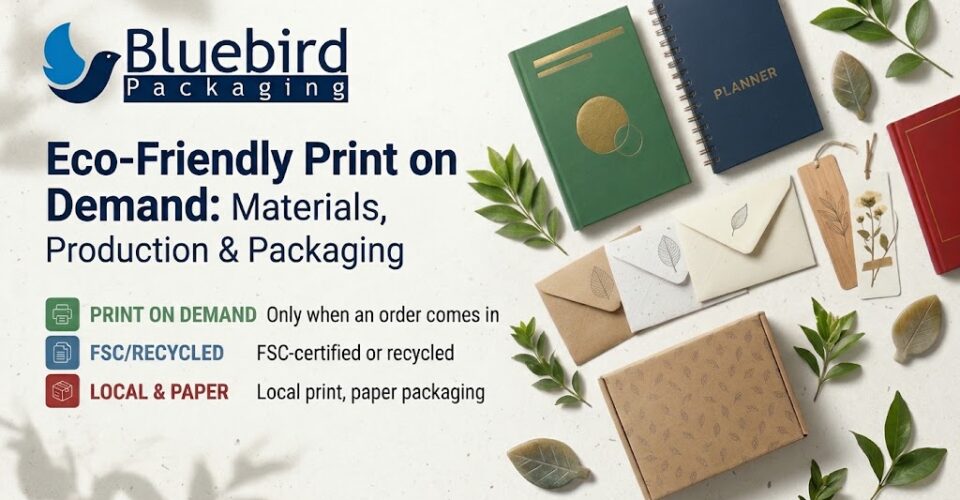
Print on demand gives businesses and creators a way to produce books, journals, stationery, artwork, apparel, and other printed products only after an order is placed. Unlike traditional bulk manufacturing, this model can reduce the need to keep large quantities of unsold inventory. However, producing items only when customers order does not automatically make a business sustainable.
The environmental impact of eco-friendly print on demand depends on several connected decisions, including paper sourcing, printing technology, ink selection, production methods, product durability, and packaging. Shipping distance, protective materials, and the amount of packaging used also influence the overall footprint of an order.
Businesses can make more responsible choices by selecting appropriate recycled or responsibly sourced materials, reducing unnecessary production waste, choosing suitable printing methods, and using packaging that protects products without excessive material.
This guide explains how sustainable print-on-demand production works, which materials and printing methods to consider, and how businesses can make better packaging and shipping decisions.
Quick Overview: What Makes Print on Demand More Eco-Friendly?
| Area | More Responsible Approach | Why It Matters |
|---|---|---|
| Production | Print products after orders are received | Can reduce unsold inventory |
| Paper | Recycled or responsibly sourced paper | Helps reduce demand for virgin fiber |
| Printing | Efficient production methods | Can help limit material and energy waste |
| Inks | Suitable water-based or lower-impact inks | May reduce certain environmental concerns |
| Finishing | Avoid unnecessary coatings and laminations | Can improve material recovery options |
| Packaging | Recyclable paperboard, kraft, or corrugated materials | Supports practical packaging choices |
| Shipping | Right-sized packaging and efficient fulfillment | Can reduce excess material and shipping volume |
1. What Is an Eco-Friendly Print on Demand?
Eco-friendly print on demand is an approach to producing customized or printed products with greater consideration for material use, waste, energy consumption, and packaging. Products are generally manufactured after a customer places an order instead of being produced in large quantities in advance.
This production model can help businesses avoid overstocking and reduce the risk of unsold products becoming waste. It also allows brands to test new designs and product variations without committing to large production runs.
However, print on demand is not automatically environmentally friendly. A product may still use virgin paper, energy-intensive printing, plastic-based finishes, excessive packaging, or long-distance shipping.
A more responsible print-on-demand process considers the entire product journey:
- Material sourcing: Selecting paper, board, fabric, or other materials with suitable environmental credentials.
- Printing: Choosing efficient equipment, processes, and inks.
- Finishing: Limiting unnecessary coatings, laminations, and decorative treatments.
- Production planning: Managing errors, test prints, and rejected products.
- Packaging: Using suitable protective materials and avoiding unnecessary layers.
- Fulfillment: Considering shipping distance, package dimensions, and delivery methods.
The goal is not simply to label a product sustainable. It is to make measurable improvements throughout its production and delivery process.
2. Is Print on Demand Actually Sustainable?

Print on demand can offer environmental advantages, but its actual impact depends on how a business manages production and fulfillment.
Reduced Unsold Inventory
Traditional manufacturing often requires businesses to estimate demand and produce stock in advance. If demand is lower than expected, excess inventory may remain in storage or eventually become waste.
Print-on-demand production reduces this particular risk because products are manufactured after orders are received. Businesses can also introduce new designs without producing large quantities upfront.
More Flexible Production
Producing smaller quantities can make it easier to test different product styles, sizes, and designs. Businesses can use customer demand to guide future production instead of relying entirely on forecasts.
However, smaller production runs are not always more resource-efficient. Frequent setup changes, individual shipments, and inefficient equipment use may increase the impact per item.
Potentially Less Storage and Waste
A print-on-demand business may need less warehouse space for finished products because it does not have to maintain large inventories. This can reduce certain storage requirements, although the environmental benefit depends on the production and fulfillment model.
Shipping Can Still Increase Environmental Impact
One important limitation is that print-on-demand orders may be shipped individually. Multiple small shipments can require more packaging and transportation than consolidated deliveries.
For this reason, businesses should evaluate production and delivery together. Reducing inventory waste is useful, but it should not come at the cost of excessive packaging or inefficient shipping.
3. Sustainable Materials for Print on Demand
Material selection is one of the most important decisions in sustainable printing. The right material depends on the product, its intended use, durability requirements, printing quality, and available recycling systems.
Recycled Paper
Recycled paper is made using recovered paper fibers. It can help reduce demand for virgin fiber and give previously used paper another purpose.
It is commonly considered for:
- Journals and notebooks
- Planners and calendars
- Brochures and flyers
- Greeting cards
- Book interiors
- Product inserts
Recycled paper is available in different weights, textures, and finishes. Before selecting it, businesses should check whether the material is suitable for their printing process and whether it provides the appearance and durability their product requires.
Responsibly Sourced Paper
Some businesses prefer paper made from responsibly managed forestry sources. Certifications such as FSC can help buyers identify products that meet specific forest-management or chain-of-custody standards.
A certification should always be verified for the specific material or supplier being used. A company should not describe every product as certified simply because one supplier offers certified paper.
Kraft Paper and Paperboard
Kraft paper and paperboard are widely used in packaging because they can provide a practical balance of strength, appearance, and printability.
They may be suitable for:
- Product sleeves
- Printed inserts
- Shipping boxes
- Retail packaging
- Paper bags
- Protective packaging components
Kraft packaging can also support a natural visual identity. However, brown color alone does not prove that a material is recycled, recyclable, or environmentally preferable. Businesses should check its actual composition and disposal guidance.
Corrugated Board
Corrugated board is commonly used for shipping because its fluted structure provides cushioning and strength. It can help protect printed products during storage and transportation.
It is useful for books, stationery bundles, art prints, and other products that need additional protection. Choosing the correct board strength and box dimensions is important: packaging that is too weak may allow damage, while oversized packaging can use unnecessary material.
Recycled and Alternative Materials
Depending on the product, businesses may also consider recycled cardboard, recycled envelopes, paper-based protective inserts, or other materials with verified environmental information.
There is no single material that works for every print-on-demand product. The best choice is the one that meets the product’s performance requirements while minimizing unnecessary material use.
4. Environmentally Considerate Printing Methods and Inks
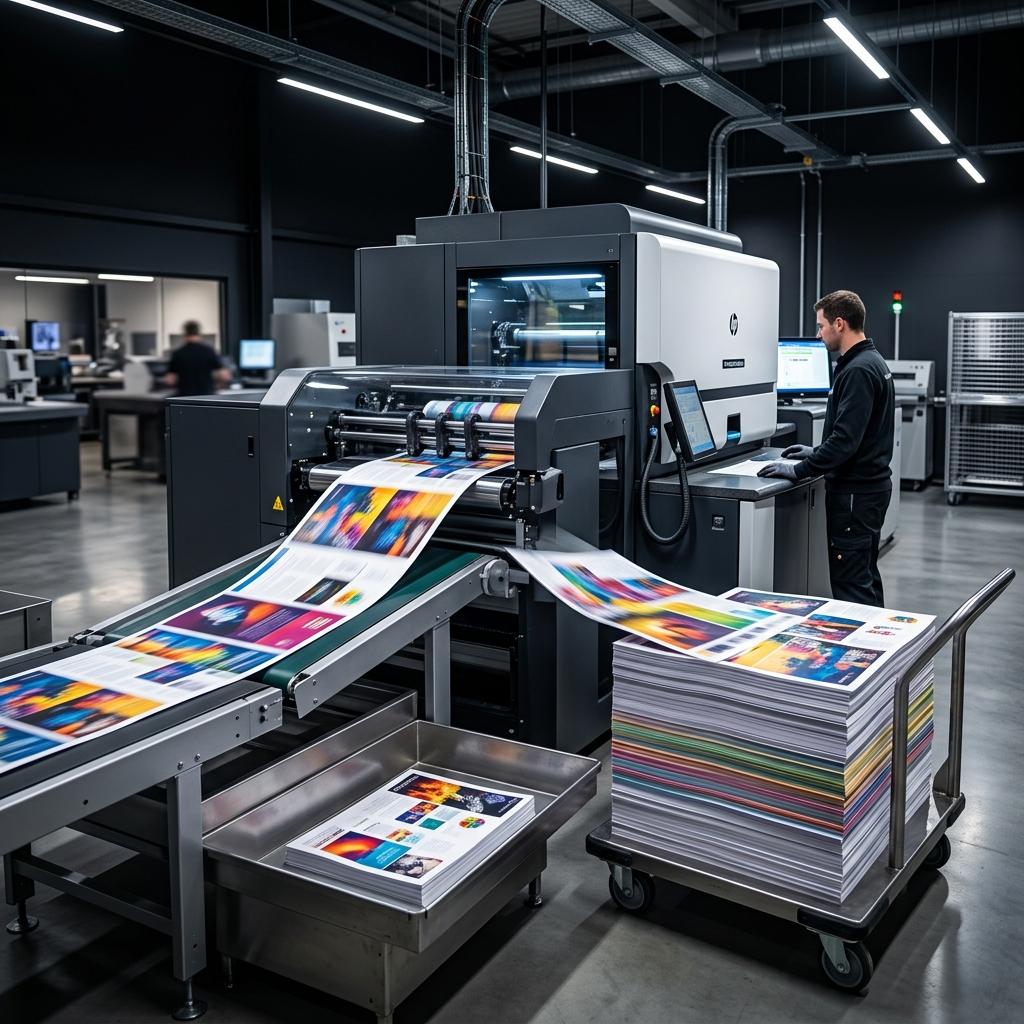
The printing process affects energy use, material consumption, production waste, and the quality of the finished product.
Digital Printing
Digital printing is commonly used for print-on-demand products because it can produce small quantities without requiring traditional printing plates. It is useful for customized orders, short runs, and products with different designs.
Its suitability depends on the equipment, substrate, ink system, production volume, and energy requirements. Businesses should evaluate the complete process rather than assuming that digital printing is always the most sustainable option.
Offset Printing
Offset printing transfers ink from a plate to a surface through an intermediate blanket. It is often used for larger print runs and can deliver consistent results across high quantities.
For print-on-demand businesses, offset printing may be less practical for individual orders because of setup requirements. However, it can be efficient for products with predictable demand and larger production volumes.
Water-Based Inks
Water-based inks use water as a major carrier and may be suitable for certain printing applications. Their environmental performance still depends on the complete formulation, printing equipment, drying requirements, and wastewater management.
Businesses should request technical information from suppliers instead of assuming that every water-based ink is harmless or suitable for all materials.
Soy-Based and Vegetable-Based Inks
Some printing suppliers offer inks made partly from soy or other vegetable oils. These inks may be an alternative to certain petroleum-based formulations.
The actual environmental benefit depends on the complete ink composition, pigments, additives, and end-of-life processing. A vegetable-based label alone does not guarantee that a printed product is recyclable or biodegradable.
Reduce Unnecessary Finishing
Gloss coatings, laminations, metallic effects, and other finishes can change the appearance and durability of printed products. Some finishes may also make paper recovery more difficult.
Businesses should choose finishing treatments according to the product’s purpose. If a simple uncoated surface provides enough protection and print quality, adding several decorative layers may not be necessary.
5. Sustainable Production and Manufacturing Practices
Material selection is only one part of responsible print production. How a product is manufactured can also affect its environmental impact.
Print According to Actual Demand
The central benefit of print on demand is that production can be linked to confirmed orders. Businesses should use order data to plan production and avoid unnecessary stock.
Reduce Test Prints and Production Errors
Incorrect colors, poor alignment, damaged sheets, and finishing mistakes can create avoidable waste.
Businesses can reduce these issues by:
- Checking artwork before sending it to production.
- Confirming dimensions and bleed settings.
- Using digital proofs where appropriate.
- Maintaining printing equipment.
- Following consistent quality-control procedures.
- Reviewing recurring production errors.
Improve Production Efficiency
Efficient equipment settings, maintenance, workflow planning, and suitable production scheduling can help reduce unnecessary energy and material use.
Suppliers should be able to explain their production practices when sustainability is an important purchasing requirement.
Consider Local or Regional Production
Producing closer to the customer may reduce transportation distance and delivery complexity. However, location alone does not determine the environmental impact of a product.
Businesses should also consider production efficiency, material sourcing, shipment consolidation, and the delivery method.
6. Eco-Friendly Print on Demand Products
Different printed products have different material and durability requirements. A material that works well for a notebook may not be suitable for a shipping box or a large-format art print.
| Product | Material Considerations | Practical Sustainability Focus |
|---|---|---|
| Books | Recycled or responsibly sourced paper | Durable binding and appropriate paper weight |
| Journals | Recycled paper and suitable covers | Avoid unnecessary decorative layers |
| Greeting Cards | Recycled or responsibly sourced cardstock | Use recyclable finishes where practical |
| Posters and Art Prints | Suitable paper with reliable print quality | Protect prints without excessive plastic |
| Planners | Paper and durable binding materials | Produce according to actual demand |
| Packaging Inserts | Kraft or paperboard | Use only necessary inserts |
| Product Boxes | Cardboard or corrugated board | Match box size to product dimensions |
Books and Notebooks
Books and notebooks need paper that supports comfortable writing or reading, consistent printing, and appropriate durability. Recycled paper may be suitable for many applications, but its texture, opacity, and weight should be tested before production.
A well-made book that remains useful for a long time may also avoid premature replacement.
Greeting Cards and Stationery
Greeting cards, invitations, and stationery can often be produced using recycled or responsibly sourced cardstock. Businesses should consider whether coatings, foils, adhesives, or mixed-material decorations affect the product’s recyclability.
Posters and Art Prints
Art prints need a surface that can reproduce colors and details accurately. The paper should be selected according to the artwork, display conditions, and customer expectations.
Protective packaging is equally important because bent corners, moisture, or surface damage can turn a successful print into a rejected product.
Planners and Calendars
Planners and calendars often contain multiple pages, binding components, and covers. Businesses can review paper weight, binding methods, and production quantities to reduce unnecessary material use without compromising usability.
7. Eco-Friendly Product Packaging and Shipping
Packaging is an important part of the print-on-demand process because printed products can be vulnerable to bending, moisture, scratches, and impact during transportation.
A responsible packaging strategy should protect the product while avoiding unnecessary layers and oversized containers.
Choose Packaging According to Product Requirements
Different printed products need different levels of protection.
- Books and notebooks: Use appropriately sized cardboard or corrugated packaging to protect covers and corners.
- Art prints and posters: Consider rigid mailers or protective tubes depending on the print dimensions and shipping conditions.
- Greeting cards: Use suitable envelopes or compact paperboard packaging.
- Stationery bundles: Use a fitted box or protective sleeve to keep items organized.
- Fragile printed products: Add suitable cushioning where necessary to prevent damage.
The aim is to avoid both under-packaging and over-packaging. Insufficient protection can lead to damaged orders and replacements, while excessive packaging increases material use.
Consider Recyclable Paper-Based Packaging
Paperboard, kraft, and corrugated materials are common packaging options for printed products. Their suitability depends on the product’s weight, size, fragility, and shipping environment.
Businesses can explore kraft packaging options for products that suit paper-based packaging, or consider corrugated boxes when additional shipping protection is required.
Use Right-Sized Packaging
A box should fit the product and any necessary protective materials without leaving excessive empty space.
Right-sized packaging can help businesses:
- Reduce unnecessary packaging material.
- Improve product stability during transit.
- Make storage and handling easier.
- Use shipping space more efficiently.
Accurate product measurements are essential when selecting packaging dimensions.
Add Protective Inserts Only When Needed
Inserts can prevent movement and help keep multiple items organized. However, every insert should serve a clear purpose.
For example, a stationery set may need a paperboard divider to separate products, while a single notebook may only require a suitable outer box. Choose inserts based on the risk of damage and the product’s presentation requirements.
Make Shipping Decisions Carefully
Shipping practices should be considered alongside packaging. Businesses can review fulfillment locations, delivery methods, shipment consolidation opportunities, and package dimensions.
A lightweight package is not automatically better if it fails to protect the product. Avoiding damage and repeat shipments is also an important part of responsible fulfillment.
For businesses looking for customized packaging, Bluebird Packaging offers packaging options that can be selected according to product dimensions, material requirements, and branding needs.
8. How to Choose a Sustainable Print on Demand Supplier
A supplier’s sustainability claims should be evaluated through specific information rather than general marketing language.
Before choosing a print-on-demand provider, ask questions about materials, production, waste management, and packaging.
Questions to Ask a Supplier
- What paper and board materials are available?
- Can you provide documentation for recycled-content or forestry certifications?
- Which printing technologies and ink systems do you use?
- How do you manage rejected prints and production waste?
- Are coatings and laminations optional?
- What packaging materials are used for shipping?
- Can you offer right-sized packaging?
- Where are products manufactured and fulfilled?
- Can you provide details about relevant environmental certifications?
- Are sustainability claims supported by current documentation?
Review Certifications and Documentation
Certifications can help businesses evaluate specific environmental or operational standards. However, each certification has a defined scope.
For example, a forestry certification may relate to the sourcing or chain of custody of paper materials. It does not automatically certify the printing process, packaging, shipping, or the entire finished product.
Ask suppliers to identify exactly which materials, facilities, and processes are covered by their documentation.
Compare More Than Price
A lower unit price may not represent the best overall value if a product has poor durability, creates more waste, or requires frequent replacements.
Compare suppliers based on material quality, print consistency, production efficiency, packaging suitability, delivery performance, and verified environmental information.
9. Common Sustainability Mistakes to Avoid
Businesses sometimes make sustainability claims without checking the complete product or production process. Avoiding a few common mistakes can make environmental decisions more credible.
Assuming Print on Demand Is Automatically Sustainable
Producing only after an order is placed can reduce unsold inventory, but it does not eliminate the environmental impact of materials, energy, packaging, and transportation.
Treating All Recycled Materials as Identical
Recycled content, quality, durability, and suitability can vary. Select materials according to the product’s actual requirements and request reliable specifications.
Using Too Much Packaging
Multiple boxes, plastic sleeves, unnecessary inserts, and excessive void fill can increase material use. Review each packaging layer and keep only what is needed for protection and presentation.
Ignoring Product Durability
A product that tears, bends, or wears out quickly may need to be replaced. Durability should be considered alongside recycled content and material sourcing.
Making Unsupported Green Claims
Terms such as “100% eco-friendly,” “zero impact,” and “completely sustainable” can be misleading if they are not supported by clear evidence.
Businesses should use precise descriptions, such as “made with recycled paper content” or “packaged in corrugated board,” only when those statements are accurate and documented.
10. Frequently Asked Questions
Is print on demand better for the environment?
Print on demand can reduce the need for large inventories and may help limit unsold products. Its overall environmental impact still depends on materials, production methods, packaging, and shipping.
What materials are best for eco-friendly print on demand?
Recycled paper, responsibly sourced paper, kraft paperboard, and corrugated board may be suitable options. The best choice depends on the product’s printing, durability, protection, and disposal requirements.
Are recycled paper products always more sustainable?
Not necessarily. Recycled paper can reduce demand for virgin fibers, but its overall impact also depends on manufacturing, transportation, quality, and the recycling process. Compare the available material information before making a decision.
Are water-based inks environmentally friendly?
Water-based inks may offer advantages in certain applications, but their environmental performance depends on the complete formulation, printing process, and waste management. Ask the printing supplier for technical details.
How can print-on-demand businesses reduce packaging waste?
Businesses can use right-sized boxes, avoid unnecessary packaging layers, select suitable paper-based materials, and add protective inserts only when needed. Packaging must still protect products during transportation.
Does local print-on-demand production reduce carbon emissions?
Local production may reduce transportation distances, but it does not guarantee lower total emissions. Production efficiency, energy sources, materials, and shipping methods should also be considered.
What should I look for in a sustainable print-on-demand supplier?
Review material specifications, relevant certifications, printing methods, production waste management, packaging choices, and fulfillment locations. Ask for documentation to support environmental claims.
Conclusion
Eco-friendly print on demand requires more than producing items after customers place orders. Businesses need to consider material sourcing, printing methods, production efficiency, product durability, packaging, and shipping as connected parts of the process.
Recycled or responsibly sourced paper, suitable inks, efficient production, and right-sized packaging can help businesses make more informed decisions. The most effective approach is to select materials and processes that meet product requirements while reducing unnecessary waste.
For brands that need customized packaging for printed products, books, stationery, and retail items, choosing the right box structure and material is an important next step. Explore custom packaging solutions from Bluebird Packaging or request a packaging quote to discuss suitable options for your products.