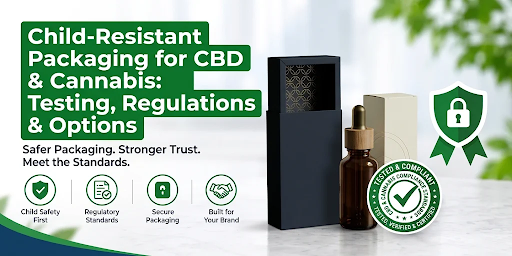
Packaging safety is one of the most important considerations for businesses manufacturing and selling CBD, cannabis, and hemp-derived products. From cannabis gummies and CBD oils to vape cartridges, concentrates, and dried flowers, these products require packaging that protects their contents while reducing the risk of accidental access by young children. This is why Child Resistant Packaging plays such an important role in the cannabis and CBD industries.
However, selecting secure packaging involves more than choosing a strong container or difficult-to-open lid. Businesses must understand applicable regulations, testing procedures, packaging materials, closure mechanisms, labeling requirements, and product-specific safety standards. A package that looks difficult to open is not automatically considered child-resistant. It must meet the applicable performance requirements and be supported by appropriate testing documentation.
For US businesses, the Poison Prevention Packaging Act (PPPA) and the Consumer Product Safety Commission’s regulations under 16 CFR Part 1700 provide an important framework for special packaging. Cannabis-specific packaging requirements are also established by individual states, which may have different rules for edibles, flower, concentrates, tinctures, and other products.
This guide explains how child-resistant packaging works, what testing standards businesses should understand, which CBD and cannabis packaging options are available, and how to evaluate suppliers before ordering custom packaging.
Quick Answer: What Is Child-Resistant Packaging?
Child-resistant packaging is specially designed packaging that makes it significantly difficult for children under five years old to open while remaining reasonably usable by adults. Under the US federal testing framework, at least 85% of tested children must be unable to open the package during the first five minutes, and at least 80% must remain unable to open it during the full ten-minute test. At least 90% of tested adults must be able to use the package successfully under the applicable adult testing procedure. Cannabis and CBD packaging requirements depend on the product and the jurisdiction where it is sold.
For CBD and cannabis businesses, common options include tested push-and-turn caps, squeeze-and-turn closures, child-resistant zipper bags, specialized containers, and locking packaging systems. The complete packaging configuration must meet the relevant requirements; an ordinary resealable bag or standard cardboard box is not automatically child-resistant.
1. Why Is Child-Resistant Packaging Important for CBD and Cannabis Products?
CBD and cannabis products come in different forms, including oils, gummies, capsules, tinctures, concentrates, vape cartridges, and dried flowers. Some products may contain THC or other compounds that can create serious health risks if accidentally consumed by children.
Child-resistant cannabis packaging helps reduce accidental access while allowing adults to open, use, and properly secure the package.
There are several reasons why businesses should prioritize appropriate packaging.
Protecting Children From Accidental Exposure
Cannabis edibles, infused gummies, and other products can resemble ordinary food or confectionery. Children may mistake them for regular snacks if packaging is poorly designed.
A properly tested child-resistant closure adds an additional barrier between children and potentially harmful contents.
Supporting Cannabis Packaging Compliance
Licensed cannabis businesses may need to follow specific state or national packaging requirements. Depending on the jurisdiction, these may include child-resistant closures, tamper-evident seals, resealability, opacity, warnings, and mandatory product information.
Maintaining Product Quality
Packaging also helps protect CBD and cannabis products from external factors such as moisture, contamination, leakage, and physical damage.
For example, CBD oils need compatible containers and secure closures, while cannabis flowers may require packaging that helps maintain suitable storage conditions.
Businesses developing product-specific solutions can explore custom CBD packaging options to understand how packaging structure, materials, and presentation work together.
Building Consumer Confidence
Consumers expect regulated products to be packaged responsibly. Appropriate closures, clear instructions, and suitable warning information demonstrate that a business considers product safety an important part of its operations.
2. Child-Resistant Packaging Regulations and Standards
Understanding Child Resistant Packaging Standards is essential before selecting a packaging supplier. Different regulations and testing standards address different aspects of packaging performance.
The following frameworks are particularly important for businesses selling regulated products.
2.1 Poison Prevention Packaging Act (PPPA)
The Poison Prevention Packaging Act of 1970 establishes requirements for special packaging intended to protect children from accidental exposure to certain regulated substances.
The US Consumer Product Safety Commission (CPSC) administers the relevant requirements under 16 CFR Part 1700.
The purpose of the PPPA is to ensure that covered substances are packaged in containers that are significantly difficult for young children to open while remaining accessible to adults.
An important distinction for cannabis and CBD brands is that the federal PPPA does not impose one blanket child-resistant packaging requirement on every cannabis or hemp-derived CBD product. State cannabis laws and other applicable product regulations may establish additional or separate obligations.
Businesses should identify the exact product category and applicable market requirements instead of assuming that all CBD products follow identical rules.
Official reference: CPSC – Special Packaging (PPPA) FAQs.
2.2 16 CFR 1700.15: Child-Resistant Packaging Performance
Section 1700.15 establishes performance requirements for special packaging.
Under the relevant child-resistance criteria:
- At least 85% of tested children must be unable to open the package during the initial five-minute period.
- At least 80% must remain unable to open it during the full ten-minute test.
- At least 90% of tested adults must be able to open and use the package successfully under the applicable adult testing procedure.
These requirements help establish a balance between child resistance and adult usability.
A package should not simply be extremely difficult for everyone to open. It must provide the required level of protection while remaining practical for intended adult users.
2.3 16 CFR 1700.20: Child-Resistant Packaging Testing
Section 1700.20 describes the testing procedures used to evaluate child-resistant packaging.
The testing process includes two main groups.
Child Testing: Children between 42 and 51 months of age participate in the child panel. They are given an initial five-minute opportunity to open the package. A demonstration of the opening method follows, and they receive an additional five minutes.
Adult Testing: Adults between 50 and 70 years of age participate in the adult-use evaluation. The testing examines whether adults can open the package using its instructions and, where applicable, properly secure it.
The testing procedure evaluates actual package performance rather than relying on a manufacturer’s visual assessment or informal demonstrations.
Official reference: Electronic Code of Federal Regulations – 16 CFR Part 1700.
2.4 ASTM D3475: Classification of Child-Resistant Packages
ASTM D3475 is an industry standard used to classify different types of child-resistant packaging.
It describes package designs according to their opening mechanisms and the actions required to access the contents.
Examples include packaging that requires coordinated movements, specialized closures, or other opening mechanisms.
However, ASTM D3475 is a classification standard, not automatic proof that a particular container has passed the required child-resistant performance testing.
Businesses should request supporting test documentation for the exact packaging configuration they intend to purchase.
Official reference: ASTM D3475 – Standard Classification of Child-Resistant Packages.
2.5 ISO 8317: International Child-Resistant Packaging Standard
ISO 8317:2015 establishes requirements and testing procedures for reclosable child-resistant packaging.
It considers whether packaging can restrict children’s access while remaining usable by adults.
This standard can be relevant to businesses operating in international markets or sourcing packaging for products sold in different countries.
However, ISO testing should not automatically be treated as a substitute for US regulatory requirements. Businesses must confirm which standards are accepted in their target market.
Official reference: ISO 8317:2015.
3. Child-Resistant Cannabis Packaging Requirements by Market
Cannabis Packaging Requirements can differ significantly depending on where products are manufactured, distributed, and sold.
A package that meets the requirements of one state may not satisfy another jurisdiction’s rules. Therefore, businesses should review the regulations applicable to every market they serve.
California Cannabis Packaging Requirements
California provides a useful example of product-specific child-resistant packaging rules.
Under California Code of Regulations, Title 4, Section 17412:
- Edible cannabis products, orally consumed concentrates, and suppositories generally require child-resistant packaging throughout the product’s life.
- Inhaled cannabis products and topical products may use packaging that is child-resistant only until first opening, provided the required warning appears.
- Certain single-serving packages may qualify for specific exceptions.
- Plastic packaging at least four mils thick and heat-sealed without an easy-open tab, dimple, corner, or flap may qualify under the conditions specified in the regulation.
California also addresses tamper evidence, resealability, and packaging that imitates products typically marketed to children.
For qualifying single-use packaging, the required statement is:
“This package is not child-resistant after opening.”
Businesses should review the complete regulation because eligibility depends on product type and packaging configuration.
Official references:
Canada Cannabis Packaging Requirements
Canada has a separate framework under the Cannabis Act and Cannabis Regulations.
Health Canada requires cannabis products, except cannabis plants and cannabis plant seeds, to be packaged in child-resistant immediate containers.
The rules also address security features, product protection, labeling, and restrictions on packaging appeal to young people.
Canadian requirements differ from US state regulations. Businesses selling in Canada should review the Canadian rules independently rather than assuming that US packaging documentation is sufficient.
Official reference: Health Canada – Packaging and Labelling Guide for Cannabis Products.
What Should Businesses Check Before Selling?
Before selecting packaging for a regulated cannabis product, confirm:
- Which federal, state, or national regulations apply?
- Does the product require initial-use or lifetime child resistance?
- Is tamper-evident packaging mandatory?
- Must the package be opaque?
- Does it need to be resealable?
- Are there specific warning statements or symbols?
- What testing documentation must the business maintain?
These checks help prevent packaging decisions based on incorrect assumptions.
4. How Does Child-Resistant Packaging Testing Work?
Child Resistant Packaging Testing evaluates whether a package can restrict access by young children while remaining usable for adults.
A manufacturer cannot establish compliance simply by demonstrating that a package is difficult to open. The applicable testing protocol must be followed.
Step 1: Select the Packaging Configuration
The first step is choosing the container, closure, material, dimensions, and opening mechanism.
Examples include:
- Push-and-turn bottle caps.
- Squeeze-and-turn closures.
- Tested resealable pouches.
- Specialized locking containers.
- Child-resistant packaging systems.
The complete package matters because changing the container or closure may affect performance.
Step 2: Prepare Test Samples
The testing organization prepares samples that represent the packaging configuration intended for production.
Material thickness, dimensions, closure components, liners, and other structural details should match the proposed final design.
Step 3: Conduct the Child Panel Test
Children aged 42–51 months participate in the prescribed testing procedure.
They receive an initial opportunity to open the package for five minutes. Afterward, the tester demonstrates the opening method and the children receive another five-minute opportunity.
The results are compared with the applicable child-resistance acceptance criteria.
Step 4: Conduct the Adult Panel Test
Adults aged 50–70 are evaluated to determine whether they can open the package properly.
For reclosable packages, the procedure also examines whether adults can correctly close and resecure the container.
Step 5: Review the Results
The testing organization evaluates the results against the relevant regulatory requirements.
If the packaging does not achieve the required performance, the design may need to be revised and tested again.
Step 6: Maintain the Test Documentation
Businesses should retain the relevant testing report and package specifications.
The documentation should identify the actual package design that was evaluated, including its closure and other important components.
5. What Does Certified Child Resistant Packaging Mean?
Certified Child Resistant Containers are packaging systems supported by appropriate testing documentation demonstrating that the tested configuration meets applicable child-resistant performance requirements.
However, businesses should be careful when interpreting the term “certified.”
A generic supplier certificate, marketing statement, or product photograph does not automatically establish compliance.
Before purchasing packaging, request the relevant documents.
Documents to Request From a Supplier
| Document | Why It Matters |
|---|---|
| Child-resistant testing report | Shows the tested performance |
| Testing standard | Identifies the procedure used |
| Laboratory details | Helps identify the testing organization |
| Package specifications | Confirms dimensions and materials |
| Closure specifications | Identifies the tested opening mechanism |
| Adult usability results | Supports practical package use |
| Reclosure results | Important for reusable packaging |
| Configuration details | Helps match the tested design to production |
The exact package you order should correspond to the configuration covered by the supporting documentation.
For example, if a pouch was tested using one specific zipper mechanism, changing the zipper or film construction may affect whether the existing test results remain applicable.
Similarly, testing one bottle-and-cap combination does not automatically establish compliance for every bottle using the same cap.
6. Types of Child-Resistant Packaging for CBD and Cannabis Products
Businesses have several packaging formats to consider, depending on the product, storage requirements, and applicable regulations.
The following options are commonly evaluated when developing CBD and cannabis packaging.
6.1 Push-and-Turn Caps
Push-and-turn caps require the user to press down while rotating the closure.
This coordinated movement helps restrict access by young children while allowing adults to operate the container.
Common applications:
- CBD oil bottles.
- Cannabis tinctures.
- Selected liquid products.
- Compatible containers requiring repeated access.
Important considerations include bottle compatibility, closure threads, sealing performance, dispensing requirements, and opening instructions.
6.2 Squeeze-and-Turn Closures
Squeeze-and-turn closures require users to apply pressure at designated points while rotating the cap.
The opening mechanism requires coordinated movement, which can make access more difficult for young children.
These closures may be suitable for selected bottles and containers, provided the complete configuration meets the applicable testing requirements.
6.3 Resealable Child-Resistant Bags
Resealable Child Resistant Packaging Bags combine flexible packaging materials with specialized zipper or locking mechanisms.
They can be useful for cannabis flower, edible products, and other compatible products.
Important design considerations include:
- Tested zipper mechanism.
- Suitable film construction.
- Reliable heat-sealed edges.
- Moisture and odor barrier performance.
- Reclosure functionality.
- Clear opening instructions.
An ordinary zipper pouch is not automatically child-resistant. The exact bag and closure combination must have appropriate supporting test evidence.
6.4 Child-Resistant Mylar Bags
Child Resistant Mylar Bags combine multilayer flexible films with specialized closure mechanisms.
They can offer a lightweight packaging option for compatible products while providing opportunities for custom printing.
Potential benefits include:
- Flexible dimensions.
- Barrier protection.
- Custom branding.
- Lightweight transportation.
- Resealable designs.
However, Mylar material itself does not make a package child-resistant. The complete construction and opening mechanism must meet the relevant requirements.
For brands planning flexible cannabis packaging, custom CBD cartridge packaging provides another useful product-specific reference.
6.5 Child-Resistant Rigid Containers
Rigid containers offer a more structured packaging format and can incorporate specialized lids, locking components, and protective inserts.
They may be suitable for selected concentrates, compatible CBD products, and products that need additional physical protection.
Possible features include:
- Specialized locking lids.
- Durable container construction.
- Secure inner compartments.
- Protective inserts.
- Compatible tamper-evident seals.
A conventional rigid box or ordinary plastic container should not be assumed to qualify as child-resistant.
6.6 Child-Resistant Folding Cartons and Sliding Boxes
Some specialized carton and sliding-box designs incorporate locking mechanisms that require specific opening movements.
These formats can provide space for branding and product information while supporting a suitable secondary packaging structure.
However, ordinary tuck-end boxes, magnetic closure boxes, and standard folding cartons are not automatically child-resistant.
The complete design must be evaluated against the applicable requirements.
6.7 Blister and Unit-Dose Packaging
Blister and unit-dose packaging can separate individual portions and help control product access.
Depending on the applicable regulation, the individual unit, the outer package, or both may need to provide child-resistant protection.
Businesses should determine the exact testing and packaging requirements before selecting this format.
7. Best Child-Resistant Packaging for Different CBD and Cannabis Products
The best packaging depends on the product’s physical properties, serving format, storage conditions, and regulatory requirements.
| Product | Packaging Options to Evaluate | Key Considerations |
|---|---|---|
| CBD Oils | Bottles with tested push-and-turn closures | Leakage and product compatibility |
| CBD Gummies | Tested resealable pouches or containers | Serving protection and resealability |
| Cannabis Flower | Tested bags or rigid containers | Moisture protection and applicable rules |
| Vape Cartridges | Compatible tested containers | Product protection and tamper evidence |
| CBD Tinctures | Bottles with suitable tested closures | Dispensing and repeated use |
| Cannabis Concentrates | Specialized tested jars or containers | Product compatibility and secure storage |
| CBD Capsules | Tested bottles or unit-dose formats | Serving control and closure performance |
| Topical CBD Products | Compatible tubes, jars, or containers | Product integrity and local regulations |
Child-Resistant Packaging for CBD Gummies
CBD gummies require particular attention because they may resemble ordinary confectionery products.
Businesses should consider packaging that provides suitable access control without using graphics or designs that appeal to children.
Important considerations include:
- Tested resealable closures.
- Appropriate serving protection.
- Product-compatible barrier materials.
- Clear product identification.
- Applicable warnings and labeling.
Brands exploring this product category can review custom gummies boxes for packaging ideas.
Child-Resistant Packaging for Cannabis Flower
Cannabis flower packaging often focuses on protecting the product from moisture, contamination, and unnecessary exposure.
Businesses can evaluate compatible pouches and rigid containers with suitable tested closure systems.
The final choice should reflect the requirements of the relevant jurisdiction, including whether the package needs single-use or lifetime child resistance.
Explore custom cannabis flower packaging for product-specific packaging solutions.
Child-Resistant Packaging for CBD Oils and Tinctures
CBD oils and tinctures commonly use bottles with specialized closures.
Businesses should consider the bottle material, dispensing mechanism, closure compatibility, leakage protection, and relevant testing documentation.
Related packaging options include CBD oil boxes and custom CBD tincture boxes.
Child-Resistant Packaging for Vape Cartridges
Vape cartridges require packaging that protects delicate components during handling and transportation.
Depending on the applicable market, the primary container, secondary packaging, or both may need to satisfy specific requirements.
Explore CBD vape oil cartridge boxes for a product-specific packaging direction.
Child-Resistant Packaging for Cannabis Concentrates
Concentrates, wax, and similar products may require specialized containers that support product protection and appropriate access control.
Businesses should evaluate closure performance, material compatibility, leakage protection, and repeated opening requirements.
Custom CBD dab wax boxes can also be considered when planning secondary packaging.
8. Difference Between Child-Resistant and Tamper-Evident Packaging
Child-resistant and tamper-evident packaging serve different safety purposes.
Although both features may be required for certain cannabis products, one does not automatically replace the other.
| Comparison | Child-Resistant Packaging | Tamper-Evident Packaging |
|---|---|---|
| Main Purpose | Restricts children’s access | Shows evidence of initial opening |
| Main Function | Uses a tested opening mechanism | Makes interference visible |
| Common Examples | Push-and-turn caps and tested locking pouches | Shrink bands and security seals |
| Reuse | May be single-use or reclosable | Usually provides evidence of first opening |
| Testing | Applicable child-resistance testing | Depends on product and regulatory requirements |
What Is Tamper-Evident Packaging?
Tamper-evident packaging is designed to show whether a product package has been opened or disturbed before purchase.
Common examples include:
- Shrink bands.
- Breakable seals.
- Security stickers.
- Heat-sealed pouches.
- Induction seals.
- Destructible labels.
For cannabis products where both features are required, businesses should select packaging that provides both functions.
A shrink band does not automatically make a package child-resistant, and a tested child-resistant closure does not necessarily provide tamper evidence.
Businesses can also explore packaging testing and quality evaluation to better understand how packaging performance is assessed.
9. Senior-Friendly Child-Resistant Packaging
Child-resistant packaging must also consider adult usability, especially for older consumers and people with limited hand strength or dexterity.
A package that is extremely difficult for everyone to open may create unnecessary usability problems.
This is why the federal testing framework includes adult-use evaluations.
Features That Support Adult Usability
Clear Opening Instructions: Simple instructions help consumers understand the correct opening sequence.
Practical Grip Areas: Properly designed surfaces can make closures easier to operate.
Usable Closure Mechanisms: The opening system should provide the required child resistance without unnecessary complexity.
Readable Information: Instructions, warnings, and product details should be easy to understand.
Consistent Performance: The package should function correctly throughout its intended use.
Businesses should not weaken a tested closure simply to make it easier to open. Any structural change should be evaluated against the relevant requirements.
10. How to Choose Compliant Child-Resistant Packaging
Selecting suitable packaging requires more than comparing prices or choosing a popular container style.
Businesses should follow a structured process before approving a design for production.
Step 1: Identify Your Product Type
Determine whether you are packaging CBD oils, cannabis gummies, flower, concentrates, vape cartridges, or topical products.
Each product may have different storage and regulatory requirements.
Step 2: Identify Your Target Market
Review the regulations in the states or countries where the product will be sold.
Do not assume that a package approved in one jurisdiction automatically meets the requirements of another.
Step 3: Determine the Required Child-Resistance Type
Identify whether your product requires:
- Initial-use child-resistant packaging.
- Lifetime reclosable child-resistant packaging.
- Individual serving protection.
- A particular tested closure or container.
Step 4: Select Compatible Materials
Material selection should consider product compatibility, moisture exposure, durability, barrier performance, and printing requirements.
Businesses can explore different packaging material types before selecting the final structure.
Step 5: Verify Testing Documentation
Request the relevant testing report and confirm that it covers the exact package configuration.
Check the container, closure, dimensions, materials, and applicable testing standard.
Step 6: Evaluate Tamper Evidence and Labeling
Determine whether your product needs tamper-evident features, opacity, resealability, mandatory warnings, or other labeling elements.
Step 7: Review the Final Production Design
Changes to materials, closures, or construction may affect package performance.
Confirm with the testing organization or qualified compliance professional whether any modification requires further evaluation.
Step 8: Maintain Manufacturing Consistency
The production package should match the tested design.
Maintain clear packaging specifications and communicate them to the manufacturer before approving bulk production.
11. Common Child-Resistant Packaging Compliance Mistakes
Even experienced businesses can make mistakes when developing cannabis and CBD packaging.
Understanding these problems can help prevent unnecessary production costs and regulatory issues.
1. Assuming Every Secure-Looking Package Is Child-Resistant
A thick cardboard box, strong adhesive, or ordinary screw-top lid does not automatically qualify as child-resistant.
Solution: Request relevant testing documentation for the complete packaging configuration.
2. Using an Untested Resealable Bag
An ordinary zipper pouch may be convenient but may not satisfy child-resistance requirements.
Solution: Confirm that the specific bag construction and closure have appropriate supporting test results.
3. Ignoring Reclosure Requirements
Certain products require packaging that maintains child-resistant performance after repeated opening and closing.
Solution: Determine whether lifetime child resistance is required for the product.
4. Confusing Tamper Evidence With Child Resistance
A sealed package may show whether it has been opened without restricting a child’s ability to access the contents.
Solution: Evaluate both functions independently.
5. Modifying the Tested Package Design
Replacing a cap, changing film thickness, or altering a locking mechanism can affect performance.
Solution: Consult the testing organization before making changes to an approved configuration.
6. Ignoring Product-Specific Regulations
Packaging rules for edibles may differ from those for inhaled products, topicals, or single-serving products.
Solution: Review the applicable regulations for each product category.
7. Using Child-Attractive Artwork
Cartoon characters, candy-like graphics, and designs resembling products marketed to children can create regulatory concerns.
Solution: Use responsible branding and professional packaging designs that do not appeal to children.
8. Failing to Maintain Compliance Records
Businesses may struggle to demonstrate compliance if they cannot provide relevant testing reports and package specifications.
Solution: Maintain organized documentation for every approved packaging configuration.
12. How Custom Packaging Supports CBD and Cannabis Brands
Regulatory compliance is essential, but packaging presentation also influences how consumers recognize and perceive a brand.
Custom packaging gives businesses opportunities to create consistent branding while considering structural and functional requirements.
However, printing, materials, and decorative finishes must never interfere with the tested closure or mandatory labeling.
Custom Printing and Branding
Professional printing allows brands to display their product information, brand identity, and applicable labeling elements.
Businesses should ensure that required warnings and regulatory information remain clear and legible.
Explore custom CBD isolate boxes when developing product-specific secondary packaging.
Material Selection
Different products require different material properties.
For example, a CBD oil bottle may need a protective outer carton, while a cannabis edible pouch may require flexible materials with appropriate barrier performance.
Businesses can review packaging material comparison before selecting suitable materials.
Custom Dimensions and Inserts
Custom dimensions help accommodate the actual product and its components.
Protective inserts can also help organize bottles, cartridges, and other products inside secondary packaging.
Explore packaging inserts and their applications when planning protective packaging structures.
Finishing Options
Appropriate printing finishes can improve the presentation of secondary cartons.
Depending on the applicable market, brands can consider suitable matte, gloss, or other finishing options while ensuring that mandatory information remains visible.
Learn more about custom packaging finishes.
Retail Packaging for CBD and Cannabis Products
Secondary packaging can provide space for product identification, instructions, branding, and other permitted information.
Businesses can explore custom retail packaging for suitable secondary packaging applications.
The final structure must still satisfy any applicable regulatory requirements.
13. Wholesale Child-Resistant Cannabis Packaging: What Should Businesses Consider?
Wholesale packaging can help cannabis and CBD brands maintain consistent packaging across different product lines.
However, buying in bulk should not come before verifying the package’s performance and regulatory suitability.
Before placing an order, evaluate the following:
- Minimum order quantity.
- Package dimensions.
- Material specifications.
- Closure compatibility.
- Child-resistant testing documentation.
- Custom printing requirements.
- Mandatory labeling space.
- Production samples.
- Manufacturing consistency.
- Delivery schedules.
- Reorder availability.
A lower-priced package may become more expensive if it requires additional testing, design changes, or replacement after failing to meet the applicable requirements.
Questions to Ask Your Packaging Supplier
- Has the exact packaging configuration undergone child-resistant testing?
- Can you provide the full supporting test report?
- Does the report cover the exact closure and material?
- Is the package suitable for repeated opening and closing?
- Can the design accommodate mandatory warnings and labeling?
- Are production samples available?
- What happens if packaging specifications change?
- Can the manufacturer maintain the same tested configuration during bulk production?
These questions help businesses evaluate suppliers and make more informed purchasing decisions.
14. Child-Resistant Packaging Compliance Checklist
Before approving CBD or cannabis packaging, review the following checklist:
- Identify the product type and target market.
- Review current federal, state, or national regulations.
- Determine whether initial-use or lifetime child resistance is required.
- Select an appropriate tested packaging mechanism.
- Verify the applicable testing standard.
- Request the complete testing report.
- Confirm the tested dimensions and material specifications.
- Review adult usability and reclosure performance.
- Determine whether tamper-evident packaging is required.
- Check opacity and resealability requirements.
- Review mandatory labeling and warning requirements.
- Ensure artwork does not appeal to children.
- Confirm the production package matches the tested configuration.
- Maintain relevant compliance records.
This checklist is a practical starting point and should be used alongside the current regulations applicable to the product and market.
15. Frequently Asked Questions About Child-Resistant Packaging
1. What is child resistant packaging?
Child resistant packaging is specially designed packaging that makes it significantly difficult for children under five years old to open while remaining reasonably accessible to adults. It must meet the applicable testing and performance requirements to support a compliant child-resistant claim.
2. Why is child resistant packaging important for CBD and cannabis products?
It helps reduce the risk of accidental access to cannabis edibles, concentrates, CBD products, and other substances. It can also help businesses satisfy applicable packaging requirements and support responsible product storage.
3. What are the requirements for child resistant cannabis packaging?
Requirements depend on the state or country where the product is sold. They may include tested closures, resealable packaging, tamper evidence, opacity, mandatory warnings, and supporting testing documentation.
4. How is child resistant packaging tested?
Under the US federal testing framework, children aged 42–51 months participate in an initial five-minute test followed by a demonstration and another five-minute attempt. Adults aged 50–70 are also evaluated for package usability and reclosure where applicable.
5. What does certified child resistant packaging mean?
It generally refers to packaging supported by testing documentation demonstrating that the tested configuration meets applicable child-resistant performance requirements. Businesses should verify that the report covers the exact container, closure, dimensions, and materials.
6. Are child resistant and tamper evident packaging the same?
No. Child-resistant packaging makes access more difficult for young children, while tamper-evident packaging provides visible evidence that a package has been opened or disturbed. Some cannabis regulations require both features.
7. What types of child resistant closures are available?
Common options include push-and-turn caps, squeeze-and-turn closures, specialized locking lids, tested zipper pouches, and other mechanisms designed to restrict access. The correct option depends on the product and applicable testing requirements.
8. Does CBD packaging need to be child resistant?
There is no single blanket US federal PPPA requirement covering every CBD product. However, certain states impose child-resistant packaging requirements on specific hemp-derived products. Businesses should review the regulations applicable to their product and market.
9. Can child resistant packaging also be senior friendly?
Yes. Child-resistant packaging is designed to restrict children’s access while remaining usable by adults. The applicable testing framework includes adult-use evaluations to assess opening and reclosure performance.
10. How do businesses choose the right child resistant packaging?
Businesses should identify the product type, review applicable regulations, select a suitable tested closure, verify testing documentation, evaluate material compatibility, and confirm whether tamper evidence, resealability, or special labeling is required.
11. What is the difference between single-use and reclosable child resistant packaging?
Single-use packaging provides child-resistant protection until it is first opened. Reclosable packaging is designed to maintain child-resistant performance after repeated opening and closing. The required format depends on the product and applicable regulations.
12. Are child-resistant Mylar bags automatically compliant?
No. Mylar is a flexible packaging material, not a child-resistant certification. The specific bag construction and closure mechanism must meet the applicable testing and regulatory requirements.
Conclusion
Child-resistant packaging is an important consideration for businesses manufacturing and distributing CBD and cannabis products. Appropriate packaging helps reduce accidental access by young children while supporting adult usability, product protection, and applicable regulatory requirements.
From push-and-turn closures and squeeze-and-turn caps to tested resealable pouches, specialized containers, and locking packaging systems, businesses have several options to evaluate. However, selecting a particular packaging style is only the beginning. The complete package must satisfy the relevant testing and regulatory requirements.
Understanding the Poison Prevention Packaging Act, 16 CFR 1700.15, 16 CFR 1700.20, ASTM D3475, and applicable state-specific cannabis regulations helps businesses make more informed packaging decisions.
The best packaging solution combines verified safety performance, suitable materials, practical usability, and responsible product presentation. By working with knowledgeable packaging manufacturers and maintaining accurate compliance documentation, CBD and cannabis businesses can develop packaging that supports consumer protection and their product requirements.
Develop Custom CBD and Cannabis Packaging With Bluebird Packaging
Looking for packaging solutions for CBD oils, cannabis flower, gummies, vape cartridges, or other products? Bluebird Packaging offers custom packaging options that can be developed around your product dimensions, material preferences, printing requirements, and branding needs.
Discuss your packaging specifications and request a customized solution for your business.
Request a Custom Packaging Quote
Official Regulatory References
- CPSC – Special Packaging (PPPA) FAQs
- 16 CFR Part 1700 – Special Packaging
- ASTM D3475 – Classification of Child-Resistant Packages
- ISO 8317:2015 – Child-Resistant Packaging
- California Department of Cannabis Control – Child-Resistant Packaging
- Health Canada – Packaging and Labelling Guide for Cannabis Products
Regulatory Disclaimer: This article provides general educational information and is not legal advice, product certification, or a guarantee of regulatory compliance. Cannabis and CBD packaging requirements vary by jurisdiction and product type and may change. Businesses should review current regulatory text and consult qualified compliance professionals before manufacturing, purchasing, or selling regulated products.