
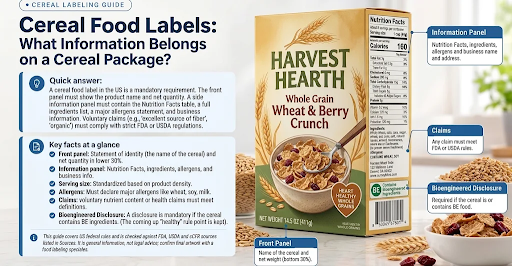
A cereal box does more than display a brand name and an attractive product image. It also provides important information that helps shoppers understand what they are buying, compare nutritional values, identify allergens, and follow storage instructions. A clear and accurate cereal food label helps build consumer confidence while supporting compliance with applicable food labeling regulations.
Whether a business sells cornflakes, granola, oatmeal, bran flakes, or children’s breakfast cereal, its packaging may need to communicate the product name, ingredient list, allergen information, Nutrition Facts, net quantity, and manufacturer details. Additional information, such as date marking, storage instructions, and nutrition or whole-grain claims, may also be relevant.
The exact requirements depend on the country where the cereal is manufactured and sold. This guide focuses primarily on U.S. FDA-regulated packaged foods and explains the main information to consider when planning cereal packaging labels.
Quick Overview: What Should a Cereal Food Label Include?
| Label Element | What It Communicates |
|---|---|
| Product name | Identifies the type of cereal |
| Net quantity | Shows the amount of cereal inside the package |
| Ingredient list | Identifies ingredients in descending order by weight |
| Allergen information | Identifies applicable major food allergens |
| Nutrition Facts | Displays serving size, calories, and nutrient information |
| Manufacturer or distributor details | Identifies the responsible business |
| Date marking | Communicates a quality or safety date where applicable |
| Storage instructions | Explains how to store the cereal |
| Product claims | Communicates claims such as whole grain or high fiber when properly supported |
1. Product Name and Statement of Identity
The product name is one of the first details shoppers notice on a cereal package. It should clearly identify the food rather than relying only on a brand name, logo, or creative product title.
Examples include:
- Corn Flakes
- Honey Oat Cereal
- Whole Grain Granola
- Bran Flakes
- Chocolate Breakfast Cereal
- Multigrain Cereal
In the United States, packaged foods generally need an appropriate statement of identity. The name should accurately describe the product and should not mislead consumers about its ingredients or characteristics.
Brand Name vs. Product Identity
A brand name helps customers recognize a product, but it does not necessarily explain what the food is.
For example, a cereal package might display a large brand logo at the top and the product identity, such as “Honey Oat Granola,” nearby. Both serve different purposes: the brand builds recognition, while the product name tells shoppers what is inside.
Front-of-Pack Product Information
The front panel, commonly called the Principal Display Panel (PDP), is the main area shoppers see when the product is displayed for sale. Businesses should plan this area carefully so that the product identity and other required information are easy to locate and read.
2. Cereal Ingredient Label: What Must Be Listed?
The ingredient list helps consumers understand what a breakfast cereal contains. In the United States, ingredients in most packaged foods are generally listed in descending order by weight, meaning the ingredient used in the greatest amount appears first.
A cereal ingredient label may include:
- Whole grain wheat
- Corn
- Oats
- Rice
- Sugar
- Honey
- Dried fruit
- Vegetable oil
- Salt
- Vitamins and minerals
- Flavorings and other permitted additives
The actual list depends on the cereal’s recipe. Manufacturers should use the correct ingredient names and account for applicable sub-ingredients when a compound ingredient is used.
Ingredient Order Matters
Consider a hypothetical cereal containing whole grain oats, sugar, dried cranberries, sunflower oil, and salt. The ingredients should be listed according to their respective weights in the finished food, not according to marketing importance or the order in which the manufacturer wants shoppers to notice them.
This matters because consumers may use the ingredient list to compare products and understand their composition.
Highlighting Key Ingredients
If a cereal package emphasizes an ingredient through its name, text, or imagery, additional ingredient-quantity rules may apply in certain circumstances.
For example, a cereal promoted as “Strawberry Granola” may need to meet requirements concerning the amount of strawberry represented in the product. Food businesses should review applicable regulations before making ingredient-focused claims.
3. Cereal Allergen Information
Allergen information is one of the most important parts of food product labeling. Some breakfast cereals contain ingredients that are major food allergens, while others may be produced in facilities that handle multiple allergenic ingredients.
Under U.S. FDA requirements, nine major food allergens must be identified when applicable:
- Milk
- Eggs
- Fish
- Crustacean shellfish
- Tree nuts
- Peanuts
- Wheat
- Soybeans
- Sesame
For example, a cereal containing wheat flour, milk powder, or almond ingredients may need to identify the relevant allergen food source on its label.
How Should Allergens Be Declared?
In the United States, major food allergen sources can generally be identified in the ingredient list or through a separate “Contains” statement, following the applicable requirements.
A simplified example might look like this:
Contains: Wheat, Milk, and Almonds.
This is an illustrative example, not a ready-to-use declaration. The actual statement must reflect the product’s ingredients and applicable allergen requirements.
What About “May Contain” Statements?
Some manufacturers use precautionary statements such as “May contain peanuts” when there is a potential for unintended allergen presence due to shared equipment or production conditions.
These statements are not a substitute for proper allergen controls. Manufacturers should assess their production processes and use precautionary labeling appropriately rather than adding broad warnings without evaluating the actual risk.
4. Breakfast Cereal Nutrition Facts
The Nutrition Facts panel helps customers understand the nutritional composition of a cereal. For most packaged foods in the United States, nutrition labeling is required unless an applicable exemption applies.
A cereal nutrition label typically communicates information such as:
- Serving size
- Servings per container
- Calories
- Total fat
- Saturated fat
- Trans fat
- Cholesterol
- Sodium
- Total carbohydrate
- Dietary fiber
- Total sugars
- Added sugars
- Protein
- Required vitamins and minerals
The exact declaration and formatting depend on the applicable FDA rules, product characteristics, and any relevant exemptions.
Serving Size on Cereal Labels
Serving size tells consumers the amount used as the basis for the nutrition information. For cereal, it may be expressed using a familiar household measure, such as cups, alongside a metric weight in grams.
For example, a hypothetical label might show:
Serving Size: 1 cup (40 g)
This is only an example. The correct serving size must be determined according to the applicable serving-size rules for the specific product.
Serving size is not necessarily a recommended portion. It is the reference amount used to present the nutritional values.
Calories and Nutrient Amounts
The calorie declaration helps shoppers understand the energy provided by a serving. Nutrient amounts allow them to compare cereals based on factors such as fat, sodium, carbohydrates, fiber, and protein.
Manufacturers should calculate and verify these values using appropriate product formulation and nutrition analysis methods.
Understanding Daily Value Percentage
The % Daily Value (%DV) indicates how much a nutrient in one serving contributes to a general daily diet.
It can help consumers understand whether a serving contains a relatively high or low amount of a nutrient. The FDA’s general guide is that 5% DV or less is considered low, while 20% DV or more is considered high.
The %DV is a reference tool, not a personalized dietary recommendation.
Added Sugar on Cereal Labels
Added sugar is especially relevant for breakfast cereals because some products contain sugar, honey, syrups, or other sweetening ingredients.
Under U.S. Nutrition Facts requirements, added sugars are declared in grams and as a percentage of Daily Value when applicable. The label distinguishes added sugars from total sugars, which can include naturally occurring sugars as well.
For a cereal brand, accurate added-sugar information is important for transparency and for helping consumers compare products.
5. Net Weight on Cereal Boxes
Net quantity tells shoppers how much cereal is contained inside the package, excluding the weight of the box and other packaging materials.
For solid foods in the United States, the declaration generally uses weight units. A cereal box might display:
NET WT 12 OZ (340 g)
This is an illustrative quantity, not a required standard package size.
Where Should Net Weight Appear?
The net quantity declaration is generally placed on the Principal Display Panel and must follow applicable requirements for position, visibility, and type size.
It should be easy to find and should not be hidden by graphics, promotional text, or other design elements.
Why Accurate Net Quantity Matters
An accurate net weight declaration helps customers compare package sizes and understand how much product they are purchasing. Manufacturers should ensure the declared quantity reflects the actual product quantity and complies with applicable measurement and labeling rules.
6. Manufacturer and Distributor Information
A cereal package should identify the responsible business according to the applicable food labeling rules.
Depending on the product and distribution arrangement, the label may identify the manufacturer, packer, or distributor, along with the required business address information.
This information helps consumers, retailers, and regulators identify the business responsible for the packaged food.
What Details May Be Included?
A cereal package may display:
- Company or business name
- Required business address
- Manufacturer or distributor identification
- Consumer contact information, such as a website or customer service channel
A website, email address, or customer service number can be useful additions, but they do not automatically replace any legally required name and address declaration.
7. Cereal Expiration Date and Best Before Date
Cereal manufacturers often include date information to help consumers and retailers understand product quality and inventory rotation.
Common phrases include:
- Best if Used By
- Best Before
- Use By
- Sell By
However, these terms do not always mean the same thing, and their regulatory treatment varies by country and product category.
Are Date Labels Required on U.S. Cereal Boxes?
For most packaged foods in the United States, federal law does not require a quality-based date label. Infant formula is an important exception with specific date requirements.
Manufacturers may voluntarily use date marking to communicate when a product is expected to retain its best quality. The FDA supports “Best if Used By” as a clearer phrase for communicating quality.
Cereal manufacturers should establish appropriate shelf-life and date-marking practices based on product characteristics, packaging, storage conditions, and applicable requirements.
Where Should the Date Be Printed?
Date codes are often placed on the top flap, bottom panel, side panel, or another accessible area of a cereal package. The location should make the information easy to find without interfering with other required declarations.
Manufacturers should also make sure the printed code remains legible throughout normal distribution and handling.
8. Whole Grain Claims and Other Cereal Label Claims
Cereal packaging often uses front-of-pack statements to highlight product characteristics. Examples may include:
- Made with Whole Grains
- High in Fiber
- No Artificial Colors
- Low Sodium
- Source of Protein
- Contains Whole Wheat
These claims can influence purchasing decisions, so they must be accurate and supported by the relevant product information.
Whole Grain Claims
A cereal package may emphasize whole grains when the product contains qualifying whole-grain ingredients. However, the wording and presentation should not mislead shoppers about the amount or proportion of whole grain in the product.
A package should not imply that a cereal is entirely whole grain if it contains a substantial amount of refined grains.
Nutrient Content Claims
Statements such as “high fiber,” “low sodium,” or “good source of” are subject to specific regulatory definitions and conditions in the United States.
Manufacturers should verify that the product meets the applicable criteria before placing these statements on the package.
Front-of-Pack Claims and Visual Design
Claims should be easy to understand and should not contradict the Nutrition Facts panel or ingredient list.
For example, a cereal marketed as a high-fiber option should have nutritional information that supports the claim. Images of fruit, nuts, or other ingredients should also represent the product accurately.
9. Cereal Food Label Design: Organizing Information on the Box
A good cereal packaging label needs to balance compliance, readability, and visual appeal. Shoppers should be able to identify the product quickly and find detailed information without struggling to read small or crowded text.
Front Panel
The front panel commonly includes:
- Brand logo
- Product identity
- Product imagery
- Net quantity declaration
- Appropriate product claims
The product name and required declarations should remain clear and prominent.
Side or Back Panels
These panels can provide space for:
- Ingredient list
- Allergen declaration
- Nutrition Facts panel
- Manufacturer or distributor details
- Storage instructions
- Date-code area
- Preparation or serving suggestions, where relevant
The final placement must follow the applicable regulations for each declaration. A designer should not assume that every item can be placed anywhere on the package.
Use Readable Typography
Food labels need to remain legible at the final printed size. Designers should consider font size, contrast, spacing, background colors, and the physical dimensions of the cereal box.
Avoid placing essential information over busy product images or decorative patterns. A clean layout makes it easier for customers to read the label and for the manufacturer to review the final artwork.
Plan the Label Before Printing
Before sending cereal packaging artwork to production, check the available panel dimensions and confirm that the Nutrition Facts panel, ingredients, allergen information, net quantity, and business details fit correctly.
A packaging proof should be reviewed at actual size so that small text, date codes, and other important details remain readable.
10. Cereal Packaging Compliance Checklist
Use this checklist as a starting point when reviewing a cereal box label for the U.S. market. It is not a substitute for a product-specific regulatory review.
| Review Item | What to Check |
|---|---|
| Product identity | Does the package accurately identify the cereal? |
| Net quantity | Is the declared net weight accurate and properly positioned? |
| Ingredients | Are ingredients listed correctly and in the required order? |
| Sub-ingredients | Are applicable compound ingredients declared properly? |
| Allergens | Are applicable major food allergens identified? |
| Nutrition Facts | Is the panel accurate and formatted according to applicable rules? |
| Serving size | Does it follow the relevant serving-size requirements? |
| Added sugars | Is the required declaration accurate? |
| Manufacturer details | Is the responsible business information included as required? |
| Date marking | Is the date code accurate and legible if used? |
| Claims | Are whole-grain and nutrient claims properly supported? |
| Artwork | Is all important information readable on the final package? |
A final compliance review should be completed before mass production. Changes to ingredients, suppliers, serving sizes, nutrition values, or claims may require the label to be reviewed again.
11. Do Cereal Food Labeling Requirements Vary by Country?
Yes. Food labeling rules differ between countries and sometimes between product categories within the same market.
For example, U.S. cereal labels are generally regulated under FDA food labeling requirements. In the European Union, prepacked food labeling is governed by EU food information rules, including requirements concerning ingredients, allergens, date marking, net quantity, and food business operator details.
Other markets may have different requirements for:
- Nutrition information formats
- Ingredient declarations
- Allergen lists
- Language and translation
- Net quantity units
- Country-of-origin statements
- Date marking
- Front-of-pack nutrition labels
- Nutrition and health claims
A cereal package intended for sale in multiple countries may therefore need different label versions or additional market-specific information.
Businesses should identify their target markets early in the packaging design process and confirm the relevant rules with qualified regulatory professionals or the appropriate food authority.
Frequently Asked Questions
1. What information must be on a cereal box?
For a typical U.S. packaged cereal, required information may include the product identity, net quantity, ingredient list, applicable allergen declarations, Nutrition Facts, and required manufacturer or distributor details. Specific requirements and exemptions depend on the product and circumstances.
2. What are the required elements of a cereal food label?
Common elements include the statement of identity, net quantity, ingredients, allergen information, Nutrition Facts, and responsible business details. Other declarations may apply depending on the product and market.
3. Does cereal packaging need a Nutrition Facts panel?
Most packaged foods in the United States require Nutrition Facts labeling unless an applicable exemption applies. Manufacturers should confirm whether their particular cereal qualifies for an exemption.
4. What ingredients must be listed on cereal packaging?
Ingredients generally need to be declared in descending order by weight, including applicable sub-ingredients. The list should accurately reflect the cereal’s formulation.
5. How should allergens be declared on cereal labels?
For U.S. FDA-regulated foods, applicable major food allergens must be identified using the required food-source names. The nine major allergens include milk, eggs, fish, Crustacean shellfish, tree nuts, peanuts, wheat, soybeans, and sesame.
6. Does a cereal box need a serving size?
When a Nutrition Facts panel is required, serving-size information is generally part of that panel. The serving size must follow the applicable FDA rules for the product.
7. Where should the expiration or best before date appear?
Date codes are often printed on a cereal box flap, bottom, or side panel. The placement should make the code easy to locate and read. In the United States, most packaged foods are not federally required to carry a quality-based date label, although manufacturers often use one.
8. Are whole grain claims regulated on cereal packaging?
Claims about whole grains and nutrient content must not mislead consumers. Certain nutrient content claims have specific regulatory criteria, and manufacturers should verify that their products meet the applicable requirements.
9. What information belongs on the front of a cereal box?
The front panel commonly displays the brand, product identity, product imagery, and net quantity. Any additional claims must be accurate and comply with applicable labeling rules.
10. Do cereal food labeling requirements vary by country?
Yes. The United States, European Union, United Kingdom, Canada, and other markets have different food labeling requirements. Brands selling internationally should review the rules for every target market.
Conclusion
A cereal food label is an essential part of both product communication and food packaging compliance. It helps shoppers identify the cereal, understand its ingredients and nutritional information, check for allergens, and find important manufacturer and date details.
For cereal manufacturers, the key is to plan the label around accurate product information, applicable regulations, and a clear packaging layout. Ingredient lists, Nutrition Facts, net weight, allergen declarations, and product claims should all be reviewed before the final artwork goes to print.
Once the label content is finalized, the cereal box design can bring the brand and product information together in a professional, shopper-friendly format. For businesses planning custom food packaging, contact Bluebird Packaging or request a packaging quote to discuss packaging options for your product.