
Milk cartons come in several sizes, from small single-serve packages used in schools and cafeterias to large containers designed for household use. Their dimensions determine how much milk they can hold, how easily they fit into refrigerators, and how efficiently they can be stored, transported, and displayed.
Understanding milk carton dimensions is useful for consumers comparing package sizes, retailers planning storage space, and businesses evaluating packaging requirements. Common capacities include half-pint, pint, quart, half-gallon, and gallon cartons. However, the exact height, width, and depth can vary depending on the carton design, material thickness, manufacturer, and packaging format.
This guide compares common milk carton sizes, explains their approximate measurements and capacities, explores gable-top and aseptic packaging, and shows how to measure a carton accurately.
Quick Overview: Milk Carton Sizes and Dimensions
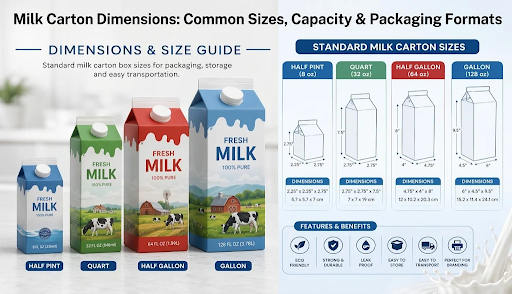
The following table provides approximate reference dimensions for common milk carton capacities. Actual measurements vary between manufacturers and packaging designs.
| Milk Carton Size | Capacity | Approximate Dimensions (H × W × D) |
|---|---|---|
| Half Pint | 8 fl oz / 237 ml | 4–4.5 × 2–2.5 × 2–2.5 in |
| Pint | 16 fl oz / 473 ml | 5–6 × 2.5–3 × 2.5–3 in |
| Quart | 32 fl oz / 946 ml | 6–7.5 × 3.5–4.5 × 3.5–4.5 in |
| Half Gallon | 64 fl oz / 1.89 L | 8–10 × 4.5–5.5 × 4.5–5.5 in |
| Gallon | 128 fl oz / 3.79 L | 10–12 × 5.5–6.5 × 5.5–6.5 in |
These are illustrative size ranges, not fixed industry standards. Gable-top cartons, rectangular cartons, and aseptic packages can have noticeably different proportions.
1. What Are Milk Carton Dimensions?
Milk carton dimensions refer to the physical measurements of a milk package, usually expressed as height, width, and depth. These measurements help identify the space a carton occupies and determine whether it fits a particular storage, display, or shipping arrangement.
Three measurements are especially important:
- Height: The vertical measurement from the bottom of the carton to its highest point, including the top structure when relevant.
- Width: The measurement across the front-facing side of the carton.
- Depth: The measurement from the front panel to the back panel.
The capacity is different from the external dimensions. Capacity describes the amount of liquid a carton is designed to hold, while its physical measurements describe the space occupied by the package.
For example, two cartons may both contain one quart of milk but have different heights and widths because one uses a narrow rectangular design and the other has a wider gable-top structure.
When comparing milk carton dimensions, always consider both the liquid capacity and the external measurements.
2. Common Milk Carton Sizes by Capacity
Milk packaging is available in several standard retail capacities. Smaller packages are often used for individual servings, while larger cartons are designed for families, food service, and household consumption.
Half Pint Milk Carton Dimensions
A half-pint milk carton holds 8 fluid ounces, approximately 237 milliliters.
These small packages are commonly used in:
- School lunch programs
- Cafeterias
- Hospitals
- Hotels
- Restaurants
- Individual beverage servings
A typical half-pint carton may measure approximately 4–4.5 inches high, with a base around 2–2.5 inches wide and deep. The exact dimensions depend on the manufacturer’s design.
Half-pint cartons are often designed for convenient handling and single-use consumption. Their compact shape also makes them suitable for organized storage in refrigerated trays.
Pint Milk Carton Dimensions
A pint carton contains 16 fluid ounces, approximately 473 milliliters.
Pint-sized milk packaging is suitable for individual consumers, small households, and food-service environments that need a larger serving than a half pint.
A typical pint carton may be approximately 5–6 inches high, with a base measuring around 2.5–3 inches on each side.
The carton may use a gable-top structure or a rectangular design. These formats can have different proportions even when their liquid capacities are identical.
Quart Milk Carton Dimensions
A quart carton holds 32 fluid ounces, equivalent to approximately 946 milliliters.
It is commonly used for household milk purchases, smaller retail requirements, and food-service applications.
A quart carton may measure around 6–7.5 inches high, with a base approximately 3.5–4.5 inches wide and deep.
The wider base can provide stability, while the height depends on the carton format and top construction.
Half Gallon Milk Carton Dimensions
A half-gallon carton contains 64 fluid ounces, approximately 1.89 liters.
It is a common household size because it provides more milk than a quart without requiring the storage space of a full gallon container.
Typical half-gallon carton dimensions may fall within:
- Height: 8–10 inches
- Width: 4.5–5.5 inches
- Depth: 4.5–5.5 inches
Some designs have a gable top, while others use a rectangular body with a sealed or screw-cap opening.
When comparing half-gallon milk carton measurements, remember that the top shape and closure can affect the total height.
Gallon Milk Carton Dimensions
A gallon milk carton holds 128 fluid ounces, approximately 3.79 liters.
It is generally used by larger households, supermarkets, and food-service businesses that require higher milk quantities.
A typical gallon-sized carton may measure approximately 10–12 inches high, with a width and depth around 5.5–6.5 inches.
The carton needs a structure strong enough to support the weight of the liquid during handling and transportation. Its dimensions also influence refrigerator storage and shelf arrangement.
3. Milk Carton Size Comparison Chart
The following comparison makes it easier to understand how milk carton capacity increases across common package sizes.
| Capacity | Fluid Ounces | Milliliters (Approx.) | Common Application |
|---|---|---|---|
| Half Pint | 8 oz | 237 ml | School and individual servings |
| Pint | 16 oz | 473 ml | Small households and personal use |
| Quart | 32 oz | 946 ml | Small household purchases |
| Half Gallon | 64 oz | 1,893 ml | Regular household consumption |
| Gallon | 128 oz | 3,785 ml | Families and food service |
Capacity doubles at each step in this sequence, but the external dimensions do not necessarily double. Manufacturers adjust the carton proportions to maintain stability, usability, and efficient material use.
For accurate packaging or storage planning, use the actual manufacturer’s measurements rather than estimating a larger carton by multiplying the dimensions of a smaller one.
4. Small Milk Carton Sizes and School Milk Packaging
Small milk cartons are commonly associated with schools, cafeterias, hospitals, and other environments where milk is served in individual portions.
Single-Serve Milk Cartons
Single-serve milk cartons are designed to hold a portion that can usually be consumed in one sitting. Common capacities include half-pint and pint sizes.
Their compact structure can make them easier to distribute, store, and organize in refrigerated spaces.
School Milk Carton Dimensions
School milk cartons are frequently available in 8-ounce or half-pint capacities, although serving sizes can differ by region and food-service program.
A typical school milk carton may have approximate dimensions of 4–4.5 inches in height and a base around 2–2.5 inches wide and deep.
The final measurements depend on the carton supplier and whether the package uses a gable-top or another structure.
School milk cartons are often designed with:
- Easy-to-handle proportions
- A sealed top for product protection
- A straw-compatible opening or other drinking feature
- Lightweight paperboard construction
- Space for product information and branding
Mini Milk Carton Sizes
Mini milk cartons are useful when a smaller portion is required. They may be used in hospitality settings, lunch services, catering, and promotional beverage distribution.
The term “mini” does not represent one universal capacity. Always check the fluid-ounce or milliliter specification before comparing different packages.
5. Different Types of Milk Carton Packaging Formats
Milk cartons are not all constructed in the same way. Their packaging format affects their external dimensions, closure design, storage requirements, and handling.
Gable Top Milk Cartons
Gable-top cartons have a folded roof-like top that forms a recognizable triangular shape when sealed. They are widely used for refrigerated milk and other liquid food products.
Common features include:
- Folded paperboard construction
- A sealed top with a peaked shape
- Different base dimensions for different capacities
- Optional opening features depending on the design
The peaked top can make the overall height different from the height of the rectangular body. This is important when measuring the complete carton for storage or secondary packaging.
Aseptic Milk Cartons
Aseptic cartons are designed for products processed and packaged under controlled sterile conditions. They are commonly used for shelf-stable milk and other beverages.
Many aseptic cartons have rectangular or brick-shaped designs, although other formats are available.
Their dimensions vary according to capacity, filling equipment, package structure, and manufacturer. A one-liter aseptic carton, for example, may have a different height and footprint from a one-liter gable-top carton.
Paperboard Milk Cartons
Paperboard is a major structural component of many milk cartons. The packaging may include additional barrier layers to protect the liquid from moisture, oxygen, light, or other external conditions.
The exact material structure depends on the product and packaging system. A paperboard appearance does not mean that every carton is made entirely of paper or can be recycled through every local recycling program.
6. What Factors Affect Standard Milk Carton Dimensions?
Even when two cartons hold the same amount of milk, their external measurements may differ. Several design and manufacturing factors influence their final size.
Carton Shape
A square-bottom carton, narrow rectangular carton, and gable-top carton distribute the same liquid volume differently.
A taller carton may have a smaller footprint, while a wider carton may be easier to stabilize or stack.
Packaging Material
Paperboard thickness and barrier construction can influence the carton’s external measurements. Material selection must also account for product protection, filling requirements, and package performance.
Closure and Top Design
A peaked gable top, flat sealed top, or screw-cap opening can affect the carton’s overall height and shape.
When measuring a carton, include the closure and top structure if the measurement will be used for storage, display, or an outer packaging fit.
Filling and Manufacturing Requirements
Cartons must work with the filling equipment and sealing process used by the manufacturer. These production requirements can influence panel dimensions, folds, seams, and overall structure.
Brand and Supplier Specifications
Different suppliers may use their own package designs for the same capacity. Therefore, there is no single universal measurement that applies to every half-gallon or gallon milk carton.
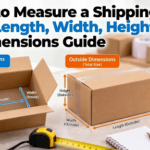
7. How to Measure a Milk Carton Correctly
Accurate measurements are important when selecting storage trays, designing shipping boxes, or comparing packaging formats.
Use a ruler or measuring tape and follow these steps:
Step 1: Measure the height
Place the carton upright on a flat surface. Measure from the bottom to the highest point of the sealed top or closure.
Step 2: Measure the width
Measure across the front panel of the carton. Keep the measuring tool straight and record the widest relevant point.
Step 3: Measure the depth
Measure from the front panel to the back panel. For a carton with a non-square base, record the actual depth rather than assuming it matches the width.
Step 4: Record the capacity
Check the package label for its fluid-ounce or milliliter capacity. Do not estimate capacity from external dimensions alone.
Step 5: Record additional features
Note the top style, closure, handle, seams, and any protruding components that could affect storage or packaging.
For secondary packaging, measure the carton at its widest and tallest points. Allow suitable clearance so the package can be inserted and removed without unnecessary pressure.
8. Milk Carton Packaging and Storage Considerations
Milk cartons need to be stored and transported in a way that protects the product and maintains package integrity.
Refrigerator Storage
Carton height, width, and depth affect how many packages can fit on a refrigerator shelf. Tall cartons may need more vertical clearance, while wider cartons occupy more shelf space.
For household storage, consider the refrigerator’s available dimensions and the position of shelves, doors, and other containers.
Retail Display
Retailers need to arrange milk cartons so that products remain stable, visible, and accessible. Consistent carton dimensions can make shelf planning easier, although mixed package formats may require separate storage arrangements.
Shipping and Secondary Packaging
Milk cartons may be placed in larger boxes, trays, or crates for distribution. The secondary packaging should support the weight of the filled cartons and reduce movement during transportation.
For general outer packaging applications, businesses can explore corrugated boxes for protective shipping structures and cardboard boxes for suitable secondary packaging requirements.
These outer packaging materials should not be confused with the liquid-contact carton itself. Any packaging that directly contacts milk must meet the applicable food-contact safety and regulatory requirements.
9. How to Choose the Right Milk Packaging Size
Selecting the right milk carton size involves more than choosing a liquid capacity. Businesses and packaging designers should consider how the product will be filled, stored, transported, and used.
Match Capacity to Customer Needs
Individual servings may require half-pint or pint cartons, while household and food-service products may need quart, half-gallon, or gallon formats.
Consider Storage Space
The package should fit the intended refrigerator, shelf, tray, or storage area. Check the external measurements rather than relying only on the stated capacity.
Evaluate Package Stability
The base dimensions and filled weight influence how stable a carton is during handling. A package should remain upright under normal storage and transportation conditions.
Review Filling and Sealing Requirements
The carton structure must be compatible with the manufacturer’s filling and sealing equipment. A design that looks suitable externally may not work with a particular production line.
Confirm Food-Contact Compliance
Milk packaging needs materials and barrier systems suitable for direct contact with the product. Businesses should request appropriate technical specifications and regulatory documentation from the packaging supplier.
For businesses planning custom secondary packaging, Bluebird Packaging offers packaging solutions that can be considered according to product dimensions, protection requirements, and branding needs. To discuss an outer packaging project, request a quote.
10. Frequently Asked Questions
1. What are the standard dimensions of a milk carton?
There is no single universal set of standard milk carton dimensions. A half-pint carton may be around 4–4.5 inches tall, while a gallon carton may be around 10–12 inches tall. Exact dimensions depend on the capacity, package shape, and manufacturer.
2. What size is a half-pint milk carton?
A half-pint milk carton holds 8 fluid ounces, or approximately 237 milliliters. Its dimensions are commonly around 4–4.5 inches high, with a base approximately 2–2.5 inches wide and deep.
3. How big is a one-pint milk carton?
A one-pint carton holds 16 fluid ounces, approximately 473 milliliters. A typical package may be around 5–6 inches tall, with a base approximately 2.5–3 inches wide and deep.
4. What are the dimensions of a half-gallon milk carton?
A half-gallon carton holds 64 fluid ounces, approximately 1.89 liters. Its approximate dimensions may range from 8–10 inches high and 4.5–5.5 inches wide and deep, depending on the design.
5. How tall is a gallon milk carton?
A gallon milk carton is commonly around 10–12 inches tall. Its exact height depends on its shape, top construction, closure, and manufacturer.
6. What are the dimensions of a school milk carton?
Many school milk cartons hold 8 fluid ounces. A typical half-pint package may be around 4–4.5 inches high, with a base measuring approximately 2–2.5 inches on each side.
7. How much milk does a standard carton hold?
The capacity depends on the package size. Common formats include half pint (8 ounces), pint (16 ounces), quart (32 ounces), half gallon (64 ounces), and gallon (128 ounces).
8. What is the difference between gable top and aseptic milk cartons?
Gable-top cartons have a folded, peaked top and are commonly used for refrigerated milk. Aseptic cartons are designed for products processed and packaged under controlled sterile conditions and are often used for shelf-stable milk. Their material structures and dimensions can differ.
9. How do you measure milk carton dimensions?
Measure the carton’s height, width, and depth with a ruler or measuring tape. Include the top and closure when measuring overall height, and record the liquid capacity separately from the external dimensions.
10. Are milk carton dimensions the same for every brand?
No. Different brands and suppliers may use different carton structures, materials, closures, and proportions. Even cartons with the same capacity can have different external measurements.
Conclusion
Understanding milk carton dimensions helps consumers, retailers, and packaging professionals compare package capacities, plan storage, and choose suitable packaging formats. Common sizes range from half-pint single-serve cartons to gallon containers, with each format designed for different usage and distribution requirements.
However, capacity alone does not determine the physical size of a carton. Its shape, material structure, closure, and manufacturing specifications all influence the final height, width, and depth. Always confirm the supplier’s actual measurements before planning storage or secondary packaging.
For businesses that need protective outer packaging for products and distribution, selecting the correct box structure and dimensions can improve handling, storage, and presentation. Explore Bluebird Packaging for custom packaging options or request a quote to discuss your requirements.