
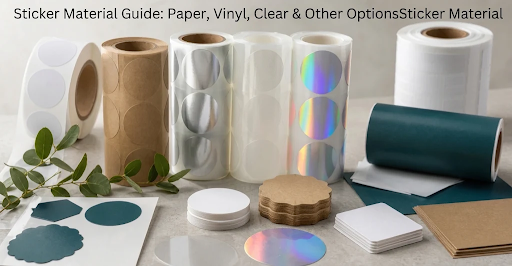
Choosing the right sticker material is just as important as creating an attractive design. The material affects how a sticker looks, how well it adheres to a surface, how long it lasts, and whether it can withstand moisture, sunlight, handling, or outdoor conditions. A sticker designed for a cardboard box may not perform well on a refrigerated bottle or a product exposed to water.
There are several sticker materials available, including paper, vinyl, transparent films, BOPP, and polyester. Each option offers different advantages in terms of appearance, durability, print quality, adhesive performance, and cost. Some are suitable for everyday product packaging, while others are better for waterproof labels, promotional stickers, and outdoor applications.
This guide explains the most common types of sticker material, compares their features, and helps you select the right option for your product, packaging, or branding requirements.
Quick Overview: Different Types of Sticker Materials
| Sticker Material | Best For | Water Resistance | Main Advantage |
|---|---|---|---|
| Paper | Product labels, boxes, indoor use | Generally low | Affordable and easy to print |
| Glossy Paper | Retail labels and colorful designs | Low unless protected | Bright, polished appearance |
| Matte Paper | Minimalist branding and information labels | Low unless protected | Smooth, non-reflective finish |
| Vinyl | Outdoor stickers and durable labels | Generally high | Flexible and weather-resistant options |
| Clear Vinyl | Glass, transparent containers, and premium labels | Generally high | Transparent, no-label appearance |
| BOPP | Bottles, jars, and product labels | Generally high | Good moisture resistance |
| Polyester | Industrial, equipment, and durable labels | Generally high | Strong resistance to wear and environmental exposure |
| Kraft Paper | Natural-style packaging and branding | Generally low | Textured, natural appearance |
Actual performance depends on the specific material grade, adhesive, ink, protective coating, and printing process. Always check the supplier’s specifications.
1. What Is Sticker Material?
Sticker material refers to the surface material, or facestock, used to create a sticker or self-adhesive label. It is the layer that receives the printed design and is attached to a backing liner with an adhesive.
A typical sticker construction includes three main components:
- Facestock: The paper or film surface on which the design is printed.
- Adhesive: The bonding layer that attaches the sticker to a surface.
- Release liner: The backing layer that protects the adhesive before application.
These components work together to determine how a sticker looks and performs. For example, a vinyl facestock may offer flexibility and weather resistance, but the wrong adhesive can still cause it to peel from a curved bottle or textured surface.
When selecting a material, consider more than its appearance. Think about the surface where it will be applied, the conditions it will face, and how long it needs to remain attached.
2. Paper Sticker Material: Affordable and Versatile
Paper sticker material is a popular choice for everyday labels, packaging stickers, promotional materials, and indoor applications. It is available in different finishes, weights, textures, and colors.
Paper stickers are generally economical and can reproduce text, logos, and colorful artwork clearly. However, standard paper is not naturally waterproof, so it may wrinkle, tear, or lose its appearance when exposed to moisture.
White Paper Sticker Material
White paper sticker material provides a clean background for logos, product information, barcodes, and colorful designs. It is a practical choice when businesses need clear printing and a familiar label appearance.
Common applications include:
- Product packaging labels
- Shipping and identification stickers
- Retail price labels
- Promotional stickers
- Food and bakery packaging labels for suitable dry applications
White paper is especially useful when the design includes several colors or small text that needs to remain readable.
Glossy Sticker Paper
Glossy sticker paper has a smooth, reflective surface that can make colors appear vibrant. It is often selected for retail packaging, promotional stickers, and designs where a polished appearance is important.
Advantages:
- Bright, eye-catching appearance
- Smooth surface for detailed graphics
- Suitable for colorful branding
- Works well for many indoor applications
Limitations:
- Can reflect light, which may affect readability at certain angles.
- Standard glossy paper is not waterproof.
- The surface may show scratches depending on the coating.
Matte Sticker Paper
Matte sticker paper has a non-reflective surface that gives labels a simple and understated appearance. It is useful for minimalist branding, product information, and designs that need to remain readable under different lighting conditions.
Advantages:
- Reduces glare and reflections.
- Creates a subtle, professional appearance.
- Works well for text-heavy designs.
- Can complement natural and premium packaging styles.
Limitations:
- Standard matte paper is not waterproof.
- Some finishes may show marks from frequent handling.
- It may not provide the same shine as glossy paper.
Kraft Sticker Paper
Kraft sticker paper has a brown, natural-looking surface that works well with rustic, handmade, organic-inspired, and minimalist branding.
It can be used for:
- Handmade product labels
- Bakery and gift packaging
- Candle and soap packaging
- Paper bags and boxes
- Brand seals and decorative stickers
Kraft stickers can complement custom kraft boxes when businesses want a consistent natural packaging appearance.
However, kraft paper is not automatically waterproof or environmentally preferable in every application. Check its composition, adhesive, coating, and disposal requirements before making sustainability claims.
3. Vinyl Sticker Material: Flexible and Durable
Vinyl sticker material is a synthetic film commonly used when greater flexibility and durability are needed. Depending on its construction, vinyl can resist moisture, handling, and outdoor exposure better than standard paper stickers.
It is available in different finishes, colors, thicknesses, and adhesive options.
Permanent Vinyl Stickers
Permanent vinyl stickers are designed to remain attached to a surface for an extended period. They are useful for product branding, equipment labels, promotional graphics, and applications where the sticker should not be removed regularly.
Typical applications include:
- Outdoor branding
- Vehicle and equipment graphics
- Durable product labels
- Promotional stickers
- Surface identification
Permanent does not mean impossible to remove. Removal difficulty depends on the adhesive, surface, application conditions, and time in place.
Removable Vinyl Material
Removable vinyl uses an adhesive designed to allow easier removal under suitable conditions. It can be useful for temporary promotions, seasonal graphics, retail displays, and temporary product identification.
Before choosing removable material, test it on the actual surface. Adhesive residue or surface damage can still occur depending on the substrate and how long the sticker remains attached.
When Should You Choose Vinyl?
Choose vinyl when your sticker needs to handle more demanding conditions than ordinary paper can support. It is worth considering for outdoor use, frequently handled items, and products exposed to moisture.
However, not every vinyl sticker is identical. Confirm the manufacturer’s water resistance, UV performance, expected service conditions, and adhesive compatibility before ordering.
4. Clear Sticker Material: Transparent and Modern
Clear sticker material is designed to create a transparent or partially transparent appearance. It is often used when brands want their logo or product information to appear directly on glass, plastic, or another visible surface without a solid white background.
Clear stickers can create a clean, minimal look for premium packaging, bottles, jars, and promotional products.
Transparent Sticker Material
Transparent sticker material allows the surface beneath the sticker to remain visible. It can be made from different film types, including clear vinyl and polyester.
Common applications include:
- Glass bottles and jars
- Cosmetic containers
- Clear product packaging
- Window graphics
- Transparent promotional stickers
The final appearance depends on the material, printing method, ink opacity, and whether a white ink layer is used beneath the design.
Clear Vinyl Stickers
Clear vinyl stickers combine a transparent appearance with the flexibility associated with vinyl. They are useful for applications where the design needs to follow a smooth surface while allowing the background to show through.
For example, a transparent logo sticker on a glass jar can create a simple branded appearance without covering the entire container.
Clear vs. White Sticker Material
The main difference is how the design interacts with the surface underneath it.
| Feature | Clear Sticker Material | White Sticker Material |
|---|---|---|
| Background | Transparent | Opaque white |
| Design appearance | Surface remains visible | Design sits on a white background |
| Best for | Glass and transparent containers | General product labels |
| Color visibility | May be affected by the background | More consistent background |
| White ink | May be needed for opaque design elements | Usually unnecessary for a white base |
Clear material is a good choice when the transparent appearance is part of the design. White material is often better when colors and text need a consistent, highly visible background.
5. Waterproof Sticker Materials: BOPP, Polyester and Other Films
If a sticker will be exposed to water, condensation, oils, or frequent handling, standard paper may not be suitable. Film-based materials are commonly used for applications that require better moisture resistance and durability.
The term waterproof should still be used carefully. A material’s performance depends on the facestock, adhesive, ink, protective finish, and application conditions.
BOPP Sticker Material
BOPP stands for biaxially oriented polypropylene. It is a polypropylene film stretched in two directions during manufacturing to improve its physical properties.
BOPP sticker material is widely used for product labels because it can offer a smooth printing surface, moisture resistance, and good performance on many packaging applications.
It is available in different forms, including:
- White BOPP
- Clear BOPP
- Gloss BOPP
- Matte BOPP
- Metallic BOPP
Common uses include:
- Bottled products
- Jars and containers
- Personal care labels
- Cosmetic packaging
- Food and beverage labels where the grade is suitable
BOPP is often a practical option when businesses need a film label that can handle moisture better than standard paper. The correct adhesive must still be matched to the container surface and storage conditions.
Polyester Sticker Material
Polyester is another film-based material used for labels that need strength and resistance to demanding conditions. It is commonly selected for industrial identification, equipment labels, durable product information, and applications where resistance to tearing or wear is important.
Depending on the grade, polyester labels may offer:
- Good dimensional stability
- Resistance to moisture
- Tear resistance
- Resistance to certain chemicals
- Suitability for demanding environments
Polyester is not automatically the best choice for every waterproof sticker. Compare its specifications with the actual conditions the label will face.
Waterproof vs. Weatherproof Sticker Material
These terms describe different performance requirements.
- Water-resistant: Can tolerate limited exposure to moisture, such as splashes or occasional contact.
- Waterproof: Designed to withstand more substantial water exposure under specified conditions.
- Weather-resistant: Designed to handle a combination of outdoor conditions, which may include sunlight, rain, and temperature changes.
A waterproof label is not necessarily UV-resistant, and a weather-resistant label may not be suitable for continuous immersion. Review the supplier’s test information before choosing a material.
6. Adhesive Sticker Materials: Permanent vs. Removable
The facestock determines the visible surface of a sticker, but the adhesive determines how it attaches to a product.
Choosing the wrong adhesive can cause labels to peel, slide, lift at the edges, or leave residue. Adhesive selection is especially important for bottles, jars, flexible packaging, textured cardboard, and products stored in cold or humid conditions.
Permanent Adhesive
Permanent adhesive is designed to create a lasting bond with a suitable surface. It is commonly used for product labels, branding stickers, and identification labels that are expected to remain in place.
Removable Adhesive
Removable adhesive is designed to allow easier removal than permanent adhesive. It is useful for temporary promotions, price labels, retail displays, and applications where the surface should remain clean after removal.
How to Select the Right Adhesive
Consider these factors before choosing:
- Surface type: Glass, plastic, metal, cardboard, and textured surfaces may require different adhesives.
- Surface condition: Dust, oil, moisture, and uneven surfaces can affect adhesion.
- Application temperature: Some adhesives require specific temperatures during application.
- Storage conditions: Cold storage, heat, humidity, and condensation can influence performance.
- Required removal: Decide whether the sticker should stay permanently or be removed later.
For reliable results, test the complete sticker construction on the actual product or packaging before placing a large order.
7. Glossy vs. Matte Sticker Materials: Which Finish Should You Choose?
Glossy and matte finishes affect the appearance and readability of stickers. They are available across different paper and film materials, so the finish should not be confused with the base material itself.
| Feature | Glossy Finish | Matte Finish |
|---|---|---|
| Appearance | Shiny and reflective | Smooth and non-reflective |
| Color presentation | Often appears vibrant | More understated |
| Readability | Reflections may affect viewing angles | Often easier to read under bright lighting |
| Branding style | Bold and eye-catching | Minimal and sophisticated |
| Common applications | Promotional and retail stickers | Product information and understated branding |
Choose glossy when you want a bright, polished look. Choose matte when you prefer a subtle finish or need to reduce glare.
Remember that a glossy or matte finish does not automatically make a paper sticker waterproof. If moisture resistance is important, choose a suitable film or protective construction and verify its performance.
8. How to Choose the Best Material for Stickers
The best material depends on the sticker’s purpose, application surface, environment, design, and budget. Instead of selecting a material based only on appearance, work through the following considerations.
Identify Where the Sticker Will Be Used
Start by identifying the surface and environment.
- Cardboard boxes: Paper or kraft stickers can work well for dry indoor packaging.
- Glass jars: Clear film or suitable BOPP labels may be appropriate.
- Plastic bottles: Choose a material and adhesive compatible with the bottle’s surface and shape.
- Outdoor surfaces: Consider vinyl or another film with verified weather and UV resistance.
- Equipment: Polyester or another durable film may be suitable for demanding identification applications.
For brands that use printed packaging, sticker selection should also complement the box material and design. Explore custom cardboard boxes and retail packaging options when planning a coordinated presentation.
Consider Moisture and Environmental Exposure
Ask whether the sticker will encounter:
- Water or condensation
- Oils or product residue
- Direct sunlight
- Heat or cold
- Frequent handling
- Abrasion or cleaning
A paper sticker may be sufficient for a dry product box, while a bottle stored in a refrigerator may require a suitable film, adhesive, and print system.
Match the Material to the Design
The design can influence the material choice.
- Detailed, colorful artwork may work well on white paper or white film.
- A natural visual identity may suit kraft paper.
- Transparent branding may require clear film.
- A high-impact promotional design may benefit from a glossy finish.
- A minimal, text-focused label may suit matte material.
Check Printer and Production Compatibility
Not every material works with every printing method. Check whether the chosen stock is compatible with the printer, ink, finishing process, and cutting method.
For example, printable vinyl sheets for desktop printers may have different requirements from commercial roll-fed vinyl. Confirm the correct material grade rather than relying on the generic material name.
Test Before Ordering in Bulk
Before approving a large order, test the sticker on the actual product or packaging.
Check:
- Adhesion after application
- Edge lifting and peeling
- Print clarity and color
- Water or moisture resistance
- Scratch and handling resistance
- Removal behavior, if applicable
A small sample test can help identify problems before they affect a full production run.
9. Best Sticker Materials for Product Packaging
Product packaging stickers do more than display a logo. They can communicate product details, reinforce brand identity, seal packaging, and create a consistent presentation.
The most suitable material depends on the packaging surface and the product’s storage conditions.
| Packaging Application | Material to Consider | Important Factor |
|---|---|---|
| Kraft boxes | Kraft or paper stickers | Visual consistency and surface adhesion |
| Cardboard product boxes | White paper or film stickers | Print clarity and adhesion |
| Cosmetic jars | BOPP, clear film, or suitable polyester | Moisture and product-contact conditions |
| Glass bottles | Clear film or BOPP | Adhesive compatibility and condensation |
| Shipping cartons | Paper labels or suitable film | Handling and legibility |
| Outdoor product labels | Vinyl or durable polyester | UV and weather performance |
| Retail packaging | Glossy, matte, or clear materials | Branding and shelf appearance |
For products such as handmade soaps, the sticker should complement the box design and remain attached during normal handling. You can also explore custom soap boxes when planning packaging and label combinations for soap products.
For cosmetic brands, the material should suit the container, product formula, and storage conditions. Consider how custom cosmetic boxes can support a consistent presentation alongside the product label.
10. Eco-Friendly Sticker Material Options
Businesses looking for more responsible packaging choices can consider recycled paper, paper-based facestocks, and materials with documented sourcing information.
However, no material should be described as environmentally friendly based on appearance alone.
Recycled Paper Stickers
Recycled paper stickers use paper fibers recovered from previous paper products. They may be suitable for dry packaging, promotional labels, and applications where a paper finish is appropriate.
Kraft Paper Stickers
Kraft paper can complement natural-looking packaging and may be available in different grades and compositions. Check whether the material contains recycled content and whether its adhesive and backing liner are compatible with the intended disposal route.
Consider the Complete Sticker Construction
A sticker is made of more than its visible surface. Its adhesive, release liner, ink, coatings, and any protective laminate can influence how it is handled and disposed of.
If recyclability is important, check with the packaging or recycling provider whether the complete sticker construction is accepted in the relevant recycling stream. Do not assume that a paper facestock makes the entire sticker recyclable.
11. Frequently Asked Questions About Sticker Materials
1. What are the different types of sticker materials?
Common sticker materials include paper, glossy paper, matte paper, kraft paper, vinyl, clear film, BOPP, and polyester. Each offers different levels of durability, moisture resistance, appearance, and cost.
2. Which material is best for stickers?
The best material depends on the application. Paper is suitable for many indoor labels and packaging stickers, vinyl is useful for flexible and durable applications, BOPP is often selected for moisture-resistant product labels, and polyester can suit demanding identification needs.
3. Is vinyl better than paper for stickers?
Vinyl is generally more suitable when flexibility, moisture resistance, or outdoor durability is required. Paper is often more economical and works well for indoor product labels, promotional stickers, and dry packaging applications.
4. What sticker material is waterproof?
Certain vinyl, BOPP, and polyester materials can be designed for waterproof applications. The complete construction matters, including adhesive, ink, and protective finish. Always verify the supplier’s specifications.
5. What is the difference between clear and white sticker material?
Clear sticker material is transparent, allowing the surface underneath to remain visible. White sticker material provides an opaque background that helps printed colors and text stand out consistently.
6. Are paper stickers suitable for product packaging?
Yes. Paper stickers are commonly used on cardboard boxes, paper bags, and other dry packaging surfaces. For products exposed to moisture, refrigeration, or frequent handling, a suitable film material may perform better.
7. Which sticker material is best for outdoor use?
Vinyl is a common choice for outdoor stickers because suitable grades can offer flexibility and resistance to weather exposure. Polyester may also be appropriate for certain durable labeling applications. Check UV resistance, temperature range, adhesive performance, and expected service life.
8. What is BOPP sticker material?
BOPP stands for biaxially oriented polypropylene. It is a plastic film used for labels and stickers that may require a smooth printing surface and better moisture resistance than standard paper. It is available in white, clear, matte, gloss, and other finishes.
9. Are removable and permanent vinyl stickers different?
Yes. Permanent vinyl uses an adhesive intended to create a lasting bond, while removable vinyl uses an adhesive designed for easier removal under suitable conditions. Actual removal performance depends on the adhesive, surface, and time in place.
10. How do I choose the right material for custom stickers?
Identify the application surface, expected exposure to water or sunlight, required durability, desired appearance, adhesive needs, and printing method. Test a sample on the actual product before approving a large order.
Conclusion
Choosing the right sticker material helps businesses create labels and stickers that look professional and perform reliably. Paper, vinyl, clear film, BOPP, and polyester each serve different purposes, so the best option depends on the product, packaging surface, environment, and required lifespan.
For indoor packaging and everyday labels, paper may provide a practical and affordable solution. For moisture exposure, vinyl or BOPP may be more suitable, while polyester can support demanding labeling applications. Clear materials are useful when brands want a transparent appearance, and kraft paper can complement natural-style packaging.
Before making a final decision, compare the material, adhesive, finish, and printing compatibility. Test samples under real conditions to make sure the finished sticker meets your requirements.
Planning a complete packaging design? Visit Bluebird Packaging to explore packaging options, or request a quote to discuss packaging requirements for your products.