
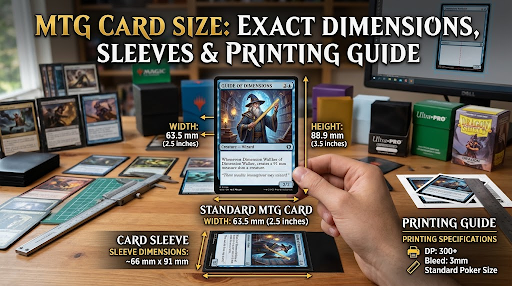
Quick Answer: A standard Magic: The Gathering (MTG) card measures approximately 2.5 × 3.5 inches (63.5 × 88.9 mm). It is commonly rounded to 63 × 88 mm in card-size references. Standard-size trading-card sleeves are designed for this format and are also commonly used for Pokémon cards. Yu-Gi-Oh! cards are smaller, so they generally require Japanese-size sleeves. If you are designing custom cards or a deck box, use the actual printer template or measure the fully sleeved deck before finalizing dimensions.
If you are searching for how big is a MTG card, the standard measurement is straightforward. However, the right dimensions can change depending on whether you are measuring the physical card, its protective sleeve, a print-ready design, or the internal space required for a storage box.
This guide explains MTG card dimensions in inches, millimeters, and centimeters, compares Magic cards with other trading-card formats, covers sleeve compatibility, and explains how to prepare a custom card design or storage package.
MTG Card Size at a Glance
The standard Magic: The Gathering card uses the familiar poker-size trading-card format. Its nominal dimensions are approximately 2.5 inches wide and 3.5 inches tall.
| Measurement | Standard MTG card |
|---|---|
| Width in inches | 2.5 in |
| Height in inches | 3.5 in |
| Width in millimeters | 63.5 mm |
| Height in millimeters | 88.9 mm |
| Common rounded metric reference | 63 × 88 mm |
| Approximate width in centimeters | 6.35 cm |
| Approximate height in centimeters | 8.89 cm |
| Common sleeve category | Standard size |
Important measurement note: You may see both 63 × 88 mm and 2.5 × 3.5 inches online. These figures are commonly used rounded references for the same card format. A direct mathematical conversion of 2.5 × 3.5 inches is 63.5 × 88.9 mm. For a close-fitting product, use the actual card or the specification provided by the manufacturer.
What Is the Standard MTG Card Size?
The standard MTG card size is approximately 2.5 inches wide by 3.5 inches tall. This is the format used for regular Magic cards, including creatures, lands, spells, tokens, and cards with different artwork treatments.
The outside dimensions generally remain consistent across ordinary Magic card releases. A borderless design, extended-art card, or foil treatment does not automatically mean the card uses a different width or height.
The official Magic: The Gathering rules and reference documents are the best starting point for checking game-related specifications. For practical sleeve selection, manufacturers also publish compatibility information. For example, Dragon Shield describes its standard-size sleeves as suitable for cards up to 63 × 88 mm, including MTG and Pokémon cards.
Why do some sources list 63 × 88 mm instead of 63.5 × 88.9 mm?
The difference comes from rounding and the way card dimensions are presented. The imperial measurement of 2.5 × 3.5 inches converts to 63.5 × 88.9 mm. Many card references round those values to approximately 63 × 88 mm.
For general sleeve shopping, both references point to the standard trading-card format. For custom printing, fitted inserts, or precision packaging, do not rely on rounded figures alone. Confirm the finished dimensions with the printer or measure a physical card.
MTG Card Size in Inches, Millimeters & Centimeters
When someone asks, “What is the size of a MTG card?”, they may need the answer for a sleeve, a deck box, a storage organizer, or a custom print file. The following conversions make the standard dimensions easier to use.
| Unit | Width | Height |
|---|---|---|
| Inches | 2.5 in | 3.5 in |
| Millimeters | 63.5 mm | 88.9 mm |
| Centimeters | 6.35 cm | 8.89 cm |
How to convert MTG card dimensions
Use these simple conversion rules:
- Inches to millimeters: Multiply inches by 25.4.
- Millimeters to inches: Divide millimeters by 25.4.
- Millimeters to centimeters: Divide millimeters by 10.
- Centimeters to millimeters: Multiply centimeters by 10.
For example:
- 2.5 × 25.4 = 63.5 mm
- 3.5 × 25.4 = 88.9 mm
- 63.5 ÷ 10 = 6.35 cm
- 88.9 ÷ 10 = 8.89 cm
These conversions are useful when comparing trading-card sizes with packaging dimensions. If you are also planning a fitted storage box, read our guide to box dimensions and sizing to understand how width, length, and depth are used when specifying a container.
How Thick Is an MTG Card?
Card thickness is different from card width and height. It can vary depending on the card’s construction, finish, condition, and whether it has a foil treatment.
Some card-size references use approximately 0.3 mm (0.012 inches) as an illustrative thickness for a regular card. Treat this as a practical estimate rather than a guaranteed specification for every card.
If you need a reliable measurement for a storage box, use a stack instead of trying to measure one thin card with an ordinary ruler.
How to measure the thickness of an MTG card
- Place a group of cards together on a flat surface.
- Align their edges without bending or compressing them.
- Measure the complete stack using a ruler or caliper.
- Divide the stack measurement by the number of cards.
- Repeat with sleeved cards if the deck will be stored in sleeves.
Example calculation:
If 50 cards form a stack measuring approximately 15 mm:
15 mm ÷ 50 cards = 0.3 mm per card.
This is an example calculation, not a guaranteed measurement for every Magic card.
Does card thickness change when a card is sleeved?
Yes. A sleeve adds a protective layer around the card. The additional material increases the overall width, height, and sometimes the stack thickness of the deck.
Double-sleeved cards take up even more room because each card has an inner sleeve and an outer sleeve. This is why a deck box should be selected according to the finished deck rather than the dimensions of a bare card.
What Size Sleeves Fit MTG Cards?
Standard-size trading-card sleeves are the usual choice for regular Magic cards. These sleeves are designed for the common 2.5 × 3.5-inch card format.
However, the actual sleeve dimensions vary between brands and product lines. A sleeve listing may describe the card size it accommodates rather than the exact outside dimensions of the sleeve itself.
For example, Dragon Shield identifies standard-size sleeves as suitable for cards measuring up to 63 × 88 mm and lists MTG and Pokémon among compatible games. You can check its standard-size sleeve guidance before selecting a product.
Standard sleeves vs. inner sleeves
| Sleeve type | Main purpose | What to check |
|---|---|---|
| Standard outer sleeves | Everyday protection and gameplay | Confirm MTG or standard-size compatibility |
| Inner sleeves | Close-fitting first layer of protection | Check the manufacturer’s perfect-fit guidance |
| Matte sleeves | Textured surface and different shuffle feel | Check card compatibility and sleeve finish |
| Clear sleeves | Display card artwork while providing protection | Confirm fit and material quality |
| Oversized sleeves | Protect special oversized cards | Check the specific oversized card format |
What is the standard MTG sleeve size?
For most regular Magic cards, choose sleeves explicitly labeled for MTG or standard-size trading cards.
Do not assume that every sleeve advertised as 63 × 88 mm has those exact measurements internally. The number may refer to the card format the sleeve is designed to fit. Check the manufacturer’s size chart and product description.
What are MTG perfect-fit sleeve dimensions?
Perfect-fit sleeves are close-fitting inner sleeves designed to sit directly around a card. They are commonly used as the first layer in a double-sleeving setup.
There is no single exact internal measurement that applies to every brand. Manufacturing tolerances and product designs can differ, so follow the specific sleeve maker’s compatibility guidance.
Avoid forcing a card into an inner sleeve that feels too tight. Carefully test the fit with one card before sleeving an entire deck.
How to double-sleeve MTG cards
Double-sleeving uses two protective layers: an inner sleeve around the card and a standard outer sleeve around the inner-sleeved card.
Follow these steps:
- Select an inner sleeve specifically designed for standard MTG cards.
- Slide the card into the inner sleeve gently.
- Check that the corners and edges are not being forced.
- Choose a compatible standard-size outer sleeve.
- Insert the inner-sleeved card into the outer sleeve.
- Check that the finished card sits flat without excessive pressure or buckling.
- Test a few cards before applying the method to the entire deck.
Double-sleeving increases the overall deck dimensions. If you are purchasing or designing a deck box, measure the fully protected cards first.
MTG Card Size vs. Pokémon Card Size
Standard Magic and Pokémon trading cards generally use the same nominal size: approximately 2.5 × 3.5 inches (63.5 × 88.9 mm).
This means many standard-size trading-card sleeves can accommodate both formats. However, the sleeve manufacturer’s compatibility chart should always be checked before purchasing.
| Feature | MTG cards | Pokémon cards |
|---|---|---|
| Common reference size | 2.5 × 3.5 in | 2.5 × 3.5 in |
| Approximate metric size | 63.5 × 88.9 mm | 63.5 × 88.9 mm |
| Sleeve category | Standard size | Standard size |
| Are many sleeves interchangeable? | Yes, when listed as compatible | Yes, when listed as compatible |
Although their nominal dimensions are similar, card stock, coatings, condition, and special product formats may differ.
If you are designing a storage tray for a mixed collection, test the actual cards and sleeves rather than assuming every product will have an identical fit.
MTG Card Size vs. Yu-Gi-Oh! Card Size
Yu-Gi-Oh! cards use a smaller format than standard Magic cards. This is an important distinction when selecting sleeves or planning storage compartments for multiple trading-card games.
| Feature | MTG | Yu-Gi-Oh! |
|---|---|---|
| Width | About 63.5 mm | About 59 mm |
| Height | About 88.9 mm | About 86 mm |
| Approximate inches | 2.5 × 3.5 in | 2.32 × 3.39 in |
| Common sleeve category | Standard size | Japanese/small size |
Can Yu-Gi-Oh! sleeves fit MTG cards?
Generally, no. Yu-Gi-Oh! sleeves are designed for a narrower card format, so they may be too tight for standard Magic cards.
Choose standard-size sleeves for regular MTG cards and Japanese-size sleeves for Yu-Gi-Oh! cards. Always check the specific manufacturer’s compatibility information.
Are MTG cards the same size as poker cards?
MTG cards use the common poker-size format of approximately 2.5 × 3.5 inches. Bridge-size playing cards are narrower, so they should not be treated as an identical format.
What Are the Dimensions of a Trading Card Compared With MTG?
The phrase “trading card size” can refer to several different formats. Standard MTG cards are part of the widely used standard-size category, but not every collectible card game uses the same dimensions.
| Card format | Approximate dimensions | Compared with MTG |
|---|---|---|
| MTG | 2.5 × 3.5 in | Standard reference |
| Pokémon | 2.5 × 3.5 in | Same common format |
| Yu-Gi-Oh! | 2.32 × 3.39 in | Smaller |
| Poker-size playing card | 2.5 × 3.5 in | Same common format |
| Bridge-size playing card | 2.25 × 3.5 in | Narrower |
This comparison is useful when selecting sleeves, dividers, storage boxes, and inserts. If a package will hold more than one card format, use the largest intended card and test the fit before production.
MTG Card Printing Size, Bleed & Safe Area
If you are preparing custom card artwork, the finished card dimensions are only one part of the print specification. Your printer may also require extra artwork beyond the trim line, a safe area for important content, and a particular file format.
For a standard MTG-style card, the common trim reference is approximately 2.5 × 3.5 inches. A printer may request a larger document to include bleed.
What size should I use to print a custom MTG card?
Start with the template supplied by the printer. Do not assume that the physical card dimensions are the same as the complete artwork-file dimensions.
For illustration, a printer that requires 0.125 inches of bleed on every side would need an artwork canvas of:
| Print specification | Example dimensions |
|---|---|
| Finished trim size | 2.5 × 3.5 in |
| Bleed on each side | 0.125 in |
| Artwork file including bleed | 2.75 × 3.75 in |
This is an example based on a particular bleed requirement, not a universal specification for all card printers.
What resolution should an MTG card design use?
A common print-design target is 300 pixels per inch (PPI) at the final output size, unless the printer specifies another requirement.
At 300 PPI, a 2.5 × 3.5-inch trim area works out to:
- Width: 2.5 × 300 = 750 pixels
- Height: 3.5 × 300 = 1,050 pixels
If the printer requires 0.125 inches of bleed on each side, the example canvas becomes 2.75 × 3.75 inches, or 825 × 1,125 pixels at 300 PPI.
These pixel values are calculated examples. Use the actual template from your selected production provider.
What is bleed in card printing?
Bleed is the extra artwork that extends beyond the final cutting line. It helps prevent unwanted white edges if the printed sheet shifts slightly during trimming.
For example, a full-background design should normally extend beyond the trim line into the bleed area when the printer requires it.
What is the safe area?
The safe area is the inner part of the card design where important content should remain. Text, numbers, logos, and essential artwork details should not be placed too close to the cutting edge.
A useful print setup includes three areas:
| Area | Purpose |
|---|---|
| Bleed | Extra artwork beyond the trim line |
| Trim | Final finished card dimensions |
| Safe area | Region for text and important design elements |
PrintNinja’s card deck setup guide provides an example of a card-printing workflow that uses 0.125-inch bleed and margin settings. These are supplier-specific instructions, so follow your chosen printer’s template instead of applying the same values automatically.
How to prepare custom card artwork for printing
- Confirm the finished card dimensions with your printer.
- Download the correct artwork template.
- Set the document dimensions according to the template.
- Extend background images and colors into the bleed area.
- Keep text and important design elements inside the safe area.
- Use the resolution and color settings requested by the printer.
- Embed or prepare fonts according to the supplier’s instructions.
- Export the artwork in the requested file format.
- Review the digital proof before approving production.
- Request a physical sample when accurate color, cutting, or fit is especially important.
For additional production guidance, review Bluebird Packaging’s articles on packaging design and packaging printing. These cover broader design and print considerations for packaging projects.
What About Oversized MTG Cards?
Not every Magic-related card uses the standard deck format. Some special products include oversized cards intended for particular game variants, display, or collection purposes.
Oversized cards should not be assumed to fit regular MTG sleeves or standard deck boxes.
Before purchasing a sleeve or storage product for an oversized card:
- Identify the exact card type.
- Measure its width and height.
- Check whether the manufacturer offers a compatible oversized sleeve.
- Measure the protected card before choosing a storage compartment.
- Confirm the box’s internal dimensions.
Do not use standard MTG card dimensions as the specification for an oversized card. The actual product should determine the sleeve and storage size.
How to Choose a Custom MTG Deck Box
A suitable deck box should protect the cards while allowing them to be removed and returned without excessive pressure. Its internal dimensions should be based on the complete deck, including sleeves and any accessories.
1. Card capacity
Decide how many cards the box needs to hold. A compact deck, a Commander deck, and a collection storage box have different space requirements.
2. Sleeve allowance
Measure the cards after sleeving. Double-sleeved decks need more room than unsleeved cards.
3. Internal dimensions
The internal width, height, and depth should be based on the actual stack. Do not use the bare card dimensions as the complete box dimensions.
4. Material selection
Paperboard can work for compact retail packaging, while corrugated structures may be appropriate when additional shipping protection is required. The right material depends on the product’s weight, handling, and distribution needs.
5. Opening style
A tuck-end, sleeve-and-tray, or rigid box structure may suit different product types and presentation goals.
6. Inserts and dividers
If the package includes tokens, dividers, rule cards, or accessories, allow room for those components in the design.
7. Branding and artwork
Consider the logo, product name, colors, graphics, and any product information that needs to appear on the box.
Bluebird Packaging offers different paper-based packaging structures that can be considered for custom product packaging. Explore custom retail boxes for retail presentation or custom rigid boxes for a more substantial presentation.
Packaging styles to consider for card decks
Cardboard boxes
A practical option to explore for compact card sets, promotional decks, and lightweight retail packaging. See custom cardboard boxes.
Corrugated boxes
Worth considering when the package needs additional protection during storage or shipping. Browse corrugated box options.
Mailer boxes
Useful when a card-game product is shipped directly to customers. Explore custom mailer boxes.
Rigid boxes
A potential option for collector sets, gift products, or premium presentation. See rigid box options.
Kraft boxes
A paper-based option for brands looking for a natural-looking packaging appearance. Explore Kraft box options.
Die-cut boxes
Useful when a custom structure or specific opening design is required. See die-cut box options.
For more background on material selection, read our guides to packaging materials and cardboard vs. corrugated boxes.
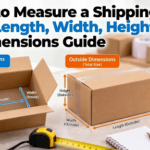
How to Measure an MTG Deck for a Custom Box
The most reliable way to select a deck box is to measure the finished deck in the exact condition in which it will be stored.
Follow this process before preparing a packaging specification:
- Prepare the deck: Use the actual cards or a representative stack.
- Add the sleeves: If the cards will be stored in sleeves, sleeve them before measuring.
- Measure the width: Check the widest point of the finished stack.
- Measure the height: Check the full height of the cards, including the sleeves.
- Measure the depth: Align the cards and measure the stack thickness without squeezing it.
- Include accessories: Add space for dividers, tokens, rule cards, and other items.
- Allow practical clearance: The cards should slide in and out without being forced.
- Confirm material thickness: The box’s internal dimensions must account for the material used in its walls.
- Review the structure: Check the opening, closure, and insert arrangement.
- Test a sample: Confirm the real deck fits before approving a larger production run.
For a more detailed explanation of measuring packaging, see our guide on how to measure a box. You can also explore packaging inserts if your deck needs separate compartments or organized storage.
If you are developing a branded card-game product, a promotional deck, or a collectible package, share the finished deck measurements and required quantity before finalizing the structure. You can request a custom packaging quote with your preferred dimensions, material, and design requirements.
Common MTG Card Size Mistakes to Avoid
Small measurement errors can cause problems when selecting sleeves, designing a box, or preparing a print file. Avoid these common mistakes:
| Mistake | Why it causes problems | Better approach |
|---|---|---|
| Treating rounded and converted dimensions as exact equivalents | The metric values may differ slightly | Confirm the printer’s or manufacturer’s specification |
| Buying sleeves without checking compatibility | Listings may use different size conventions | Choose sleeves explicitly listed for MTG |
| Measuring only an unsleeved card | Sleeves increase the finished dimensions | Measure the sleeved deck |
| Using card size as box size | The box also needs room for clearance and material thickness | Calculate internal dimensions separately |
| Ignoring bleed | Trimming can leave unwanted white edges | Use the printer’s artwork template |
| Placing text near the trim line | Important content may be cut off | Keep essential details inside the safe area |
| Using one size for every trading-card game | Some games use smaller or larger formats | Check each card format separately |
| Approving a box without a fit test | The real deck may not fit as expected | Test a physical sample |
Frequently Asked Questions About MTG Card Size
1. What is the exact size of an MTG card?
A standard MTG card is commonly specified as 2.5 × 3.5 inches, equivalent to 63.5 × 88.9 mm. Some references round this to approximately 63 × 88 mm. Use the printer’s specification or measure the physical card when precision is important.
2. How big is a MTG card in inches?
A regular Magic: The Gathering card is approximately 2.5 inches wide and 3.5 inches tall. This is the standard poker-size trading-card format.
3. What are the dimensions of a MTG card in millimeters?
The standard imperial measurement converts to approximately 63.5 mm wide by 88.9 mm tall. It is often rounded to 63 × 88 mm in general card-size references.
4. What is the size of a MTG card in centimeters?
A standard MTG card measures approximately 6.35 cm wide and 8.89 cm tall. Rounded references may show the size as 6.3 × 8.8 cm.
5. What size sleeves fit MTG cards?
Standard-size trading-card sleeves are generally suitable for regular MTG cards. Choose a product that specifically lists Magic: The Gathering compatibility and check its manufacturer’s size guide.
6. Are MTG cards the same size as Pokémon cards?
Yes, both commonly use the standard 2.5 × 3.5-inch trading-card format. Many standard-size sleeves are compatible with both, but check the sleeve manufacturer’s product information.
7. Are MTG cards the same size as Yu-Gi-Oh! cards?
No. Standard MTG cards are approximately 2.5 × 3.5 inches, while Yu-Gi-Oh! cards are approximately 2.32 × 3.39 inches. Yu-Gi-Oh! cards generally use Japanese-size sleeves.
8. How thick is a standard MTG card?
A commonly used estimate for a regular card is around 0.3 mm, but actual thickness can vary with card construction, finish, and condition. Measure a stack if you need an accurate estimate for storage.
9. What size should I use to print a custom MTG card?
Use the finished dimensions and artwork template supplied by your chosen printer. The standard 2.5 × 3.5-inch size is a useful starting point, but the complete print file may need additional bleed and a safe area.
10. What resolution should an MTG card design use?
A common target is 300 PPI at the final print size, unless the printer specifies otherwise. The artwork canvas must also account for the required bleed.
11. How much bleed is needed for custom trading-card printing?
Bleed requirements vary by printer. Some card-printing services use 0.125 inches on each side, but this should not be treated as a universal rule. Download and follow the exact template supplied by your production provider.
12. Can I use standard MTG card dimensions to design a deck box?
Use the card dimensions as a starting reference, not as the finished box dimensions. Measure the full deck after sleeving and include clearance for dividers, accessories, and the packaging material.
13. Do foil MTG cards have different dimensions?
Foil cards generally use the same nominal width and height as regular cards. Their construction and finish can affect thickness and how they behave over time, so measure the actual cards if a close-fitting storage solution is required.
14. Are older MTG cards a different size from newer cards?
Regular Magic cards use the same general standard card format. Different artwork treatments or card releases do not normally mean a different external card size.
15. What is the best box for storing a 100-card Commander deck?
The best box depends on whether the cards are unsleeved, single-sleeved, or double-sleeved, as well as whether the package includes tokens or dividers. Measure the complete deck and select a box based on its actual internal dimensions and stated sleeved-card capacity.
16. Can I make and sell custom MTG cards?
Be careful with Wizards of the Coast intellectual property. Its Fan Content Policy says fan content using its IP must be free to access and cannot be sold or licensed for compensation without permission. Custom card designs should not be presented as genuine official cards or use protected artwork, logos, or other material without the necessary rights. Review the policy and seek permission where required.
Final Takeaway: What Is the Standard MTG Card Size?
The standard MTG card size is approximately 2.5 × 3.5 inches (63.5 × 88.9 mm), often rounded to 63 × 88 mm. Standard-size trading-card sleeves are generally the right category for regular Magic cards, while Yu-Gi-Oh! cards use a smaller format.
If you are printing custom card artwork, follow the selected printer’s trim, bleed, safe-area, resolution, and file requirements. If you are designing a deck box, measure the cards after sleeving and include space for dividers and practical clearance.
For businesses creating branded card-game products, promotional decks, or collectible packaging, explore custom retail packaging and custom rigid packaging. You can also request a packaging quote with the deck capacity, finished measurements, material preference, and artwork requirements.
Sources & Further Reading
- Magic: The Gathering — Official Rules
- Dragon Shield — Sleeve Size FAQs
- Dragon Shield — Standard-Size Sleeves
- PrintNinja — Card Deck Setup Guides
- Wizards of the Coast — Fan Content Policy
Magic: The Gathering and related names are trademarks of Wizards of the Coast. This independent size and packaging guide is not affiliated with or endorsed by Wizards of the Coast.