
Table of Contents
- 1. Why Display Packaging Matters in Retail
- 2. What Is Display Packaging?
- 3. Benefits of Display Packaging
- 4. Main Types of Display Packaging
- 5. Floor Display Boxes Vs. Floor Display Boxes
- 6. Retail Promotions: Cardboard Display Boxes Are Effective.
- 7. Custom-Printed Display Boxes in Action: Branding
- 8. Beauty and Cosmetic Displays
- 9. What to do when you want your packaging to attract customers at the point of purchase
- 10. Buy Display Packaging at Wholesale Prices and Sell More
- 11. The rigid display boxes add luxury to premium products
- 12. How Display Packaging Enhances Brand Recognition
- 13. Ideal Display Packaging for Electronics and Tech Accessories
- 14. Finding Display Boxes That Work Best for Your Industry
- 15. Display Packaging for Food, Snacks & Beverages
- 16. Display Packaging for Small Products
- 17. Display Packaging for Promotional Campaigns
- 18. Seasonal and Limited-Edition Display Packaging
- 19. Sustainable and Eco-Friendly Display Packaging
- 20. Display Packaging for E-Commerce and Shipping
- 21. Display Packaging vs. Traditional Product Packaging
- 22. Display Packaging vs. Standard Retail Packaging
- 23. How Much Does Custom Display Packaging Cost?
- 24. How to Choose the Right Display Packaging
- 25. Common Display Packaging Mistakes to Avoid
- 26. How to Make Display Packaging More Effective
- 27. How Display Packaging Builds Brand Recognition
- 28. Display Packaging and Product Presentation
- 29. Display Packaging for Retail Shelves
- 30. Display Packaging for Small Businesses
- 31. Display Packaging for New Product Launches
- 32. Display Packaging for Luxury Products
- 33. How to Choose a Custom Display Packaging Manufacturer
- 34. How to Order Custom Display Packaging
- Step 1: Define Your Product
- Step 2: Choose the Display Type
- Step 3: Select the Material
- Step 4: Determine Dimensions
- Step 5: Prepare Artwork
- Step 6: Select Printing and Finishes
- Step 7: Request a Quote
- Step 8: Review the Prototype or Sample
- Step 9: Approve Production
- Step 10: Plan Delivery and Storage
- 35. Frequently Asked Questions About Display Packaging
- What is display packaging?
- What is the purpose of display packaging?
- What are the most common types of display packaging?
- What material is best for display packaging?
- Are display boxes customizable?
- Can display packaging be printed with a logo?
- Are display boxes suitable for cosmetics?
- Can display packaging be used for electronics?
- Is cardboard good for display packaging?
- Can I order display packaging wholesale?
- How much does custom display packaging cost?
- Can display packaging be eco-friendly?
- How do I choose the right display box?
- 36. Final Takeaway: Make Your Product Stand Out With Custom Display Packaging
Packaging is more than just a way to protect your product. Packaging can influence whether shoppers pick up your product. It determines if they notice it, know what it is and are confident to do so. Display packaging is a combination of product protection and visual merchandising. It helps brands to create a strong presence in retail areas such as shelves, counters or checkout areas.
Businesses can select structures to match the products they sell, their retail environment and their branding objectives. They have a wide range of options, from counter displays and floor displays, to premium rigid packaging and custom-printed cartons. Displaying products in the right way can help them be more visible, accessible, and memorable.
The guide will explain what custom display packaging is and how to order it. It also explains the types of materials and their applications in the industry, as well as the wholesale options available.
Ready to make your products impossible to ignore?
Create custom display packaging designed around your product, brand, and retail space. Get a custom quote from Bluebird Packaging and turn your packaging into a powerful point-of-sale tool.
1. Why Display Packaging Matters in Retail
The shelves of retail stores are overcrowded. If the packaging is not attractive, even if a product has excellent qualities, it may be overlooked by shoppers.
This problem can be solved by using display packaging that offers visibility, brand recognition, protection, access, and organization.
Displays that are well designed can help:
- Give products stronger shelf presence
- Important product information is easier to see
- Impulse purchases can be encouraged
- Brand recognition is important for brand awareness
- Organise your products into one area
- New or Seasonal Products
- Promote your campaigns to make them more visible
- Shoppers can enjoy a better overall experience
Display packaging can be designed so that it is visible to the customer during their purchase process. Display packaging is more than just a container. It’s a part of a merchandising plan.
2. What Is Display Packaging?
Display packaging can be used to display products in an attractive way while being promoted or sold. Display packaging can be used on shelves in retail stores, counters at checkout, aisles of the store, and other places where consumers interact with product.
Display packaging can be used to organize multiple products or hold one. It can have open fronts or die-cut sections with transparent windows.
Packaging can be personalized with logos, graphic images, brand colors, information about the product, marketing messages, and special finishes.
What Makes Display Packaging Different?
The primary focus of traditional packaging is to contain and protect the product. Display packaging has another function: it is used for merchandising.
A conventional box can be used to protect a product inside of a shipping carton. Retail display boxes can be delivered to a shop and placed on the counter or shelf, so that customers are able to view and use the product without the need for the retailer to open and unpack each unit.
Key Functions of Display Packaging
Display packaging is capable of performing multiple functions at once.
- Protective: Reduces damage caused by handling, retail display and storage.
- Presenting the product in a more appealing way.
- Organise multiple products neatly.
- Branding is the way a company’s visual identity is communicated.
- Information: Features, instructions, advantages, and promotional messages.
- Easy access to products: This allows customers to view and pick up items.
- Retailers can use the available counter and shelf space more effectively with merchandising.
3. Benefits of Display Packaging
Display packaging is more than just a pretty package. Displays that are carefully designed can have a significant impact on how consumers interact with products and retailers’ selling spaces.
Increase Product Visibility
In crowded retail settings, products compete to attract attention. Packages can be more noticeable with strong graphics, contrast colors, product window, and strategically placed packaging.
Impulse purchases are encouraged
While waiting for the checkout, or while moving around a shop, attractive counter displays of small products can encourage customers to purchase additional items.
Enhance Brand Recognition
Shoppers can easily recognize the products in different stores by using consistent logos, colours, typography and imagery.
Maximize Retail Area
The best display structures can accommodate multiple products on a limited amount of shelf space or counter.
Easy Access to Products
Customers can easily see products and grab them with open-front displays and trays.
Promote Your Business
Display packaging is a great way to communicate special offers, limited editions and seasonal releases, as well as new products, directly at the purchase point.
Presenting Products Better
Presentation can affect the perceived quality of a product. The use of premium materials and finishes is particularly effective in cosmetics, jewellery, electronic products, luxury goods, gifts and other high-end items.
4. Main Types of Display Packaging
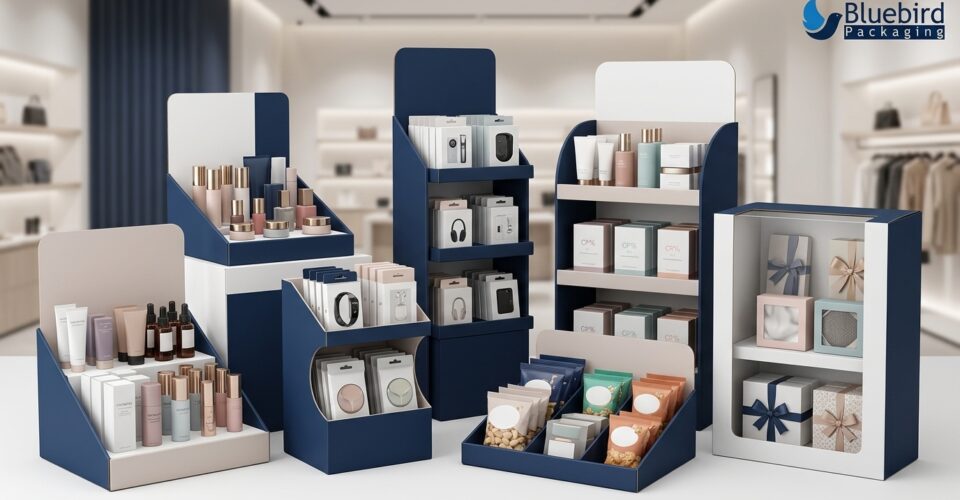
Display structures are different for each product and environment. The right display style will depend on the product’s size, weight and quantity as well as store location, accessibility requirements, branding, and brand recognition.
Counter Display Boxes
Counter display boxes can be used for counters, check-out areas, reception desks and small retail spaces.
These are especially useful when:
- Cosmetics
- Chocolates
- Small Accessories
- Lip Balms
- Travel size products
- Small electronics
- Promo products
The proximity of the retailer to their customer is its biggest asset. A strategically-placed counter display is a great way to increase sales when shoppers are waiting for or finishing a purchase.
Floor Display Boxes
The floor display box is a larger unit that sits directly on the retail flooring.
These work best for:
- Product launches
- Campaigns for promotion
- Snack products
- Drinks
- Electronic accessories
- Buy products in bundles
- Seasonal Collections
Floor displays are more flexible than other types of display, as they can take up more space vertically and horizontally. This allows for greater graphics and product information. They also allow multiple products to be displayed.
Display Trays
Display trays are a great way to present products in rows that can be easily accessed.
These are great for shoppers who need to browse products, compare them, or even pick one up.
Window Display Boxes
The window box includes a section of transparent plastic that lets customers see the contents without having to open the package.
The following situations are particularly suitable for this approach:
- Cosmetics
- You can also buy food
- Toys
- Gifts
- Accessoires
- Retail products that are specialized
Die-Cut Display Boxes
Packaging can be made with custom openings, shapes and tabs.
It gives the brands greater freedom in creating a display that is tailored to a specific product.
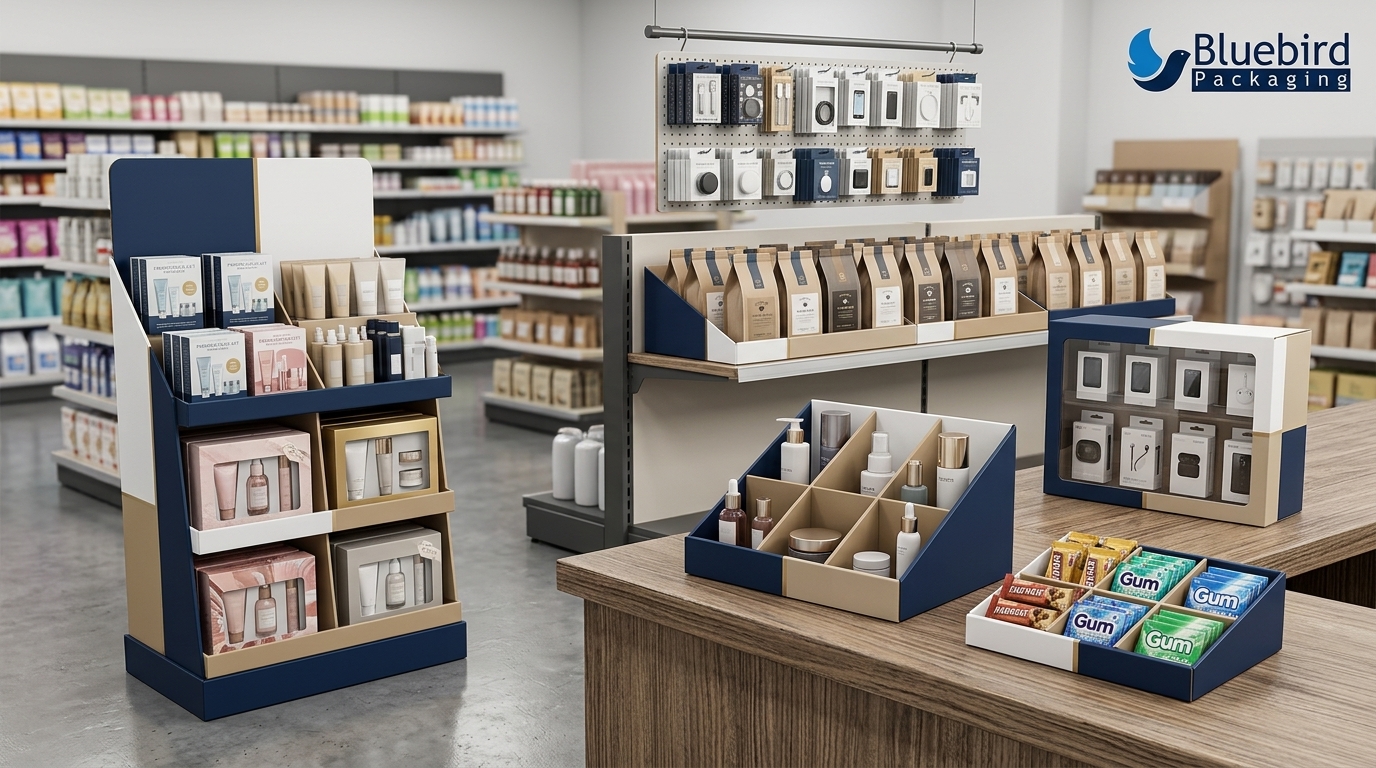
Hanging Display Packaging
The hanging displays Boxes can be used with pegboards or hooks. These are ideal for displaying small, lightweight items vertically.
Shelf-Ready Display Packaging
Shelf-ready packaging has been designed for a smooth transition from storage and shipping to retail display. Packaging can be directly placed on the display or shelf without the need to unpack and arrange the product.
The Different Types of Display Packaging
| Display Packaging Type | The Best for | Main Advantage |
|---|---|---|
| Counter Display Boxes | Checkout areas for small products | Impulse purchases are encouraged |
| Floor Display Boxes | Larger retail campaigns | High Visibility |
| Display Trays | Shelves and counters | Access to products is easy |
| Window Display Boxes | Visible products | Customers can see products |
| Die-Cut Display Boxes | Unique product shapes | Customization is available in a variety of ways |
| Hanging Displays | Lightweight products | Savings on shelf space |
| Shelf-Ready Displays | Retail shelves | Faster merchandise |
5. Floor Display Boxes Vs. Counter Display Boxes
The purpose of counter and floor displays is different. It depends on the available space, size of product, and location where most customers will interact with product.
Counter Display Boxes
Counter Displays are designed to be compact for areas with high traffic, such as check-out counters.
The ideal time to use them is:
- Floor space is limited
- Small products
- It is important to buy on impulse
- This campaign targets the checkout traffic
- The products must be easily accessible
Floor Display Boxes
The floor displays can be larger, and attract customers from the other side of an aisle.
The ideal time to use them is:
- More space is needed for products
- Brands want to make a strong impact with their visual impact
- Launch of a new product
- Displaying multiple products together
- A dedicated space is required for seasonal promotions
Compare
| Features | Counter Display | Floor Display |
|---|---|---|
| Placement | Countertops, checkouts and other areas | Floors and aisles of stores |
| The Size | Compact | The Larger |
| Buy Best Products | Compact and lightweight | Collections of medium or larger products |
| The main goal | Impulse sales | High Visibility |
| Dimensions | Low-cost | Higher |
| Branding Area | Limited | Further information |
| Usage Typical | Promotions and discounts are available. | Launches of new products and marketing campaigns |
6. Retail Promotions: Cardboard Display Boxes Are Effective.
The most popular material for retail packaging is cardboard, because of its affordability, versatility, ease of printing, and low weight.
Promotional Campaigns that are Affordable
Cardboard is often used by brands for seasonal displays, retail campaigns, temporary promotional materials, and product launches because of its strong visual impact.
It is lightweight and easy to handle
Lightweight cardboard can be moved and installed by retail staff more easily than heavy alternatives.
Simple to customize
The cardboard supports many different graphics, color schemes, designs and finishes.
The Large Scale Printing is Suitable
The design can incorporate detailed brand graphics, images of products, directions, messages and promotional material.
Sustainable Potential
Cardboard packaging, depending on its material and finish can help achieve recycling and sustainability objectives.
7. Custom-Printed Display Boxes in Action: Branding
Display boxes provide a great way to communicate with potential clients about your brand.
Display boxes printed with custom designs can include
- Logos
- Brand colors
- Photographic Product
- Images
- Taglines
- Product benefits
- Directions
- Certificates
- Promoting messages
- QR Codes
- Information about websites
- Social media details
It is not necessary to fill every space in a packaging. Whitespace is a great way to make information more readable and the packaging look cleaner.
The Printing Supports the Product
Graphics should be in line with the positioning and personality of the product.
Elegant imagery and subtle typography can enhance the look of a premium beauty product. Children’s snacks may need brighter graphics with playful illustrations. A modern and clean visual system may be beneficial for an electronics product.
Before the customer has to read the entire label, the packaging should clearly communicate the nature of the product.
8. Beauty and Cosmetic Displays
Display packaging is ideal for beauty and cosmetics products because the visual aspect of the package can have a significant impact on how customers view the product.
The cosmetic displays are designed to:
- Makeup
- Skincare
- Hair Care
- Fragrances
- Lip Products
- Beauty products
- Travel size products
- Gift Sets
The Best Features of Beauty Packaging
Transparent windows allow the customer to view colors, shapes or products.
Matte finishes create an elegant, refined appearance.
The addition of gloss finishes to a room can create a vibrant and striking visual.
The use of foil accents creates a high-end look.
Organise multiple cosmetics with custom inserts.
Displaying small beauty products in compact structures is a great way to display them.
Luxury cosmetics can benefit from rigid displays that are durable and provide a better unboxing.
9. What to do when you want your packaging to attract customers at the point of purchase
Display packaging that is effective combines both visual appeal and practicality.
Use a clear visual hierarchy
The most important information is the one that’s easiest to spot.
Hierarchical structure:
Brand – Product name – Main benefit – Supporting information – Call to action
Use Brand-Appropriate Colors
Instead of being just bright to attract attention, colors should be chosen that reinforce product categories and brand identities.
Making Text Easy to Read
The typeface should be readable at the distance that customers will likely see it.
Display the product when appropriate
Windows, sections that are open, and product holders strategically placed can assist customers in understanding what they’re buying.
Accessible Products
A display that is attractive will be less successful if the customer cannot pick up your product comfortably.
Maintain a Consistent Design
Display packaging must be consistent with other brand touchpoints, such as the website, packaging and advertising of products, or any other marketing materials.
10. Buy Display Packaging at Wholesale Prices and Sell More
Wholesale or bulk production is a good option for businesses that need large amounts of displays.
The cost per unit can be reduced by ordering larger quantities because the manufacturing setup, print and production resources are spread across more units.
Wholesale Display Packaging: Benefits
- Lower potential cost per unit
- Packaging that is consistent across all locations
- Easier planning for large campaigns
- Inventory management is a better way to manage your inventory
- Brand consistency is important
- Convenient reordering
- Multi-location retail stores can benefit from this product
Businesses should order no more packaging than what they can store and use. Before placing large orders, businesses should consider the packaging dimensions, storage needs, demand for products, and duration of a campaign.
11. The rigid display boxes add luxury to premium products
These rigid display boxes, which are often associated with high-end packaging, are made of thick and sturdy boards.
These can be used for:
- Perfumes
- Luxurious cosmetics
- You can also find out more about the following:
- Electronics
- Premium accessories
- Gifts
Rigid Display Packages: Features and Benefits
The thick board provides a substantial, solid feel.
Additional product protection can be provided by soft interiors, such as foam, specialty paper, satin, or velvet-like materials.
Magnet closures create an opening experience that is superior.
The addition of ribbon closures to a garment can give it a touch of luxury.
Inserts made to order can be used to position the product exactly inside a box.
The rigid display packaging costs more than the lightweight cartons. However, it is appropriate when packaging experiences are important to the perceived value of a product.
12. How Display Packaging Enhances Brand Recognition
Customers encounter thousands of products across physical and digital retail environments. Consistent packaging can help a brand become easier to recognize.
Consistent Logo Placement
A recognizable logo placed consistently across displays helps create visual familiarity.
Consistent Color System
Using brand colors consistently can make different product displays look like part of the same product family.
Memorable Product Presentation
A distinctive structure or display concept can make a product easier to remember.
Strong Visual Shelf Presence
Graphics should work from a distance as well as close up. The display should immediately communicate which brand and product are being presented.
Brand recognition is not created by one display alone. It develops through repeated exposure and consistency.
13. Ideal Display Packaging for Electronics and Tech Accessories
Electronics and accessories require packaging that balances presentation with protection.
Suitable products may include:
- Phone accessories
- Charging cables
- Earbuds
- Smartwatches
- Chargers
- Adapters
- Small computer accessories
- Gaming accessories
Features to Include
Custom-fit compartments can reduce unnecessary movement.
Protective inserts can help keep components organized.
Clear windows or panels can allow customers to inspect the product.
Instructional printing can communicate compatibility, features, and usage information.
Strong structural materials can provide additional protection during handling.
For electronics, packaging should not sacrifice product security merely to achieve a more attractive appearance.
14. Finding Display Boxes That Work Best for Your Industry
Every industry has different packaging requirements. A cosmetic brand may prioritize elegance and visibility, while a food company may focus on accessibility and product protection.
Beauty & Cosmetics
Focus on premium appearance, product visibility, compact organization, and brand consistency.
Electronics
Prioritize protection, compartments, product information, and clean modern graphics.
Snacks & Beverages
Bright graphics, product accessibility, strong branding, and efficient shelf organization can be important.
Pharmaceuticals
Packaging should prioritize appropriate product protection, clear information, readability, and applicable regulatory requirements.
Jewelry
Premium materials, rigid structures, custom inserts, and refined finishes can support a luxury presentation.
Toys
Windows and colorful graphics can help children and parents understand the product before purchase.
Bakery & Food Products
Display packaging can help showcase products while supporting practical handling and product protection.
15. Display Packaging for Food, Snacks & Beverages
Food and beverage products often depend heavily on shelf visibility.
Display packaging can help organize products while presenting important information such as:
- Product name
- Flavor
- Ingredients
- Serving information
- Brand identity
- Promotional messaging
- Product imagery
For food products, the packaging structure and material should be selected according to the product’s requirements, handling conditions, and applicable food-contact considerations.
Counter displays can be useful for smaller snacks and impulse products, while floor displays can support larger promotional campaigns.
16. Display Packaging for Small Products
Small products can become difficult to notice when placed among larger packages.
Display packaging can give them a dedicated visual space.
Suitable products may include:
- Cosmetics
- Jewelry
- Accessories
- Candies
- Small electronics
- Stationery
- Beauty tools
- Promotional items
Counter displays and hanging structures can be especially useful because they place small products closer to customers’ natural viewing areas.
17. Display Packaging for Promotional Campaigns
Promotional displays can be designed specifically around marketing campaigns rather than permanent product lines.
They can highlight:
- New product launches
- Discounts
- Bundles
- Limited editions
- Seasonal collections
- Holiday promotions
- Brand collaborations
- Loyalty campaigns
The display itself can become part of the marketing campaign.
For example, a limited-edition product can use a distinctive seasonal display that communicates scarcity and creates a sense of urgency without overwhelming the customer.
18. Seasonal and Limited-Edition Display Packaging
Seasonal packaging gives brands an opportunity to refresh their visual presence throughout the year.
Examples include:
- Valentine’s Day
- Easter
- Summer promotions
- Back-to-school campaigns
- Halloween
- Thanksgiving
- Christmas
- New Year promotions
Seasonal display packaging should still retain recognizable brand elements. Changing everything about the design can make the brand difficult to identify.
A better approach is to keep the core identity consistent while adding seasonal colors, illustrations, patterns, messages, or promotional elements.
19. Sustainable and Eco-Friendly Display Packaging
Sustainability has become an important consideration for many brands and shoppers.
Display packaging can support sustainability objectives through thoughtful material and structural choices.
Options to Consider
- Recyclable paperboard
- Kraft materials
- Recycled-content boards
- Right-sized packaging
- Reduced excess material
- Minimal unnecessary components
- Reusable display structures where appropriate
Sustainability is not simply about putting an “eco-friendly” message on a package. Brands should consider the complete packaging system, including material sourcing, manufacturing, transportation, usage, and end-of-life disposal.
Display Packaging Materials Comparison
| Material | Appearance | Strength | Best Use | Sustainability Considerations |
|---|---|---|---|---|
| Cardboard | Versatile | Moderate | General retail displays | Often recyclable depending on construction |
| Kraft | Natural | Moderate | Eco-focused brands | Paper-based and commonly recyclable |
| Corrugated | Practical | High | Heavier products and larger displays | Recyclability depends on components |
| Folding Carton | Clean and printable | Moderate | Retail products | Efficient material use possible |
| Rigid Board | Premium | Very High | Luxury products | Uses more material but offers durability |
20. Display Packaging for E-Commerce and Shipping
Although display packaging is traditionally associated with physical retail, modern brands can also design packaging with e-commerce in mind.
A package may need to perform several jobs:
Protect the product during shipping → Present the product professionally → Support the unboxing experience → Reinforce the brand
This can be especially useful for businesses selling products through both retail stores and online channels.
The structure should be tested for shipping conditions rather than assuming a retail display will automatically provide adequate protection during transportation.
21. Display Packaging vs. Traditional Product Packaging
Display packaging and conventional product packaging are not necessarily competing solutions. They simply serve different priorities.
| Feature | Display Packaging | Traditional Product Packaging |
|---|---|---|
| Primary Purpose | Presentation + protection | Protection + containment |
| Retail Visibility | High | Varies |
| Merchandising | Built into structure | Usually limited |
| Product Access | Often easier | Depends on box design |
| Branding Area | Often extensive | Moderate to extensive |
| Promotional Use | Excellent | Possible |
| Shelf Organization | Strong | Varies |
| Best For | Retail presentation | General product packaging |
22. Display Packaging vs. Standard Retail Packaging
Standard retail packaging may simply contain a product and allow it to be placed on a shelf. Display packaging is intentionally designed to help merchandise the product.
A display structure may hold multiple units, create a dedicated branded area, communicate promotional messaging, or make products easier to access.
For products that compete heavily for attention, the additional structural and design considerations can provide meaningful merchandising advantages.
23. How Much Does Custom Display Packaging Cost?
There is no single price for custom display packaging because several variables affect the final cost.
Main Cost Factors
Material: Different boards and grades have different costs.
Dimensions: Larger structures generally require more material.
Quantity: Larger production runs may reduce the unit cost.
Printing: The printing process and number of printed surfaces influence cost.
Finishes: Foil, specialty coatings, embossing, and other finishes can add cost.
Structural complexity: Highly customized die-cut structures may require additional tooling or production steps.
Inserts: Custom inserts can increase both material and assembly requirements.
Shipping: Size, weight, destination, and order quantity can influence transportation costs.
The best way to estimate a project is to provide the manufacturer with accurate product dimensions, quantity, artwork requirements, desired material, and intended use.
24. How to Choose the Right Display Packaging
Before choosing a display structure, ask several practical questions.
What Are You Selling?
Product dimensions, weight, fragility, shape, and quantity will influence the ideal structure.
Where Will It Be Displayed?
A countertop display requires a different approach from a floor-standing unit.
How Much Product Must It Hold?
The display should accommodate the required quantity without appearing overcrowded.
Does the Product Need to Be Visible?
If customers benefit from seeing the actual product, consider windows, open fronts, or exposed display areas.
How Important Is Premium Presentation?
Luxury products may justify rigid structures and specialty finishes.
Will It Be Shipped?
If the packaging must travel through a distribution network, structural strength and protection become more important.
What Is the Budget?
A simple cardboard display may be sufficient for a short promotion, while a premium long-term display may justify a more substantial structure.
25. Common Display Packaging Mistakes to Avoid
Even attractive packaging can fail when practical details are overlooked.
Choosing the Wrong Size
A display that is too small may overcrowd products, while one that is too large can waste space.
Ignoring Product Weight
Heavy products require appropriate structural support.
Using Too Much Text
Customers should understand the key message quickly.
Weak Branding
If the brand is difficult to identify, the display loses one of its major marketing functions.
Poor Product Accessibility
Customers should be able to understand how to pick up or interact with the product.
Overcomplicated Design
Too many colors, graphics, finishes, and messages can create visual confusion.
Ignoring Retail Placement
A display designed for a countertop should not automatically be used as a floor display.
Forgetting Shipping Requirements
Retail displays that are shipped to stores or customers need appropriate protection during transportation.
26. How to Make Display Packaging More Effective
Effective display packaging combines design, structure, branding, and usability.
Use these principles:
- Design around the actual product.
- Measure the product accurately.
- Select a material suitable for its weight and handling requirements.
- Keep the brand immediately recognizable.
- Use a clear visual hierarchy.
- Make important information easy to read.
- Give customers easy access to the product.
- Use windows when product visibility matters.
- Add inserts when organization or protection is necessary.
- Choose finishes that support the brand rather than simply increasing decoration.
- Consider the retail environment before finalizing the structure.
- Test the packaging before committing to a large production run.
27. How Display Packaging Builds Brand Recognition
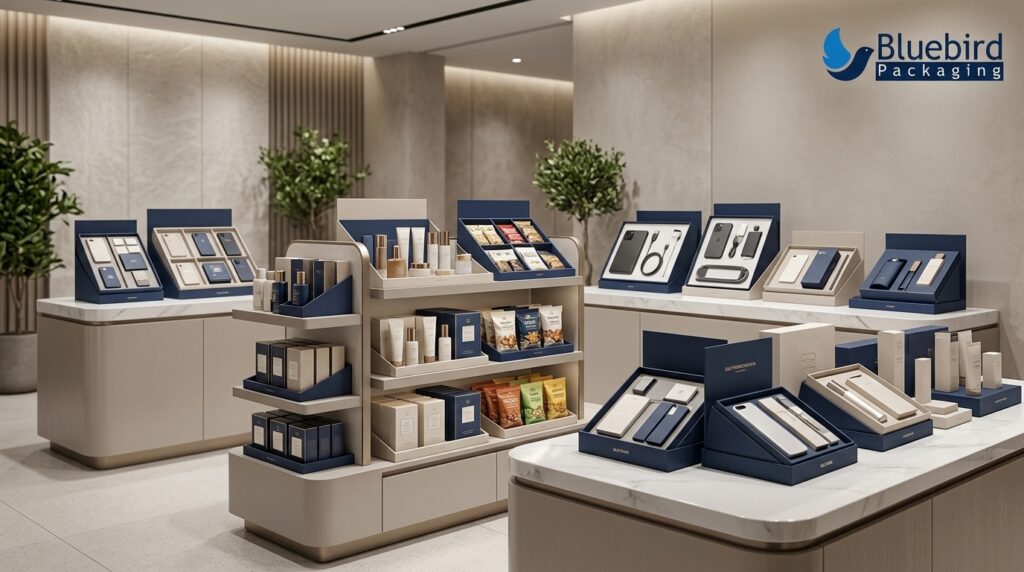
A display can act like a miniature billboard inside a store.
Every element contributes to recognition:
- Logo
- Color palette
- Typography
- Product photography
- Illustrations
- Messaging
- Structural shape
- Finishes
- Product arrangement
When these elements remain consistent across displays, product boxes, advertising, and online channels, customers are more likely to recognize the brand.
A memorable display does not necessarily need to be complicated. Sometimes a simple, distinctive structure with strong branding is more effective than an overloaded design.
28. Display Packaging and Product Presentation
Product presentation is especially important when customers are comparing similar products.
Display packaging can help answer important questions before a customer even picks up the product:
- What is the product?
- Who makes it?
- What does it do?
- Why is it different?
- What benefit does it provide?
- How many units are included?
- Is it part of a special promotion?
A well-organized display reduces visual confusion and gives customers a clearer path from noticing the product to considering the purchase.
29. Display Packaging for Retail Shelves
Shelf displays need to work within a limited amount of space.
Consider:
- Shelf height
- Product orientation
- Customer viewing distance
- Number of product units
- Brand visibility
- Restocking requirements
- Product accessibility
Packaging should also remain stable when several units are placed together.
A strong shelf display makes the product family look organized rather than crowded.
30. Display Packaging for Small Businesses
Small businesses do not necessarily need expensive displays to create a professional retail presence.
A simple custom cardboard display with strong branding can provide an affordable starting point.
Businesses can focus on:
- Clear branding
- Efficient dimensions
- Practical materials
- Simple printing
- Limited but effective finishes
- Appropriate quantities
As sales increase, the display structure can evolve into larger floor displays, premium materials, or more complex merchandising systems.
31. Display Packaging for New Product Launches
A new product needs to compete for attention quickly.
Launch displays can be designed around:
- “New” messaging
- Product benefits
- Brand story
- Launch offers
- QR codes
- Product demonstrations
- Limited-edition graphics
The display should make the new product easy to identify without requiring customers to search through a crowded shelf.
32. Display Packaging for Luxury Products
Luxury packaging boxes relies heavily on perception.
Premium display packaging can use:
- Rigid board
- Specialty papers
- Foil stamping
- Embossing
- Debossing
- Magnetic closures
- Custom inserts
- Soft-touch finishes
- High-quality printing
However, luxury does not simply mean adding more finishes. The structure, typography, material, color, and overall design need to work together.
33. How to Choose a Custom Display Packaging Manufacturer
Choosing the right packaging manufacturer can affect both the quality and efficiency of your project.
Consider whether the manufacturer can provide:
- Custom dimensions
- Multiple material options
- Custom structures
- High-quality printing
- Specialty finishes
- Inserts
- Prototypes or samples
- Bulk production
- Consistent quality
- Packaging consultation
- Shipping support
It is also important to provide accurate product specifications and artwork so the manufacturer can recommend an appropriate structure.
34. How to Order Custom Display Packaging
Preparing your project details in advance will make the ordering process easier.
Step 1: Define Your Product
Be aware of the dimensions, weight and quantity as well as any protection requirements.
Step 2: Choose the Display Type
Determine whether you require a counter, floor, window, hanging, or other structure.
Step 3: Select the Material
Select cardboard, Kraft paper, rigid board or folding cartons.
Step 4: Determine Dimensions
Consider the number of units that your display will hold and how accurate you can be with product measurement.
Step 5: Prepare Artwork
Include the right logo, colors and graphics as well as product details in your artwork.
Step 6: Select Printing and Finishes
Consider whether your project requires standard full-color print, glossy or matte coatings, foi, embossing or windows.
Step 7: Request a Quote
Please provide quantity, dimension, materials, printing and finishing information, as well as shipping details.
Step 8: Review the Prototype or Sample
Review the artwork and structure before you approve large-scale production.
Step 9: Approve Production
Production can start once the specification is confirmed.
Step 10: Plan Delivery and Storage
Think about where you will store the displays and how they are going to reach retailers.
Planning a custom display project?
Share your product dimensions, quantity, preferred display style, and branding requirements with Bluebird Packaging. Our team can help you choose a practical structure and create packaging built around your product.
35. Frequently Asked Questions About Display Packaging
What is display packaging?
Display packaging is packaging designed to present and merchandise products while also providing containment and protection. It is commonly used on shelves, countertops, checkout areas, and retail floors.
What is the purpose of display packaging?
Its purpose is to improve product presentation, visibility, organization, accessibility, branding, and retail merchandising.
What are the most common types of display packaging?
There are many types of display packaging, including counter display boxes and floor displays.
What material is best for display packaging?
What is the best material for your product? For lightweight products like retail items, cardboard and folding cartons are often used. Corrugated material can be stronger, while rigid board and corrugated boards are commonly used for high-end products.
Are display boxes customizable?
Yes. Customization is possible for display packaging in size, structure and printing as well as colors, finishes, window inserts, branding, and finishing.
Can display packaging be printed with a logo?
Yes. Custom printing can incorporate logos, brand colors, product imagery, promotional messages, instructions, and other graphics.
Are display boxes suitable for cosmetics?
Yes. Yes. Cosmetic packaging that is designed to display beauty products can include windows, premium finishes and inserts, counter displays as well as compact structures.
Can display packaging be used for electronics?
Yes. Display packaging for electronics and accessories with inserts, custom-fitted compartments, windows and printed information is available.
Is cardboard good for display packaging?
The cardboard is popular because it’s lightweight, versatile and printable. It is also suitable for many retail uses.
Can I order display packaging wholesale?
Yes. Yes. Wholesale production or bulk products can benefit retailers, manufacturers and companies with multiple locations.
How much does custom display packaging cost?
The cost depends on many factors, including the material used, its dimensions, quantities, finishing, inserts and structural complexity.
Can display packaging be eco-friendly?
Yes. When developing sustainable packaging, brands can take into consideration recyclable paperboards, Kraft materials and recycled-content material, as well as right-sized structures and reduced unnecessary elements.
How do I choose the right display box?
Begin by determining the dimensions, weight and fragility of your product, its retail location, quantities, branding requirements, budget, and shipping circumstances.
36. Final Takeaway: Make Your Product Stand Out With Custom Display Packaging
Display packaging can be more than just a box placed on the shelf. This packaging can be used as a display for retail, a branding tool, a product organizer, a promotional platform and the first point of contact between your product, and potential customers.
Businesses can select from an array of options, including rigid and flexible structures as well as cardboard displays. They also have a choice between different materials, designs, sizes, finishes, printing techniques, etc. Your product, your industry, the retail environment you are in, as well as budget and branding objectives, will determine which solution is best for you.
A well-designed display will make your product look better, more appealing, and organized..
Ready to create display packaging built specifically for your products?
Turn Your Packaging Into Your Best Retail Display
Don’t let your products disappear among competing brands. Bluebird Packaging can help you create custom display packaging with the right structure, dimensions, materials, printing, and finishing for your products.
Custom design. Professional presentation. Stronger shelf presence.