

Shipping costs are not determined by postage alone. The box itself can influence how much space a shipment occupies, how efficiently it can be packed, how much protection it needs, and how much material is used. For ecommerce brands shipping hundreds or thousands of orders, a small packaging inefficiency can become a significant operating expense.
The biggest ecommerce packaging mistake is treating the box as a container instead of treating it as part of the fulfillment system. This guide covers 10 common Ecommerce Packaging Mistakes and explains what businesses can do instead.
Quick Answer: What Ecommerce Packaging Mistakes Increase Shipping Costs?
The most common problems include oversized boxes, dimensional shipping costs, poor product measurement, excessive empty space, unnecessarily heavy materials, inefficient structures, excessive protective material, limited box sizes, ignored order combinations, and packaging designed without considering fulfillment.
Mistake #1: Using Oversized Packaging
Oversized packaging is one of the easiest problems to overlook. A business may think that a bigger box gives the product more protection. Sometimes it does, but too much space can create other problems.
Large boxes may:
- Require more material
- Take more warehouse space
- Need more void fill
- Increase package dimensions
- Increase shipping costs in some carrier pricing models
- Allow more product movement
The goal should not be the smallest possible box. The goal is the right-sized box that provides suitable protection without unnecessary space.
Mistake #2: Ignoring Dimensional Shipping Costs
Businesses often focus on product weight while overlooking package dimensions. Depending on the carrier and service, shipping charges may consider dimensional weight.
That means a lightweight product inside a large package can cost more to ship than expected.
Simple Example
| Package | Approx. Dimensions | Product Weight | Packaging Efficiency |
|---|---|---|---|
| A | 6 × 6 × 4 in | 1 lb | Compact |
| B | 12 × 10 × 8 in | 1 lb | Oversized |
| C | 8 × 7 × 5 in | 1 lb | Moderate |
| D | 6 × 5 × 4 in | 1 lb | Highly compact |
The exact shipping charge depends on the carrier, destination, service, and applicable dimensional-weight rules.
The lesson is simple: Do not evaluate shipping packaging based on weight alone.
Mistake #3: Choosing the Box Before Measuring the Product
A common workflow is:
Find box → place product inside → add filler.
A more efficient workflow is:
Measure product → determine clearance → select structure → calculate packaging dimensions.
Measure:
- Product length
- Product width
- Product height
- Product weight
- Fragility
- Number of units per order
Then determine how much internal space is actually required.
For businesses ordering Ecommerce Shipping Boxes, this information is particularly useful when developing custom dimensions.
Mistake #4: Leaving Too Much Empty Space
Empty space is not automatically bad. Fragile products may need clearance and protective materials. But unnecessary empty space creates inefficiency.
A large cavity can also allow products to move during transportation.
Instead of simply adding more filler, ask:
“Can the structure itself position the product more efficiently?”
Possible solutions include:
- Inserts
- Dividers
- Custom cavities
- Better-fitting cartons
- Product-specific dimensions
Mistake #5: Choosing Materials Based Only on Appearance
A heavier package is not automatically a better package. Material selection should consider the complete packaging requirement.
Important factors include:
- Product weight
- Fragility
- Shipping environment
- Required stiffness
- Box structure
- Storage
- Presentation
- Budget
For example, a lightweight retail product may not require a very heavy structure. A fragile ecommerce product may need stronger protective packaging.
The correct approach is to match material performance to the actual requirement.
Mistake #6: Selecting the Wrong Box Structure
A box can be strong and still be inefficient. The structure affects assembly, closing, product access, storage, packing speed, protection, and presentation.
For ecommerce, mailer structures can be useful for certain products because they are designed around shipping and fulfillment.
When evaluating Ecommerce Packaging Solutions, businesses should consider whether the current structure works efficiently throughout the entire fulfillment process.
Mistake #7: Adding Too Much Protective Material
Protection is important, but more material does not automatically mean better protection.
If a product requires a small amount of cushioning, adding several unnecessary layers may create:
- Higher material usage
- More packing time
- More storage requirements
- Higher package volume
- A less efficient unboxing experience
Instead, test the packaging system. The objective is to provide enough protection for the expected shipping environment without unnecessary packaging.
Mistake #8: Using One Box Size for Every Product
A single box size can seem convenient. But ecommerce catalogs often contain products with different dimensions, weights, fragility levels, order quantities, and product combinations.
Using one large box for everything may create excessive empty space.
A better strategy may involve a small family of standardized box sizes.
Example Packaging Size Strategy
| Product Type | Suggested Packaging Approach | Main Goal |
|---|---|---|
| Small single item | Small custom carton | Reduce unused space |
| Medium product | Medium mailer | Balance protection and efficiency |
| Fragile item | Protective structure | Reduce movement |
| Multi-item order | Larger organized structure | Efficient consolidation |
| Premium product | Branded mailer + internal support | Protection + experience |
| Subscription order | Standardized recurring box | Fulfillment efficiency |
Mistake #9: Ignoring Multi-Product Orders
A customer ordering three products is not necessarily three separate shipments. If products can safely be consolidated, packaging should account for common order combinations.
This can help businesses think beyond:
One product → one box
and instead evaluate:
Common order → optimized packaging configuration
For example, a skincare company might design one packaging system for individual products and another for two- or three-product bundles.
This is especially important for subscription and repeat-purchase businesses.
Mistake #10: Designing Packaging Without Considering Fulfillment
A package that looks excellent but takes too long to assemble can become expensive at scale.
Ask:
- Can warehouse staff pack it quickly?
- Is the closure intuitive?
- Does it require excessive tape?
- Are inserts easy to position?
- Does the product drop into place?
- Can the package be stored efficiently?
- Can multiple SKUs use a common process?
Ecommerce Packaging Solutions should be evaluated as part of the fulfillment workflow—not as an isolated design object.
The Hidden Cost of Packaging Inefficiency
Shipping is only one part of the equation. An inefficient package can affect:
Material Cost + Shipping Cost + Labor Cost + Storage Cost + Damage Cost + Returns Cost
That is why the cheapest box is not necessarily the cheapest packaging solution.
Total Packaging Cost Framework
| Cost Area | What to Look At | Possible Problem |
|---|---|---|
| Material | Board, Kraft, corrugated | Over-specification |
| Shipping | Dimensions + weight | Oversized package |
| Labor | Packing time | Complicated structure |
| Storage | Box volume | Too many sizes |
| Damage | Product protection | Weak structure |
| Returns | Product condition | Poor protection |
| Customer experience | Unboxing | Excessive or poor packaging |
How to Reduce Ecommerce Packaging Costs Without Making Packaging Cheap
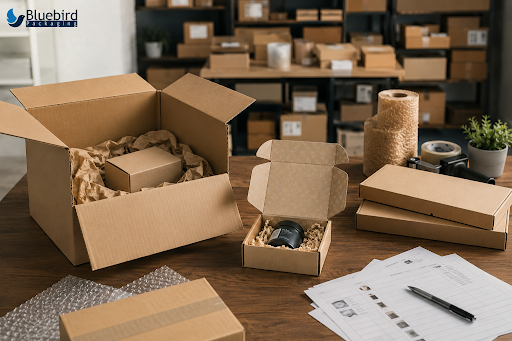
Cost reduction should focus on efficiency, not simply using lower-quality materials.
1. Measure Your Current Boxes
Record:
- Box dimensions
- Product dimensions
- Shipping weight
- Average orders per month
- Void fill usage
2. Identify Your Most Common SKUs
You may discover that a small number of products represent most orders. Optimize those first.
3. Analyze Empty Space
Look at actual packed orders. If there is excessive empty space, determine whether the box can be resized or redesigned.
4. Standardize Where Practical
Instead of 20 packaging sizes, perhaps a carefully planned group of sizes can cover most orders.
5. Test Before Scaling
Do not change packaging across thousands of orders based only on theory. Run controlled tests and track:
- Damage
- Returns
- Packing time
- Material usage
- Shipping cost
- Customer feedback
A Better Way to Think About Ecommerce Packaging
Instead of asking:
“What is the cheapest box?”
Ask:
“What package gives us the lowest total cost while protecting the product and maintaining the customer experience?”
That question produces better decisions.
A slightly stronger box could reduce damage. A slightly smaller box could reduce dimensional costs. A simpler closure could reduce labor. A better internal fit could reduce void fill.
Packaging optimization is therefore a business process, not simply a design exercise.
Optimize Your Packaging Around Your Products
If your current boxes are too large, too complicated, or not designed around your actual products, it may be time to rethink the structure. Explore custom ecommerce packaging options and provide your product dimensions, quantity, shipping requirements, and preferred materials.
How Bluebird Can Fit Into the Process
Custom packaging can be developed around:
- Product dimensions
- Material
- Structure
- Printing
- Finishing
- Quantity
- Internal requirements
Bluebird’s custom quote process allows businesses to provide product information, dimensions, quantity, material, printing, finishing, descriptions, and artwork or reference images.
That information gives a packaging manufacturer a much better starting point than simply saying:
“I need a shipping box.”
Get a Packaging Specification Review
Before placing a large order, share your current packaging requirements and compare your existing dimensions with the product specifications. This can help identify whether the biggest opportunity is material, structure, size, protection, or fulfillment efficiency.
Frequently Asked Questions
What is the biggest ecommerce packaging mistake?
Using packaging that is significantly larger than necessary is one of the most common problems. However, the biggest issue overall is failing to design packaging around the actual product and fulfillment process.
Does smaller packaging always cost less to ship?
Not always. Shipping costs depend on factors such as destination, service, carrier rules, weight, and dimensions. Smaller packaging can improve efficiency, but it should still provide adequate protection.
How can I reduce ecommerce packaging costs?
Start by analyzing product dimensions, box dimensions, shipping charges, empty space, protective materials, and packing time. Then test right-sized packaging and appropriate structures.
Should ecommerce packaging be lightweight?
It should be appropriately lightweight rather than unnecessarily heavy. Material selection should balance weight, strength, protection, presentation, and cost.
Are mailer boxes good for ecommerce?
Mailer boxes can be suitable for many ecommerce products, particularly when the structure provides adequate protection and the dimensions fit the product and fulfillment requirements.
How many ecommerce box sizes should a business have?
There is no universal number. A business should use enough sizes to handle its common products and orders efficiently without creating unnecessary inventory complexity.
Build a More Efficient Ecommerce Packaging System
Measure your products, optimize your box dimensions, choose the right structure, and test your packaging before scaling.
Final Takeaway
Reducing ecommerce packaging costs does not mean making your packaging cheap. It means making it efficient. The most effective ecommerce packaging systems are designed around real products, real orders, real fulfillment workflows, and real shipping conditions. Measure your products. Analyze your box dimensions. Reduce unnecessary space. Choose the right structure. Test your packaging before scaling. The result can be a package that protects the product, supports the brand, and makes better financial sense at the same time. Talk to Bluebird Packaging about a custom solution if you are ready to build packaging around your actual ecommerce requirements.