
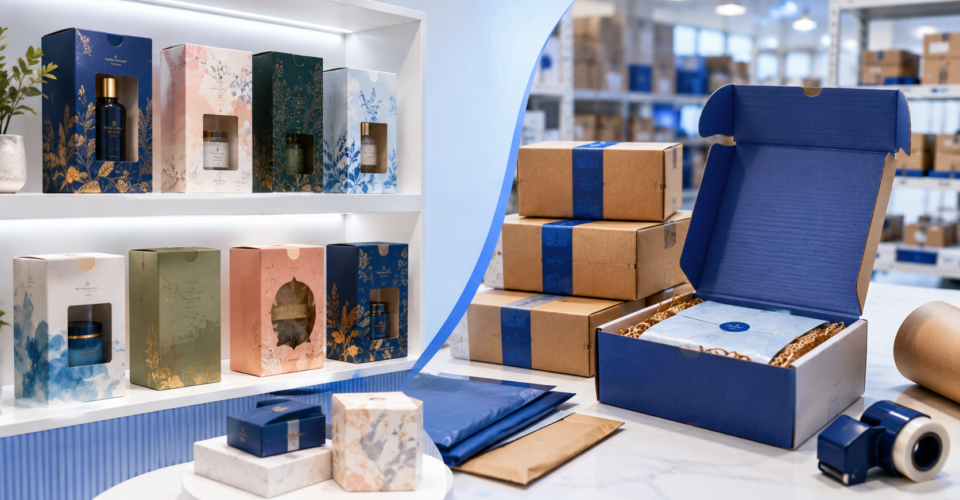
Retail and ecommerce packaging may look similar at first, but they are designed around two very different customer journeys.
Retail packaging is primarily built to attract attention, communicate product information, and compete for space on a physical shelf. Ecommerce packaging has to survive handling and transportation while creating a strong unboxing experience after the product reaches the customer.
The right choice depends on where your product is sold, how it is handled, what protection it needs, and how customers interact with it.
For brands selling through both channels, the answer is often not choosing one packaging style over the other. Instead, businesses can develop packaging systems that maintain the same brand identity while adapting the structure to each sales environment.
Quick Answer: Retail vs. Ecommerce Packaging
The biggest difference is where the packaging has to perform its most important job.
Retail packaging must work in a store environment where shoppers may compare dozens of products side by side. Ecommerce packaging must perform through fulfillment, transportation, delivery, and unboxing.
| Factor | Retail Packaging | Ecommerce Packaging |
|---|---|---|
| Main environment | Store, shelf, counter, display | Warehouse, carrier network, doorstep |
| Primary goal | Visibility and product communication | Protection and delivery |
| Customer interaction | Before purchase | Mostly after purchase |
| Key design factor | Shelf appeal | Shipping efficiency |
| Structure | Cartons, display boxes, window boxes, hang tabs | Mailers, shipping boxes, protective cartons |
| Branding | Designed to attract shoppers | Designed to enhance the unboxing experience |
| Protection needs | Moderate to high depending on product | Often higher because of transportation |
| Size priority | Shelf dimensions and product presentation | Product fit and shipping efficiency |
Need the Right Packaging for Your Sales Channel?
Share your product dimensions, quantity, material preference, structure, and intended application with Bluebird Packaging to develop packaging around your retail or ecommerce requirements.
What Is Retail Packaging?

Retail Packaging is packaging designed specifically for products sold through physical stores, retail counters, shelves, displays, or other in-person selling environments.
A shopper normally sees the package before purchasing the product. That means the packaging has to communicate several things quickly:
- What the product is
- Who the brand is
- Why the product is different
- Important product information
- Visual quality
- Usage or product benefits
A package competing on a crowded shelf does not have unlimited time to communicate.
This is why Retail Product Packaging often combines structural functionality with visual hierarchy.
For example, a skincare product may need a compact carton with clear product information, while a hanging accessory could benefit from an integrated hang tab.
Brands can explore different formats through Bluebird Packaging’s retail collection as they evaluate the structure that fits their products and selling environment.
What Is Ecommerce Packaging?
Ecommerce Packaging is designed for products sold and fulfilled through online channels.
Unlike retail packaging, the package may travel through several stages before reaching the customer:
- Manufacturing
- Warehousing
- Picking
- Packing
- Transportation
- Sorting
- Last-mile delivery
- Customer unboxing
That creates different priorities.
A beautiful box is not enough if the product moves excessively inside it or the package uses considerably more material and space than necessary.
Ecommerce Product Packaging should therefore balance protection, dimensions, material efficiency, branding, and customer experience.
For products that need a shipping-focused structure, brands can explore mailers designed for online fulfillment from Bluebird Packaging.
Why Retail Packaging and Ecommerce Packaging Are Not Interchangeable
A common mistake is assuming that one box can perform equally well everywhere.
It can sometimes work, but the requirements are different.
Imagine a premium cosmetic product.
In a store, the box may need:
- Strong front-panel branding
- Product information
- Attractive finishing
- Shelf visibility
- A compact footprint
Online, the same product may additionally require:
- Better resistance to handling
- Appropriate internal clearance
- Protection from movement
- Efficient outer dimensions
- A memorable unboxing experience
This does not mean ecommerce packaging has to look plain.
It means the structure and design should account for the entire journey rather than only the moment when the customer sees the product.
7 Key Differences Businesses Should Consider

1. The First Impression Happens at Different Times
Retail packaging creates an impression before purchase. Ecommerce packaging creates an important impression after purchase, although product images and digital branding influence the buying decision online.
This distinction changes what the package needs to accomplish.
Retail packaging needs to answer:
“Why should I pick this product?”
Ecommerce packaging needs to answer:
“Did the product arrive safely, and does this feel like the brand I ordered from?”
The strongest ecommerce brands consider both.
2. Shelf Competition vs. Shipping Conditions
Retail packaging competes visually.
Ecommerce packaging competes physically.
A retail box can be positioned among competing products for weeks or months. An ecommerce package may encounter conveyor systems, stacking, sorting, vehicles, and repeated handling within a much shorter period.
Therefore, Ecommerce Shipping Boxes generally need to be selected with transportation conditions in mind.
3. Size Has Different Consequences
Retailers often care about shelf dimensions and how efficiently products fit within displays.
Online sellers care about the relationship between package dimensions, product weight, protection, and transportation.
An oversized shipping box can create unnecessary empty space and increase material consumption. A box that is too small may create pressure on the product or make packing inefficient.
The best approach is to develop the package around actual product dimensions.
4. Product Visibility
Retail packaging can benefit from visible product areas.
For example, a window can allow customers to inspect a product before purchasing.
In ecommerce, customers generally see product photography before placing an order. The physical package therefore has a different presentation role.
This does not make windows irrelevant online, but it changes their purpose.
5. Branding Works Differently
Branded Retail Packaging has to communicate visually in a public shopping environment.
Branded Ecommerce Packaging is more closely connected with the customer’s unboxing experience.
Retail branding often emphasizes:
- Logo visibility
- Product name
- Color recognition
- Product information
- Shelf differentiation
Ecommerce branding can emphasize:
- Exterior graphics
- Opening experience
- Interior printing
- Inserts
- Thank-you messaging
- Brand storytelling
6. Protection Requirements
Retail packages still need to protect products, but ecommerce adds transportation variables.
A fragile product sold online may require:
- Additional clearance control
- Inserts
- Stronger outer packaging
- Appropriate board selection
- More secure closure
- Shock and movement considerations
The correct packaging depends on the product rather than the sales channel alone.
7. The Unboxing Experience
For ecommerce brands, the box can become part of the product experience.
Customers may photograph the package, share it online, or remember the opening experience.
That makes Ecommerce Packaging Design an opportunity to create a branded touchpoint rather than treating the package as disposable shipping material.
Can One Packaging Solution Work for Both Retail and Ecommerce?
Yes, but it should be evaluated carefully.
Some products can use a primary retail package inside a suitable shipping package. Others can use a stronger structure that performs adequately in both environments.
A useful strategy is to separate the product presentation layer from the transportation layer.
For example:
Product → Branded Retail Box → Protective Shipping Packaging
This can preserve retail presentation while adding transportation protection.
For simpler products, one custom structure may perform both functions.
Choosing the Right Packaging: A Practical Decision Framework
Instead of asking:
“Should I choose retail packaging or ecommerce packaging?”
Ask these seven questions:
- Where is the product primarily sold?
- Will customers see the package before purchase?
- How fragile is the product?
- How far will it typically travel?
- Does the product need internal support?
- What are the storage and fulfillment requirements?
- Is packaging presentation a major part of the brand experience?
Your answers will help determine whether you need dedicated retail packaging, ecommerce packaging, or a coordinated system.
Retail vs. Ecommerce Packaging Decision Matrix
| Business Situation | Better Starting Point | Why |
|---|---|---|
| Product sold mainly in stores | Retail packaging | Shelf visibility matters |
| Product sold primarily online | Ecommerce packaging | Shipping performance matters |
| Premium product sold online and in stores | Coordinated packaging system | Both presentation and protection matter |
| Fragile ecommerce product | Protective shipping structure | Transportation creates additional risk |
| Small retail product on peg hooks | Hang-tab style | Display positioning can improve visibility |
| Subscription products | Mailer-focused structure | Repeated shipping is central to the business |
| Gift products | Premium presentation + protection | Customer experience matters in both channels |
How Materials Influence the Decision
The material should follow the application.
Cardboard can work well for many retail applications where print quality, customization, and structural flexibility are important.
Kraft can support brands looking for a natural visual direction while still allowing customization.
Corrugated materials may be appropriate where greater shipping protection is required.
Rigid structures can create a more substantial premium presentation.
For example, custom cardboard packaging options can be considered when a brand needs a balance of presentation, customization, and practical packaging performance.
Retail Packaging vs. Ecommerce Packaging: Which Is More Expensive?
There is no universal answer.
Cost depends on:
- Material
- Dimensions
- Quantity
- Printing
- Finishing
- Structure
- Inserts
- Production requirements
- Shipping requirements
Trying to compare prices without comparing specifications can produce misleading conclusions.
A better approach is to compare the total packaging cost per successfully delivered product, not simply the cost of one empty box.
If ecommerce packaging reduces damage, improves packing efficiency, or minimizes unnecessary dimensions, a slightly more expensive package may create better overall economics.
A Smarter Strategy for Omnichannel Brands
Brands selling through both retail and ecommerce should avoid creating two completely unrelated visual identities.
Instead, maintain consistent:
- Logo placement
- Typography
- Brand colors
- Product naming
- Graphic language
- Finishing style
Then adapt the structure where necessary.
For example:
- Retail: Compact carton with strong front-facing graphics.
- Ecommerce: Protective mailer with consistent branding and an interior unboxing experience.
The customer should still recognize the same brand.
Build Packaging Around Your Sales Channel
Your packaging should not force your product to adapt to a generic box.
Start with Bluebird Packaging’s custom packaging solutions and provide your product dimensions, preferred material, quantity, structure, and intended application so the packaging can be developed around your actual requirements.
Build Packaging Around Your Sales Channel
Whether you sell through retail stores, ecommerce platforms, or both, Bluebird Packaging can help develop packaging around your product, protection requirements, presentation goals, and fulfillment process.
Frequently Asked Questions
Is retail packaging different from ecommerce packaging?
Yes. Retail packaging is primarily designed for physical presentation, shelf visibility, product information, and in-store handling. Ecommerce packaging places greater emphasis on transportation, product protection, packing efficiency, and unboxing.
Can retail packaging be used for ecommerce?
Sometimes. It depends on the product, package strength, dimensions, and shipping conditions. Some retail boxes can be shipped directly, while others benefit from an additional protective outer package.
Is ecommerce packaging always stronger than retail packaging?
Not necessarily. Strength should be determined by the product and handling conditions. A lightweight retail product may need minimal protection, while a fragile ecommerce product may require additional support.
What type of packaging is best for products sold online?
There is no single best structure. Mailer boxes, shipping cartons, corrugated packaging, and other custom formats can work depending on product size, weight, fragility, fulfillment process, and shipping conditions.
Should a brand use different packaging for retail and ecommerce?
It can be beneficial when the channels have substantially different requirements. However, the visual identity can remain consistent across both packaging systems.
How do I choose the right packaging for my business?
Start with your product dimensions, weight, fragility, selling channel, shipping requirements, quantity, and presentation goals. Then select the material and structure around those requirements.
Final Takeaway
Retail and ecommerce packaging solve different problems.
Retail packaging wins attention before the sale. Ecommerce packaging protects the product during the journey and reinforces the brand after delivery.
The best packaging strategy is not necessarily about choosing one over the other. For growing brands, the smarter approach is to create a packaging system that keeps the brand recognizable while adapting the structure to the way each product is sold, handled, displayed, and delivered.
If you are unsure which structure fits your product, talk with a packaging expert and compare the options around your actual product specifications rather than choosing a box based only on appearance.
Ready to Choose the Right Packaging?
Share your product dimensions, quantity, preferred material, packaging structure, and selling channel with Bluebird Packaging to get started.