
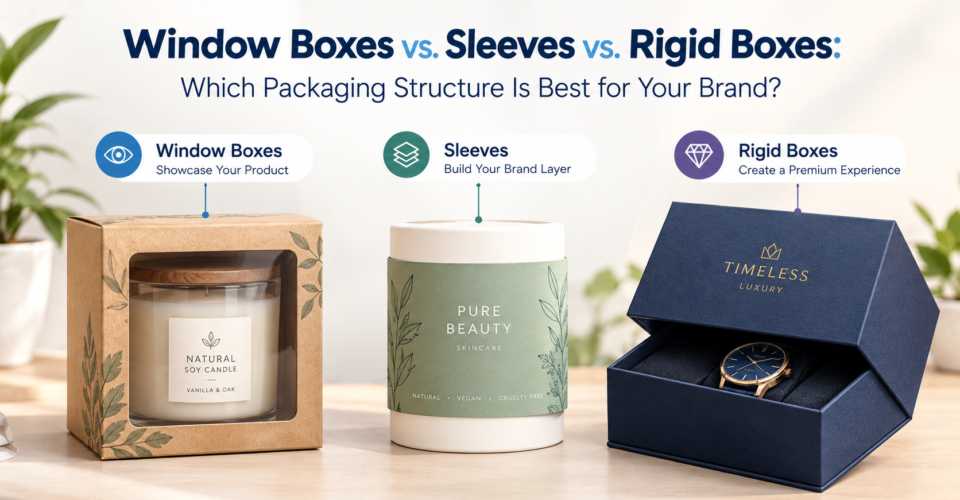
Choosing packaging is often presented as a design decision. In reality, it is a product-fit decision. A window box, sleeve, and rigid box can all create attractive packaging, but they solve different problems. One may prioritize product visibility, another may emphasize minimalism and branding, while another may be built around premium presentation and structural presence.
At Bluebird Packaging, Custom Packaging Structures can be developed according to product dimensions, material preferences, presentation goals, protection requirements, sales channels, and branding needs. This allows businesses to select packaging based on what the product actually requires rather than choosing a structure based only on appearance.
Whether you are comparing Window Boxes, Packaging Sleeves, or Rigid Boxes, the right choice depends on your product, selling environment, protection requirements, budget, and desired customer experience.
Need Help Choosing the Right Packaging Structure?
Share your product dimensions, quantity, material preference, selling environment, and presentation goals with Bluebird Packaging. We can help evaluate the appropriate packaging structure for your product.
Quick Answer: Window Boxes vs. Sleeves vs. Rigid Boxes
Window Boxes: Best when customers benefit from seeing the product before purchase.
Packaging Sleeves: Best when you want a lightweight branded layer around an existing product, container, tray, or inner package.
Rigid Boxes: Best when premium presentation, durability, and a substantial unboxing experience are priorities.
The right packaging structure is not necessarily the most expensive option. It is the structure that solves the most important packaging problem for your product.
Quick Comparison
| Feature | Window Boxes | Sleeves | Rigid Boxes |
|---|---|---|---|
| Product visibility | High | Depends on product | Usually low |
| Premium feel | Medium to high | Medium | High |
| Structural strength | Depends on material | Low to medium | High |
| Branding area | High | Medium to high | High |
| Product presentation | Strong | Minimalist | Premium |
| Typical use | Retail/display | Product wrapping | Luxury/gifting |
| Shipping suitability | Product dependent | Product dependent | Strong but heavier |
| Storage efficiency | Depends on structure | High | Lower |
| Cost | Low to medium | Low to medium | Medium to high |
What Are Window Boxes?
Window Boxes are packages that include a transparent section allowing customers to see some or all of the product without opening the package.
They are particularly useful when visual product characteristics influence purchase decisions. The physical product can become part of the packaging presentation instead of being completely hidden.
Window Boxes can be useful for:
- Soap
- Bakery products
- Candles
- Gifts
- Cosmetics
- Small accessories
- Specialty food products
A window can frame the product while still providing exterior space for branding, product information, graphics, and other packaging elements.
When Should You Choose a Window Box?
A window structure may be appropriate when:
- Product appearance matters
- Customers benefit from product inspection
- Texture or color supports the purchase decision
- The physical product is visually attractive
- Retail shelf visibility is important
However, a window is not always necessary. If your product requires strong branding or your visual identity depends on full-surface graphics, a completely printed box may provide a better solution.
What Are Packaging Sleeves?
Packaging Sleeves are printed or branded structures that wrap around a product, inner box, tray, bottle, container, or another package.
Sleeves can create a strong visual identity without requiring a completely enclosed package. They can be particularly useful when the product already has primary protection and the sleeve is primarily intended for branding and presentation.
Sleeves are often useful when:
- The product already has primary protection
- You need an additional branding layer
- A minimalist presentation is desired
- You want to reveal part of the product
- You need flexible product presentation
- Different SKUs require different visual treatments
Why Choose a Sleeve?
A sleeve can create a different visual experience from a traditional carton. Instead of presenting a completely closed package, it can create a layered presentation:
Product → Inner Structure → Branded Sleeve
This approach can be particularly effective for premium minimalist brands. Sleeves can also allow businesses to maintain one underlying structure while changing the outer printed sleeve for different products, seasons, campaigns, or limited editions.
What Are Rigid Boxes?
Rigid Boxes are constructed from thicker, more substantial board and are generally associated with premium presentation and structural presence.
Rigid packaging can be considered for:
- Luxury products
- Jewelry
- Cosmetics
- Watches
- Fragrances
- Gifts
- Premium collections
- Special editions
Rigid packaging can create a sense of substance when customers pick up the package. It can also support a carefully designed opening experience, making the package itself part of the overall product presentation.
Bluebird Packaging can develop rigid structures around premium products, product dimensions, inserts, presentation requirements, and branding objectives.
Window Boxes vs. Sleeves vs. Rigid Boxes: Detailed Comparison
| Decision Factor | Window Box | Sleeve | Rigid Box |
|---|---|---|---|
| Customer needs to see product | Excellent | Good | Limited |
| Minimalist aesthetic | Good | Excellent | Good |
| Premium positioning | Good | Good | Excellent |
| Product protection | Good depending on structure | Limited by itself | Excellent |
| Shelf presentation | Excellent | Good | Excellent |
| Gift presentation | Good | Good | Excellent |
| Shipping | Depends on structure | Usually needs another protective layer | Strong |
| Custom branding | Excellent | Excellent | Excellent |
| Easy product identification | Excellent | Good | Moderate |
| Unboxing experience | Good | Excellent | Excellent |
How to Choose Between the Three
Rather than starting with aesthetics, start with the product. Understanding what the packaging needs to accomplish can make structure selection more practical.
Does the Customer Need to See the Product?
If yes, a window structure deserves serious consideration. When the visual appearance of the product is part of the buying decision, hiding it may remove one of its selling advantages.
A window can make the physical product part of the retail presentation while still providing space for branding and product information.
Does the Product Already Have Protection?
If the product is already contained in a bottle, jar, inner carton, tray, or other protective structure, a sleeve may provide enough branding and presentation.
If the product requires complete enclosure or additional structural support, a box may be more appropriate.
Is Premium Presentation Central to the Brand?
If the package itself needs to communicate luxury, rigid packaging may be the strongest candidate.
This can be especially relevant when:
- Product price is high
- Packaging is retained by customers
- The product is purchased as a gift
- Unboxing is part of the experience
- Brand positioning depends on premium presentation
Is the Product Primarily Sold in Retail?
Retail products have to communicate quickly. A window box can combine Product Visibility + Branding + Protection.
A sleeve can create Branding + Minimalism + Product Visibility.
A rigid box can create Premium Presentation + Structure + Brand Experience.
The best choice depends on the product category and selling environment.
Packaging Structures by Industry
| Industry | Window Box | Sleeve | Rigid Box | Strong Starting Option |
|---|---|---|---|---|
| Handmade soap | Excellent | Excellent | Good | Window box/sleeve |
| Luxury soap | Good | Good | Excellent | Rigid |
| Cosmetics | Excellent | Excellent | Excellent | Product dependent |
| Candles | Excellent | Good | Excellent | Window/rigid |
| Jewelry | Limited | Limited | Excellent | Rigid |
| Gifts | Excellent | Good | Excellent | Rigid/window |
| Food display products | Excellent | Good | Limited | Window |
| Premium accessories | Good | Good | Excellent | Rigid |
| Retail products | Excellent | Good | Good | Window/carton |
| Ecommerce products | Product dependent | Usually secondary | Good | Protection first |
Window Packaging: When Product Visibility Sells
Product visibility is not simply a visual feature. It can help reduce uncertainty by allowing customers to see characteristics of the physical product before purchase.
A customer may want to know:
- What color is the product?
- What does the texture look like?
- What does the physical product actually look like?
- Does the product match the image?
- Is the item arranged properly?
A well-positioned window can answer some of these questions without requiring customers to open the package.
However, the window should have a purpose. It should be selected because product visibility improves the buying experience rather than simply because competing products use one.
Sleeves: The Underrated Branding Layer
Sleeves are often overlooked because they do not look as substantial as rigid boxes. However, that can also be their advantage.
A sleeve can:
- Refresh existing packaging
- Create a premium branding layer
- Differentiate product SKUs
- Reduce the need for a fully printed inner package
- Add seasonal messaging
- Support limited editions
- Create flexible product presentation
For example, a skincare brand could maintain one internal tray structure while changing sleeves for holiday collections, new product launches, limited editions, gift sets, and seasonal campaigns.
This can create flexibility without redesigning the entire packaging system.
Rigid Packaging: When the Box Becomes Part of the Product
Rigid packaging can create a different physical and visual experience. The customer does not simply receive a container; they receive a presentation.
This can be particularly relevant for:
- Premium fragrances
- Jewelry
- Luxury cosmetics
- Watches
- Corporate gifts
- Special editions
Rigid boxes can also incorporate premium finishes and structural features such as inserts, magnetic closures, layered construction, shoulder structures, and specialized opening formats.
For premium products, these features can help make the packaging part of the overall customer experience.
Don’t Choose a Structure Based on Price Alone
The cheapest structure may create a higher total cost if it damages products, requires additional protective packaging, looks inconsistent with the product price, requires difficult assembly, creates poor shelf presentation, or limits future product variations.
Likewise, the most expensive structure may be unnecessary for an everyday product.
The goal should be value alignment. The packaging structure should provide the appropriate combination of protection, presentation, branding, functionality, and cost for the intended application.
Structure Selection Framework
| If Your Main Goal Is… | Consider… | Why |
|---|---|---|
| Product visibility | Window box | Lets the product participate in presentation |
| Minimal branding layer | Sleeve | Adds graphics without full enclosure |
| Premium experience | Rigid box | Strong physical and visual presence |
| Retail shelf impact | Window/carton | Strong product communication |
| Luxury gifting | Rigid | Supports premium presentation |
| Product family flexibility | Sleeve system | Easy visual variation |
| Ecommerce protection | Protective box | Structure prioritizes transportation |
| Low-complexity packaging | Simple carton/sleeve | Easier production and handling |
How Branding Changes Across Structures
Your brand identity should remain recognizable regardless of the packaging structure.
Consistency can be maintained through:
- Logo
- Typography
- Colors
- Product naming
- Illustration style
- Graphic language
- Finishing
The structure can then change according to the product and application.
For example:
- Retail SKU: Window box
- Premium SKU: Rigid box
- Seasonal SKU: Sleeve
All three can still belong to the same brand family when the visual identity remains consistent.
What About Custom Packaging Structures?
Custom Packaging Structures are useful when standard box formats do not solve the product’s requirements effectively.
A custom structure can be developed around:
- Product dimensions
- Weight
- Shape
- Number of components
- Display requirements
- Shipping requirements
- Opening experience
- Branding
- Inserts
This approach can be particularly useful for unusual products or brands with several product configurations.
Bluebird Packaging can develop packaging structures according to the application and product requirements, including folding cartons, tuck-end boxes, window boxes, hang-tab structures, insert boxes, sleeves, and rigid structures.
How to Test a Packaging Structure Before Ordering at Scale
Do not evaluate packaging only from a computer screen. A physical sample or prototype can provide useful information about fit, handling, presentation, and functionality.
Product Fit
Does the product sit correctly inside the selected structure?
Opening Experience
Can customers open the package without unnecessary frustration?
Protection
Does the structure keep the product appropriately positioned during handling?
Visual Hierarchy
Can customers immediately identify the brand and product?
Shelf Appearance
Does the package look appropriate beside competing products?
Shipping
If the package will be used for ecommerce fulfillment, can the structure tolerate normal handling and transportation requirements?
Storage
Can your warehouse store the packaging efficiently before and after assembly?
Related Packaging Solutions
Window boxes, sleeves, and rigid boxes can work alongside other custom packaging structures to create a coordinated packaging system.
Businesses developing packaging for different product categories can also explore Custom Retail Boxes for additional retail packaging options.
For beauty and cosmetic products, packaging can be coordinated with Custom Cosmetic Boxes and other product-specific packaging solutions.
Frequently Asked Questions
Are window boxes better than rigid boxes?
Not necessarily. Window boxes are better when product visibility is important, while rigid boxes are generally better when premium presentation and structural presence are priorities.
Are sleeves considered packaging?
Yes. Sleeves can function as a branding and presentation layer around a product, tray, carton, container, or other package.
Are rigid boxes suitable for ecommerce?
They can be suitable for premium ecommerce products, but the complete shipping system should be evaluated for weight, dimensions, protection, and transportation requirements.
Which packaging structure is most premium?
Rigid packaging is generally associated with premium and luxury presentation. However, perceived quality also depends on design, materials, finishing, construction, and brand positioning.
Are window boxes good for retail?
Yes. They can be particularly effective when customers benefit from seeing the product before purchase.
Which structure is best for a small brand?
There is no universal answer. A small brand should prioritize product fit, sales channel, budget, protection, presentation, and future packaging requirements before selecting a structure.
Can one brand use multiple packaging structures?
Absolutely. Using different structures for different product tiers, SKUs, campaigns, or selling channels can be an effective strategy as long as the visual identity remains consistent.
Can packaging structures be customized?
Yes. Custom packaging structures can be developed according to product dimensions, material, quantity, branding, presentation requirements, inserts, windows, shipping needs, and other specifications.
Final Takeaway
Window Boxes, Packaging Sleeves, and Rigid Boxes are not simply three different ways to make packaging look attractive. They represent three different approaches to packaging.
Window Box → “See the product.”
Sleeve → “Experience the brand layer.”
Rigid Box → “Experience the premium presentation.”
The smartest choice depends on what your product needs most.
If visibility drives purchase, start with a window. If flexibility and branding are priorities, consider a sleeve. If premium presentation is central to your brand, evaluate a rigid structure.
If none of these structures perfectly fits the product, a custom packaging approach may be the better answer.
Bluebird Packaging can help evaluate your packaging structure according to product dimensions, quantity, material preference, presentation requirements, selling environment, and intended application.
Find the Right Packaging Structure for Your Brand
Whether you need window boxes, packaging sleeves, rigid boxes, custom cartons, inserts, or another packaging structure, Bluebird Packaging can help develop a solution around your product requirements.