

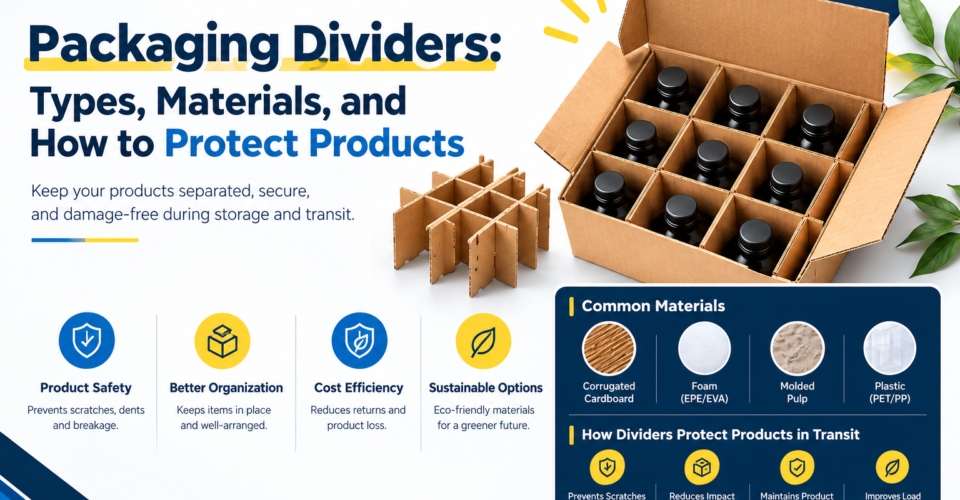
Packaging dividers are internal components that separate products inside a box, helping prevent items from colliding, shifting, scratching, or breaking during handling and transportation. Depending on the product, these components may be made from corrugated cardboard, paperboard, foam, molded pulp, or other materials designed to provide separation, cushioning, or a more organized presentation.
For U.S. businesses shipping glass bottles, cosmetics, food products, electronics, accessories, or multi-item orders, the right divider can make packaging easier to assemble and products easier to organize. The best design depends on product dimensions, weight, fragility, the number of items per box, and the conditions the package may encounter during delivery.
A divider is not always the same as a fitted insert. Dividers typically create separate compartments, while inserts may be shaped around individual products to hold them in a specific position. Choosing between them—and selecting the right material—helps businesses balance protection, packaging cost, packing efficiency, and presentation.
Quick Answer: What Are Packaging Dividers Used For?
Packaging dividers separate multiple products or components within the same package. They are commonly used to reduce product-to-product contact, organize items, maintain spacing, and support safer handling during shipping and storage.
The most suitable option depends on the job:
- Corrugated cardboard dividers: Useful for separating multiple bottles, jars, containers, or other items in shipping cartons.
- Paperboard inserts: Suitable for lightweight retail products, small components, and presentation-focused packaging.
- Die-cut inserts: Designed around specific product shapes to help hold individual items in place.
- Foam inserts: Useful when a product requires cushioning or precisely shaped cavities, depending on the foam and application.
- Molded pulp inserts: Can provide shaped protection for products such as glassware, electronics, and consumer goods.
- Layer pads: Separate horizontal layers of products rather than creating individual cells within one layer.
For many multi-item shipping orders, a properly fitted corrugated partition is a practical starting point. Products with unusual shapes, delicate surfaces, or premium presentation requirements may benefit more from a custom-fit insert.
What Is the Difference Between Packaging Dividers, Partitions, and Inserts?
Packaging dividers, partitions, and inserts are related terms, but they do not always describe the same structure. Suppliers may use the terms differently, so businesses should explain what the component needs to do instead of relying on the name alone.
A divider separates items or creates individual sections inside a box. A partition commonly refers to an interlocking grid that creates multiple cells, particularly for products such as bottles and jars. An insert is a broader term for an internal component that supports, positions, cushions, or presents a product.
These distinctions matter when requesting a quote. A supplier needs to know whether you want a simple grid between multiple products, a fitted tray for one item, or a more protective structure that supports the product from several sides.
For a broader understanding of internal packaging components, Bluebird Packaging’s article on different styles of packaging inserts and box partitions is a relevant related resource.
Types of Packaging Dividers and Inserts
Different divider structures solve different packaging problems. Some separate products economically, while others are designed to hold specific shapes, provide cushioning, or improve the presentation when a box is opened.
1. Corrugated Cardboard Dividers
Corrugated cardboard dividers are made from corrugated board and are commonly assembled into partitions or compartments inside a shipping box. Depending on the design, interlocking strips can create a grid that separates each item from its neighbors.
These dividers are particularly useful when several products share one carton. For example, a business shipping twelve glass bottles may use a grid with twelve cells to reduce direct contact between bottles during normal handling.
Corrugated partitions can also be supplied flat and assembled during packing, depending on their construction. This can help with storage and fulfillment, but the board thickness, flute construction, and cell dimensions must suit the products and the outer box.
Consider corrugated dividers when:
- You need to separate multiple items in one shipping carton.
- Products are similar in size and can be arranged in a regular grid.
- You want a paper-based option for transport packaging.
- The divider needs to fit an existing corrugated box.
- Packing teams need a repeatable layout for bulk orders.
The divider must be designed around the actual box dimensions. A grid that fits loosely may allow products to move, while cells that are too tight can make loading difficult or put pressure on product edges.
Businesses selecting outer packaging should also consider the available corrugated boxes for shipping and product protection so the box and internal partition work together.
2. Paperboard Dividers and Inserts
Paperboard inserts are generally thinner than many corrugated structures and can work well for lightweight products or retail packaging. They may be folded, cut, scored, or slotted to hold small products and accessories in place.
A paperboard insert can separate cosmetics, organize a gift set, support small components, or provide a defined position for each item in a branded package. Depending on the design and material, it may also be printed or coordinated with the outer box.
Paperboard is often worth considering when appearance, low bulk, and organized presentation are priorities. However, a thin insert should not automatically be treated as suitable for heavy products or demanding shipping conditions. Its stiffness and performance depend on the board grade, structure, and contact points.
3. Die-Cut Packaging Inserts
Die-cut inserts use a cutting pattern to create openings, slots, folds, or shaped sections that hold products in specific positions. The design can be tailored to a product’s outline, accessories, or arrangement within the box.
For example, a skincare kit may include a bottle, jar, and applicator. A custom insert can create a separate location for each item, making the contents easier to organize and helping reduce movement inside the package.
Die-cut inserts can be useful when:
- Products have different shapes or dimensions.
- Each component needs a defined location.
- The package needs to present items in a planned arrangement.
- Accessories must remain together with the main product.
- A standard divider grid cannot provide the required fit.
The design should account for product tolerances, ease of removal, assembly, and the material’s ability to retain its shape. A cavity that fits the product too tightly may make removal awkward; a cavity that is too loose may not hold it securely.
4. Foam Box Inserts
Foam inserts use shaped cavities or supporting sections to hold products and help absorb certain impacts. Their performance depends on the foam type, density, thickness, geometry, and the product being protected.
They are often considered for electronics, delicate components, glass items, instruments, and high-value product kits where controlled positioning and cushioning are important.
Foam is not a universal solution. Some foams may be unsuitable for particular surfaces, chemical environments, temperatures, or recycling goals. The insert should be evaluated against the product’s protection needs and the brand’s material requirements.
Use foam when shaped cushioning is needed and the material is appropriate for the application. If paper-based packaging is a priority, compare foam with die-cut corrugated board or molded pulp before making a final selection.
5. Molded Pulp Inserts
Molded pulp inserts are formed from fiber-based material into cavities or supporting shapes. They can be designed to cradle products, separate components, or help maintain spacing inside a package.
They may suit products such as glassware, small appliances, electronics, and certain consumer goods. The shape of the insert can provide localized support, but the final performance depends on the product geometry, pulp formulation, wall thickness, and manufacturing design.
Molded pulp can be an option for brands evaluating alternatives to some plastic inserts. However, do not assume every molded pulp design has identical strength, moisture resistance, or recycling outcomes. Confirm the exact material and the requirements of the intended supply and recycling systems.
6. Layer Pads and Flat Separators
Layer pads are flat sheets placed between layers of products. Unlike a grid partition, a layer pad does not normally create a separate cell around each item. Instead, it separates one horizontal layer from another.
They can be useful in bulk shipping, stacked cartons, and packaging systems where products are arranged in rows or tiers. Depending on the application, a pad may help distribute loads, separate surfaces, or support a repeatable stacking pattern.
Layer pads are not a substitute for individual compartments when items need protection from side-to-side contact. A packaging specification may combine layer pads with dividers when both vertical and horizontal separation are needed.
Packaging Divider Materials Compared
Material selection affects protection, assembly, storage, appearance, and disposal. The right choice is the one that meets the actual packaging requirements rather than simply being the thickest or most expensive option.
For context on the outer box materials used alongside these components, see Bluebird Packaging’s overview of packaging materials and their common applications.
Benefits of Using Packaging Dividers
Packaging dividers do more than create separate compartments. When designed correctly, they can support safer handling, improve organization, and make packing processes more consistent.
Reduced Product-to-Product Contact
One of the primary reasons to use packaging dividers is to prevent items from directly contacting each other. This is especially useful when a carton contains glass bottles, jars, cans, small appliances, or other products that may be scratched or damaged by contact.
A divider reduces direct contact, but it does not guarantee that products will arrive undamaged. The outer box, cushioning, closure, and shipping conditions also affect performance.
Better Product Organization
Dividers make it easier to assign a consistent position to each item. This can be useful for multipacks, sample kits, gift assortments, and orders containing several product variations.
For fulfillment teams, a clearly defined layout may also simplify visual checks and reduce the chance of leaving out a component. The actual benefit depends on the packing workflow and whether the insert is easy to load correctly.
More Consistent Packing
A well-designed insert helps standardize how products are placed inside a package. Instead of arranging loose items by hand each time, packers can use predefined compartments or cavities.
For businesses shipping repeat orders, this can make the packing process more predictable. The design should be tested with the real product and packing sequence before being adopted across a large order.
Improved Retail Presentation
Internal packaging components can make a product kit look organized when customers open the box. Each product has a defined position, and accessories can be arranged in a logical sequence.
This is particularly useful for beauty kits, branded gift sets, electronics accessories, and promotional packages. The insert should support the intended presentation without making it unnecessarily difficult to remove the products.
Potentially Less Unnecessary Void Fill
When a properly fitted insert holds items in place, a business may be able to reduce some loose filler materials. Whether this actually reduces material use depends on the product, box size, insert construction, and protective requirements.
The goal should be to use the simplest design that provides the required protection, not to add inserts where they do not improve the packaging.
Packaging Dividers for Different Industries
The right design varies by product category. A partition for glass bottles has different requirements from an insert for cosmetics or a compartment tray for small accessories.
Glass Bottles, Jars, and Containers
Bottles and jars are common applications for cell partitions because multiple containers can collide during transit. Corrugated grids help keep items separated and maintain an organized arrangement inside the shipping carton.
For best results, consider bottle diameter, height, closure shape, total carton weight, and the amount of movement that may occur during handling. If products have different sizes, a uniform grid may not be sufficient.
Cosmetics and Skincare Products
Cosmetic packaging may contain bottles, jars, tubes, applicators, and accessories in one box. A fitted paperboard insert can help keep these items organized while supporting a neat presentation.
The insert should accommodate product dimensions, cap shapes, and any secondary packaging around the product. For brands developing outer cartons, custom cosmetic packaging for beauty and skincare products can be considered alongside the internal layout.
Bakery and Food Packaging
Food and bakery packaging may need separators to keep individual items apart and preserve their arrangement. Examples include assortments of chocolates, pastries, or products packed in multiple compartments.
Material selection should account for the intended food application, grease or moisture exposure, handling, and any applicable food-contact requirements. A divider should not be assumed to be food-contact compliant simply because it is made from paper or cardboard.
Businesses evaluating outer packaging for baked goods can explore custom bakery boxes for cakes, cookies, and assorted treats.
Electronics and Accessories
Electronics packaging may require shaped inserts to hold a main device and its accessories separately. Depending on the product, this could include cables, adapters, small components, or instruction materials.
A fitted insert can reduce movement and help make the contents easy to identify. However, electronics may also have requirements related to static discharge, surface abrasion, or sensitivity to pressure. The insert material and design should be chosen accordingly.
Gifts, Kits, and Premium Products
Gift sets and premium product kits often need a balance of protection and presentation. Inserts can hold multiple products in a planned layout and make the package feel organized when opened.
For these applications, consider the arrangement of the products, how customers will remove them, and whether the insert should match the outer packaging. Businesses considering premium presentation can compare the insert design with rigid boxes for structured retail and gift packaging.
How to Choose the Right Packaging Dividers
The most effective way to select packaging dividers is to start with the product and shipping requirements, then work backward to the material and structure. Avoid selecting a divider based on appearance alone.
Step 1: Measure the products and box
Measure product length, width, and height, including caps, handles, protrusions, or protective wraps. If you already have an outer box, record its internal dimensions rather than relying only on external measurements.
Step 2: Decide how many compartments you need
Determine how many products will go into each carton and whether they are identical or different. A regular grid may work for identical bottles, while a mixed product kit may need a more tailored insert.
Step 3: Assess weight and fragility
Consider whether the items are rigid, fragile, heavy, sharp-edged, or sensitive to surface scratches. The divider should provide the required separation and support, while additional cushioning may be needed for impact protection.
Step 4: Choose a suitable structure and material
Compare corrugated partitions, paperboard inserts, foam, and molded pulp according to fit, protection, assembly, cost, and material preferences. Choose the simplest option that meets the requirements.
Step 5: Test the design with real products
Check whether products load easily, stay in position, and can be removed without unnecessary force. For shipping applications, evaluate the complete package rather than testing the divider in isolation.
For further help with measuring packaging, use this method for checking box dimensions before ordering.
Questions to Answer Before Requesting a Quote
Prepare the following details to help a packaging supplier understand your needs:
- Product dimensions and approximate weight.
- Number of items in each box.
- Existing outer box dimensions, if applicable.
- Product fragility and surface sensitivity.
- Intended shipping method and handling conditions.
- Preferred material or material restrictions.
- Whether the insert needs printing or a specific appearance.
- Estimated order quantity and any expected product variations.
Photos, drawings, and physical product samples can help clarify the required fit. A sample insert or prototype is especially useful when the product shape is complex or the packaging must protect high-value goods.
How to Design Dividers That Fit Properly
The performance of a divider depends heavily on fit. Even a suitable material may not work well if the cells are too large, the structure is unstable, or the insert does not align with the box.
Use Internal Box Dimensions
The divider must fit inside the actual usable space of the outer box. External dimensions include the board thickness and therefore do not describe the exact space available for the insert.
If a box is already in use, measure its interior and confirm the usable height as well as length and width. Also account for flaps, closures, or any internal features that may interfere with the divider.
Match the Cell Size to the Product
Each compartment should hold its product securely without making packing or removal difficult. The required clearance depends on product geometry, packaging tolerances, material stiffness, and the way items are loaded.
Cylindrical products such as bottles may need different spacing from rectangular cartons or irregularly shaped components. A design that works for one product size may not work for a revised size or a different cap.
Consider Assembly and Packing Speed
A divider should be practical for the people who pack the boxes. Interlocking partitions may be convenient for repeat packing operations, while a fitted tray can be more suitable when products need to be placed in a specific arrangement.
Consider whether the divider arrives flat, how it is assembled, and whether it can be inserted without slowing the packing process. If the product assortment changes regularly, a modular design may be worth evaluating.
Test the Complete Packaging System
The divider is only one part of the package. Product weight, outer carton strength, cushioning, closure, and handling all influence how well the complete system performs.
For shipping-sensitive applications, testing may include checking fit, tilting or shaking the packed carton, and evaluating the complete package under appropriate distribution conditions. These checks are useful for identifying obvious movement, but they do not replace a suitable formal test when one is required.
Businesses can also review packaging testing and performance considerations when developing a more consistent packaging process.
Can Packaging Dividers Reduce Shipping Damage?
Packaging dividers can help reduce damage caused by products striking one another, but they cannot eliminate every type of shipping damage. Their effectiveness depends on the product, divider structure, outer carton, cushioning, and handling conditions.
A partition is especially useful when several rigid items need to stay separated. For example, it can help prevent glass bottles from making direct contact inside a carton. However, if the whole package is dropped or crushed, the divider may not provide enough cushioning or structural strength on its own.
For fragile items, consider the complete protection system:
- Select an outer box with appropriate strength.
- Use dividers or inserts that match the product dimensions.
- Add cushioning where impact protection is required.
- Prevent excessive movement inside the carton.
- Check that the package closes securely.
- Test the packed product under realistic handling conditions.
When the outer box also needs to be selected, compare available cardboard boxes for general packaging applications with the requirements of the product and shipping route.
Are Cardboard Packaging Dividers Recyclable?
Many paper-based dividers and inserts can be recycled where local programs accept the material, but the actual outcome depends on the board, coatings, adhesives, contamination, and local recycling facilities. It is better to verify the material and local rules than to assume every insert is recyclable.
The U.S. Environmental Protection Agency recommends checking local recycling requirements and keeping recyclable materials clean and dry. Its recycling guidance for common materials is a useful starting point for businesses reviewing packaging disposal practices.
Businesses considering paper-based dividers can evaluate the following:
- Material composition: Identify whether the insert is corrugated board, paperboard, molded fiber, foam, or a combination of materials.
- Coatings and finishes: Check whether lamination, plastic components, or other treatments affect local recycling acceptance.
- Product contamination: Food residue, oils, and liquids can affect whether paper-based materials are accepted.
- Separation requirements: Some programs may ask users to separate mixed materials before recycling.
- Local collection rules: Recycling practices vary by city and service provider across the United States.
If recyclability is a priority, discuss material options with the supplier before production. A paper-based insert can be a sensible choice for some products, but protection and fit must still meet the product’s needs.
Common Packaging Divider Mistakes to Avoid
A divider that looks suitable on paper may not perform as expected if it has not been designed around the product and box. Avoid these common issues:
- Using the wrong dimensions: A loose divider allows movement, while an overly tight one can make loading difficult.
- Choosing material by price alone: A low-cost insert may not provide sufficient strength or cushioning for the application.
- Ignoring product variation: Different sizes, closures, or accessories may require different compartment layouts.
- Expecting a divider to replace cushioning: Separation and shock absorption are related but different functions.
- Overlooking packing workflow: A complicated insert may slow fulfillment or increase assembly errors.
- Skipping sample testing: A design should be checked with real products before a large order is approved.
- Assuming recyclability without verification: Coatings and mixed materials may affect how a local program handles the insert.
Reviewing these details early can help reduce redesigns and make packaging specifications clearer for the supplier.
Packaging Dividers vs. Loose Fill: Which Is Better?
Packaging dividers and loose-fill materials serve different purposes. Dividers organize items into defined spaces, while loose fill is commonly used to occupy empty space and limit movement around products. The right option depends on the product and the way the package is packed.
A carton containing multiple glass bottles may benefit from a divider grid. A single irregularly shaped product may need a fitted insert, cushioning, or a combination of protective materials. The goal is to select a packaging system that keeps the product secure without adding unnecessary components.
Frequently Asked Questions About Packaging Dividers
1. What are packaging dividers?
Packaging dividers are internal components that separate products or create individual compartments inside a box. They help organize items and reduce direct contact between products during storage, handling, and shipping.
2. What is the best material for packaging dividers?
There is no single best material for every application. Corrugated cardboard works well for many multi-item shipping cartons, paperboard can suit lightweight retail products, and foam or molded pulp may be appropriate when shaped support or cushioning is needed.
3. Are cardboard box inserts suitable for fragile products?
They can be suitable when the insert’s material, structure, and fit match the product’s protection requirements. Fragile items may also need cushioning and an appropriately designed outer box, so the complete packaging system should be evaluated.
4. What is the difference between a divider and a custom box insert?
A divider generally separates items or creates compartments. A custom box insert is a broader term for an internal component that positions, supports, cushions, or presents a product. Some inserts include dividers, while others use shaped cavities or trays.
5. Can packaging dividers be made for existing boxes?
Often, yes. The supplier will need the existing box’s internal dimensions, the products’ dimensions, and the required number of compartments. The fit should be checked to ensure the divider does not move excessively or prevent the box from closing properly.
6. Are foam inserts better than cardboard inserts?
Foam may provide shaped cushioning for certain delicate or high-value products, while cardboard inserts can offer practical separation and a paper-based option. The better choice depends on product fragility, required protection, budget, presentation, and material preferences.
7. Can dividers be used for bottles and jars?
Yes. Corrugated partitions are commonly used to separate bottles, jars, and other similar items in shipping cartons. Cell size, board construction, product weight, and the outer box should be considered together.
8. Are paperboard and corrugated dividers recyclable?
They may be recyclable where local programs accept the material and its condition. Coatings, adhesives, contamination, and mixed components can affect acceptance, so confirm the specific material and local recycling requirements.
9. What information is needed to order custom packaging dividers?
Provide product dimensions, product weight, the number of items per box, the outer box’s internal dimensions, intended use, and any material or presentation preferences. Product photos or physical samples can help clarify the required design.
10. Do packaging dividers eliminate shipping damage?
No. Dividers can help reduce product-to-product contact and movement, but they do not guarantee damage-free shipping. The outer carton, cushioning, closures, product fragility, and shipping conditions all influence protection.
Choose Packaging Dividers That Match Your Products
The right packaging dividers should separate products effectively, fit the outer box, and support the way items are packed, shipped, stored, or presented. Corrugated partitions are often useful for multi-item cartons, while paperboard, foam, and molded pulp inserts may suit products with different protection and presentation requirements.
Before choosing a design, consider the product dimensions, weight, fragility, number of items, shipping conditions, and material preferences. Testing the complete packaging system with real products helps confirm that the divider fits and performs as intended.
Bluebird Packaging provides packaging solutions for businesses that need to coordinate product protection, box structure, and brand presentation. If you’re planning a new packaging layout or reviewing an existing one, share your product and box specifications to discuss suitable options.
Ready to discuss your packaging requirements? Request a quote from Bluebird Packaging and include your product dimensions, order quantity, and any requirements for dividers or inserts.





1 Comments
[…] For additional internal packaging ideas, see packaging inserts and packaging dividers. […]