
Choosing a packaging material is not just about finding a box that fits your product. The material affects product protection, shipping performance, printing quality, shelf presentation, packaging cost, and end-of-life disposal. A material that works well for a lightweight retail carton may not provide enough protection for a fragile item shipped across the country.
This packaging material comparison explains the differences between paperboard, cardboard, corrugated board, Kraft paper, rigid box materials, and flexible packaging. It compares their common uses, strengths, limitations, cost considerations, and sustainability factors so businesses can make better-informed packaging decisions.
Quick answer: Corrugated board is often a practical choice for shipping and transit protection; paperboard is commonly used for lightweight printed retail cartons; Kraft paper and Kraft-based boards suit many natural-looking packaging designs; and rigid boxes are popular for premium presentation. The best packaging material depends on the product’s weight, fragility, dimensions, branding requirements, budget, and shipping conditions.
For custom box projects, businesses can explore Bluebird Packaging to review available packaging options and discuss their specifications.
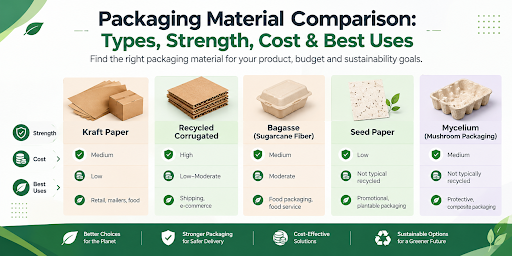
Packaging Material Comparison Chart
The table below provides a starting point for comparing common packaging materials. Cost and performance are relative, not fixed: the grade, thickness, construction, quantity, and supplier can change the result.
| Material | Typical strength and protection | Relative cost tendency | Printing and presentation | Common uses |
|---|---|---|---|---|
| Paperboard | Best suited to many lightweight products; limited cushioning on its own | Low to medium | Excellent potential for detailed retail graphics | Folding cartons, cosmetics, small consumer products |
| Corrugated board | Can offer good rigidity and cushioning, depending on construction | Low to medium | Printing quality depends on board and print method | Shipping boxes, mailers, transport packaging |
| Kraft paper or Kraft board | Varies by weight and construction; paper alone offers limited cushioning | Low to medium | Natural paper appearance; printing options vary | Bags, sleeves, selected boxes and wraps |
| Rigid box board | Substantial structure and premium presentation; protection still depends on design | Medium to high | Suitable for premium wrapped surfaces and finishes | Gift boxes, luxury goods, presentation kits |
| Flexible plastic films | Can provide moisture or product barriers when correctly specified; not a rigid box | Varies widely | Suitable for printed pouches, bags and films | Food packs, pouches, selected consumer products |
| Molded pulp | Can hold and cushion shaped products when designed appropriately | Varies by design and volume | Usually less suited to photographic graphics than coated cartons | Protective inserts, trays, product supports |
Relative cost tendencies are general guidance, not supplier quotes. Actual pricing depends on specifications and order quantities.
For a broader overview, see Bluebird’s guides to packaging materials and different types of packaging.
1. Paperboard vs. Cardboard Packaging
Paperboard and cardboard are often used interchangeably in everyday language. In packaging specifications, however, paperboard generally refers to a manufactured paper-based board used for cartons, while “cardboard” is a broad, less precise term that can refer to different board materials. Always confirm the actual construction with the supplier.
Paperboard Packaging
Paperboard is commonly used for folding cartons that need a printable surface and a neat retail appearance. It can be cut, creased, folded, and assembled into many box styles.
Advantages
- Suitable for detailed product graphics and branding.
- Can be formed into a range of carton shapes.
- Often useful for lightweight retail packaging.
- Can be designed with product information and promotional messaging.
Limitations
- Does not inherently provide the cushioning of corrugated board.
- Protection depends on board grade, structure, and product fit.
- Moisture resistance depends on the material and any coatings or treatments.
Common applications: Cosmetics, skincare cartons, small retail goods, product sleeves, and many consumer product boxes.
Cardboard Packaging
Because “cardboard” can refer to different paper-based constructions, its strength and performance cannot be judged from the name alone. Ask whether the proposed package uses solid paperboard, corrugated board, or another construction.
For custom retail applications, compare the dimensions, board grade, printing, and closure style before approving the design.
Explore custom retail boxes for an example of a retail-focused packaging category.
2. Corrugated Board vs. Paperboard
This is one of the most important packaging material differences for businesses shipping products.
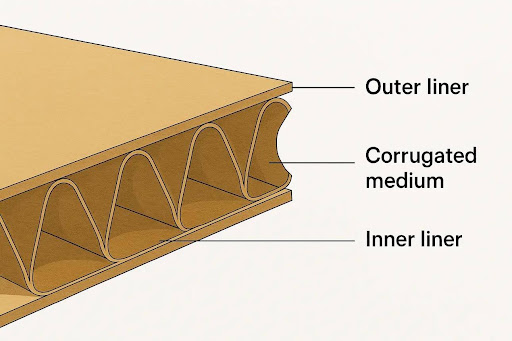
Corrugated board contains a fluted paper layer between linerboards. The fluting helps create a structure that can provide rigidity and cushioning. Paperboard is generally a solid sheet of board and is commonly used for folding cartons.
| Comparison factor | Corrugated board | Paperboard |
|---|---|---|
| Construction | Fluted medium with linerboard layers | Solid paper-based board |
| Common role | Shipping and transport packaging | Retail and product cartons |
| Cushioning | Can provide cushioning through its structure | Usually limited without additional inserts |
| Retail graphics | Possible, depending on the board and print process | Often well suited to detailed printed graphics |
| Product weight | Can be specified for a range of shipping loads | Commonly used for lightweight packaged products |
| Best application | Transit, storage, and shipping | Product presentation and compact cartons |
When Should You Choose Corrugated Packaging?
Consider corrugated packaging when the box needs to withstand shipping and handling, support stacking, or protect a product in distribution. The correct board grade and box design depend on the package’s dimensions, product weight, shipping conditions, and handling risks.
For example, a business shipping multiple products to customers may need a corrugated outer box even if each product is individually packed in a printed paperboard carton.
Explore corrugated boxes for shipping-focused packaging options.
When Should You Choose Paperboard?
Paperboard is often appropriate when the primary goal is a neat, printed retail carton for a lightweight product. If the package will also be shipped, it may need a protective outer container.
Neither material is automatically better in every situation. The correct decision depends on the function of the package.
3. Kraft Paper vs. Cardboard Packaging
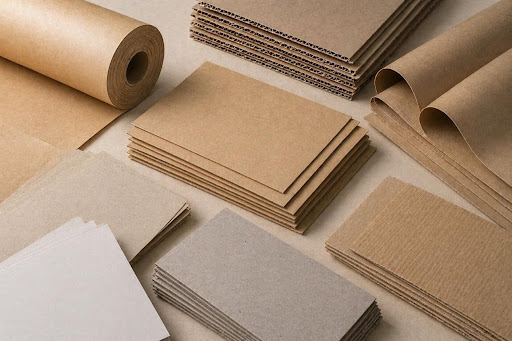
Kraft paper is a paper material commonly associated with a natural brown appearance. Kraft board and corrugated constructions can also be used in box manufacturing. “Cardboard,” meanwhile, is a broader term, so this comparison depends on which cardboard construction is being considered.
| Factor | Kraft paper or Kraft-based packaging | Other cardboard or paperboard packaging |
|---|---|---|
| Appearance | Often natural, understated, and paper-like | Ranges from plain board to coated, full-color surfaces |
| Printing | Depends on surface, ink, and print method | Depends on board grade and coating |
| Strength | Varies with paper weight and construction | Varies with material and construction |
| Protection | Paper alone offers limited cushioning | Corrugated board can provide added structure |
| Common use | Wraps, bags, sleeves, and selected boxes | Retail cartons, shipping boxes, and product boxes |
| Sustainability | Depends on sourcing, coatings, composition, and disposal | Depends on composition, sourcing, coatings, and disposal |
Which Is Better for Branding?
Kraft-based packaging can suit brands that want a natural, minimalist look. Coated paperboard can be a better fit for designs that require detailed graphics, specific color reproduction, or a different surface appearance.
The right choice is the one that supports your brand while meeting the functional requirements of the package.
For additional context, explore Kraft packaging and packaging design.
4. Rigid Boxes vs. Corrugated Boxes
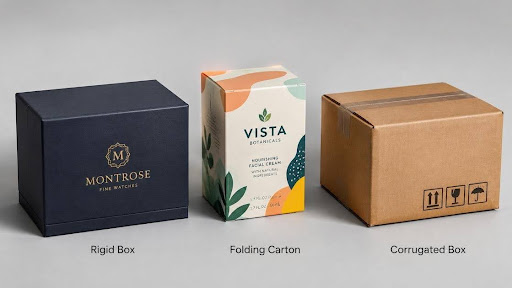
Rigid and corrugated boxes serve different purposes, even though both can be used to package products.
Rigid boxes are commonly selected for premium presentation. Corrugated boxes are frequently used for shipping, storage, and distribution. The best choice depends on whether the package’s primary job is presentation, protection, or both.
| Factor | Rigid boxes | Corrugated boxes |
|---|---|---|
| Primary role | Premium presentation and gifting | Shipping, storage, and transit |
| Structure | Thick, substantial board construction | Fluted board with linerboards |
| Typical appearance | Premium, often wrapped or finished | Functional, branded, or plain |
| Cost tendency | Often higher due to construction and finishing | Varies with grade, size, and order volume |
| Customization | Can include inserts, specialty finishes, and closures | Can include custom dimensions, printing, and inserts |
| Common applications | Gifts, luxury products, presentation kits | E-commerce orders, shipping cartons, distribution |
Which Is Best for Luxury Products?
Rigid boxes are often preferred when a substantial feel, premium presentation, or gift-ready appearance is important. However, premium packaging still needs to fit the product and protect it appropriately.
Explore custom rigid boxes or rigid boxes to review this packaging category.
Which Is Best for Shipping?
Corrugated boxes are commonly used for shipping because the fluted structure can provide rigidity and cushioning. The correct specification depends on the product’s weight, fragility, dimensions, and shipping environment.
For many premium e-commerce products, businesses can combine the two: a rigid box for presentation and a corrugated outer carton for transit protection.
5. Paper vs. Plastic Packaging
Paper-based and plastic packaging should be compared according to the product’s functional needs rather than by assuming one is always better.
Paper-based packaging is often useful for cartons, boxes, bags, and protective inserts. Flexible plastic packaging may be suitable where sealing, flexibility, transparency, or specific barrier properties are important.
| Factor | Paper-based packaging | Plastic packaging |
|---|---|---|
| Common formats | Cartons, boxes, bags, paper wraps | Films, pouches, bags, containers |
| Structural protection | Depends on board type and design | Depends on polymer, thickness, and format |
| Moisture barrier | May require a suitable coating or construction | Some formats offer strong moisture barriers |
| Printing | Wide range of printing options | Printability varies by material and process |
| End-of-life | Recycling depends on composition and local facilities | Recycling depends on polymer, format, and local facilities |
| Best choice | Many dry goods, cartons, and box applications | Products requiring specific flexibility, sealing, or barrier properties |
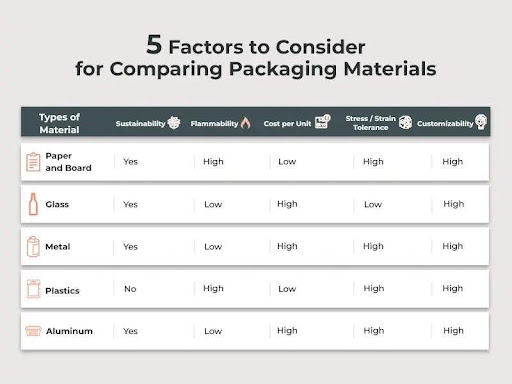
A material comparison should also consider product shelf life, contamination risk, food-contact requirements, storage, shipping, and local waste-management infrastructure.
For products that require direct food contact, confirm that the complete packaging construction is suitable for the intended application.
6. Packaging Material Strength Comparison
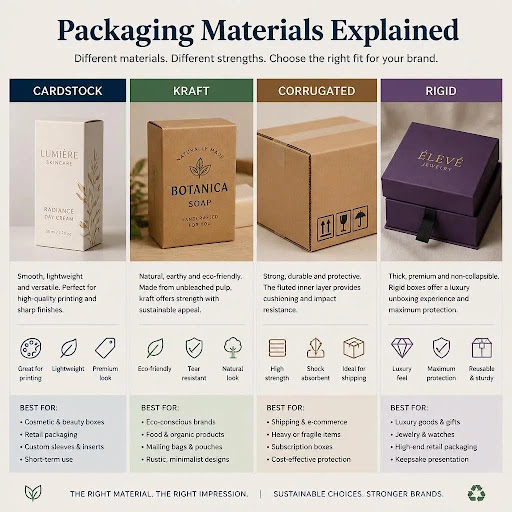
Strength is not a single property. Packaging may need to resist compression, puncture, tearing, impact, or bending. The appropriate performance measure depends on the way the package will be used.
For example:
- Compression resistance: Relevant to stacking and storage.
- Impact protection: Relevant when products may be dropped or bumped.
- Puncture resistance: Important for certain products and handling environments.
- Cushioning: Helps limit movement or reduce impact transfer when properly designed.
- Moisture resistance: Relevant when exposure to humidity or liquids is a concern.
Corrugated board may be suitable for shipping boxes, but performance varies by board grade and box construction. Paperboard can work well for retail cartons, while a rigid box may offer a substantial structure without necessarily replacing the protective outer carton needed for shipping.
Practical tip: For fragile or valuable products, test the complete package—including the product, inserts, closures, and outer shipping box—rather than selecting material based on appearance alone.
7. Packaging Material Cost Comparison
There is no universal price ranking for packaging materials. A small folding carton, a large corrugated shipping box, a laminated Kraft box, and a rigid gift box have different constructions and production requirements.
The most useful cost comparison uses equivalent packaging specifications.
| Cost factor | What to check |
|---|---|
| Material grade | Board thickness, composition, and performance requirements |
| Dimensions | Larger packaging may require more material |
| Quantity | Unit costs and setup economics may change with volume |
| Printing | Print method, coverage, and color requirements |
| Finishing | Coatings, laminations, foil, and specialty effects |
| Inserts | Additional components and assembly requirements |
| Tooling or setup | Whether the structure requires initial production setup |
| Freight | Box dimensions, shipment weight, destination, and delivery method |
| Damage risk | Whether insufficient protection could increase replacement or return costs |
A cheaper material may not provide good overall value if it leads to damaged products, poor presentation, or inefficient packing. On the other hand, a premium construction may be unnecessary if a simpler material meets the actual requirements.
To plan a custom order, review this custom packaging cost guide.
8. Sustainable Packaging Materials Comparison
Sustainability depends on the full packaging system, including raw materials, manufacturing, transport, product protection, reuse, and disposal. No material is automatically the most sustainable for every product or market.
Paperboard and Corrugated Board
These paper-based materials may be recyclable through local systems, depending on the construction and contamination. They can be useful where a box or carton is appropriate for the product.
Kraft-Based Packaging
Kraft packaging can be a good fit for selected designs, but the material’s natural appearance alone does not prove that the package has a lower environmental impact.
Rigid Boxes
Rigid boxes can provide a durable presentation format and may sometimes be reused. However, their environmental performance depends on the board, wrap, adhesives, coatings, and overall material use.
Flexible Packaging
Flexible packaging can use less material by weight than some rigid formats, but recycling options and barrier requirements vary widely. The product, material construction, and local waste infrastructure must be considered.
When comparing sustainability claims, ask suppliers about recycled content, material sourcing, coatings, recyclability, and relevant documentation. Avoid relying on vague terms such as “eco-friendly” without supporting evidence.
Read more about sustainable packaging.
9. Best Packaging Materials for Different Products
The best packaging material depends on the product’s physical properties, how it will be sold, and how it will reach the customer.
| Product type | Material to consider | Important considerations |
|---|---|---|
| Cosmetics and skincare | Paperboard cartons or rigid boxes | Branding, dimensions, product fit, print quality |
| E-commerce orders | Corrugated board | Transit protection, box size, packing efficiency |
| Luxury gifts | Rigid box board | Presentation, inserts, closures, finishes |
| Lightweight retail goods | Paperboard | Shelf presentation, graphics, folding structure |
| Heavy products | Appropriately specified corrugated board or other engineered packaging | Weight, compression, handling and stacking |
| Fragile products | Corrugated outer box plus suitable inserts or cushioning | Impact protection, fit and package testing |
| Bakery products | Packaging specifically suitable for the intended food application | Food contact, grease, ventilation and product shape |
| Flexible food products | Suitable flexible packaging construction | Sealing, barrier properties and food-contact requirements |
| Subscription products | Mailer or corrugated box, with suitable inserts if needed | Unboxing, product fit, and shipping |
| Retail displays | Paperboard or corrugated display structures | Product weight, visibility and display duration |
These are starting points, not universal rules. For example, a cosmetic product may use a paperboard carton for shelf presentation but require a protective shipping box for online orders.
Bluebird Packaging offers relevant categories to explore, including cosmetic boxes, bakery boxes, and mailer boxes.
10. How to Choose the Right Packaging Material
Use this checklist before requesting a quote from a packaging manufacturer or supplier.
Step 1: Identify the Primary Purpose
Is the package intended for retail display, shipping, storage, gifting, or product protection? If it needs to perform more than one function, identify the most important requirements first.
Step 2: Measure the Product
Record the product’s length, width, and height. Include accessories, inserts, and the space needed to place or remove the product safely.
Step 3: Assess the Risks
Consider product weight, fragility, moisture exposure, stacking, temperature conditions, and handling during shipping. These factors help determine whether the package needs a stronger board, an insert, or additional protective material.
Step 4: Choose the Packaging Structure
Decide whether you need a folding carton, corrugated box, rigid box, mailer, sleeve, or another format. Material and structure should be selected together because the same material can perform differently in different designs.
Step 5: Establish Branding Requirements
If the package represents your brand, decide on the logo, colors, artwork, typography, product information, and any finishing requirements. Ask the supplier which print methods and finishes are suitable for your chosen material.
Step 6: Compare Total Cost
Request pricing based on the same dimensions, materials, quantities, printing, finishing, and delivery requirements. This makes supplier quotes easier to compare.
Step 7: Request a Proof or Sample
Where available, review a structural sample or physical proof before approving a large order. For products that need substantial protection, consider testing the complete package under realistic shipping conditions.
11. Where Can You Order Custom Packaging Materials and Boxes?
Businesses can source packaging from a packaging manufacturer, a distributor, a specialist material supplier, or a custom packaging company. The right supplier depends on whether you need stock packaging, custom dimensions, printed boxes, specialty materials, or large-volume production.
When evaluating a supplier, check:
- Available material grades and packaging styles.
- Minimum order quantities for the selected product.
- Printing and finishing capabilities.
- Artwork support and proofing options.
- Production estimates and shipping arrangements.
- Quote details, including setup and additional charges.
- Material specifications and supporting sustainability documentation where relevant.
For businesses looking for custom printed boxes, Bluebird Packaging is one option to evaluate. Review its cardboard box options and submit your dimensions, quantity, material preference, and design requirements through its custom packaging quote form.
Frequently Asked Questions About Packaging Material Comparison
1. Which packaging material is best for different products?
Corrugated board is often suitable for shipping, paperboard is commonly used for retail cartons, Kraft-based materials can suit natural-looking packaging, and rigid boxes are popular for premium presentation. The best choice depends on product weight, protection needs, branding, budget, and shipping conditions.
2. What Is the Difference Between Cardboard and Corrugated Packaging?
Cardboard is a broad everyday term for paper-based board packaging. Corrugated board has a fluted layer between linerboards, which can provide additional rigidity and cushioning. Confirm the exact construction when comparing supplier specifications.
3. Is Paperboard Stronger Than Kraft Paper?
Not necessarily. Paperboard and Kraft paper vary in thickness, weight, fiber composition, and construction. A particular paperboard grade may be more rigid than a thin Kraft paper, but the material name alone is not enough to determine strength.
4. Which Packaging Material Is Best for Shipping?
Corrugated board is a common choice for shipping because its construction can provide rigidity and cushioning. The appropriate board grade, box design, and internal protection depend on the product’s weight, fragility, dimensions, and shipping conditions.
5. What Is the Most Cost-Effective Packaging Material?
There is no single lowest-cost material for every application. Cost depends on material grade, dimensions, quantity, printing, finishing, setup, freight, and required protection. Compare equivalent specifications rather than material names alone.
6. Which Packaging Materials Are Most Sustainable?
The answer depends on the package’s complete construction, sourcing, production, reuse, recycling infrastructure, and ability to protect the product. Paper-based materials may be recyclable in suitable local systems, but coatings, mixed materials, and contamination can affect their end-of-life options.
7. What Is the Difference Between Rigid and Corrugated Boxes?
Rigid boxes are commonly used for premium presentation and gifting, while corrugated boxes are frequently used for shipping and distribution. Some products use a rigid inner box with a corrugated outer shipping carton to meet both needs.
8. Which Packaging Material Offers the Best Product Protection?
Protection depends on the product and the package design. Corrugated board, fitted inserts, cushioning, molded pulp, and other materials can all play a role. Fragile products should be evaluated and tested using the complete packaging system.
9. Is Cardboard or Plastic Better for Packaging?
Neither is universally better. Paper-based materials can suit boxes and cartons, while plastic films or containers may be necessary for flexibility, sealing, or particular barrier requirements. Compare functionality, material use, product safety, and local end-of-life options.
10. How Do You Compare Packaging Materials?
Compare construction, strength, cushioning, moisture resistance, printing, dimensions, cost, sustainability, and intended use. Start with the product’s requirements, then request supplier specifications and comparable quotes.
Final Thoughts
A useful packaging material comparison should focus on performance and application—not just the name of the material. Paperboard, corrugated board, Kraft-based packaging, rigid boxes, and flexible materials all have different strengths and limitations.
For shipping, prioritize suitable protection and package testing. For retail, consider product fit and printed presentation. For luxury products, evaluate structure and finish. For sustainability, assess the complete material construction and local disposal options.
If you’re planning a custom packaging project, explore Bluebird Packaging’s cardboard boxes or request a quote with your product dimensions, quantity, and packaging requirements.