
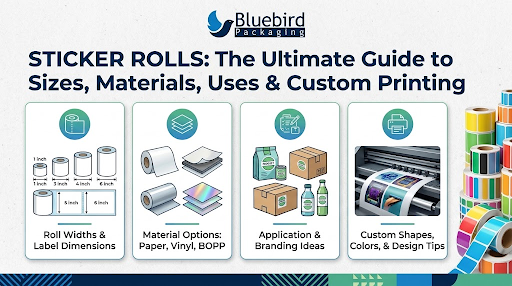
Sticker rolls are a practical way to print and apply labels to products, jars, bottles, boxes, bags, and shipping packages. They keep multiple stickers on a continuous backing liner, making them easy to peel by hand or feed through a compatible dispenser or labeling machine. For businesses that apply the same label repeatedly, roll stickers can help streamline packaging and improve consistency.
Quick answer: Sticker rolls are best for applying repeated labels to products or packaging, especially in medium- to high-volume operations. The right option depends on sticker dimensions, material, adhesive, finish, quantity, core diameter, roll diameter, and application method. Choose roll labels for repeat product labeling and efficient application; choose sticker sheets when you need several designs in small quantities.
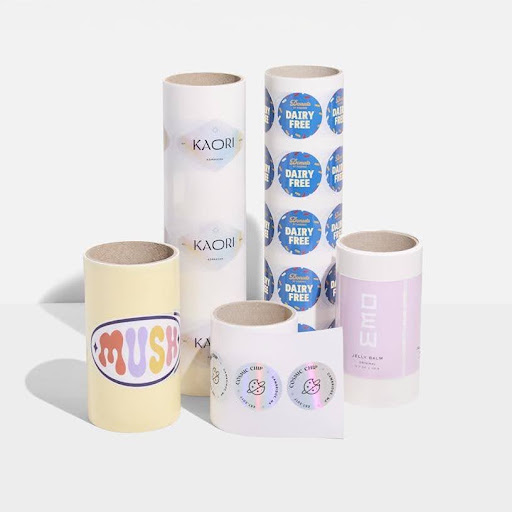
This guide explains sticker roll sizes, materials, printing options, label capacity, unwind direction, and how to choose custom sticker rolls for your business.
What Are Sticker Rolls?
Sticker rolls are self-adhesive labels printed and cut on a continuous strip of backing material, then wound around a central core. Individual labels peel away from the liner when needed.
They are also called roll stickers, roll labels, custom roll labels, or sticker labels on rolls. These terms are often used interchangeably, although a supplier may distinguish decorative stickers from labels designed for product identification or machine application.
A typical sticker roll contains several layers and specifications that work together:
- Face stock: The visible paper or film that carries the printed design.
- Ink or printed layer: The colors, text, logo, barcode, or other artwork.
- Adhesive: The layer that attaches the sticker to the product or package.
- Release liner: The backing that protects the adhesive before application.
- Core: The tube in the center of the roll.
- Label gap: The space between individual labels, where applicable.
- Outside diameter: The total diameter of the finished roll.
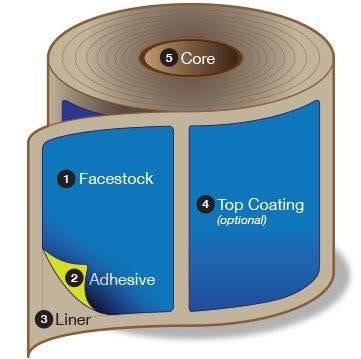
Most custom printed roll labels are kiss-cut, meaning the cut passes through the label material but leaves the backing liner intact. This keeps each label attached to the roll until it is peeled away.
For a wider understanding of how packaging components work together, explore this guide to different types of packaging.
How Do Sticker Rolls Work?
Sticker rolls are produced by printing a design on pressure-sensitive label material, cutting the labels to the required shape, removing excess material where needed, and winding the finished labels onto a core.
The exact process varies by printing method, material, and label construction. For machine application, the finished roll must also meet the applicator’s requirements.
A simplified process looks like this:
- Artwork preparation: The design is created at the required dimensions.
- Material selection: Paper or film is chosen based on the product and environment.
- Printing: The design is printed using a suitable production process.
- Die-cutting: Labels are cut to the requested shape while preserving the liner.
- Finishing: A coating, varnish, or laminate may be added if required.
- Slitting and rewinding: The material is trimmed and wound into rolls.
- Quality checks: The supplier checks print quality, cutting, roll construction, and agreed specifications.
For a broader look at print preparation, see Bluebird Packaging’s guide to packaging printing and its resource on packaging artwork.
Sticker Rolls vs. Sticker Sheets: Which Should You Choose?
The biggest difference between sticker rolls and sticker sheets is how the labels are supplied and applied. Both formats can carry printed designs, but they suit different workflows.
| Factor | Sticker rolls | Sticker sheets |
|---|---|---|
| Format | Labels wound around a core | Labels arranged on flat sheets |
| Best use | Repeated labeling and larger runs | Small runs or mixed designs |
| Application | Hand application, compatible dispensers, or machines | Primarily hand application |
| Design flexibility | Often one label design per roll, depending on supplier | Multiple designs may fit on one sheet |
| Storage | Compact, stackable rolls | Flat and easy to file |
| Production workflow | Convenient for repeated application | Convenient for picking individual designs |
| Machine compatibility | Suitable when roll specifications match the equipment | Generally unsuitable for roll-fed applicators |
| Cost considerations | May be economical for repeated labels at higher quantities | May suit low quantities and varied artwork better |
A roll format is not automatically cheaper. Pricing depends on order quantity, label size, material, print coverage, finishing, cutting, and supplier setup costs. Avery’s format guidance also distinguishes rolls as useful for larger orders and machine application, while sheets can suit smaller quantities.
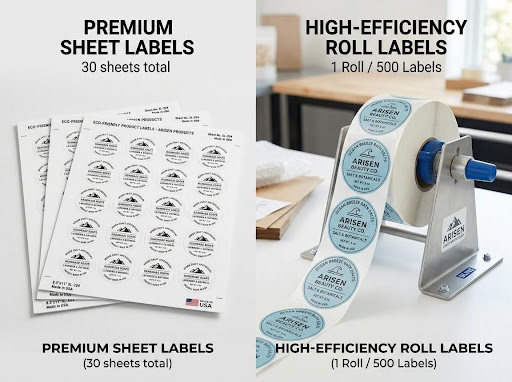
Choose sticker rolls when:
- You apply the same product label to hundreds or thousands of items.
- Your team labels jars, bottles, boxes, pouches, or bags regularly.
- You use a compatible dispenser or automatic labeling equipment.
- You need consistent logo seals for outgoing orders.
- You want repeatable label placement across a product range.
Choose sticker sheets when:
- You need only a small number of labels.
- You want different designs or sizes on the same sheet.
- You are testing new artwork before committing to a larger order.
- You need to hand out individual stickers at events or include them in customer packages.
For brand stickers used to decorate or seal packaging, see these ideas for custom stickers for packaging and sticker packaging.
Sticker Roll Sizes: Dimensions, Core Diameter, and Roll Diameter
Sticker roll sizes refer to more than the width and height of an individual label. To order the right format, you need to distinguish label dimensions, core diameter, roll outside diameter, and the spacing between labels.
1. Common sticker label dimensions
The best sticker size depends on the available surface, the amount of information to display, and how the product will be handled.
| Example label size | Common applications |
|---|---|
| 1 × 1 inch | Small seals, price dots, and compact identification labels |
| 1.5 × 1.5 inches | Small logo stickers and lid labels |
| 2 × 2 inches | Box seals, brand marks, and sample packaging |
| 2 × 3 inches | Product labels for small containers and packages |
| 3 × 3 inches | Larger logo stickers, jars, and gift packaging |
| 4 × 3 inches | Product information labels on suitable containers |
| 4 × 6 inches | Shipping labels and larger identification labels |
These are examples, not universal standard sizes. Suppliers may offer different dimensions, shapes, and tolerances.
Before selecting a label, measure the surface where it will be applied. A sticker intended for a curved bottle, for example, may need different dimensions from one intended for a flat box panel.
For a box or package, consider the available panel, folds, edges, and opening mechanism. For bottles and jars, measure the usable surface rather than relying only on container capacity.
2. What is a sticker roll core?
The core is the hollow tube around which the labels are wound. Its inside diameter must fit the spindle, holder, dispenser, or applicator that will use the roll.
Common core diameters include:
| Core diameter | Typical context |
|---|---|
| 1 inch / approximately 25.4 mm | Some desktop thermal printers and compact label systems |
| 1.5 inches / approximately 38 mm | Selected printers and label-handling equipment |
| 2 inches / approximately 50.8 mm | Some label printers and specialist equipment |
| 3 inches / approximately 76.2 mm | Many industrial label rolls and commercial applicators |
Equipment requirements vary by model. For example, Avery’s roll-label guidance lists 25 mm, 40 mm, and 76 mm core options for its service.
Important: Do not order a core size simply because it is described as standard. Check the technical specifications for your exact machine or dispenser.
3. What is the outside diameter of a sticker roll?
The outside diameter, often shortened to OD, is the measurement across the entire finished roll, including the labels and liner wound around the core.
It affects how many labels fit on the roll and whether the roll fits inside the equipment.
A larger roll can hold more labels when the other specifications remain the same. However, the maximum roll diameter is limited by the printer or applicator.
4. What is the gap between sticker labels?
The gap is the distance between adjacent labels on the backing liner. Some die-cut roll labels use a small gap, but the required spacing depends on the cutting method, sensor system, and supplier specifications.
For machine-applied labels, the gap may affect whether the equipment detects and feeds each label correctly. Confirm the required spacing with the label manufacturer or equipment supplier rather than assuming a single measurement applies to every roll.
How Many Stickers Come on a Roll?
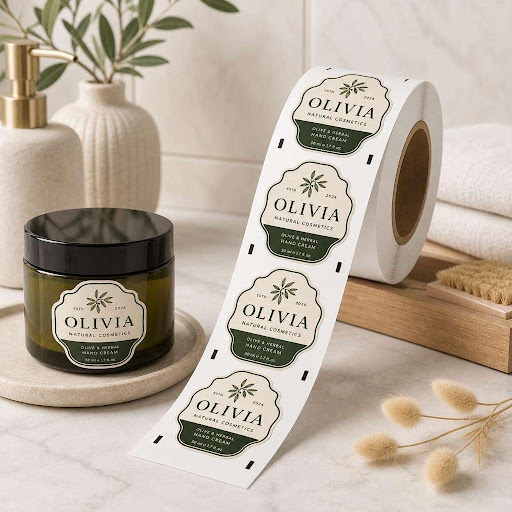
There is no universal number of stickers per roll. The capacity depends on the label’s length along the feed direction, liner thickness, gap, core diameter, outside diameter, and winding arrangement.
A roll with small labels can generally hold more pieces than a roll with large labels, provided the other specifications are similar.
For example:
- A small round logo sticker may allow many labels to fit on a roll.
- A long rectangular bottle label takes up more material per label.
- A large shipping label uses considerably more liner space than a small seal.
- A thicker label construction may reduce the number of labels that fit on a roll of the same outside diameter.
How to estimate sticker roll capacity
A simplified estimate for a single lane of labels is:
N ≈ (D² − d²) / [4t(L + g)]
Where:
- N = estimated number of labels
- D = roll outside diameter
- d = core outside diameter used for the roll calculation
- t = combined thickness of the label material and liner
- L = label length along the direction of feed
- g = gap between labels
All measurements must use consistent units. This is an approximation: real roll capacity can differ because of winding tension, liner thickness variation, the core wall, and production tolerances. For multi-lane rolls, the number of labels across the web also matters.
The practical approach: Tell the supplier the label dimensions, desired quantity, core diameter, maximum outside diameter, and application method. Ask them to confirm the final labels-per-roll specification before production.
Types of Sticker Rolls and Roll Labels
The best sticker roll type depends on where the label will be used, how it will be applied, and what information it needs to communicate.
1. Custom logo sticker rolls
Logo sticker rolls display a brand mark, wordmark, or simple graphic. Businesses use them on product packaging, tissue paper, bags, cartons, and mailers.
They can be useful when a business wants to add branding to plain packaging without printing a separate design on every package. Choose dimensions that suit the package panel or sealing area.
2. Product label sticker rolls
Product label rolls carry information such as product names, flavors, scents, sizes, ingredients, or usage details. The material and adhesive should suit the product surface and storage conditions.
For packaging that requires a consistent visual identity, align the label’s typography, colors, and logo with the rest of the brand’s packaging design.
3. Barcode and QR code sticker rolls
Barcode and QR code labels support product identification, inventory workflows, tracking, and access to digital information.
For reliable scanning, use clear contrast, suitable print quality, and enough quiet space around the code. Test the final printed label with the intended scanner before ordering at scale.
If labels will be printed by a thermal printer, verify that the label material, printer technology, and ribbon requirements are compatible.
4. Waterproof sticker rolls
Water-resistant labels are useful when products may encounter condensation, splashes, refrigeration, or damp handling.
Film-based materials such as BOPP are common options for moisture-exposed applications. However, water resistance depends on the entire label construction, including the face material, adhesive, ink, and any protective coating or laminate. A waterproof face material alone does not guarantee that the label will stay attached in every environment.
5. Clear sticker rolls
Clear labels create a low-visibility or “no-label” appearance on suitable transparent containers. They are often considered for bottles, jars, cosmetics, and other products where the package or product remains visible.
Check whether the artwork needs a white ink layer to keep text and graphics visible against a transparent or colored surface.
6. Kraft and paper sticker rolls
Paper and kraft labels can suit dry products, cartons, handmade goods, and brands seeking a natural visual style.
Paper labels are not automatically suitable for moisture-heavy environments. If the product will be chilled, handled with wet hands, or exposed to oils, confirm the material and adhesive performance before ordering.
7. Thermal sticker rolls
Thermal labels are designed for compatible thermal printing systems. They are commonly used for shipping labels, barcode labels, inventory labels, and operational identification.
There are different thermal technologies, and not every roll works in every printer. Confirm the printer model, label dimensions, core, roll diameter, and sensor requirements.
8. Custom die-cut roll stickers
Die-cut roll stickers can be produced in shapes such as circles, squares, rectangles, ovals, or custom outlines. The cutting method and artwork setup depend on the design and supplier.
For most custom-shaped roll labels, the sticker is cut through the face material while the liner remains intact. If you need each sticker to be a separate piece with no shared liner, ask whether individually cut stickers are more appropriate.
Choosing the Right Sticker Roll Material
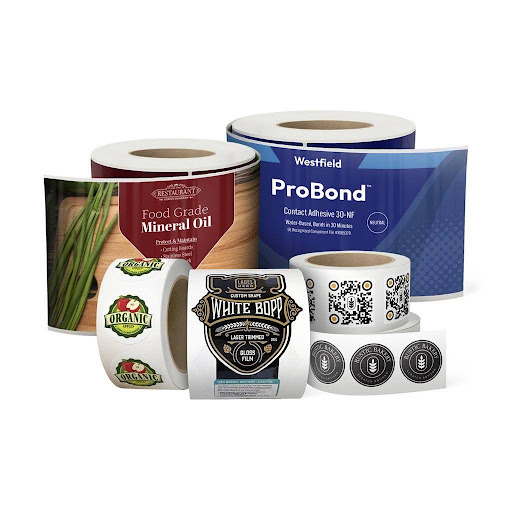
Sticker material influences print appearance, durability, flexibility, and performance on the intended surface. Before choosing a material, consider moisture, temperature, oils, sunlight, friction, storage conditions, and the type of product being labeled.
| Material | Potential advantages | Common applications | Important consideration |
|---|---|---|---|
| Coated or uncoated paper | Practical for many indoor applications | Boxes, dry goods, promotional labels | Can be vulnerable to moisture |
| Kraft paper | Natural, textured appearance | Handmade products and rustic branding | Surface and print appearance vary |
| White BOPP film | Useful for many product-label applications and moisture exposure | Bottles, jars, cosmetics, food packages | Confirm adhesive and environment compatibility |
| Clear BOPP film | Transparent appearance | Clear containers and minimalist labels | White ink may be needed for visibility |
| Metallic film | Reflective or premium appearance | Promotional and premium product labels | Print contrast and finishing require planning |
| Vinyl or other durable films | Flexible options for selected demanding uses | Certain outdoor or frequently handled products | Confirm exact environmental and surface requirements |
These are general selection guidelines, not guarantees of performance. Material suppliers offer different constructions, adhesives, and temperature ranges. For examples of material specifications, see the SheetLabels roll-label material guide.
How to choose the right adhesive
The adhesive should be selected for both the surface and the conditions the product will experience.
- Permanent adhesive: For labels intended to remain attached during normal use.
- Removable adhesive: For selected temporary labels where clean removal is important.
- High-tack adhesive: For certain surfaces that require stronger initial adhesion.
- Freezer or low-temperature adhesive: For applications that require performance in cold conditions.
Do not select adhesive based only on the label material. A label that sticks well to clean glass may behave differently on textured cardboard, flexible film, dusty plastic, or a surface that is cold or oily.
For demanding applications, test a sample on the actual product surface under realistic storage and handling conditions.
Gloss, matte, and protective finishes
Finishes affect how the label looks and how well its surface resists handling.
- Gloss: Creates a shiny finish and can make colors appear vivid.
- Matte: Reduces glare and offers a softer visual appearance.
- Protective laminate or varnish: May improve resistance to scuffs, moisture, or handling, depending on the construction.
- Specialty effects: Metallic or holographic materials can help create a distinctive visual treatment.
A protective finish cannot make every paper label waterproof or guarantee resistance to every chemical. Confirm the expected conditions with the supplier.
Custom Sticker Rolls for Packaging and Branding
Custom sticker rolls can help businesses brand packaging without requiring every box, bag, or container to be printed with a full custom design. They can also be used to communicate product details or seal a package.
The most effective label design is one that fits the package, remains legible, and supports the brand’s visual identity.
Sticker rolls for ecommerce packaging
A logo sticker can seal tissue paper, close a product box, or add a brand detail to a shipping package. It can be particularly useful when a business uses plain mailers or cartons for different product lines.
For a complete ecommerce packaging approach, combine labels with appropriately sized mailer boxes and consider the broader principles of ecommerce packaging.
Sticker rolls for retail products
Retail product labels may display a logo, product name, scent, flavor, size, barcode, or other relevant information. Their layout should remain readable at the size customers will see on the shelf.
For retail packaging, make sure the sticker does not obscure important package information or interfere with opening the box. A label can complement custom retail boxes when the sticker and box are designed to work together.
Sticker rolls for cosmetics and skincare
Cosmetic and skincare products often require labels that fit curved containers, small surfaces, or premium packaging. Material compatibility matters because some products may encounter oils, moisture, or frequent handling.
Check the available label surface and required product information before choosing a shape or size. Depending on the packaging format, a label may complement custom cosmetic boxes or a larger product-packaging design.
Sticker rolls for food and bakery products
Food businesses may use labels for product identification, flavors, dates, batch details, or branding on appropriate containers and outer packaging.
The label material and adhesive should suit the actual application and storage conditions. Where food-contact rules, ingredient declarations, or other labeling regulations apply, confirm the requirements for the specific product and jurisdiction.
For the outer package, a sticker may complement suitable bakery boxes or other food packaging, but the label alone does not establish that a package is food-safe.
Sticker rolls for shipping packages
Businesses may use logo seals, handling labels, barcodes, and shipping labels on outgoing orders. The required material and adhesive depend on whether the label is decorative, informational, or used by a shipping workflow.
A decorative sticker is not a substitute for the carrier’s required shipping label. Keep tracking information and barcodes clear, and avoid placing decorative graphics over machine-readable areas.
For brands using corrugated packaging, review these options for corrugated boxes.
How to Choose Sticker Rolls for Your Business
Before ordering custom sticker rolls, work through the following decisions. This helps reduce the chance of ordering a label that looks correct but does not fit the product or application method.
Step 1: Identify the purpose
Decide what the sticker needs to do. Is it a logo seal, a product label, a barcode, a shipping label, or a promotional sticker?
The purpose determines the information, material, size, and durability requirements.
Step 2: Measure the application surface
Measure the flat or usable area where the sticker will sit. For curved containers, consider the container’s profile and how the label will wrap around it.
Avoid measuring only the overall product size. The usable label area may be smaller because of folds, seams, shoulders, ridges, closures, or other design features.
Step 3: Choose the material and adhesive
Consider the surface type, temperature, moisture, oils, handling, and expected label life. If the conditions are demanding, ask the supplier which material construction and adhesive are suitable.
Step 4: Decide whether you will apply labels by hand or machine
For hand application, the roll may be easier to use if the labels peel cleanly and the roll is comfortable to handle.
For machine application, confirm the following before production:
- Core diameter
- Maximum outside roll diameter
- Label width and length
- Gap or repeat length
- Web or liner width
- Winding and unwind direction
- Label sensor compatibility
- Required roll count or labels per roll
These specifications can determine whether a roll feeds correctly through the equipment. Supplier and equipment documentation emphasize checking core size, roll diameter, and unwind direction before ordering.
Step 5: Prepare print-ready artwork
Use the supplier’s template and cutting specifications rather than guessing at the final file dimensions.
Your artwork checklist should include:
- Correct finished label size and shape
- Bleed and safe area according to the printer’s template
- Readable text at the final printed size
- High-resolution raster images where needed
- Correct color mode and any special ink requirements
- A separate vector cut line if the supplier requests one
- Adequate contrast for small text, barcodes, and QR codes
A commonly used raster artwork target is 300 DPI at final size, but the actual requirements depend on the printing method and design. Vector artwork is often preferable for logos and type. Always follow the chosen supplier’s specifications.
Step 6: Order a proof or sample when appropriate
A digital proof helps check layout, spelling, color placement, and cut-line positioning. A physical sample is more useful for evaluating adhesion, texture, color appearance, and application on the actual product.
For an important packaging run, test the label on the intended surface before approving a large order.
How Much Do Custom Sticker Rolls Cost?
The cost of custom sticker rolls varies by supplier and specification. A single price per roll is not meaningful without knowing the label size, material, quantity, and finishing requirements.
Factors that can affect the quote include:
| Cost factor | Why it matters |
|---|---|
| Label dimensions | Larger labels use more material and may reduce the number of labels per roll |
| Order quantity | Production setup and volume pricing can affect the unit cost |
| Material | Different papers, films, adhesives, and specialty stocks have different costs |
| Print design | Full-color printing, specialty inks, and variable data can affect production |
| Finish | Lamination, varnish, metallic effects, or other finishes may add cost |
| Shape and cutting | Custom shapes may require specific tooling or production setup |
| Roll construction | Core size, roll diameter, and labels per roll affect finishing and winding |
| Application requirements | Machine-compatible specifications may require additional coordination |
| Packaging and delivery | Packing method, shipping location, and delivery requirements can affect the total |
How to manage sticker roll costs
- Choose a suitable size: Avoid using a larger label than the product needs.
- Keep the design practical: Specialty effects should serve a clear branding or functional purpose.
- Estimate demand realistically: Compare the total order cost with expected usage and storage capacity.
- Standardize labels where appropriate: Reusing a common label size or material across compatible products may simplify ordering.
- Compare like-for-like quotes: Make sure each supplier is quoting the same size, material, quantity, finish, and roll specifications.
- Test before scaling: A sample can help identify material or fit issues before they affect a larger run.
For wider packaging budget considerations, see this guide to custom packaging costs and ideas for packaging for small businesses.
How to Store and Handle Sticker Rolls
Correct storage helps preserve label quality. Heat, humidity, sunlight, dust, and unsuitable storage conditions can affect some adhesives, liners, and printed materials.
Use the material supplier’s storage recommendations whenever possible. As general good practice:
- Keep rolls in their original packaging until needed.
- Store them in a clean, dry place away from direct sunlight.
- Avoid excessive heat and sudden environmental changes.
- Keep the roll edges protected from crushing, dust, and contamination.
- Use labels within the supplier’s recommended shelf life.
- Allow labels to acclimate to the application environment when the supplier advises it.
There is no single storage temperature or shelf life that applies to all sticker rolls. Follow the specifications for the particular label construction and adhesive.
Applying labels cleanly
For manual application, begin with a clean, dry surface. Align the label before pressing it down, then smooth it from the center toward the edges to reduce trapped air.
For automatic application, test the roll on the intended equipment and confirm that the label feeds and releases consistently. If labels peel, wrinkle, skew, or fail to adhere, review the surface condition, adhesive selection, roll direction, and equipment setup before assuming the printed artwork is at fault.
Common Sticker Roll Problems and How to Avoid Them
| Problem | Possible cause | Practical solution |
|---|---|---|
| Roll does not fit the printer | Incorrect core or outside diameter | Check the printer’s media specifications |
| Labels feed upside down or sideways | Incorrect unwind direction | Confirm the applicator’s required orientation |
| Labels peel off the product | Unsuitable adhesive or surface conditions | Test the adhesive on the actual surface |
| Labels wrinkle on curved containers | Incorrect size or application method | Recheck dimensions and test the label placement |
| Barcode will not scan | Poor contrast, insufficient print quality, or unsuitable sizing | Test a production-quality label with the intended scanner |
| Text is cut off | Artwork too close to the cut line | Follow the supplier’s bleed and safe-area template |
| Label edges lift in moisture | Material or adhesive is unsuitable for the environment | Select a compatible construction and test it |
| Too few labels fit on each roll | Label length, liner thickness, or roll dimensions differ from expectations | Confirm labels per roll and outside diameter before ordering |
A successful sticker roll order requires both suitable artwork and the correct physical specifications. Checking both before production is more reliable than fixing problems after the labels have been delivered.
Sticker Rolls and the Rest of Your Packaging
Sticker rolls can support a wider packaging strategy, but they should be planned alongside the package itself. The label should fit the available surface, match the brand’s visual identity, and avoid covering necessary information or interfering with opening and closing.
For example, a business might use a logo sticker to seal tissue paper inside a mailer, a product label on a container, or a branded seal on a gift box. A consistent design across these touchpoints can make the packaging feel more coordinated.
If you are developing a complete package rather than labels alone, explore custom packaging solutions, custom rigid boxes, and other options on the Bluebird Packaging website.
Bluebird Packaging focuses on custom packaging boxes and related packaging solutions. If your project also requires a custom box, you can request a packaging quote with the product dimensions, packaging format, quantity, and branding requirements. For label-only roll printing, confirm the service and specifications with a specialist roll-label supplier.
Frequently Asked Questions About Sticker Rolls
1. What are sticker rolls?
Sticker rolls are self-adhesive labels printed and cut on a continuous backing liner, then wound around a core. They can be peeled by hand or used with compatible dispensers and labeling machines.
2. What are sticker rolls used for?
Businesses use sticker rolls for product labels, logo seals, jar and bottle labels, shipping labels, barcodes, QR codes, inventory identification, and promotional stickers.
3. What sizes do sticker rolls come in?
Sticker rolls can be produced in a range of label dimensions, shapes, core diameters, and outside roll diameters. The available options depend on the supplier, material, and application equipment. Measure the product surface and check the machine requirements before ordering.
4. Are sticker rolls better than sheet stickers?
Sticker rolls are often more convenient for repeated labeling, larger quantities, dispensers, and compatible applicators. Sticker sheets may be more practical for small orders, multiple designs, or distributing different stickers together. The best format depends on the application and price quote.
5. How many stickers come on a roll?
The number depends on label length, material and liner thickness, core diameter, outside diameter, and spacing. Ask the supplier to confirm the quantity per roll for your exact specifications.
6. Can you order custom sticker rolls with a logo?
Yes, many roll-label suppliers offer custom printed labels with logos, brand colors, product names, and other artwork. Check the available materials, print methods, minimum quantities, and finishing options before placing the order.
7. Which material is best for sticker rolls?
There is no single best material for every application. Paper can suit many dry indoor uses, while selected film materials such as BOPP may be more suitable for moisture-exposed products. The adhesive, finish, surface, and storage conditions also affect performance.
8. Are sticker rolls waterproof?
Some sticker rolls can resist water when made with suitable film materials, inks, adhesives, and protective finishes. Paper labels are generally less suitable for wet environments unless specifically constructed for that purpose. Confirm the supplier’s performance specifications for your application.
9. Are sticker rolls suitable for product packaging?
Yes. Sticker rolls can be used on boxes, bags, jars, bottles, and other compatible packaging surfaces. They are especially useful when the same label needs to be applied repeatedly. Make sure the material and adhesive suit the package surface and conditions.
10. When should a business use roll labels instead of individual stickers?
Use roll labels when you need repeated product labeling, consistent placement, quick manual peeling, or machine application. Individual stickers may be more suitable when each sticker is intended to be handed out separately or distributed as a standalone item.
11. What is the difference between sticker rolls and roll labels?
The terms often overlap. “Roll labels” commonly refers to labels used for products, identification, or packaging, while “sticker rolls” can also describe decorative or promotional stickers supplied on a roll. Suppliers may use the terms differently, so check the product specifications.
12. What core size should I choose for custom sticker rolls?
Choose a core diameter that fits the printer, dispenser, or applicator. Common options include 1-inch and 3-inch cores, with other sizes available for some equipment. Check the exact model specifications rather than relying on a general standard.
13. What does unwind direction mean for sticker rolls?
Unwind direction describes how the labels are oriented as they come off the roll, including which edge leads and whether the labels face inward or outward. It matters for compatible dispensers and automatic applicators. Follow the equipment manufacturer’s diagram when specifying it.
14. Can sticker rolls be waterproof and removable?
Some materials and adhesives can be designed for moisture resistance and removability, but the combination depends on the supplier’s available constructions. Waterproof performance and clean removal should be tested on the actual product surface under expected conditions.
15. What should I send a supplier to get a quote for sticker rolls?
Provide the label size and shape, material, adhesive requirements, print design, quantity, finish, core diameter, outside roll diameter, labels per roll, and application method. If using a machine, include the model and required unwind direction.
Final Takeaway: How to Choose the Right Sticker Rolls
Sticker rolls are a practical choice for businesses that need repeated, consistent labeling on products and packaging. The right order begins with the label’s purpose and dimensions, then considers material, adhesive, finish, quantity, core size, roll diameter, and application method.
For manual use, focus on easy peeling, suitable adhesion, and clear print quality. For machine application, verify every roll specification against the equipment before production. If the labels will be exposed to moisture, oils, refrigeration, or frequent handling, test the full label construction in realistic conditions.
Most importantly, compare supplier quotes using the same specifications and approve a proof or sample where appropriate. That helps you choose sticker rolls that fit your product, workflow, and budget without relying on assumptions about standard sizes or performance.
Planning a coordinated packaging project? Explore custom packaging options or contact Bluebird Packaging about custom boxes that complement your product-labeling and branding plans.