

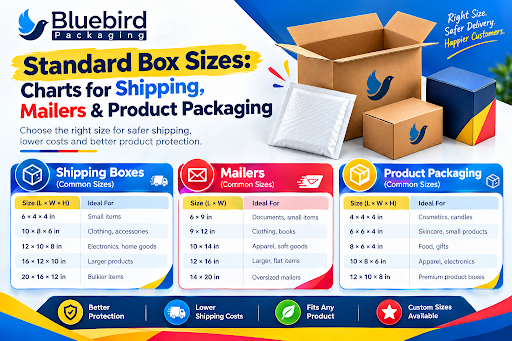
Choosing the right box size can help businesses protect products, reduce unnecessary packaging, organize inventory, and manage shipping expenses. Whether you ship small accessories, sell products online, package retail merchandise, or fulfill bulk orders, understanding standard box sizes makes it easier to select a suitable carton.
Common shipping box sizes include 6 × 4 × 3 inches, 8 × 6 × 4 inches, 10 × 8 × 6 inches, 12 × 9 × 6 inches, and 12 × 12 × 12 inches. Larger options, such as 16 × 12 × 8 inches and 18 × 18 × 18 inches, can accommodate bigger products and multi-item orders. However, these are commonly used examples rather than a universal set of standard dimensions. Availability varies by supplier, box style, material, and intended use.
This guide covers standard box sizes in inches and centimeters, shipping carton dimensions, mailer box sizes, retail packaging dimensions, moving boxes, measurement methods, and practical tips for selecting the right size for your products.
Quick Answer: What Are the Standard Box Sizes?
Standard box sizes are commonly available packaging dimensions used for shipping, retail, storage, e-commerce, and product presentation. Small shipping boxes often measure around 6 × 4 × 3 to 8 × 6 × 4 inches, medium cartons may include 12 × 9 × 6 or 12 × 12 × 12 inches, and large boxes can include 18 × 18 × 18 or 24 × 18 × 18 inches.
There is no single standard box size that fits every product or supplier. The best size depends on the product’s dimensions, required cushioning, weight, box strength, and shipping method.
For most businesses, the best starting point is to measure the fully packed product, determine the necessary internal dimensions, and then check the finished box’s external dimensions before calculating shipping costs.

Standard Box Sizes Chart in Inches and Centimeters
The following standard box sizes chart provides a practical reference for common rectangular and cube-shaped shipping cartons. The centimeter measurements are rounded conversions from inches.
These are illustrative commercial box sizes, not a guarantee that every supplier stocks each dimension. Confirm availability, board grade, and whether the listed dimensions are internal or external before ordering.
How to use this chart: Start with the product’s packed dimensions, not just the dimensions of the product itself. Add the space required for inserts, protective wrapping, and safe closure. Then select a box with sufficient internal space and appropriate structural strength.
For a more detailed measurement process, see our box dimensions guide.
What Are Standard Shipping Box Sizes?
Standard shipping box sizes are commonly used carton dimensions that make it easier to pack, store, and ship products consistently. Businesses often keep a selection of small, medium, and large cartons to handle their most frequent order types.
Corrugated cartons are widely used for shipping because their fluted structure can provide cushioning and stacking strength. The correct construction depends on product weight, box dimensions, handling conditions, and the level of protection required.
Common Shipping Box Sizes Chart
Volume is calculated by multiplying length × width × height. It represents the space inside a box only when the listed dimensions are internal dimensions.
A larger carton is not automatically stronger than a smaller one. If you ship heavy or fragile products, check the board construction and load requirements instead of choosing a box based on size alone.
Explore shipping boxes and corrugated boxes when comparing shipping carton options.
Small, Medium, and Large Box Sizes
Terms such as small, medium, and large are useful for organizing packaging inventory, but they are not precise industry-wide specifications. One supplier’s medium carton may have different dimensions from another supplier’s medium box.
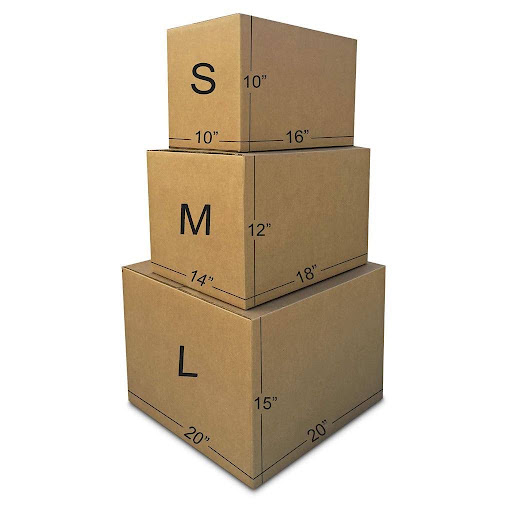
For repeat orders, record the exact length, width, height, material, and box style instead of relying on the size label alone.
Small Box Sizes
Small boxes are suitable for compact products that need protection without excessive empty space.
Common examples include:
- 4 × 4 × 4 inches for small accessories and components.
- 6 × 4 × 3 inches for small packaged products.
- 6 × 6 × 4 inches for cosmetics, samples, and compact items.
- 8 × 6 × 4 inches for candles, books, and small electronics.
- 8 × 8 × 8 inches for mugs, jars, and products that need additional cushioning.
Small box sizes can help reduce unnecessary material and shipping volume, provided the product still has enough protective clearance.
Medium Box Sizes
Medium boxes are useful for routine e-commerce orders, apparel, household goods, and multi-item shipments.
Common examples include:
- 10 × 8 × 6 inches for small retail products.
- 12 × 9 × 4 inches for flat or low-profile products.
- 12 × 9 × 6 inches for apparel and mixed orders.
- 12 × 12 × 12 inches for larger product combinations.
- 16 × 12 × 8 inches for electronics and household products.
Choose a rectangular carton when the product is long or flat. A cube may be more suitable for products with similar length, width, and height.
Large Box Sizes
Large boxes are designed for bulky products, multi-item orders, and goods that require more packing space.
Examples include:
- 16 × 16 × 16 inches for larger household products.
- 18 × 18 × 16 inches for grouped retail products.
- 18 × 18 × 18 inches for bulky goods.
- 24 × 18 × 18 inches for larger items and consolidated orders.
Large cartons require careful attention to strength and shipping cost. A box filled with heavy books may need a stronger construction than the same box filled with lightweight pillows.
Standard Mailer Box Sizes for E-Commerce

Mailer boxes are commonly used for direct-to-consumer orders, subscription boxes, product kits, and branded deliveries. They are designed to provide a neat presentation while keeping products secure during fulfillment and transportation.
The appropriate size depends on the packed product, closure design, insert requirements, and the amount of protective material needed.
These sizes are examples of common formats rather than a guarantee of stock availability. Mailer box dimensions may vary with the closure style, corrugated flute, board thickness, and supplier specifications.
For branded e-commerce packaging, explore mailer boxes and our guide to e-commerce packaging.
Standard Product Box Sizes for Retail Packaging
Retail product boxes are selected for a combination of fit, presentation, shelf space, and product protection. Unlike shipping cartons, many retail boxes are made from folding paperboard or rigid board rather than shipping-grade corrugated material.
The following dimensions are examples to help with early planning. They are not fixed dimensions for every product in each category.
Before finalizing product packaging dimensions, measure the product at its widest points and account for accessories, inserts, and any protective wrap. A box that fits the product without room for the closure or insert is not necessarily the correct size.
For retail packaging options, see custom retail boxes and product display boxes.
Standard Corrugated Box Sizes
Corrugated boxes are commonly used for shipping, storage, and distribution because they combine paper liners with a fluted inner layer. The construction can be selected according to the product’s weight, fragility, stacking conditions, and transportation requirements.
Common corrugated box dimensions include 8 × 6 × 4, 10 × 8 × 6, 12 × 12 × 12, 16 × 12 × 8, and 18 × 18 × 18 inches. Availability and strength ratings vary by supplier.
When selecting standard corrugated box sizes, consider the following:
- Board construction: Single-wall and double-wall cartons offer different structural properties.
- Product weight: Dense products may require stronger board or a smaller carton.
- Stacking: Boxes stored or transported under other cartons need appropriate compression performance.
- Protection: Fragile items may require cushioning, inserts, or dividers.
- Moisture: Humidity and exposure to water can affect corrugated board strength.
- Closure: Flap design, tape, and sealing methods contribute to package performance.
Do not choose corrugated packaging by dimensions alone. A well-sized carton must also have the strength to support the packed product and withstand its expected handling conditions.
For product-specific options, visit corrugated packaging and custom cardboard boxes.
Standard Moving Box Sizes
Moving boxes serve a different purpose from many e-commerce shipping cartons. Their size should account for both the volume and weight of the contents, because a large box filled with dense items can become difficult to lift and may be more prone to failure.
The following are illustrative moving box dimensions, not universal specifications.
Keep heavy items in manageable cartons and reserve larger boxes for lighter contents. For fragile belongings, select suitable cushioning and a carton with enough structural strength.
Moving box labels are not standardized across every retailer. Check the actual dimensions and recommended load limits before buying.
USPS Flat Rate Box Sizes: Official Dimensions
Some shipping boxes have specific carrier-defined dimensions. These should be distinguished from ordinary commercial box sizes.
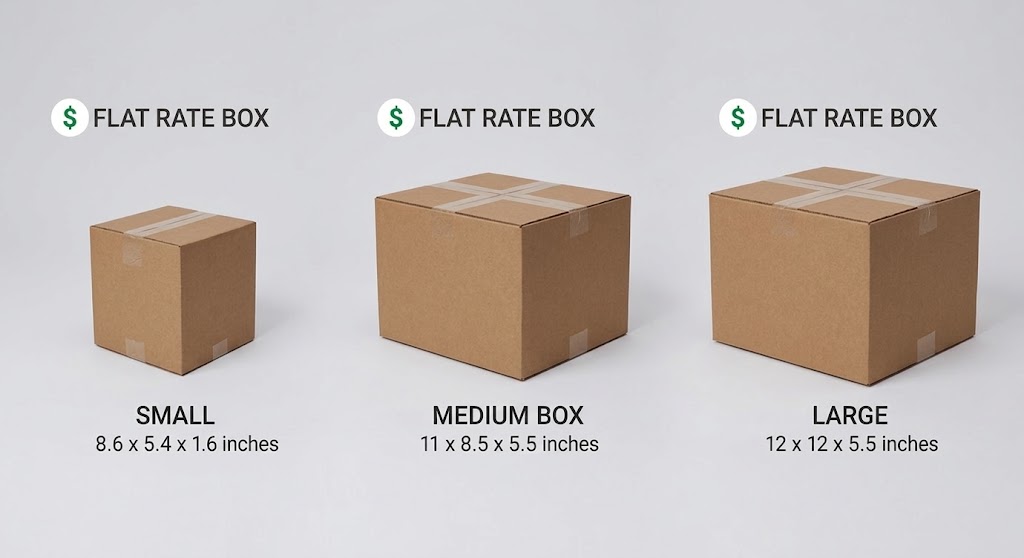
The United States Postal Service publishes official inside and outside measurements for its Priority Mail Flat Rate boxes. The examples below are based on the USPS Flat Rate reference; check the current specifications before purchasing supplies or finalizing a packaging design.
Source: USPS Priority Mail Flat Rate box dimensions.
Flat Rate pricing applies only when you use the eligible USPS-provided Flat Rate packaging and comply with the applicable conditions. A custom box with similar dimensions does not automatically qualify for Flat Rate pricing.
Also, do not confuse a carrier’s branded box sizes with universal standard packaging dimensions. Other commercial cartons can have different sizes and pricing rules.
Internal vs. External Box Dimensions
One of the most common box-sizing mistakes is assuming that internal and external dimensions are the same.
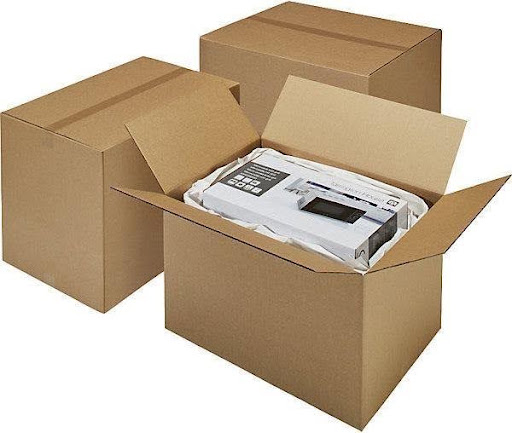
Internal dimensions describe the usable space inside the box. They help determine whether the product, inserts, and protective material will fit.
External dimensions describe the outside of the assembled box. These measurements are important for shipping calculations, storage planning, and checking carrier size limits.
For example, a carton advertised as 12 × 9 × 6 inches may refer to its internal dimensions. The outside dimensions will be slightly larger because of the board thickness and construction.
When ordering packaging, ask the supplier to confirm whether dimensions are internal or external. When preparing a shipping label, measure the closed, packed parcel according to the carrier’s instructions.
Read our how to measure a box guide before finalizing your packaging specifications.
How to Measure Box Dimensions Correctly
Most rectangular box measurements are written in this order:
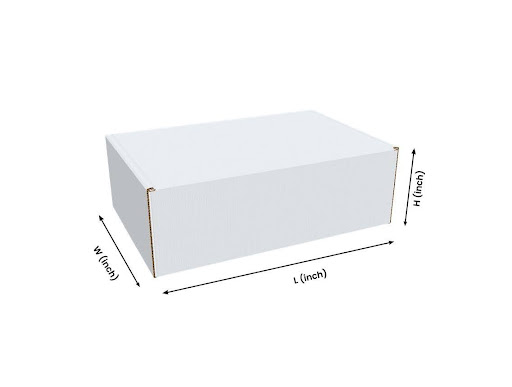
Length × Width × Height (L × W × H)
- Length: The longest side of the box opening.
- Width: The shorter side of the opening.
- Height: The vertical distance from the bottom to the opening when the box is upright.
For example, a 12 × 9 × 6-inch carton is 12 inches long, 9 inches wide, and 6 inches high.
To choose a box size accurately:
- Measure the product at its widest, longest, and tallest points.
- Include caps, handles, protrusions, and accessories.
- Decide what cushioning or inserts the product requires.
- Add the required clearance around the product.
- Select a box whose internal dimensions accommodate the packed item.
- Assemble a sample and confirm that the product fits without being forced.
- Measure the closed package externally before entering dimensions into shipping software.
Example: Calculating the Required Box Size
Suppose a product measures 10 × 7 × 4 inches and needs one inch of protective clearance on every side.
The minimum internal dimensions would be:
- Length: 10 + 1 + 1 = 12 inches
- Width: 7 + 1 + 1 = 9 inches
- Height: 4 + 1 + 1 = 6 inches
The starting point is therefore a box with approximately 12 × 9 × 6 inches of usable interior space.
This is only a planning example. The correct clearance depends on the product’s fragility, cushioning type, insert design, and packing method. Some items need less room, while fragile or irregularly shaped products may require more.
For additional guidance, use our box measurement guide and packaging size guide.
How Box Size Affects Shipping Costs
Choosing a box involves more than finding one that fits. Oversized packaging can increase material use and shipping volume, while undersized packaging can compromise protection.
Dimensional Weight
Dimensional weight, sometimes called DIM weight, reflects the space a parcel occupies in relation to its actual weight. Depending on the carrier, service, and account terms, shipping charges may be based on dimensional weight rather than scale weight.
A commonly used dimensional-weight calculation for eligible U.S. shipments is:
Length × Width × Height ÷ applicable divisor
For example, a 16 × 12 × 8-inch package has a volume of 1,536 cubic inches. Dividing 1,536 by 139 gives approximately 11.1 pounds before any applicable rounding rules. The carrier’s current formula and pricing terms determine the final billable weight.
Use the official carrier guidance to check the rules for your shipment:
- FedEx dimensional weight calculation
- UPS package dimensions, size limits, and weight guide
- USPS Priority Mail and Flat Rate information
Do not assume every carrier uses the same divisor, rounding method, or service limits. Verify the current rules before setting a standard box specification for recurring shipments.
Why Right-Sizing Matters
A correctly sized box can help businesses:
- Reduce unnecessary void fill and packaging material.
- Limit product movement during transportation.
- Improve packing-station efficiency.
- Make storage and inventory management more predictable.
- Avoid some unnecessary shipping volume.
However, the smallest possible box is not always the best box. There must be enough room for required cushioning and safe closure.
Explore our guides to shipping packaging and protective packaging to understand how box dimensions and protection work together.
How to Choose the Right Packaging Box Size
The best packaging box size depends on the product, packaging format, shipping method, and business requirements. Use the following checklist before placing an order.
1. Start With Product Dimensions
Measure the product rather than guessing from its category. Two products sold as the same type may have different dimensions, accessories, or packaging requirements.
For multi-item orders, arrange the items in their intended packing positions and measure the complete arrangement.
2. Allow Room for Protection
Fragile products may need foam, paper cushioning, inserts, or dividers. These components occupy space and must be included when determining the internal box dimensions.
For products that need separation or a fitted presentation, explore packaging inserts, box inserts, and box partitions.
3. Consider Material and Box Style
A folding carton, corrugated shipping box, and rigid presentation box can share similar dimensions while serving very different purposes.
Choose a structure based on product weight, protection needs, appearance, and how the package will be handled. For premium presentation, a custom rigid box may be appropriate; for shipping, a corrugated carton may provide a more suitable structure.
4. Review Branding Requirements
Product packaging may need room for printed artwork, product information, barcodes, labels, or decorative finishes. Make sure the dimensions provide enough usable panel space for your design.
If branding is important, explore custom packaging and custom box sizes.
5. Compare the Full Cost
Compare more than the price per box. Consider printing, inserts, material grade, assembly, storage, freight, and expected order volume.
For regular shipments, a small range of carefully selected box sizes may simplify purchasing and packing. If standard sizes leave excessive empty space or do not protect the product correctly, custom dimensions may be worth evaluating.
6. Test Before Scaling Up
Build and pack a sample before committing to a large production run. Check the fit, closure, cushioning, strength, finished dimensions, and packed weight.
For fragile, heavy, or valuable products, consider testing the complete package under realistic handling and shipping conditions.
Standard Box Sizes vs. Custom Box Sizes
Standard box sizes can be convenient when an available carton fits the product and provides sufficient protection. Custom box sizes are useful when standard options do not match the product’s dimensions, branding requirements, or protective needs.
Standard packaging may be a practical choice for repeat shipments of common products. Custom packaging is worth considering when a better fit, a specific presentation, or a product-specific insert can improve the overall packaging system.

Bluebird Packaging offers customized packaging options for businesses that need product-specific dimensions and branding. You can review your requirements and request a custom packaging quote.
Frequently Asked Questions About Standard Box Sizes
What are the most common standard box sizes?
Common commercial box sizes include 6 × 4 × 3, 8 × 6 × 4, 8 × 8 × 8, 12 × 9 × 6, 12 × 12 × 12, and 16 × 12 × 8 inches. Availability varies by supplier, box construction, and intended application.
What is the standard shipping box size in the USA?
There is no single standard shipping box size across the United States. Businesses commonly use several small, medium, and large carton dimensions based on their products, shipping services, and packing requirements.
What are standard cardboard box sizes?
Common cardboard box dimensions include 6 × 4 × 3, 8 × 6 × 4, 10 × 8 × 6, 12 × 12 × 12, and 16 × 12 × 8 inches. Confirm the material construction and whether the dimensions describe the inside or outside of the box.
What are standard mailer box sizes?
Common mailer box formats include 6 × 4 × 2, 8 × 6 × 3, 10 × 8 × 4, 12 × 10 × 5, and 14 × 10 × 6 inches. The best option depends on the packed product, inserts, closure style, and supplier availability.
Are box dimensions listed as length, width, and height?
Yes, box dimensions are commonly expressed as length × width × height. Confirm the supplier’s measurement convention, and check whether the dimensions are internal or external.
How do I calculate box volume?
Multiply the length by the width and height using the same unit. For example, a 12 × 10 × 8-inch box has a nominal volume of 960 cubic inches. If you need cubic feet, divide the cubic-inch result by 1,728.
Should I use internal or external box dimensions?
Use internal dimensions to determine whether the product and its protective materials will fit. Use the finished package’s external dimensions when calculating shipping measurements or checking carrier requirements.
How much bigger should a shipping box be than the product?
There is no single clearance allowance for every item. Durable products may need minimal extra space, while fragile products may require cushioning on multiple sides. Calculate the space required by the actual protective materials instead of adding an arbitrary amount.
What is the difference between standard and custom box sizes?
Standard box sizes are common dimensions that suppliers may stock or regularly manufacture. Custom box sizes are produced to specified dimensions and can be useful for unique products, fitted inserts, and specialized packaging requirements.
Do bigger boxes always cost more to ship?
Not always, but larger packages may incur higher charges because of dimensional weight, size limits, or service-specific rules. Compare the carrier’s current pricing method and ensure the box provides sufficient protection without unnecessary space.
What are standard moving box sizes?
Moving boxes are commonly categorized as small, medium, large, and extra large, but exact dimensions vary among suppliers. Choose a size based on the contents’ volume and weight, and avoid packing dense items into oversized cartons that become difficult to lift.
Can I order custom packaging in non-standard dimensions?
Yes. Custom packaging can be specified to suit the product’s dimensions, protective needs, and branding requirements. The appropriate design depends on the material, box style, order quantity, and production specifications.
Final Thoughts
Standard box sizes provide a useful starting point for shipping, retail packaging, e-commerce fulfillment, and storage. Common dimensions such as 8 × 6 × 4, 12 × 9 × 6, 12 × 12 × 12, and 16 × 12 × 8 inches can cover many routine applications, but they are not universal specifications.
Measure the packed product, calculate the necessary internal space, check the finished external dimensions, and confirm the carton strength before finalizing your choice. For products that do not fit available cartons or require specific branding, inserts, or protection, custom box sizes may be the better solution.
If your business needs packaging tailored to its products, contact Bluebird Packaging for a custom packaging quote.





1 Comments
[…] the product’s actual volume and test a filled sample. You can also review our guide to standard box sizes and packaging measurements when coordinating pouches with outer […]