Choosing the right Mylar pouch is about more than finding a bag that looks large enough. The correct size needs to accommodate your product’s weight, volume, shape, filling method, and sealing requirements. A pouch that is too small can make filling difficult, while an oversized bag may look underfilled, increase packaging costs, and take up unnecessary storage space.
Businesses use Mylar packaging for snacks, coffee, dried foods, powders, herbs, supplements, and many other products. However, the same pouch dimensions do not hold the same weight of every product. Lightweight snacks occupy more space than dense powders, while whole coffee beans need a different amount of room than finely ground coffee.
This guide explains common Mylar Bag Sizes, compares dimensions by approximate product weight, and shows how to select the right pouch for retail packaging and food storage. You will also learn how to measure a pouch, understand gussets, compare flat and stand-up formats, and plan custom dimensions for your brand.
Quick Answer: What Mylar Bag Size Do You Need?
The right Mylar bag size depends on the product’s density, shape, and intended fill quantity. As a general starting point, small 3 × 4-inch pouches are often used for samples, 3.5 × 5-inch pouches for small portions, 4 × 6-inch pouches for compact retail products, and 5 × 8-inch or 6 × 9-inch pouches for larger portions.
For bulk food storage, larger formats such as 10 × 14 inches or 12 × 16 inches may be more suitable. These are planning references, not universal weight guarantees. Always test the actual product in the selected pouch before approving a production size.
Mylar Bag Size Chart by Weight and Dimensions
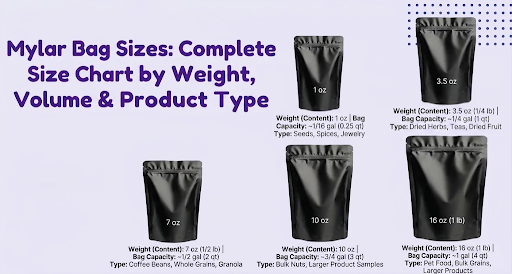
A Mylar bag size chart helps narrow down the options before you request samples or custom packaging. The following table provides common starting dimensions for different product quantities.
| Approximate Product Quantity | Common Pouch Dimensions | Typical Packaging Use |
|---|---|---|
| 1 gram | 3 × 4 inches | Small samples, spices, compact portions |
| 3.5 grams | 3.5 × 5 inches | Small retail portions, dried products |
| 7 grams | 4 × 6 inches | Snacks, herbs, small product quantities |
| 14 grams | 5 × 8 inches | Medium retail portions |
| 28 grams / 1 ounce | 6 × 9 inches | Coffee, snacks, dried products |
| ¼ pound / 113 grams | 8 × 10 inches | Larger retail or bulk portions |
| ½ pound / 227 grams | 10 × 12 inches | Bulk snacks and dry goods |
| 1 pound / 454 grams | 12 × 16 or 13 × 15 inches | Larger food and storage quantities |
| 1 gallon capacity | Often around 10 × 14 inches | Household dry-food storage |
| 5-gallon capacity | Commonly around 20 × 30 inches | Large bulk storage or bucket liners |
Important: These dimensions are approximate industry planning examples. Manufacturers may list different measurements for the same weight category, and a pouch’s usable capacity changes with its depth, gusset, material construction, zipper, and seal area. A one-ounce pouch for dried herbs may not hold one ounce of dense powder or whole coffee beans.
For a more accurate selection, measure the product’s actual volume and test a filled sample. You can also review our guide to standard box sizes and packaging measurements when coordinating pouches with outer packaging.
Small Mylar Bag Sizes
Small Mylar bags are designed for samples, single portions, compact products, and lightweight retail items. They are useful when a brand wants to control portion sizes or offer trial-size packaging.
Common small Mylar pouch dimensions include:
- 2 × 3 inches: Very small samples, sachet-style products, and tiny portions.
- 3 × 4 inches: Compact samples, spices, and small quantities.
- 3.5 × 5 inches: Trial-size products and small retail portions.
- 4 × 6 inches: Small snacks, dried products, and selected compact items.
The product’s thickness and shape matter as much as its weight. A flat powder may fit into a smaller pouch than bulky pieces of the same weight. Leave enough room for the product to enter the pouch without damaging the opening or contaminating the sealing area.
Medium Mylar Bag Sizes
Medium pouches are suitable for products that need more filling space while remaining convenient for retail shelves, storage, and everyday use.
Common options include:
- 5 × 7 inches: Medium snack portions, samples, and compact dry goods.
- 5 × 8 inches: Larger retail portions and products that need extra headspace.
- 6 × 8 inches: Medium-sized products with a wider front panel.
- 6 × 9 inches: Larger retail portions, coffee, and selected dry products.
- 7 × 9 inches: Products that need additional width or height.
Medium Mylar bag dimensions are especially useful for brands that sell different serving sizes. A business can use a coordinated pouch design across multiple sizes while adjusting the artwork and product information for each pack.
Large Mylar Bag Sizes
Large Mylar bags are generally used for bulk products, family-size portions, and products that need more storage capacity.
Common dimensions include:
- 8 × 10 inches: Larger retail packs and bulk dry goods.
- 10 × 12 inches: Bulk snacks, coffee, and larger quantities of dry products.
- 10 × 14 inches: Some gallon-style food storage applications.
- 12 × 16 inches: Larger dry-food portions and storage needs.
- 13 × 15 inches: Large retail or wholesale packaging, depending on product density.
- 20 × 30 inches: Some large-volume storage and bucket-liner applications.
Large pouches should be tested when filled because a bag that looks spacious when empty can become difficult to close once the product settles. If the product is heavy or has sharp edges, discuss film strength, seal construction, and puncture resistance with the manufacturer.
Mylar Bag Sizes by Product Weight
Weight-based sizing is popular because many products are sold in fixed quantities. However, weight is only one part of the sizing decision. The product’s bulk density determines how much space that weight occupies.
1 Gram Mylar Bags
A 1-gram pouch is commonly associated with small samples and compact retail portions. A 3 × 4-inch pouch is one possible starting point, but the actual fit depends on whether the contents are flat, granular, fluffy, or irregularly shaped.
Before choosing the final size, consider:
- The product’s physical dimensions.
- Whether the product is loose or compressed.
- The required headspace above the fill.
- Whether the pouch needs a zipper or heat seal.
- Any labeling or regulatory information that must appear on the pack.
3.5 Gram Mylar Bags
A 3.5-gram quantity is often used as a small retail portion. Pouches around 3.5 × 5 inches or 4 × 6 inches can be useful starting points.
A stand-up pouch may need a wider or deeper construction than a flat pouch with the same front-panel dimensions. Test the loaded pouch to confirm that the product does not crowd the zipper or top seal.
7 Gram Mylar Bags
For a 7-gram product, a 4 × 6-inch pouch is a common starting reference. Some products may need a 5 × 7-inch or 5 × 8-inch format if they contain bulky pieces or require more headspace.
Do not assume that every 7-gram product will fit the same bag. Granules, powders, dried pieces, and irregular shapes behave differently during filling.
1 Ounce Mylar Bags
One ounce is approximately 28.35 grams. A 6 × 9-inch pouch is a useful starting reference for many products, but the actual dimensions depend on the product’s volume and the pouch’s construction.
For coffee, snacks, and other dry products, check whether the pouch needs a bottom gusset, zipper, tear notch, or heat-sealable top. These features can change the usable filling space.
Larger Quantities: ¼ Pound, ½ Pound and 1 Pound
Larger product quantities generally require more width, height, or gusset depth.
| Product Weight | Approximate Starting Dimensions | Common Applications |
|---|---|---|
| ¼ pound | 8 × 10 inches | Dry snacks, herbs, bulk portions |
| ½ pound | 10 × 12 inches | Coffee, dry foods, larger packs |
| 1 pound | 12 × 16 or 13 × 15 inches | Bulk dry goods and storage |
Use these sizes as a starting point rather than a fixed specification. A pound of lightweight cereal may occupy considerably more space than a pound of dense grains or powder.
Mylar Bag Sizes by Volume: Quart, Gallon and Bulk Storage
For food storage, volume can be more useful than weight because the bag needs to hold a particular amount of space. A gallon-size pouch, for example, is selected for its approximate internal volume rather than for a guaranteed weight of rice, flour, or beans.
Common storage formats include:
- Quart-size pouches: Useful for smaller portions, ingredients, and household storage.
- Half-gallon pouches: Suitable for moderate quantities of dry goods.
- One-gallon pouches: Often used for larger household portions of rice, beans, flour, and other dry foods.
- Five-gallon liners: Used in some bulk-storage systems and food-grade buckets.
How Much Can a Gallon-Size Mylar Bag Hold?
A gallon is a volume measurement, not a weight measurement. The amount of product a gallon-size Mylar bag can hold depends on the product’s density and how it settles.
For example, a gallon of rice, flour, dried fruit, and cereal will not weigh the same. Even two types of rice may pack differently because grain shape and moisture content affect the amount of space they occupy.
When planning food storage, consider:
- The total volume of the food.
- Whether the product is whole, crushed, powdered, or irregular.
- The space needed for an oxygen absorber, if used.
- The headspace required for heat sealing.
- Whether the pouch will be stored alone or inside a bucket.
Utah State University Extension discusses food-safe packaging options, including Mylar-type bags, for long-term storage of certain dry foods. Its guidance also emphasizes appropriate storage conditions and food-safe oxygen absorbers. Read its food storage and packaging guidance.
Mylar Bag Sizes for Different Product Types
The best Mylar bag dimensions vary by product category. Use the following examples as a practical starting point, then test the actual product before selecting a final specification.
Mylar Bag Sizes for Coffee
Coffee packaging needs to account for the product’s form, freshness requirements, and filling method. Whole beans occupy a different volume than ground coffee, so a pouch sized for one may not work for the other.
Consider:
- Small sample pouches for tasting portions.
- Medium stand-up pouches for retail coffee.
- Larger gusseted pouches for multi-serving quantities.
- Appropriate barrier and closure features for the intended coffee product.
For coordinated product presentation, explore custom tea boxes and other packaging options for beverage-related products.
Mylar Bag Sizes for Snacks and Candy
Snacks can be bulky even when their total weight is relatively low. Chips, popped products, dried fruit, nuts, and candy pieces all need different internal space.
A pouch for fragile snacks may need extra headspace to reduce crushing during filling and handling. A denser candy product may fit into a smaller pouch, depending on its shape and quantity.
Related packaging options include custom snack boxes, candy boxes, and popcorn boxes.
Mylar Bag Sizes for Powder Products
Powders can settle and compact during filling, which changes their final volume. Fine powders may also create dust around the zipper or heat-seal area.
When selecting a pouch for powder products, check:
- The product’s bulk density.
- The filling equipment and filling speed.
- The required seal width.
- Whether a zipper is necessary.
- The product’s moisture and oxygen sensitivity.
A sample-fill test is particularly useful for powders because a small change in density can make a noticeable difference in capacity.
Mylar Bag Sizes for Dry Food Storage
Dry foods such as rice, beans, grains, pasta, and flour may be stored in Mylar-type pouches when the material and construction are suitable for the intended use.
For long-term storage, the pouch is only one part of the system. Food condition, moisture, sealing, oxygen management, and the outer storage container also matter. Utah State University Extension provides practical information on storing white rice and the use of appropriate food-safe storage containers.
If you sell packaged food, compare your pouch design with other food packaging solutions to create a consistent presentation across your product range.
Flat vs. Stand-Up Mylar Bag Sizes
The shape of a pouch affects its capacity and how it looks when filled. Two pouches with similar front-panel measurements may have different usable volumes if one has a gusset and the other does not.
| Feature | Flat Mylar Bag | Stand-Up Mylar Pouch |
|---|---|---|
| Construction | Usually two flat panels | Includes a bottom gusset |
| Storage | Lies flat | Can stand when filled correctly |
| Shelf display | Suitable for hanging or flat placement | Useful for upright retail display |
| Depth | Limited by the product and flexible panels | Increased by the gusset |
| Common uses | Samples, small portions, compact products | Snacks, coffee, retail food products |
What Are Flat Mylar Bags?
Flat Mylar bags are flexible pouches with a simple, flat construction. They are useful for small products, samples, and items that do not need to stand upright on a retail shelf.
Their dimensions are generally described by width and height. However, the usable space can still be affected by the side seals, top seal, zipper, and product shape.
What Are Stand-Up Mylar Pouches?
Stand-up pouches use a bottom gusset that opens when the pouch is filled. This allows the package to stand on a shelf and creates additional depth.
They are commonly considered for coffee, snacks, dried foods, and other retail products. When comparing stand-up pouch dimensions, ask for the finished dimensions with the gusset opened, not just the flat lay dimensions.
Gusseted Mylar Bags: How the Gusset Changes Capacity
A gusset is a folded section of material that expands to provide depth. Depending on the pouch design, it may be located at the bottom or along the sides.
A gusset can:
- Increase the pouch’s usable volume.
- Help a filled pouch stand upright.
- Change the front-facing display area.
- Affect how the package sits during storage and shipping.
- Influence the amount of material needed for production.
A flat pouch and a gusseted pouch should not be compared by width and height alone. Ask the supplier to confirm the finished depth and usable internal dimensions.
How to Measure Mylar Bag Dimensions Correctly
Accurate measurements help prevent sizing errors before production. Most flat pouch dimensions are listed as width × height, but gusseted pouches need an additional depth measurement.
Follow these steps:
Step 1: Measure the Width
Measure the pouch from its left edge to its right edge while it is laid flat. Do not include the side seals as usable internal space unless the supplier specifies otherwise.
Step 2: Measure the Height
Measure from the bottom edge to the top edge. Confirm whether the stated height includes the zipper, top seal, or header area.
Step 3: Measure the Gusset
For a stand-up pouch, identify the bottom gusset or side gusset. Ask for the gusset depth and the finished dimensions after the pouch is opened.
Step 4: Identify the Usable Filling Area
The full outside measurement is not necessarily the usable product area. Side seals, bottom folds, zipper tracks, and top sealing zones reduce the space available for filling.
Step 5: Test the Filled Pouch
Place the actual product inside a sample pouch. Check whether it fills comfortably, closes correctly, and leaves enough space for the intended sealing method.
For additional measurement guidance, see our articles on how to measure a box and box dimensions. Although boxes and pouches have different constructions, accurate product measurement is important for both.
What Factors Affect Mylar Bag Capacity?
A pouch’s advertised capacity is only a starting point. Several factors determine how much product it can practically hold.
1. Product Density
Density describes how much mass occupies a given volume. Dense powders and grains may weigh more than lightweight snacks that fill the same space.
2. Product Shape
Whole beans, irregular dried foods, flat pieces, and fine powders settle differently. Products with unusual shapes may leave empty spaces between pieces.
3. Gusset Depth
A wider or deeper gusset can provide more room, but the finished shape and front-panel area may change.
4. Seal and Zipper Space
A pouch needs enough material above the product for its closure and seal. Filling too close to the top can interfere with a reliable seal.
5. Material Thickness and Construction
The film structure, laminate, and pouch construction affect flexibility and durability. A heavier product or one with sharp edges may require a more robust specification.
6. Filling Method
Manual filling and automated filling equipment may require different opening dimensions and headspace. The pouch must work with the actual production process, not just the product’s final weight.
How to Choose the Right Mylar Bag Size for Your Product
Choosing the correct size becomes easier when you follow a repeatable process.
1. Identify the product and target quantity.
Write down the product type and the exact quantity that each pouch should contain.
2. Measure the product’s volume.
Do not rely on weight alone. Measure the product in the form in which it will be packed.
3. Select a pouch style.
Decide whether a flat pouch, stand-up pouch, or gusseted pouch is more suitable for the product and retail display.
4. Allow space for filling and sealing.
Include enough headspace for the zipper, heat seal, and any required insert or absorber.
5. Consider storage and transportation.
Check how the filled pouch will be stacked, shipped, displayed, or stored.
6. Request a sample or prototype.
A physical sample is the most practical way to confirm dimensions before ordering a production quantity.
7. Approve the final artwork and specifications.
Check the dimensions, closure, material, finish, print area, and all required product information before production.
If your business needs packaging for several products or sizes, review our guide to custom packaging design and packaging materials before finalizing the specification.
Material, Thickness and Food-Contact Considerations
Not every pouch that looks like a Mylar bag is suitable for every product. Flexible packaging can use different film layers and laminates, each with its own barrier, appearance, flexibility, and sealing characteristics.
When discussing material options, ask the manufacturer about:
- The film structure and layer composition.
- The barrier properties required for the product.
- The recommended thickness for the intended application.
- Compatibility with the filling and sealing process.
- Puncture and tear resistance.
- Food-contact suitability, where applicable.
For products sold in the United States, food-contact packaging materials must comply with the applicable requirements for their intended use. The FDA explains that food-contact substances may need authorization through an applicable food additive regulation, Food Contact Notification, or another recognized regulatory pathway. A generic claim such as “food safe” should not replace documentation for the actual material and intended conditions of use.
Read the FDA’s information on food packaging and substances that come into contact with food.
You can also explore our guides to packaging material types and packaging testing when comparing packaging performance.
Custom Mylar Bag Dimensions for Branding and Retail Packaging
Standard pouch sizes are useful for planning, but some products need custom dimensions. A custom pouch can be designed around the product’s actual shape, required fill quantity, display requirements, and brand artwork.
Depending on the packaging supplier’s available manufacturing options, features to discuss may include:
- Custom width, height, and gusset depth.
- Printed front and back panels.
- Resealable zipper closures.
- Tear notches.
- Hang holes.
- Clear product windows.
- Matte or glossy finishes.
- Different barrier-film constructions.
The best design balances product fit and brand presentation. A pouch should not be oversized simply to create a larger print area. It should provide enough room for the product, a reliable closure, and clear product information without appearing unnecessarily empty.
For coordinated packaging across multiple product lines, explore custom CBD boxes and retail packaging solutions. You can also compare custom Mylar bags with other formats such as Kraft boxes when planning a complete packaging system.
If you already know your preferred pouch dimensions, share your specifications and quantity through our custom packaging quote form before finalizing the design.
Common Mylar Bag Sizing Mistakes to Avoid
Even a well-designed pouch can create problems if the dimensions are selected without testing. Avoid these common mistakes:
- Choosing by weight alone: The same weight of two different products may occupy very different volumes.
- Ignoring the gusset: A flat measurement does not explain the full capacity of a stand-up pouch.
- Leaving too little headspace: The pouch may be difficult to fill, close, or heat seal.
- Using the outside dimensions as usable space: Seals, folds, and zipper tracks reduce the filling area.
- Selecting an oversized pouch: Too much empty space can make retail packaging look poorly filled.
- Skipping a sample test: A product may behave differently once it is poured, settled, or placed inside the pouch.
- Overlooking the material specification: The right dimensions do not guarantee that the film is suitable for the product.
- Approving artwork before confirming dimensions: Changes to the pouch size can affect the print layout and safe design area.
A practical way to avoid these issues is to test the product in the proposed pouch and confirm the final specifications before the production run.
Frequently Asked Questions About Mylar Bag Sizes
1. What are the standard Mylar bag sizes?
Common Mylar bag dimensions include 2 × 3, 3 × 4, 3.5 × 5, 4 × 6, 5 × 8, 6 × 9, 8 × 10, 10 × 12, and larger formats. Availability varies by supplier and pouch construction. The best size depends on product volume, density, gusset depth, and sealing requirements.
2. How do I choose the right Mylar bag size?
Start by identifying the product’s weight and measuring its actual volume. Then choose a pouch style, account for the gusset and seal area, and test a filled sample. Do not select a final size based only on a generic weight chart.
3. What size Mylar bag holds one ounce?
A 6 × 9-inch pouch is a common starting reference for a one-ounce product, but it is not a universal rule. Lightweight or bulky products may need a larger pouch, while dense products may fit into a smaller one. Test the actual product before confirming the dimensions.
4. How many grams fit in a Mylar bag?
The number of grams depends on the pouch’s internal volume and the product’s density. A 4 × 6-inch pouch may hold a different weight of powder, coffee beans, dried fruit, or snacks. Pouch dimensions alone cannot establish an exact gram capacity.
5. Are Mylar bag sizes measured by weight or volume?
Mylar bags are generally specified by physical dimensions, such as width and height, while product capacity may be described by weight or volume. Weight tells you how heavy the contents are; volume tells you how much space they occupy. Both are useful when choosing a pouch.
6. What size Mylar bag is best for food storage?
The right size depends on the food, quantity, storage period, and container. Smaller pouches can work for individual portions, while gallon-size and larger formats are used for some bulk dry-food applications. Always select a material intended for the food-contact use and follow suitable storage and sealing practices.
7. How do you measure Mylar bag dimensions?
Measure the width from side to side and the height from the bottom to the top. For a gusseted pouch, also confirm the gusset depth and finished expanded dimensions. Ask the supplier to distinguish outside dimensions from the usable filling area.
8. What is the difference between flat and stand-up Mylar bags?
Flat Mylar bags have a simple flexible construction and generally lie flat when empty. Stand-up pouches include a bottom gusset that expands when filled, allowing them to stand upright. Their usable capacity and display footprint can therefore differ even when their front-panel measurements are similar.
9. How much can a gallon-size Mylar bag hold?
A gallon-size bag is designed around an approximate volume, not a fixed product weight. The weight it holds depends on the density and shape of the contents. Rice, flour, beans, cereal, and dried fruit will not all weigh the same when they occupy one gallon.
10. Does product density affect Mylar bag capacity?
Yes. Product density has a direct effect on how much weight fits into a given pouch volume. Dense products occupy less space per unit of weight than lightweight or bulky products. This is why a sample-fill test is important before approving a final pouch size.
Conclusion: Find the Right Mylar Bag Size for Your Product
The right Mylar pouch should fit the product comfortably, provide enough room for filling and sealing, and support the way the package will be stored or displayed. Small pouches are useful for samples and compact portions, medium formats work for many retail products, and larger gusseted or storage pouches can accommodate bulk quantities.
Use a Mylar bag size chart as a starting point, but make the final decision based on product density, actual volume, pouch construction, and a physical sample test. Confirm the material and food-contact suitability for the intended application before production.
If you are planning branded packaging, request a custom packaging quote with your product type, target fill weight, dimensions, preferred pouch style, and quantity. Sharing these details helps the packaging team recommend a more suitable specification.
Need help selecting custom pouch dimensions? Send your product measurements and packaging requirements through our Request a Quote page. You can also contact Bluebird Packaging to discuss your packaging project.
References
- U.S. Food and Drug Administration (FDA): Food Packaging and Food-Contact Substances
- Utah State University Extension: Food Storage and Packaging
- Utah State University Extension: Storing White Rice
Packaging dimensions in this guide are general planning references, not guaranteed capacity specifications. Confirm final measurements, material suitability, and product fit with your packaging manufacturer before placing a production order.