
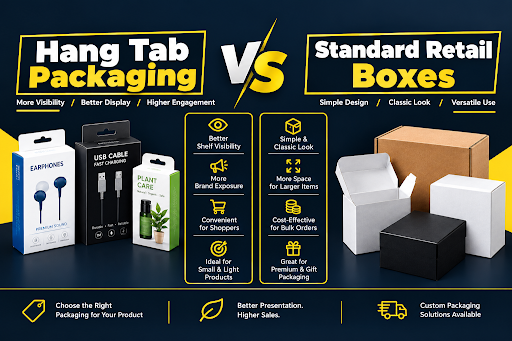
Hang tab packaging and standard retail boxes serve different display needs. Hang tab packaging is designed to hang from retail peg hooks or compatible display fixtures, while standard retail boxes are generally designed to stand on shelves, sit on counters, or stack with other products. The right choice depends on where your product will be sold, its size and weight, the retailer’s display system, and the protection your product needs.
For US brands selling electronics accessories, cosmetics, small hardware, stationery, toys, personal care products, and other compact merchandise, packaging is both a protective structure and a merchandising tool. A hanging box can make a small product easier to see in a pegboard display. A conventional carton can provide a more practical fit for shelf-based retail, product storage, and many premium product presentations.
This comparison explains how both formats work, their advantages and limitations, material and printing options, cost considerations, and how to choose custom retail packaging for your product.
Hang Tab Packaging vs. Standard Boxes: A Quick Answer
Choose hang tab packaging when your retailer uses peg hooks, pegboards, clip strips, or compatible hanging displays and your product can be safely supported by the package’s hanging feature. Choose standard retail boxes when the product is intended to sit upright, lie flat, stack on shelves, or be presented on a counter without a hanging mechanism.
Neither format is universally better. A hang tab changes how a package is displayed; it does not automatically make the box stronger, more protective, or more affordable.
| Comparison factor | Hang tab packaging | Standard retail boxes |
|---|---|---|
| Primary display method | Peg hooks, compatible hanging rails, or display strips | Shelves, counters, display units, or stacking |
| Main advantage | Supports vertical merchandising | Offers flexible shelf and counter presentation |
| Shelf footprint | Can reduce reliance on horizontal shelf space | Depends on package size and shelf arrangement |
| Product visibility | Can keep the front panel facing shoppers | Depends on shelf position and orientation |
| Structural design | Includes an integrated or attached hanging feature | Usually has no hanging feature |
| Weight considerations | Tab and attachment must support the loaded package | Base, panels, and closure must support normal handling and stacking |
| Branding | Front-facing artwork can be visible on a peg | Multiple panels can be used for branding and information |
| Storage | Requires suitable space for the tab and display-ready cartons | Often easier to pack and store in conventional carton formats |
| Best suited for | Compact products intended for hanging display | Products sold on shelves, counters, or in stacks |
| Important limitation | Incompatible hooks or inadequate tab strength can cause problems | May be less suitable when the retailer expects peg-ready merchandise |
What Is Hang Tab Packaging?
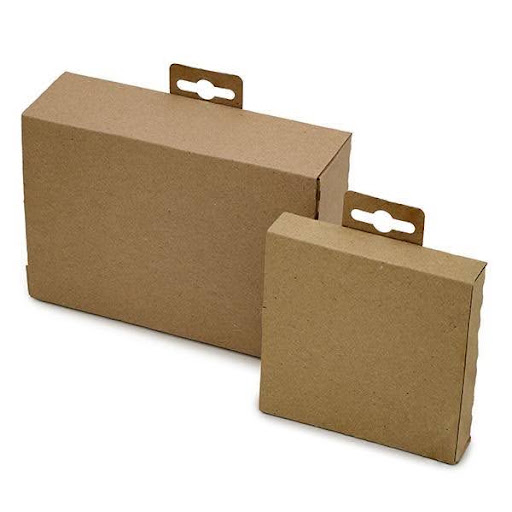
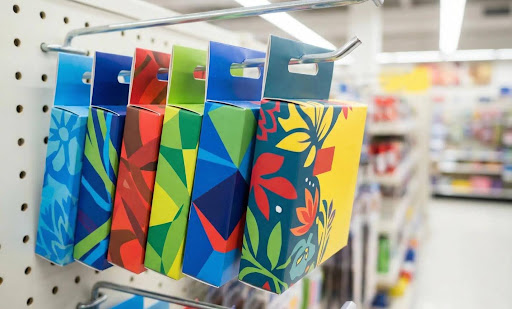
Hang tab packaging is a retail package with a hanging feature that allows the product to be suspended from a compatible retail fixture. The feature may be cut directly into the carton, formed as an extended panel, reinforced with additional material, or added as a separate adhesive tab.
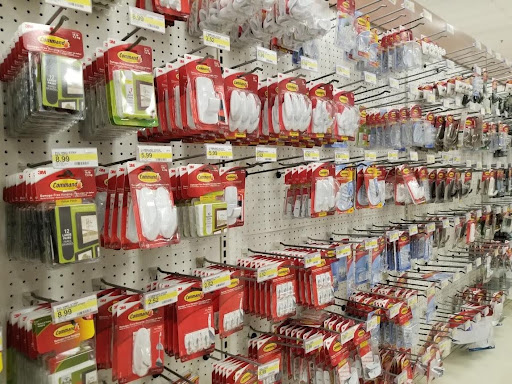
It is commonly used when stores arrange small products vertically on pegboards, hooks, wire racks, or display strips. Instead of occupying a full shelf position, the package hangs in a designated merchandising area.
Common applications include:
- Small electronics accessories and cables.
- Hardware items and compact tools.
- Cosmetics and personal care products.
- Stationery, craft supplies, and small toys.
- Lightweight household accessories.
- Promotional products and impulse-purchase items.
Common Types of Hang Tab Packaging
Integrated die-cut hang tabs are formed as part of the carton structure. The hanging opening is cut into a panel or extended tab, allowing the carton to hang without requiring a separate adhesive component.
Euro slot hang tabs use a shaped slot designed for compatible retail peg hooks. The exact slot dimensions and placement should be agreed with the retailer or display supplier.
Reinforced hang tabs use additional material or a reinforced construction around the hanging area when the application requires extra support. Reinforcement should be designed for the product’s loaded weight and expected handling.
Adhesive hang tabs are separate tabs attached to a package or backing surface. They can be useful when the original package does not include an integrated hanging feature, but adhesive compatibility and load capacity must be verified.
Custom-shaped hang tabs can be designed around the package structure, brand presentation, and required display fixture. A distinctive shape should never compromise the hanging feature’s performance.
For brands considering a purpose-built carton, Bluebird Packaging’s custom hang tab box packaging guide provides a relevant starting point for understanding hanging retail box design.
What Are Standard Retail Boxes?

Standard retail boxes are packaging cartons designed primarily for shelf placement, counter display, stacking, storage, or conventional product presentation. They typically do not include a built-in hanging tab, although a suitable box may be modified if a retailer later requires a hanging option.
These boxes can use folding carton paperboard, cardboard, corrugated board, or other appropriate constructions. The right choice depends on product weight, fragility, presentation requirements, and the distribution environment.
Common examples include:
- Folding cartons for cosmetics and personal care products.
- Printed cartons for consumer electronics.
- Cardboard boxes for accessories and household items.
- Corrugated boxes for products requiring additional structural protection.
- Countertop cartons for compact merchandise.
- Retail boxes designed for gift products or premium presentation.
Standard retail packaging is flexible because it can be designed for a broad range of dimensions, openings, closures, and display orientations. However, it may not be suitable for a retailer whose merchandising plan requires products to hang from hooks.
Brands comparing conventional carton formats can review Bluebird Packaging’s cardboard packaging boxes and custom retail box options to consider different packaging directions.
What Are the Main Differences Between Hang Tab Boxes and Regular Boxes?
The main differences are the display method, structural requirements, retail fixture compatibility, and how the product is handled on the sales floor. Both formats can offer custom printing and branding, so the decision should start with the display environment rather than appearance alone.
1. Product Display and Visibility
Hang tab packaging is intended for hanging displays. It can position products in vertical rows, make individual packages easy to browse, and present the front panel toward shoppers when the fixture is arranged correctly.
Standard boxes are more versatile for shelf and counter layouts. They can be arranged front-facing, stacked, or grouped into product families, but their visibility depends on shelf height, orientation, and neighboring merchandise.
A hanging package is not automatically more visible in every store. If the retailer places the product in a crowded corner or uses an incompatible hook arrangement, the benefit may be limited. Likewise, a well-positioned standard carton can be highly visible on a shelf.
2. Shelf Space and Store Layout
Hang tab packaging can make use of vertical merchandising space, which may help retailers display small products without allocating each item a broad shelf footprint. The actual space savings depend on the store fixture, product dimensions, spacing between hooks, and number of packages displayed.
Standard retail boxes need sufficient shelf or counter space for their footprint. That can be an advantage for products that require a stable base, a larger presentation panel, or an organized stack.
Before choosing a structure, ask the retailer where the product will be displayed and how much space is available. Packaging should fit the real planogram or fixture rather than an assumed display environment.
3. Structural Design and Durability
Hang tab boxes have an additional structural consideration: the hanging feature must support the fully packed product. The slot or tab, surrounding material, carton closure, and attachment method all influence performance.
Standard retail boxes do not need to support the product from a hanging point, but they still need appropriate stiffness, closure strength, and protection for the intended use.
Neither packaging type should be selected based on appearance alone. A package that looks sturdy in a digital mockup may still need physical testing when its performance depends on a specific load, fixture, or handling pattern.
4. Branding and Printing Space
Both hang tab packaging and standard boxes can support custom graphics, logos, product information, and brand colors. A hang tab may occupy part of the top area or change the shape of the carton, so the artwork should be developed around the approved dieline.
Standard cartons may provide a simpler rectangular layout, but their available print area still depends on the structure, folds, glue flaps, and package dimensions.
When creating artwork, keep key information clear and legible, and avoid placing important graphics across folds, cut lines, or areas covered during assembly.
5. Storage and Packing Efficiency
Standard cartons can be convenient for storage and packing because their structure is often straightforward and their top panels may not include extended tabs. Hang tab boxes can also be designed to ship flat, depending on the carton construction, but their tabs may affect nesting, bundling, or handling.
Evaluate both formats in their unassembled and finished states. A box that is efficient to store may not be the most efficient to display, and a package optimized for display may require extra care during packing.
Which Materials Work Best for Hanging and Standard Retail Packaging?
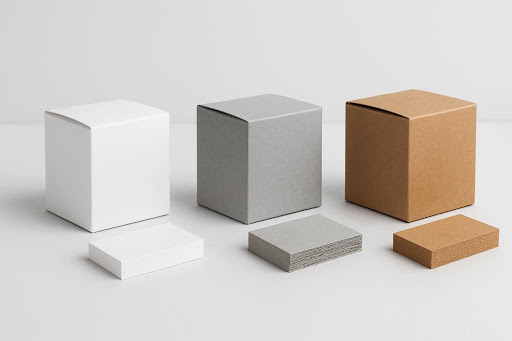
The material should be selected according to the package’s structure, product weight, printing requirements, and handling conditions. A hanging feature can be added to different carton constructions, but not every material or box style will be suitable for every load.
Folding Carton Paperboard
Folding carton paperboard is often considered for compact retail products that need clear branding and a neat, lightweight package. It can support printed artwork and can be converted into cartons with suitable integrated hang tabs, provided the board and design meet the application’s requirements.
Corrugated Board
Corrugated board has a fluted structure between liner sheets and is commonly used when a package needs additional cushioning or structural strength. It may suit certain larger or heavier retail products, but the appropriate construction must be assessed for the intended hanging or shelf use.
Explore corrugated packaging boxes when the product requires a different level of protection from a typical folding carton.
Kraft Paperboard
Kraft paperboard may be suitable when the brand wants a natural paper appearance. It can be used for selected retail carton structures, including hanging formats, depending on the grade, thickness, and design.
Review Kraft packaging box options if a natural-looking surface fits the product’s brand identity.
Rigid Board
Rigid boxes are typically selected for substantial presentation and premium packaging rather than lightweight peg-hook merchandising. Their suitability depends on the product and display requirements, and a conventional rigid box should not be assumed suitable for hanging simply because it has a strong construction.
For premium shelf presentation or gift packaging, compare custom rigid box options.
Material names alone do not determine strength. Board grade, thickness, box geometry, closure, and the location of the hanging feature all affect the finished package. Bluebird Packaging’s packaging materials overview can help with the initial material comparison.
When Should You Choose Hang Tab Packaging?
Hang tab packaging is worth considering when the retail environment is built around hanging products and the package can safely support its contents.
It is often a good option for:
- Small products that need peg-hook display: Accessories, cables, and compact hardware may fit well in a hanging format.
- Retailers with limited shelf space: Vertical display can help organize small products in a defined merchandising area.
- Products sold in several variations: Hanging cartons can present different sizes, colors, or product types in an organized row.
- Products that benefit from front-facing branding: The front panel can remain visible when the box is correctly positioned.
- Promotional products: Compact merchandise intended for impulse-purchase areas may benefit from hanging placement.
However, hang tab packaging is not the right choice for every small product. The item must be compatible with the hanging structure, and the retail fixture must accept the tab design. Heavy products, fragile items, or packages with a high center of gravity may need a different structure or additional support.
When Standard Retail Boxes Make More Sense
Standard retail boxes may be a better choice when:
- Products are sold on conventional shelves or counters.
- Packages need to stand upright or stack neatly.
- The product requires a larger front panel or multiple visible sides.
- The package is part of a gift set or premium presentation.
- The retailer does not use hanging fixtures.
- Storage and packing requirements favor a conventional carton.
A standard box may also be preferable when a hanging feature would add unnecessary complexity without improving the customer’s ability to find or understand the product.
Which Packaging Is Best for Different Retail Products?
The best format depends on how the product is sold, not just which industry it belongs to. A compact item may be sold in a hanging display at one retailer and on a shelf at another.
| Product type | Hang tab packaging may suit it when… | Standard retail boxes may suit it when… |
|---|---|---|
| Electronics accessories | The retailer uses peg hooks for cables, adapters, or small accessories | The item is sold in a larger carton or countertop arrangement |
| Cosmetics | A compact product is merchandised on a hanging rack | The brand needs a conventional shelf carton |
| Hardware | The product is compact and the hanging feature can support its weight | The item is heavy, bulky, or sold in a stacked format |
| Stationery and craft supplies | The product is displayed vertically for easy browsing | Products are arranged in bins, shelves, or counter displays |
| Toys and small accessories | The package fits the retailer’s hanging display system | The product needs a larger presentation or a stable base |
| Personal care products | Hanging placement matches the retail planogram | The range is sold in shelf-aligned cartons |
| Gift products | A lightweight item is designed for hanging presentation | A structured gift box or multi-item set is required |
| Household products | The product is compact and appropriate for a peg display | The item needs stronger protection or more substantial packaging |
For products that need a dedicated display rather than a single hanging carton, custom display boxes may be another option. The best structure is the one that matches the retail fixture, product requirements, and buying experience.
How Much Do Hang Tab Boxes Cost Compared With Standard Retail Boxes?
There is no universal price difference between hang tab packaging and standard retail boxes. Pricing depends on the material, dimensions, order quantity, printing, structural complexity, and whether the hanging feature is integrated or added separately.
An integrated tab may require a different dieline and cutting layout. An adhesive tab can introduce an additional component and application step. A standard carton may avoid those specific requirements, but its overall cost can still be higher if it uses thicker board, premium finishing, or a more complex structure.
Cost Factors to Compare
| Cost factor | What to check |
|---|---|
| Material | Board grade, thickness, and material specification |
| Dimensions | Finished box size and material use |
| Hanging feature | Integrated tab, reinforced slot, or separate adhesive tab |
| Printing | Number of colors, coverage, and artwork requirements |
| Finishing | Coatings, foil, embossing, or other decorative effects |
| Quantity | Unit pricing at the quantities you actually need |
| Assembly | Whether the package requires additional folding, gluing, or tab application |
| Protection | Inserts or other components needed for the product |
| Shipping and storage | Carton dimensions, flat-pack configuration, and handling needs |
When comparing quotations, request the same box dimensions, material, order quantity, printing, and finishing for both formats. Ask the supplier to specify any extra structural or assembly requirements rather than comparing only the unit price.
For a broader view of packaging budgets, see Bluebird Packaging’s packaging cost considerations. Small businesses can also review packaging options for small businesses when balancing customization with production volume.
How to Design Custom Hang Tab Packaging for Retail
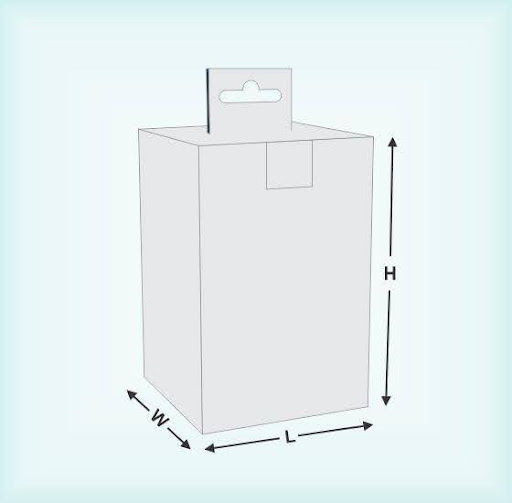
A successful hang tab box starts with the product and display requirements. The graphic design should come after the basic structure, hanging method, and dimensions have been established.
Step 1: Confirm the Retail Fixture
Ask the retailer or display supplier whether the package will hang from a pegboard, wire hook, slatwall accessory, clip strip, or another system. Confirm the required opening shape and dimensions before approving the dieline.
A Euro slot should not be assumed compatible with every fixture. The exact design needs to be checked against the intended display hardware.
Step 2: Measure the Product and Packed Configuration
Measure the product’s length, width, and height. Include any protective wrap, insert, or accessory that will be packed with it.
The box should hold the product securely without unnecessary empty space. Use Bluebird Packaging’s box measurement guidance to help define the required dimensions.
Step 3: Specify the Product Weight and Support Requirements
The hanging tab needs to support the complete packed product, not just the empty carton. The supplier should assess the board, slot geometry, attachment, and expected handling conditions.
Do not rely on a generic load estimate for every package. The appropriate specification depends on the actual construction and application, so testing may be necessary before production.
Step 4: Plan the Front Panel
The front panel should make the brand and product easy to recognize. Prioritize the logo, product name, key differentiator, and any necessary product information.
Because the hanging feature may extend above the main carton, plan the artwork around the full structure. Keep important text away from folds, cut lines, and areas that may be hidden by the hook.
Step 5: Prepare Print-Ready Artwork
Confirm the dieline, bleed, safe zones, colors, and print requirements with the packaging supplier. The final design should account for the material and finishing method.
Bluebird Packaging’s packaging printing guidance and packaging design ideas can help inform the visual direction.
Step 6: Review a Sample
Before approving a large order, review a physical sample when the tab strength, fit, closure, or display orientation is important. Check that the package hangs as intended and that the product remains securely enclosed during normal handling.
Step 7: Confirm the Production Details
Before production, approve the dimensions, material, box style, hanging feature, printing, finish, quantity, and delivery requirements. A clear specification helps avoid confusion between the artwork approval and the finished product.
Printing and Finishing for Hanging and Standard Retail Boxes
Both formats can use custom printing, but the final artwork must work with the package structure and display method.
Common options include:
- Full-color printing: Suitable for product illustrations, branding, and SKU differentiation.
- Matte finish: Creates a restrained, low-glare appearance.
- Gloss finish: Adds shine and can emphasize colorful artwork.
- Foil stamping: Adds metallic accents where compatible with the material and design.
- Embossing or debossing: Adds tactile detail to selected elements.
- Window features: May allow product visibility, depending on the structure and protection requirements.
For hang tab cartons, the hanging feature should be incorporated into the dieline before artwork is finalized. For standard cartons, artwork should still account for folds, closures, and the panels customers see first.
Not every finish is appropriate for every board grade or printing method. Confirm compatibility and review a proof when color accuracy or finish quality is especially important. Bluebird Packaging’s packaging finish options provide additional context for planning the final appearance.
Common Mistakes to Avoid When Choosing Retail Packaging
Avoid these common mistakes when comparing hang tab packaging with standard boxes:
- Choosing a hang tab without checking the fixture: The slot must fit the retailer’s actual display hardware.
- Ignoring the product’s packed weight: The hanging feature must support the full package under expected conditions.
- Selecting packaging based on appearance alone: Material, structure, and handling requirements are equally important.
- Assuming every small product needs a hang tab: Shelf or counter placement may be more practical.
- Overcrowding the artwork: Keep the front panel clear and readable at the intended viewing distance.
- Forgetting storage and assembly: Consider how the cartons will be packed, stored, shipped, and assembled.
- Comparing quotations with different specifications: Use the same material, size, quantity, printing, and finishing when comparing prices.
- Skipping sample checks: When structural performance matters, evaluate a sample before approving production.
- Ignoring the distribution route: A retail carton may require additional outer packaging for ecommerce shipping.
The goal is not to select the most elaborate packaging format. It is to choose a structure that supports product protection, practical merchandising, and a consistent brand presentation.
Frequently Asked Questions About Hang Tab Packaging vs. Standard Boxes
What is the difference between hang tab packaging and standard retail boxes?
Hang tab packaging includes a hanging feature designed for compatible retail hooks or fixtures. Standard retail boxes generally sit on shelves, counters, or stacks. Both can be customized, but their display methods and structural requirements differ.
Are hang tab boxes better for retail displays?
They can be better when the retailer uses peg hooks or other hanging fixtures. Standard boxes may be more appropriate for shelf-based merchandising. The best option depends on the store layout and product requirements.
Which products work best with hang tab packaging?
Compact electronics accessories, small hardware, stationery, cosmetics, and selected personal care products may suit hang tab packaging. The package must be compatible with the display fixture and strong enough for the loaded product.
Can standard retail boxes be converted into hanging packaging?
Sometimes. A suitable carton may be redesigned with an integrated tab or adapted using an appropriate separate hanging component. The package material, structure, product weight, and fixture compatibility should be reviewed before making the change.
Are integrated hang tabs stronger than adhesive hang tabs?
Neither type is automatically stronger in every application. Performance depends on the material, attachment, slot geometry, surface condition, product weight, and handling. The finished package should be specified and tested for its intended use.
Do hang tab boxes cost more than standard retail boxes?
They may require additional structural design, material, or assembly, but the actual price depends on the complete specification. Compare quotations using the same dimensions, quantity, material, printing, and finishing.
Can hang tab packaging be custom printed?
Yes, suitable hang tab cartons can be designed with logos, product information, brand colors, and other artwork. The design should account for the hanging feature, dieline, folds, and available print area.
Are hang tab boxes suitable for heavy products?
They can be suitable for some heavier products if the structure and hanging feature are specifically designed and verified for the intended load. Heavy or awkwardly shaped products may require another packaging format or additional support.
What is a Euro slot hang tab?
A Euro slot is a shaped opening used to hang a package from a compatible retail peg. Its dimensions and placement should be confirmed against the intended fixture rather than assumed to fit every hook.
How do I choose the right retail packaging for my product?
Start with the product’s dimensions and weight, the retail display method, required protection, brand presentation, and production budget. Confirm the packaging structure and display compatibility before finalizing the artwork.
For additional technical context about standard and custom hanging components, consult Do-It Corporation’s comparison of regular and custom hang tabs.
Conclusion: Choose Packaging Around the Retail Display
Hang tab packaging and standard retail boxes each solve a different merchandising problem. Hanging cartons are useful when products need to be displayed on compatible peg hooks or fixtures. Standard retail boxes are often more practical for shelf placement, counter displays, stacking, and conventional product presentation.
Before selecting either format, consider the display environment, product dimensions and weight, material, print requirements, storage, and total production cost. If a hanging feature is required, confirm the fixture dimensions and structural performance before approving the design.
Bluebird Packaging can help you explore packaging options based on your product and brand requirements. Start by reviewing its retail packaging options, then request a custom packaging quote with your product dimensions, quantity, artwork, and intended display method.
The right retail package is one that fits the product, works with the retailer’s merchandising system, and presents your brand clearly to customers.