
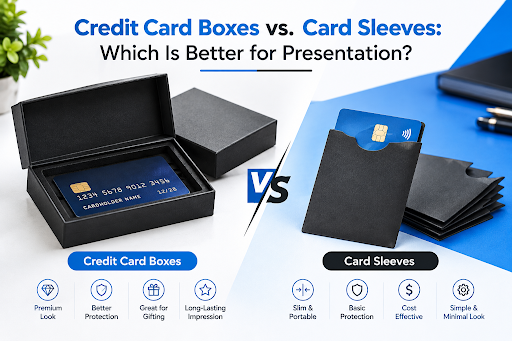
Credit card boxes and card sleeves serve different packaging purposes. Credit card boxes are generally better for premium presentation, structured protection, and multi-item packaging, while card sleeves are ideal for slim, lightweight, and cost-conscious card distribution. The best option depends on the type of card, the customer experience you want to create, your budget, and how the package will be stored or delivered.
For US businesses, the choice can affect more than appearance. Banks, membership organizations, gift card providers, retailers, and promotional brands may need packaging that accommodates a card, welcome letter, activation instructions, or other inserts. A compact sleeve can be sufficient for a simple card handout, while a custom box can create a more deliberate presentation for a VIP membership, gift card, or premium customer welcome kit.
This guide compares credit card boxes vs. card sleeves by protection, materials, printing, customization, cost, sustainability, and practical applications. It also explains how to select the right format for your card program.
Credit Card Boxes vs. Card Sleeves: A Quick Answer
Choose a card box when presentation, a structured interior, or space for additional materials matters. Choose a card sleeve when you need a slim package that holds a card with minimal bulk and straightforward branding.
Neither format is universally better. A well-designed sleeve can look professional, and a box can still feel underwhelming if its dimensions, material, and graphics are poorly chosen.
| Comparison factor | Credit card boxes | Card sleeves |
|---|---|---|
| Presentation | Structured, substantial, and suitable for premium experiences | Slim, simple, and minimalist |
| Protection | Can provide more structural support, especially with a fitted insert | Provides basic containment; protection depends on material and fit |
| Storage and shipping | Usually takes up more space | Generally compact and space-efficient |
| Additional contents | Can accommodate welcome cards, instructions, and inserts | Best for a card or a small, flat set of materials |
| Branding | Exterior, interior, inserts, and multiple surfaces can be customized | Primarily relies on printed panels and sleeve construction |
| Finishing | Can support a range of finishes depending on material | Can support printing and selected finishes depending on construction |
| Assembly | May require more components or assembly | Often simpler to assemble and pack |
| Cost considerations | More material and structural complexity may increase cost | Simpler structures may reduce material use and handling |
| Typical applications | VIP cards, premium gift cards, membership kits, special editions | Promotional cards, everyday gift cards, loyalty cards, and standard card distribution |
The practical rule: use the simplest format that meets your protection and presentation requirements. If the card is part of a premium customer experience, consider a box. If the priority is efficient distribution of a single card, a sleeve may be all you need.
What Are Credit Card Boxes?
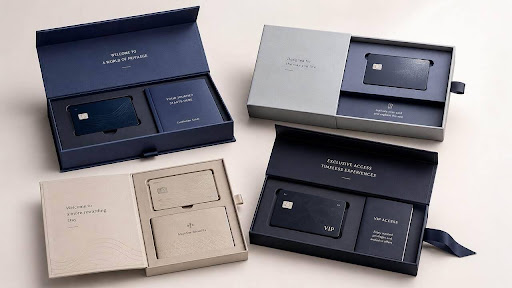
Credit card boxes are custom or standard packaging structures designed to hold credit-sized cards and similar items. They may be made from folding paperboard, thicker cardboard, rigid board, or other suitable packaging materials, depending on the intended use.
Businesses can customize the dimensions, structure, printed artwork, finishing, and internal layout. Some boxes hold a single card, while others accommodate a card with a welcome message, information sheet, or additional promotional material.
Bluebird Packaging’s custom Credit Card Boxes are designed for applications including payment cards, membership cards, loyalty programs, promotional cards, and premium card presentations.
When a Card Box Makes Sense
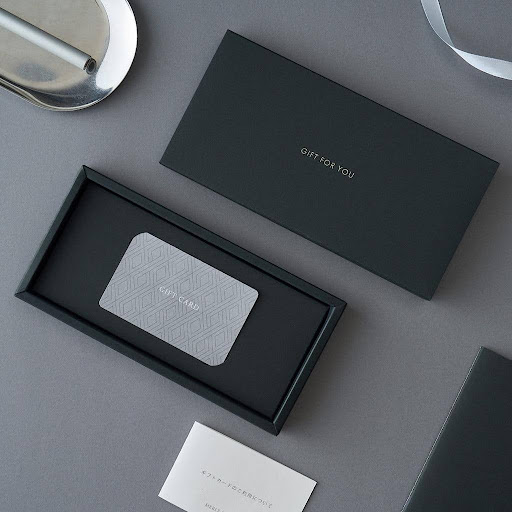
A box is worth considering when the packaging itself is part of the customer experience. For example, a premium membership program might present the membership card inside a fitted insert, with a welcome message placed underneath. The packaging can feel more organized than a loose card in a simple sleeve.
Card boxes may be useful for:
- Premium membership and VIP programs.
- Gift cards presented as gifts.
- New-customer welcome kits.
- Corporate and promotional card programs.
- Limited-edition or special-release cards.
- Card packages containing printed instructions or other inserts.
The structure should match the complete package, not just the card. If a welcome letter, protective holder, or additional information is included, its dimensions need to be considered before the box is finalized.
Common Card Box Structures
Different structures offer different combinations of presentation, storage, and convenience.
- Folding cartons: Lightweight boxes that can be printed and stored flat before assembly.
- Rigid setup boxes: More substantial boxes commonly used for premium presentation.
- Two-piece boxes: Separate lid-and-base construction that creates a classic gift-style opening.
- Magnetic-closure boxes: A structured format with a flap closure, suitable for selected premium kits.
- Boxes with inserts: Packaging with an internal component to position the card and any additional contents.
For more substantial presentation, Bluebird Packaging’s luxury rigid packaging options provide a useful starting point for comparing premium structures. The right design still depends on card dimensions, quantity, and the intended opening experience.
What Are Card Sleeves?
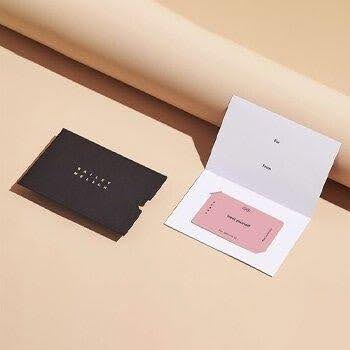
Card sleeves are slim packaging pieces that hold a card between folded or joined panels. They are commonly made from paper or paperboard and can be printed with a logo, brand colors, product information, or a promotional message.
Unlike a box, a sleeve generally uses less structure and has a flatter profile. This can make it useful for card handouts, gift card programs, loyalty cards, and other applications where compact packaging is a priority.
Benefits of Card Sleeves
Card sleeves offer several practical advantages:
- Compact format: They generally occupy less space than boxes.
- Simple branding: A logo, color system, and short message can create a recognizable design.
- Efficient handling: A simple structure can be convenient for high-volume packing and distribution.
- Flat storage: Many sleeves can be stored flat before assembly.
- Minimalist appearance: Their clean format suits brands that prefer understated presentation.
- Potential material efficiency: A sleeve may use less packaging material than a more elaborate box, although the actual difference depends on the design.
A sleeve is often the practical choice when the card itself is the main item and there is no need for a deep interior, fitted insert, or additional contents.
Limitations of Card Sleeves
A sleeve does not provide the same structural support as every box design. Depending on the paperboard grade and fit, it may offer less resistance to crushing, bending, or rough handling.
Sleeves can also be less suitable when a package needs to hold several components securely. If a card is being shipped, the sleeve should be assessed as part of the complete mailing or shipping system rather than assumed to provide sufficient transit protection on its own.
For brands that want a lightweight package with a professional appearance, a custom printed sleeve can still be effective. The key is to select the right material and construction for the actual use.
Which Provides Better Protection for Cards?
A properly designed box can provide more structural protection than a simple sleeve, but the result depends on the construction and the handling conditions. A rigid box with a suitable insert may help keep a card in position and reduce direct pressure on it. A sleeve can provide basic containment and surface coverage but may not offer equivalent protection against crushing.
Protection matters when cards must travel through distribution channels, be stored in quantity, or arrive in a particular condition. Scratches, bending, pressure, moisture, and movement inside the package are all considerations.
| Protection need | Box | Sleeve |
|---|---|---|
| Keeping a card contained | Suitable when sized correctly | Suitable when fit and closure are appropriate |
| Preventing surface scuffs | Depends on the interior and card contact surfaces | Depends on the sleeve material and fit |
| Reducing bending or crushing | A stronger structure may offer better resistance | Usually provides less structural support |
| Holding inserts and information | Can be designed for multiple components | Best suited to flat, lightweight contents |
| Shipping protection | May need additional outer packaging | Usually needs a suitable protective mailer or outer package when shipped |
A box is not automatically protective simply because it is a box. A loose card inside an oversized box may move around, and a thin folding carton may offer limited resistance to heavy pressure. Similarly, a sleeve made from an appropriate material and correctly sized for the card can work well for routine handling.
For shipping-focused applications, review the broader requirements for corrugated packaging and ecommerce packaging. The outer shipping package should be selected according to the full shipment, not just the card’s dimensions.
Which Looks More Premium: A Box or a Sleeve?
A box often creates a more substantial presentation because it introduces a structured opening and can accommodate an insert or multiple printed surfaces. A sleeve can also look premium when its typography, materials, color palette, and finish are carefully selected.
The difference is less about the format alone and more about how the packaging fits the brand and the occasion.
When a Box Creates a Stronger Impression
Consider a box when:
- The card represents a premium membership or VIP program.
- The customer receives a welcome kit with several components.
- The package is intended to be given as a gift.
- The opening experience is part of the brand presentation.
- The card needs a dedicated position inside the package.
A rigid box with a fitted insert and a restrained design can make the presentation feel deliberate. For a premium card program, a logo, a welcome message, and a neatly positioned card may be more effective than adding decorative features without a clear purpose.
When a Sleeve Is the Better Design Choice
A sleeve can be ideal when the brand wants a clean, compact, modern appearance. It may be particularly suitable for gift cards sold at a retail counter, loyalty cards distributed in-store, or promotional cards included with another product.
A well-designed sleeve can use strong typography, a distinctive color, a simple illustration, or a carefully placed logo to create brand recognition without a complex structure.
For a broader look at visual hierarchy, brand consistency, and packaging artwork, explore Bluebird Packaging’s packaging design guidance.
Materials for Card Boxes and Sleeves
The material affects appearance, stiffness, printing, weight, and how the packaging behaves during handling. The most suitable material depends on whether you are designing a simple sleeve, a folding carton, or a more substantial rigid box.
Paperboard and Cardboard
Paperboard is commonly used for printed sleeves and folding cartons because it can be cut, folded, and printed in a range of designs. Depending on its grade and thickness, it can create a lightweight package or a more structured carton.
It is worth distinguishing between a folding paperboard box and a rigid box. A folding carton is designed to be formed from a flat sheet, while rigid packaging uses a more substantial construction. Both can be appropriate for card packaging, but they serve different presentation and structural needs.
Bluebird Packaging’s custom cardboard boxes can be customized with different dimensions, printing, and finishing options. For an overview of other material types, see the company’s packaging materials guide.
Kraft Paperboard
Kraft paperboard can suit businesses that want a natural-looking, understated design. It may work well for promotional cards, gift cards, and brands with minimalist visual identities.
The brown surface can influence how printed colors appear, so artwork should be evaluated on the selected stock. Kraft should not automatically be described as more sustainable than other paperboard options; recycled content, coatings, construction, and local recycling availability all matter.
Rigid Board
Rigid board is commonly chosen when a package needs a more substantial feel and a premium presentation. It can be suitable for VIP memberships, special-edition cards, and gift-oriented packaging.
Rigid construction generally takes up more space than a flat sleeve and may involve more material and assembly. The added structure is most useful when it contributes to protection, organization, or the intended customer experience.
Choosing the Right Material
| Material or structure | Typical role | Main consideration |
|---|---|---|
| Lightweight paperboard | Printed sleeves and simple cartons | Fit, print quality, and handling |
| Thicker paperboard | More structured folding cartons | Stiffness and folding performance |
| Kraft paperboard | Natural-looking sleeves or cartons | Color appearance and surface characteristics |
| Rigid board | Premium card boxes | Structure, storage, and presentation |
| Corrugated board | Selected shipping or protective applications | Package size and distribution requirements |
The material name alone does not determine quality. Confirm the actual specification, dimensions, printing method, and intended use before selecting a package.
Printing, Finishes, and Customization
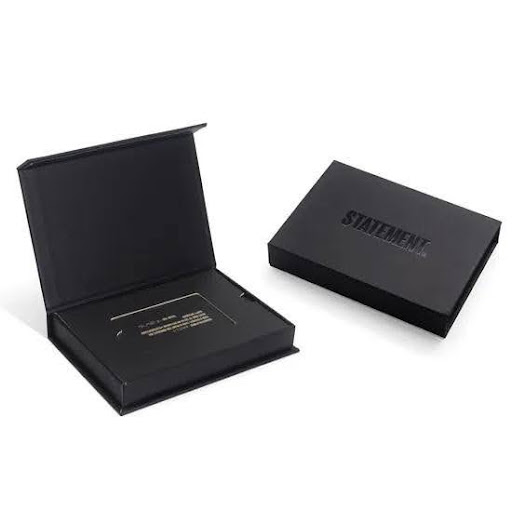
Printing and finishing can make a simple sleeve feel more considered or help a box fit into an established brand identity. The right approach depends on the substrate, design, budget, and desired appearance.
Printing Options for Card Packaging
Custom printed card packaging can incorporate:
- Brand logos and colors.
- Card program or membership names.
- Welcome messages.
- Product or service information.
- Instructions and supporting details.
- Patterns, illustrations, and graphics.
- Website or contact information where appropriate.
A sleeve usually relies on its outer panels to communicate the brand. A box can offer additional surfaces, including the lid, sides, and interior, depending on the structure.
If brand colors are important, request a print proof on the intended material. Colors can look different across substrates and finishes, and a screen preview cannot fully reproduce the appearance of a finished package.
For more information about artwork and print choices, review Bluebird Packaging’s packaging printing options.
Finishes That Can Improve Presentation
| Finish | Visual effect | Potential application |
|---|---|---|
| Matte | Subdued, low-glare appearance | Corporate and minimalist branding |
| Gloss | Reflective surface | Bright, high-contrast graphics |
| Foil stamping | Metallic accents | Premium logos or card program names |
| Embossing | Raised design details | Tactile brand marks |
| Debossing | Indented design details | Subtle, understated branding |
| Spot UV | Selective gloss | Highlighting a logo or graphic |
| Soft-touch coating | Smooth tactile feel | Selected premium presentations |
Not every finish is suitable for every material or construction. Confirm compatibility with the packaging supplier, especially if several effects will be combined.
A sleeve may need only a well-printed logo and clean typography to look professional. A rigid box may justify a specialty finish when it supports the intended premium experience. Explore these packaging finishes and their uses before adding decorative effects to the specification.
Cost Comparison: Boxes vs. Sleeves
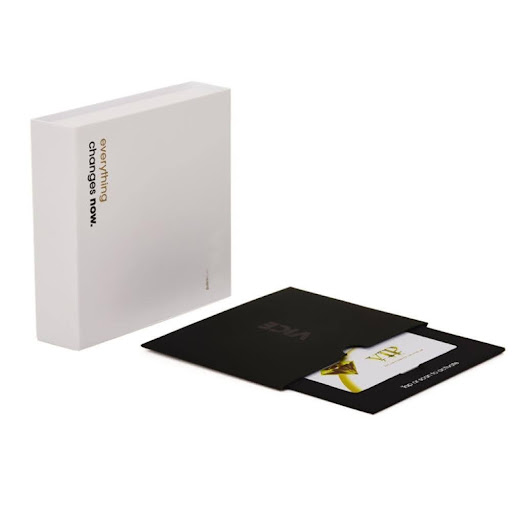
A sleeve may be less expensive than a box when the design uses less material and requires fewer components. However, there is no universal price difference: custom dimensions, printing, quantity, finishing, inserts, assembly, and shipping all affect the quotation.
A rigid box typically involves a more substantial construction than a simple sleeve. That added structure may be justified for a premium card program, but it may be unnecessary for a card distributed in large quantities at an event or retail counter.
What Affects the Price?
- Material: Board grade and thickness affect material requirements.
- Dimensions: Larger packages generally require more material.
- Structure: Rigid boxes, inserts, and multi-part designs can add complexity.
- Printing: Artwork coverage and color requirements influence the print specification.
- Finishing: Foil, embossing, lamination, and specialty coatings may increase cost.
- Quantity: Unit pricing can vary with production volume and setup requirements.
- Assembly: More components may require additional handling.
- Shipping and storage: Package size and how the finished items are transported can affect total project cost.
For a fair comparison, request a quote for both formats using the same card dimensions, quantity, artwork, and finishing requirements wherever possible. Compare the total project cost as well as the per-unit price.
Bluebird Packaging’s custom packaging cost guide explains common factors that influence packaging budgets.
Sustainability: Are Card Sleeves Better Than Boxes?
A sleeve can use less material than a box, particularly when the box would otherwise contain only one card. But material use alone does not establish the overall environmental impact of a package.
The final comparison depends on the board, recycled content, coatings, inks, adhesives, inserts, manufacturing, transport, and the recycling systems available where the package is used.
How to Evaluate Paper-Based Card Packaging
Before making a material or environmental claim, consider these questions:
- Does the package use recycled fiber, virgin fiber, or a combination?
- Are coatings, laminations, windows, or other materials added?
- Can the package be separated into recyclable components?
- Is the material accepted by local recycling programs?
- Is the package appropriately sized, or does it use unnecessary material?
- Are environmental claims supported by the supplier’s documentation?
The US Environmental Protection Agency provides background on paper and paperboard recycling. This is useful general context, but it does not establish whether every customized box or sleeve is recyclable in every US community.
A compact sleeve may be a sensible option when it meets the product’s needs without unnecessary packaging. A box may be justified when the added structure serves a clear purpose, such as holding multiple items or improving the presentation of a premium program.
Best Packaging for Different Card Applications
The right format becomes clearer when you consider how the card will be distributed and what the recipient needs to receive.
| Application | Format to consider | Why it may fit |
|---|---|---|
| Standard bank card distribution | Sleeve or simple carton | Compact format for a card and basic information |
| Premium membership card | Rigid box or structured carton | Space for a card, welcome message, and inserts |
| Retail gift card | Sleeve or small box | Depends on display method and gifting expectations |
| Loyalty card handout | Sleeve | Simple, lightweight presentation |
| VIP customer welcome kit | Rigid box with inserts | Organizes several components |
| Promotional event cards | Sleeve or folding carton | Efficient distribution and branded artwork |
| Limited-edition card | Premium box or printed sleeve | Choice depends on perceived value and budget |
| Multiple cards with information materials | Box with suitable insert | More room for organized contents |
| Card shipped with another product | Sleeve or carton inside protective outer packaging | Format can be selected around the complete shipment |
For premium applications, Magnetic Closure Rigid Boxes may be worth considering when a more structured opening is part of the intended experience. A Two Piece Rigid Setup Box offers a separate lid-and-base format, while Collapsible Rigid Boxes can be considered when a rigid-style presentation and storage efficiency both matter.
These structures are alternatives to evaluate, not requirements for every card program.
How to Choose Between a Box and a Sleeve
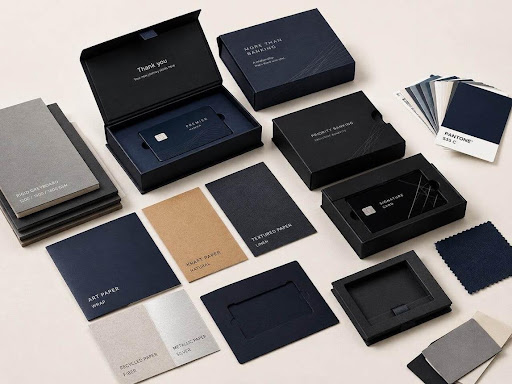
Use this practical decision process before requesting a quotation.
Step 1: Define the Contents
Start with the card’s dimensions and thickness. Identify whether the package will hold one card, multiple cards, a welcome letter, instructions, or other inserts.
The complete packed configuration determines the space required.
Step 2: Define the Presentation Goal
Ask what the recipient should experience when the package arrives. If the goal is a simple branded handout, a sleeve may be sufficient. If the card is part of a premium welcome kit or gift, a box may better support the presentation.
Step 3: Assess Protection Needs
Consider storage, handling, shipping, and the likelihood of pressure or bending. Select the structure and material according to the actual conditions rather than assuming every box or sleeve provides the same protection.
Step 4: Set the Design Requirements
Decide which branding elements are essential. Confirm the logo, colors, typography, product information, and any special finishes. If the artwork depends on precise colors, request an appropriate proof.
Step 5: Compare Costs and Quantities
Request comparable quotes for the formats that meet your requirements. Include the same quantity, dimensions, artwork, finishing, and relevant shipping details to make the comparison useful.
Step 6: Review a Sample When Appropriate
For a premium, fitted, or multi-component package, a sample can help you check card fit, opening, insert placement, material feel, and print appearance before production.
Card Packaging Checklist
- Card dimensions and thickness confirmed.
- All additional contents identified.
- Box or sleeve selected for the intended use.
- Material and board grade specified.
- Printing and finishing requirements confirmed.
- Internal fit and ease of removal reviewed.
- Shipping and storage requirements considered.
- Environmental claims checked against the actual specification.
- Comparable quotations reviewed.
- Artwork or sample approved where necessary.
For sizing help, use Bluebird Packaging’s box measurement guide. For a wider range of packaging structures, you can also explore its custom rigid boxes collection.
Common Mistakes to Avoid
Even a well-designed package can disappoint if the structure and artwork are not planned around the card.
Choosing a box only because it looks premium: A rigid box may be unnecessary for a standard card handout. Use the structure that serves the customer experience and practical requirements.
Choosing a sleeve without considering handling: A slim sleeve may not provide enough structural protection for a card that will be shipped or handled extensively. Consider the full distribution system.
Using oversized packaging: Too much unused space can allow the card or inserts to move and can make the package feel poorly fitted.
Adding too many finishes: Foil, embossing, coatings, and other effects should support the design rather than compete with one another.
Ignoring the full contents: If the package includes a welcome letter or instructions, measure and plan for those items before finalizing the dimensions.
Comparing prices with different specifications: A rigid box and a paper sleeve are not equivalent products. Compare formats that meet the same requirements and evaluate what each option delivers.
Making unsupported environmental claims: Do not assume that a sleeve, Kraft material, or paper-based box is automatically recyclable or environmentally preferable. Verify the complete specification.
Small businesses developing branded card programs can also review Bluebird Packaging’s advice on packaging for small businesses and custom packaging solutions when planning a practical design and budget.
Frequently Asked Questions About Credit Card Boxes vs. Card Sleeves
1. What is the difference between card boxes and card sleeves?
A card box is a structured package that can provide more space for inserts and a more substantial presentation. A sleeve is a slim paper-based holder designed primarily to contain a card with minimal bulk. Their protection and appearance depend on the actual material and construction.
2. Which is better for luxury card packaging?
A rigid box is often a strong choice for luxury presentation because it can accommodate inserts, multiple components, and specialty finishes. A well-designed sleeve can also look premium when its artwork and materials are carefully selected.
3. Are card sleeves cheaper than boxes?
A simple sleeve may cost less than a more complex box because it can require less material and fewer components. Actual pricing depends on quantity, dimensions, material, printing, finishing, and assembly.
4. Do card boxes provide better protection than sleeves?
A suitably constructed box may offer greater resistance to pressure and bending than a simple sleeve. However, protection depends on the board grade, fit, structure, inserts, and handling conditions. Neither format should be assumed to provide complete shipping protection on its own.
5. Can card sleeves be custom printed?
Yes. Depending on the material and production process, sleeves can feature logos, brand colors, graphics, product information, and promotional messaging. Print proofs are useful when accurate color reproduction is important.
6. Can credit card boxes include inserts?
Yes. A box can be designed with an insert to hold the card in a defined position or to organize additional contents such as welcome cards, instructions, or promotional materials.
7. What is the best packaging for gift cards?
A sleeve may be suitable for standard gift card distribution, retail display, or promotional handouts. A box may be more appropriate when the gift card is intended to feel like a premium gift or comes with additional materials.
8. Are paper card sleeves recyclable?
Some paper-based sleeves may be accepted in local recycling programs, but acceptance depends on the material, coatings, adhesives, and local facilities. Check the actual package specification and local guidance before making a recyclability claim.
9. Which packaging is best for membership cards?
For routine membership distribution, a sleeve or simple carton may be sufficient. A premium membership or VIP program may benefit from a box with a fitted insert and welcome materials. The choice depends on the desired presentation and handling requirements.
10. How do I select the correct size for card packaging?
Measure the card and any additional contents, then specify the required internal dimensions and clearance. Review the finished fit to ensure the card can be inserted and removed without unnecessary movement or excessive pressure.
11. Can rigid boxes be used for promotional card programs?
Yes. Rigid boxes can be suitable for special campaigns, premium membership kits, limited-edition cards, and other promotional applications where a substantial presentation is useful. They may be unnecessary for high-volume programs that prioritize compact distribution.
12. What should I include when requesting a card packaging quote?
Provide card dimensions, quantity, preferred structure, material, artwork, printing requirements, finishes, inserts, and delivery destination. If you are unsure which structure to choose, describe the card program and how recipients will receive the package.
Conclusion: Which Is Better for Your Card Program?
When comparing credit card boxes vs. card sleeves, start with the purpose of the packaging rather than the appearance alone. A sleeve is often the practical choice for compact, straightforward card distribution, while a box is worth considering when you need a more substantial presentation, additional contents, or a structured interior.
The best option depends on card dimensions, protection requirements, branding, order quantity, budget, and the experience you want to create for the recipient. Review the material, artwork, finishing, and complete packaging system before committing to production.
Bluebird Packaging offers custom card packaging options that can be developed around your product dimensions, preferred material, branding, and presentation requirements. You can also review its packaging design ideas to explore approaches that align the package with your brand identity.
Find the Right Card Packaging for Your Brand
Request a custom packaging quote to discuss a card packaging solution tailored to your project.