
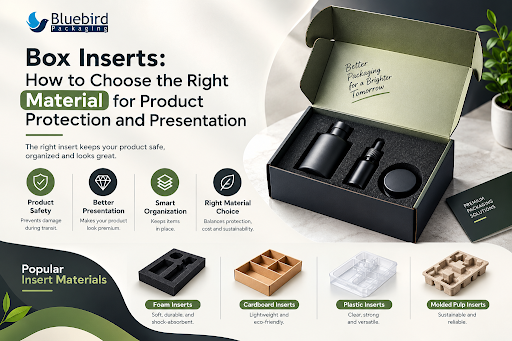
Box inserts are internal packaging components designed to hold products in place, separate multiple items, reduce unwanted movement, and improve how a package looks when opened. Depending on the product and shipping conditions, they can be made from cardboard, corrugated board, foam, molded pulp, or other suitable materials.
The right insert does more than fill empty space. It supports the product at appropriate points, helps prevent items from colliding, makes packing more organized, and can create a cleaner presentation for retail, gift, and e-commerce packaging. For businesses shipping fragile products or selling curated product sets, a properly fitted insert can be an important part of the overall packaging design.
Bluebird Packaging helps businesses explore packaging options for different products and applications. When planning custom inserts, consider the product’s dimensions, weight, fragility, presentation requirements, and the box that will hold the insert.
Quick Answer: What Are Box Inserts?
Box inserts are fitted components placed inside packaging to secure, cushion, separate, or present products. Common types include die-cut cardboard inserts, corrugated partitions, foam trays, molded pulp supports, and multi-compartment dividers.
Choose an insert based on what the product needs:
- For lightweight retail products: Paperboard or die-cut cardboard inserts may provide suitable positioning and presentation.
- For shipping and heavier items: Corrugated inserts and partitions may offer additional structural support.
- For delicate or precision-shaped products: Properly selected foam inserts can provide shaped cavities and cushioning.
- For multiple products in one box: Dividers or compartment trays help keep items separate.
- For paper-based packaging preferences: Cardboard, corrugated board, or molded pulp may be options, depending on the product and required protection.
- For premium presentation: Custom-fit trays can arrange products neatly and make them easier to remove.
The best solution is the one that fits both the product and the outer box. An insert that looks attractive but allows the product to move may not provide enough protection during shipping.
What Are Packaging Inserts and How Do They Work?
Packaging inserts are internal components engineered or selected to support products within an outer package. They can hold an item in a defined position, create separate compartments, provide a barrier between products, or cushion areas that are vulnerable to impact.
An insert may be a simple folded piece of cardboard, a die-cut tray with several cavities, a foam block shaped around a product, or a molded tray that follows the product’s contours. Its structure depends on the item’s dimensions, weight, shape, fragility, and intended use.
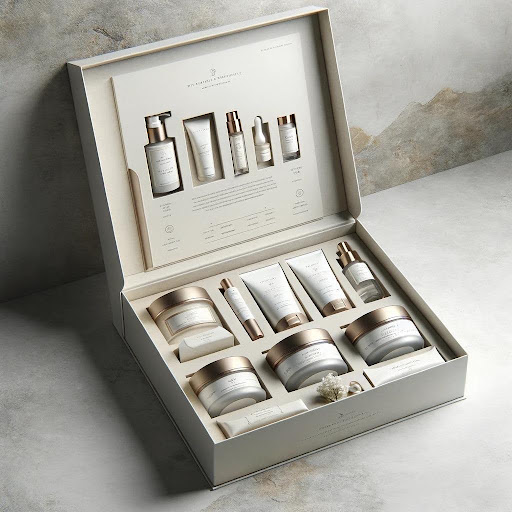
For example, a skincare gift set containing a bottle, jar, and accessory may need three separate compartments. A box containing glass bottles may need dividers that prevent the bottles from touching. A product kit with cables and small components may need a tray that keeps each part organized and easy to identify.
Box inserts also work together with the outer packaging. A suitable insert inside a well-designed cardboard box made for product storage and delivery can help limit movement, but the complete package still needs to be appropriate for its handling and shipping conditions.
What Do Box Inserts Actually Do?
The main functions of packaging inserts include:
- Product positioning: Keep products aligned instead of allowing them to slide around.
- Separation: Prevent multiple items from rubbing against or striking one another.
- Cushioning: Absorb or distribute some forces when the insert material and design are appropriate.
- Organization: Give each item or component a designated space.
- Presentation: Display products neatly when a customer opens the box.
- Packing efficiency: Help staff place products in a consistent arrangement.
- Information delivery: Support printed cards, instructions, promotional materials, or product documentation.
Not every insert performs all these functions equally well. A thin paperboard tray may be excellent for organizing lightweight products but unsuitable for protecting a heavy item from repeated impacts. Material and structure should always match the actual job.
Types of Box Inserts and Materials
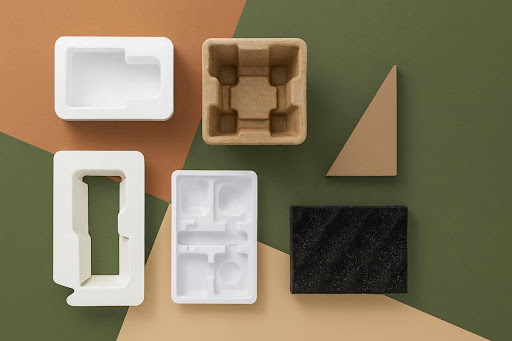
The most suitable insert material depends on protection requirements, product weight, box construction, appearance, production quantity, and budget. The following materials serve different purposes, and there is no single option that works best for every package.
1. Cardboard and paperboard inserts
Cardboard or paperboard inserts are useful for organizing lightweight products, separating components, and creating a neat presentation inside cartons and gift boxes. They may be cut, scored, folded, or assembled into a tray with individual product spaces.
They are often considered for cosmetics, small accessories, promotional kits, and retail packaging where shape, appearance, and organization matter. The required board thickness and structure depend on product weight and the level of support needed.
2. Corrugated box inserts
Corrugated inserts use fluted board to create partitions, pads, supports, and protective compartments. Their construction can provide useful rigidity for shipping applications, particularly when multiple items need to remain separated.
They may suit bottles, jars, components, and products shipped in outer corrugated cartons. For heavier shipments, the insert should be designed as part of the complete package rather than selected by material name alone.
3. Foam box inserts
Foam inserts can be cut or formed to accommodate particular shapes. Depending on the foam type, thickness, density, and design, they can help cushion products and reduce unwanted movement.
They are commonly considered for electronics, tools, delicate components, instruments, and premium presentation packaging. Material selection matters because foam types differ in resilience, compression behavior, moisture characteristics, and suitability for repeated use.
4. Molded pulp inserts
Molded pulp inserts are formed from pulp-based material into a tray or protective shape. They can be designed to support products at specific points and are often considered for paper-based packaging systems.
Applications may include glass containers, consumer goods, electronics accessories, and gift products. Suitability depends on the molded shape, material performance, moisture exposure, product weight, and shipping conditions.
5. Dividers and partitions
Dividers create individual spaces inside a box, particularly when multiple items must be packed together. They can be made from cardboard or corrugated board and arranged in grids, rows, or custom layouts.
They are useful for bottle shipments, multi-product kits, parts, and other applications where products should not collide. Learn more about packaging dividers designed to separate products within a box.
Box Insert Material Comparison
These categories can overlap. A corrugated insert can also be a divider, for example, while a paperboard insert may be designed as a tray with several compartments. Choose by function as well as material.
For broader context on how board grades and other packaging materials differ, review the main materials used in product packaging.
How Box Inserts Protect Products During Shipping
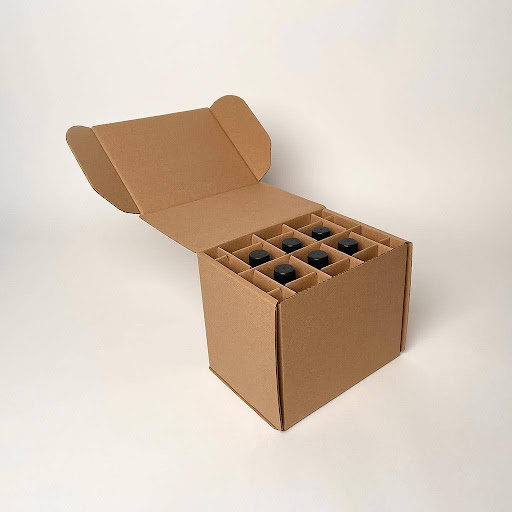
Box inserts help protect products by limiting movement, separating items, and supporting vulnerable areas inside the package. Their effectiveness depends on the insert’s geometry, material properties, fit, and the performance of the outer box.
During transit, packages may be lifted, stacked, tilted, vibrated, or dropped. If an item moves freely inside a box, it can collide with the walls or with other items. A well-designed insert reduces that freedom of movement and can help distribute loads more appropriately.
However, an insert is not a guarantee against damage. The product, insert, outer box, cushioning, closure, and shipping conditions all influence the result. Fragile or high-value products may require testing of the complete packed configuration.
Preventing Product-to-Product Contact
When a box holds multiple items, separate compartments can prevent them from knocking against one another. This is particularly relevant for glass containers, small electronics, accessories, and bundled products.
A partition should be tall and stable enough for its purpose. If the compartments are too wide, products may still shift; if they are too tight, packing can become difficult or the insert may put unwanted pressure on the item.
Supporting Fragile Areas
Some products are more vulnerable at specific points, such as corners, edges, necks, handles, or protruding components. An insert can be shaped to support suitable areas while leaving delicate surfaces clear of direct pressure.
The contact points must be chosen carefully. A tight cavity is not automatically protective: it can scratch a finish, compress a soft surface, or concentrate force in the wrong place.
Reducing Unnecessary Movement
Custom-fit inserts can help prevent products from shifting in transit. But the insert and outer carton must be designed together. A well-fitted tray placed in an oversized box may still move as a complete unit, while an insert that is too small may not stay in position.
Businesses shipping items in corrugated boxes designed for transport and handling should consider the insert, box dimensions, and any additional cushioning as one system.
Testing the Complete Package
For shipments with demanding handling requirements, assess the actual product inside the final box and insert. Depending on the risk, testing may include drop, vibration, compression, or handling simulations performed using an appropriate procedure.
Do not assume that a material label such as “foam” or “corrugated” alone establishes performance. The finished package needs to be evaluated against the product’s weight, fragility, shipping route, and expected handling.
Custom Box Inserts for Different Industries
Custom box inserts are useful when a standard tray or divider cannot provide the right fit, organization, or presentation. Businesses can specify cavity shapes, compartment sizes, insert depth, material, and layout according to the product range.
Cosmetics and Skincare
Skincare kits may contain bottles, jars, tubes, applicators, and printed information cards in one package. A custom insert can give each item its own position, making the set easier to pack and more organized when opened.
For a beauty brand, consider the product’s dimensions, cap or pump shape, surface finish, and whether the package will be shipped or primarily displayed at retail. A fitted paperboard insert may work for lightweight products, while heavier glass containers may need a more supportive design.
Brands developing coordinated packaging can explore custom cosmetic boxes for beauty and personal care products.
Electronics and Accessories
Electronics packaging may need to hold a device, charging cable, adapter, instructions, and other accessories without allowing the components to collide. Separate cavities can also make the contents easier to identify during unpacking.
Foam may be appropriate for some precision-shaped products, while folded board or corrugated inserts may suit lighter accessories. Select the material based on the item’s weight, sensitivity, surface finish, and the required level of protection.
Food and Beverage Products
In food and beverage packaging, inserts may separate jars, bottles, gift assortments, or other products that should not touch during transport. The insert must be appropriate for the specific application, and any direct food-contact use must meet the applicable requirements.
For bakery assortments, partitions can help keep individual items organized. Businesses considering custom food packaging for takeout and packaged products should confirm that the chosen structure and material suit the product, handling, and storage conditions.
Gifts and Premium Product Sets

Gift boxes often contain multiple products arranged to create a deliberate opening experience. A fitted insert can hold each item in place, reveal the contents in an organized way, and make the components easier to remove.
For premium products, the insert’s color, surface, texture, and layout should complement the outer box without interfering with functionality. Brands comparing structures can consider rigid packaging for premium product presentation.
E-Commerce and Subscription Boxes
Subscription boxes may contain several products of different sizes, so insert design needs to account for the entire assortment. Dividers or trays can help organize the contents and reduce unwanted contact, while printed cards can sit in a separate section.
For direct-to-consumer orders, coordinate the insert with the outer box so the packed products fit without unnecessary empty space. Bluebird’s mailer boxes for e-commerce and subscription shipments are one option to evaluate when choosing an outer package for an organized product layout.
How to Choose the Right Box Inserts
The right insert starts with the product and its use, not with a material preference. Before selecting a design, identify what needs to be held, how the package will be handled, and what the insert must accomplish.
Step 1: Measure the product and the box
Record each product’s length, width, height, and any unusual contours. Measure the usable interior of the outer box and allow space for the insert material and required clearances. For multiple products, measure each item and map the intended arrangement.
Step 2: Assess fragility and weight
Determine which areas are most likely to be damaged and whether the product can tolerate pressure at the intended contact points. Heavy products may require a different structure from lightweight retail items.
Step 3: Choose the material
Compare board, corrugated, foam, and molded pulp based on support, cushioning, product compatibility, appearance, and budget. Consider recycling goals where relevant, but verify the actual material and local recycling requirements.
Step 4: Plan the cavity layout
Decide how many compartments are needed, how the products should face, and how customers or packing staff will remove them. The insert should hold the items securely without making them unnecessarily difficult to access.
Step 5: Review a prototype
Test the insert with the real products and outer box. Check fit, movement, ease of packing, removal, and any areas where the insert may scratch or compress the product. For shipping applications, test the assembled package when appropriate.
Before approving dimensions, use a consistent box measurement method for length, width, and depth. Accurate measurements help reduce redesigns and improve the fit between the insert and the outer package.
Box Inserts vs. Dividers vs. Void Fill
These packaging components can look similar, but they serve different purposes. The right choice depends on whether the priority is precise positioning, separation, or filling empty space.
A box may use more than one of these components. For example, a fitted insert may organize several items while cushioning material protects the assembly inside a shipping carton.
If a package contains several components, box partitions that separate items inside packaging may be worth evaluating alongside a custom tray.
Custom Packaging Inserts: Design, Printing, and Fit
Custom packaging inserts can be designed around a specific product or assortment rather than adapted from a generic shape. This is especially useful when items have unusual contours, must be displayed in a certain orientation, or need separate spaces for accessories.
The design process should begin with product measurements and the outer box’s interior dimensions. Next, determine the insert’s material, thickness, cavity depth, support points, and method of assembly. For a set containing multiple products, map the layout so each item has sufficient room and can be removed without disturbing the others.
Should Inserts Be Printed?
Not all inserts need printing. An unprinted insert may be the most practical choice when the priority is protection, separation, or packing speed. Printing can be useful when the insert is visible as part of the product presentation or when it needs to carry instructions, labels, or brand graphics.
If artwork is required, review the design with the insert’s folds, cuts, and contact areas in mind. Important information should remain readable, and printed surfaces should be suitable for the intended use.
Businesses planning a coordinated package can review packaging design principles for structure and presentation before finalizing the layout.
Why the Outer Box and Insert Should Be Designed Together
The insert should fit the inside of the actual box, not simply match the product’s measurements. Box walls, flaps, closures, and the insert’s own thickness all affect the available space.
Designing the components together can also help avoid unnecessary packaging volume. An insert that fits correctly may improve organization and reduce unwanted movement, but the total dimensions still need to support safe handling and efficient shipping.
For products requiring a more tailored exterior structure, custom packaging options built around a product’s dimensions can help align the box and insert requirements.
Are Cardboard and Paper-Based Inserts Recyclable?
Cardboard and paper-based inserts may be recyclable where local facilities accept the material and its condition. Recyclability can depend on coatings, adhesives, attached materials, contamination, and whether the insert is made from compatible paper grades.
Foam and molded pulp should not be treated as interchangeable from a recycling perspective. Foam types vary, and molded pulp products may have different material compositions and local collection options. Always check local guidance rather than relying only on a broad label such as “eco-friendly.”
When evaluating insert materials, businesses can:
- Consider paper-based options where they meet the protection requirements.
- Avoid unnecessary material combinations when easier separation or recycling is a priority.
- Use the minimum practical amount of material without compromising product protection.
- Confirm whether coatings, laminations, adhesives, or windows affect recycling.
- Review the local waste provider’s acceptance rules for the specific material.
The U.S. Environmental Protection Agency provides useful background on paper and paperboard packaging, waste, and recycling data. Its data describes material categories and U.S. waste management trends; it does not mean every insert is recyclable in every location.
For businesses assessing the wider package, sustainable packaging choices and material considerations provide additional context.
Common Box Insert Mistakes to Avoid
A custom insert can still underperform if the design does not match the product or the way it will be handled. Avoid these common mistakes before approving a production run.
- Choosing material before defining the purpose: Decide whether the insert needs to cushion, separate, position, or present the product before selecting a material.
- Measuring only the product: The insert must also fit the usable interior of the outer box, including its own thickness and required clearances.
- Making cavities too loose or too tight: Excessive clearance allows movement, while an overly tight fit can make products difficult to remove or place pressure on sensitive areas.
- Ignoring the complete shipping package: The insert and outer carton must work together. Review protective packaging designs for safer product handling when assessing the full package.
- Skipping testing: For products vulnerable to impact or vibration, assess the final packed product rather than relying only on the insert’s appearance.
- Overdesigning the insert: Extra compartments, decorative layers, or specialty materials can add cost without improving the product’s protection or presentation.
- Failing to check consistency: For repeat orders, maintain the approved dimensions, material specification, and layout so the insert continues to fit the intended products.
Businesses with higher-risk or more demanding shipments can also review product protection packaging approaches and packaging testing considerations before deciding on the final design.
What Affects the Cost of Custom Box Inserts?
The price of custom box inserts depends on the material, design complexity, order quantity, and production process. A simple folded cardboard insert may have different cost requirements from a multi-cavity foam tray or a molded pulp insert that requires dedicated tooling.
Important cost factors include:
- Material: Board grade, foam type, thickness, and material availability.
- Design complexity: Number of cavities, folds, cutouts, layers, and assembly steps.
- Dimensions: Larger inserts may require more material or larger production layouts.
- Order quantity: Unit pricing can change with order volume and setup requirements.
- Printing and finishing: Printed surfaces or specialty finishes may add production steps.
- Sampling and testing: Prototypes and testing may require additional time or expense.
- Packing and shipping: The insert’s final shape and the way it is packed can affect storage and freight.
To compare supplier quotes accurately, provide the same product dimensions, outer-box dimensions, material preferences, quantity, and design requirements to each supplier. A quote based on a clear specification is more useful than a comparison based on the term “custom insert” alone.
For a broader breakdown of pricing factors, review common costs involved in packaging production. You should also ask about quality checks, tolerances, sample approval, and repeat-order consistency; packaging quality control practices can help frame those discussions.
Frequently Asked Questions About Box Inserts
1. What are box inserts used for?
Box inserts hold products in place, separate multiple items, provide support or cushioning, and improve presentation inside a package. They are used in shipping boxes, retail cartons, gift sets, subscription boxes, and packaging for fragile or multi-part products.
2. What is the best material for custom box inserts?
The best material depends on product weight, fragility, shape, shipping conditions, presentation requirements, and budget. Paperboard is often suitable for organizing lightweight items, corrugated board can provide structural support, foam can be shaped around delicate products, and molded pulp may suit certain protective tray applications.
3. Are cardboard box inserts suitable for shipping?
They can be suitable when their structure, board grade, fit, and outer box are appropriate for the product and shipping conditions. Cardboard inserts can organize products and separate items, but fragile or heavy goods may need stronger structures, additional cushioning, or package testing.
4. What is the difference between box inserts and dividers?
Box inserts is a broad term for components placed inside packaging to support, organize, cushion, or present products. Dividers are a specific type of insert that separates products or components into individual compartments.
5. Are foam box inserts better than cardboard inserts?
Neither is universally better. Foam may be useful for shaped cavities and cushioning, while cardboard can be useful for compartment layouts, product positioning, and paper-based packaging systems. The correct choice depends on the product’s protection needs, material compatibility, presentation, and end-of-life requirements.
6. Can packaging inserts be made for multiple products?
Yes. Custom inserts can be designed with separate compartments for product sets, accessories, bottles, components, or gift assortments. The layout should account for the dimensions of every item and make packing and removal practical.
7. Are molded pulp inserts recyclable?
Some molded pulp inserts can be recycled through suitable paper recycling systems, but acceptance depends on the material composition and local recycling facilities. Confirm the specific product’s material details and local collection guidance before making recycling claims.
8. Do custom packaging inserts increase packaging costs?
They can add material, design, tooling, or assembly costs. However, the overall value should be assessed against the insert’s purpose, including product organization, protection, presentation, and packing efficiency. Request a quote based on the complete packaging specification to understand the actual cost.
9. Should box inserts be designed with the outer box?
Yes. The insert needs to fit the usable interior of the outer box, and both components should be reviewed together. This helps avoid a loose fit, interference with the closure, or unnecessary empty space.
10. What information is needed to request a quote for custom inserts?
Provide the product dimensions and weight, the outer box’s internal dimensions, the number of items, intended use, preferred material if known, order quantity, and any printing or presentation requirements. Product photos or drawings can also help clarify the desired layout.
Choose Box Inserts That Fit Your Products
The right box inserts help keep products organized, reduce unwanted movement, and create a more considered package-opening experience. Cardboard, corrugated board, foam, molded pulp, and dividers each offer different advantages, so the choice should reflect the product’s dimensions, fragility, shipping conditions, and presentation needs.
For reliable results, start with accurate measurements, select a material suited to the application, design the insert and outer box together, and review a prototype before committing to production. A well-planned insert should be practical to pack, secure enough for its intended use, and appropriate for the complete packaging system.
Bluebird Packaging offers a range of packaging options for businesses developing product-specific packaging. Explore custom rigid packaging for premium product presentation or visit the Bluebird Packaging homepage to learn more about available packaging solutions.
Planning a new packaging project? Share your product dimensions, quantity, and packaging requirements through the Bluebird Packaging quote request page to discuss a suitable option.