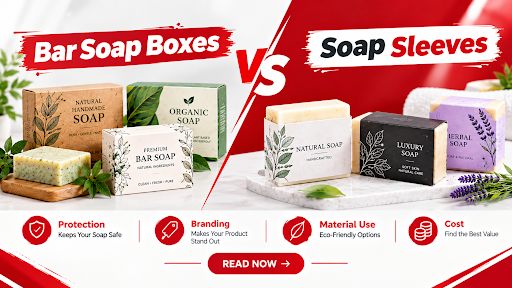
Bar soap boxes and soap sleeves can both create attractive, branded packaging, but they serve different purposes. A full soap box encloses more of the bar and generally offers better protection from handling and surface damage, while a paper sleeve uses less material and keeps more of the soap visible. The right option depends on your product, retail environment, branding needs, shipping method, and packaging budget.
For handmade soap makers and personal care brands in the United States, packaging is more than a finishing touch. It affects how customers see the product, how easily they can identify its scent or ingredients, how the bar is protected during handling, and how efficiently the product can be packed and displayed.
Some brands need a fully enclosed carton with room for detailed product information. Others prefer a simple belly band that wraps around the soap and lets customers see its color, shape, or texture. In some cases, combining a sleeve with an inner wrap or protective carton provides a practical balance.
This guide compares bar soap boxes and soap sleeves across protection, printing, branding, material usage, assembly, retail presentation, shipping, and cost so you can choose a format that fits your product and business goals.
Bar Soap Boxes vs. Soap Sleeves: A Quick Answer
Choose a full carton when your soap needs more surface coverage, extra space for product information, or a more enclosed retail presentation. Choose a sleeve when visibility, a minimalist design, reduced material use, and straightforward packaging are priorities—and when leaving part of the soap exposed is appropriate for the product.
Neither option is universally better. A sleeve is not a substitute for shipping protection, and a carton does not automatically make a soap bar moisture-proof or damage-proof. The material, fit, construction, and handling environment all matter.
| Comparison factor | Bar soap boxes | Soap sleeves |
|---|---|---|
| Coverage | Encloses most or all of the bar, depending on design | Usually wraps around part of the bar |
| Surface protection | Generally offers more coverage against scuffs and direct handling | Leaves some surfaces and edges exposed |
| Product visibility | Depends on the design; windows or open styles can provide visibility | Often allows customers to see more of the soap |
| Branding space | Usually offers several panels for graphics and information | More limited, often focused on one main band |
| Printing | Can support multi-panel artwork and product information | Suits compact logos, names, scent details, and short messaging |
| Material use | Often uses more material per pack | Often uses less material, depending on sleeve size and construction |
| Assembly | May require folding, closing, or gluing | Often involves wrapping and securing a band |
| Retail presentation | Can create a more enclosed, structured appearance | Can create a simple, handmade, product-forward look |
| Shipping | May help protect the bar, but may need an outer shipping package | Usually needs additional protection for shipping |
| Best suited to | Retail ranges, detailed branding, and products needing more coverage | Handmade bars, minimalist branding, and products where visibility matters |
What Is the Difference Between Soap Boxes and Soap Sleeves?
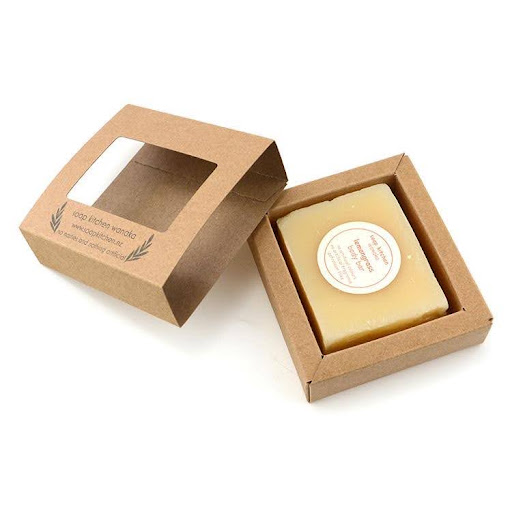
The key difference is how much of the soap each format encloses. A soap box is a carton with panels and a defined structure around the product. A soap sleeve is a band or partial covering that wraps around the bar without necessarily enclosing its ends, top, bottom, or sides.
Both can be made from paper-based packaging materials and customized with brand colors, logos, product names, and other artwork. However, their structures create different opportunities and limitations.
What Are Bar Soap Boxes?
Bar soap boxes are cartons designed to hold a soap bar inside a defined packaging structure. Depending on the box style, they can enclose most of the product and provide several panels for branding, product identification, and other information.
Common design features include:
- Front, back, and side panels for printed artwork.
- Tuck flaps or other closures to hold the carton together.
- Different dimensions for individual bars or soap sets.
- Space for product names, scent descriptions, ingredients, and other relevant information.
- Optional windows or design features that make part of the product visible.
- Compatible inserts or inner wraps where the application requires them.
For example, a US soap brand selling several facial cleansing bars may use the same carton structure for every product while changing the color, product name, and scent or formula information. This helps maintain consistent branding across the range.
Bluebird Packaging’s custom Bar Soap Boxes are a relevant starting point for exploring a carton format tailored to individual soap products.
What Are Soap Packaging Sleeves?
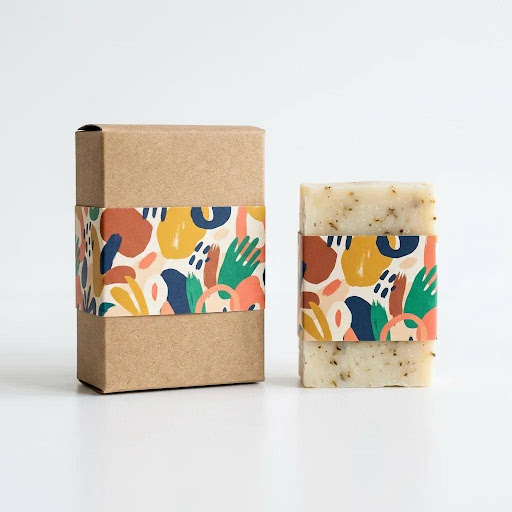
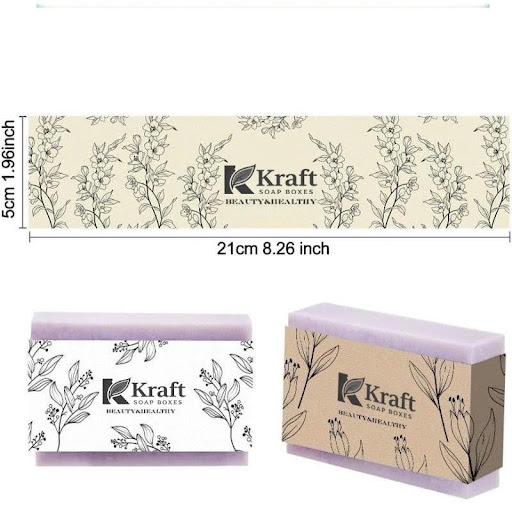
A soap packaging sleeve is a strip or band of material that wraps around part of a soap bar. It may be made from Kraft paper, printed paperboard, or another suitable material, depending on the design and production requirements.
Unlike a fully enclosed carton, a sleeve usually leaves some of the soap exposed. That can make the product’s color, shape, texture, or decorative details more visible.
Soap sleeves are commonly considered for:
- Handmade and artisan soap bars.
- Minimalist packaging designs.
- Products where customers benefit from seeing the soap.
- Short product names and simple brand messaging.
- Small product ranges with a consistent visual identity.
- Packaging concepts that aim to reduce the amount of material used.
The sleeve must fit securely enough to stay in position during normal handling. If it is too loose, it may slide off; if it is too tight, it may be difficult to apply or could affect the finished presentation.
A sleeve also leaves some areas exposed to handling, dust, scuffing, and contact with other items. If those concerns matter for your product, consider an inner wrap or a more enclosed format.
Which Offers Better Protection: Soap Boxes or Sleeves?
A full carton generally provides more physical coverage than a belly-band sleeve, but the actual level of protection depends on the structure, material, fit, and distribution conditions. A box can help reduce direct contact with the bar and protect more edges, while a sleeve mainly holds branding and product information in place.
That difference matters when products are handled repeatedly, packed with other items, displayed on shelves, or shipped to customers.
Protection During Storage and Retail Handling
A well-fitted carton can help shield the soap from surface scuffs and direct contact during storage or retail handling. It can also keep the bar together with its printed product information.
A sleeve can offer enough coverage for some products, particularly when the soap is sold in a controlled retail setting and customers can handle it carefully. However, exposed surfaces may collect dust or experience more direct contact.
Think about the product’s actual journey:
- Will the soap be handled by staff before display?
- Will customers pick it up and put it back on the shelf?
- Does the soap have a delicate top, decorative pattern, or easily marked surface?
- Will several bars be packed tightly together?
- Does the product need an inner wrap?
The answers help determine whether the extra coverage of a carton is worth the additional material.
Protection During Shipping
Neither a soap sleeve nor a retail carton should automatically be treated as complete shipping protection. Parcel shipments can involve compression, vibration, abrasion, and repeated handling. The outer shipping package and the way products are packed together are important.
A carton may help prevent direct rubbing between bars, but it can still be crushed if its specification is unsuitable for the shipping conditions. A sleeve generally offers less protection against crushing or edge impacts because more of the bar remains exposed.
For ecommerce orders, evaluate the entire packaging system: the soap, any inner wrap, the retail package, the shipping box or mailer, and any protective material. Bluebird Packaging’s ecommerce packaging guide can help you consider how retail packaging fits into the wider delivery process.
Do Soap Boxes Protect Against Moisture?
Not necessarily. Ordinary paperboard cartons and paper sleeves are not inherently waterproof. They may soften, stain, or deform when exposed to moisture, depending on the material and any coatings or treatments.
If your soap is freshly made, contains residual moisture, or is likely to be exposed to humid conditions, decide whether it needs an appropriate inner wrap or another protective component. Allow for the soap’s actual curing and storage requirements rather than assuming that a carton alone solves moisture-related concerns.
Branding and Printing: Which Format Gives You More Space?
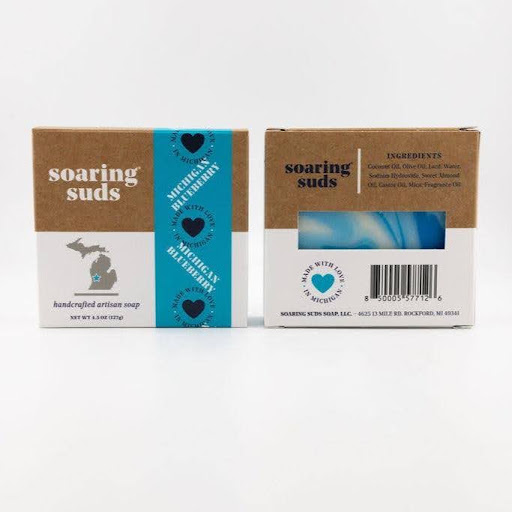
Soap boxes usually provide more printable surface area because they have multiple panels. Sleeves offer a smaller, focused space that can work well for a logo, product name, scent, and concise brand message.
The right amount of branding space depends on what customers need to know and how complex your design is.
Branding With Custom Printed Bar Soap Boxes
A carton can carry different information on different panels. The front might show the logo and product name, while the side or back can carry additional details, depending on the product and applicable labeling requirements.
This can be useful for brands that need to distinguish several formulas, communicate product details, or maintain a coordinated retail range.
For example, a collection of lavender, charcoal, oatmeal, and citrus soaps can use one box layout with controlled changes in color and imagery. The structure stays consistent while the individual products remain easy to distinguish.
Consider these design elements:
- A clearly visible brand name and product name.
- A consistent hierarchy for scent, formula, or variant.
- Readable typography and sufficient contrast.
- Product imagery or illustrations that support the brand identity.
- Space for required or useful product information.
- Consistent placement of recurring brand elements across the range.
Artwork should be prepared for the approved carton layout rather than designed only as a flat front image. Folding areas, glue zones, closures, and panel boundaries can affect where important elements should appear.
For practical guidance, see Bluebird Packaging’s packaging printing options and considerations.
Branding With Soap Sleeves
A sleeve concentrates the design into a smaller area. This can create a clean, simple look, but it requires prioritizing the most important information.
A sleeve design might include:
- Brand logo.
- Soap name or scent.
- A short description.
- Selected ingredient or formula information, where appropriate.
- A website or QR code if it serves a useful purpose.
- Required information that fits the chosen format and applicable rules.
A sleeve can work especially well when the soap itself is part of the visual identity. A bar with a distinctive color, texture, or decorative pattern can remain visible while the band supplies the brand context.
However, a narrow sleeve is not always sufficient for all the information a business wants to include. If you need more space, consider a carton, a separate label, or a suitable combination of packaging elements.
Which Is Better for Premium Branding?
Both can look premium when the design is well executed. A carton offers more room for structured graphics, multi-panel storytelling, and selected finishing effects. A sleeve can create a restrained, tactile presentation when the material, typography, and product appearance are carefully coordinated.
Premium presentation does not require the greatest number of printed panels or decorative effects. It requires the format to fit the product and communicate the brand clearly.
Soap Boxes vs. Sleeves: Material Usage and Sustainability
A sleeve often uses less material than a full carton because it covers only part of the soap. However, the actual difference depends on the sleeve’s width, overlap, paper weight, carton dimensions, and whether either format needs an inner wrap or additional packaging.
Using less material per package can be a useful design objective, but it does not by itself prove that a packaging option has a lower environmental impact. Material sourcing, production, printing, coatings, transport, product protection, and end-of-life handling also matter.
When a Sleeve May Use Less Material
A simple paper band can be efficient when the soap is stable, its exposed surfaces can tolerate normal handling, and only a modest amount of branding is needed. Less material may also mean less packaging to store and handle, depending on the supply and assembly process.
But the comparison should include the complete package. If a sleeve requires an additional protective wrap, label, or outer container, the total material use may be closer to that of a carton than expected.
When a Full Carton May Be Worth the Additional Material
A carton may be the more practical choice when the bar needs more coverage, when the product information requires several panels, or when a defined structure helps the product stay organized in a retail display or gift set.
Avoid judging packaging solely by the amount of paper used. Consider whether the chosen format protects the product adequately and whether it supports the intended retail and shipping process.
For a broader view of paper-based packaging options, explore Bluebird Packaging’s packaging materials overview. You can also review its sustainable packaging considerations and packaging recycling guidance when evaluating the complete material specification.
Are Paper Soap Sleeves and Cartons Recyclable?
Some paper-based sleeves and cartons may be accepted in local paper recycling programs, but the finished construction matters. Coatings, laminations, adhesives, windows, and other components can affect how packaging is handled by recycling systems.
Do not assume that a package is recyclable everywhere just because it is made mainly from paper. Confirm the actual material construction and local recycling guidance before printing environmental claims.
The US Environmental Protection Agency provides useful background on paper and paperboard recycling. For consumer-facing claims, brands should ensure that any environmental wording is accurate and adequately supported.
Which Packaging Is More Cost-Effective?
There is no universal rule that soap sleeves always cost less than soap boxes. Sleeves often require less material and may be simpler to assemble, but the final price depends on the full specification and the supplier’s production process.
A box may have a higher material requirement but provide more printing space, a more enclosed structure, or a format that fits an existing packing process. A sleeve may be economical for a straightforward design, but intricate die-cutting, specialty paper, complex printing, or manual application can affect its cost.
What Affects the Price of Soap Boxes and Sleeves?
| Cost factor | Full soap box | Soap sleeve |
|---|---|---|
| Material usage | Often higher because of multiple panels | Often lower, depending on band size and overlap |
| Board specification | Depends on the required stiffness and structure | Depends on sleeve stiffness and how securely it must stay in place |
| Printing | More surface area may be available | Smaller print area, but detailed artwork may still affect production |
| Finishing | Multiple panels may need finishing | Finishing may be concentrated on one area |
| Assembly | Folding and closing may be required | Wrapping and securing may be simpler |
| Additional packaging | May still need an inner wrap or shipping protection | May need a wrap or outer package to protect exposed soap |
| Order quantity | Affects unit price and setup allocation | Also affects unit price and setup allocation |
How to Compare Supplier Quotes Fairly
To decide which option offers better value, request quotes using the same product dimensions, quantity, artwork, material preferences, and delivery requirements. Include any inner wrap or protective components that each format needs.
Compare the total packaging cost per saleable unit, not just the cost of the printed box or sleeve. If one option needs extra labor, a separate label, or additional shipping protection, include those items in the comparison.
Before committing to production, use Bluebird Packaging’s custom packaging cost guide to review the factors that influence packaging pricing. You can then request a quote based on your exact specifications rather than relying on generic price estimates.
Packaging Assembly: Which Is Easier to Use?
The easiest format depends on the soap’s dimensions, the packaging design, and how the product is packed. A sleeve can be straightforward to wrap around a uniform rectangular bar, while a carton may require folding, closing, and checking that the bar fits correctly.
For small businesses that pack orders by hand, assembly time can affect the workflow. For larger operations, the ability to pack consistently and efficiently may be more important than the apparent simplicity of the design.
Assembly Considerations for Soap Boxes
A carton may arrive flat and need to be formed before the soap is inserted. Depending on its style, it may require tuck flaps, a glued seam, or another closure. The box should fit the soap without being so tight that packing becomes difficult.
Before choosing a design, consider:
- Whether the carton can be assembled consistently.
- Whether the closure stays secure during normal handling.
- Whether the soap is inserted directly or wrapped first.
- Whether the artwork remains correctly aligned when folded.
- Whether the packing process is manual or uses equipment.
Assembly Considerations for Soap Sleeves
A sleeve generally wraps around the bar and may be secured by a tight fit, adhesive, or another appropriate method. Its simplicity depends on the material and design. A sleeve that slides off or requires careful alignment can create more work than expected.
Test the sleeve on actual production-size bars, including any wrapper. Confirm that it stays in place, does not obscure important branding, and can be applied consistently.
For either format, accurate dimensions matter. Use Bluebird Packaging’s box measurement guide to help establish the product dimensions and communicate the intended fit.
Which Packaging Works Best for Retail and Ecommerce?
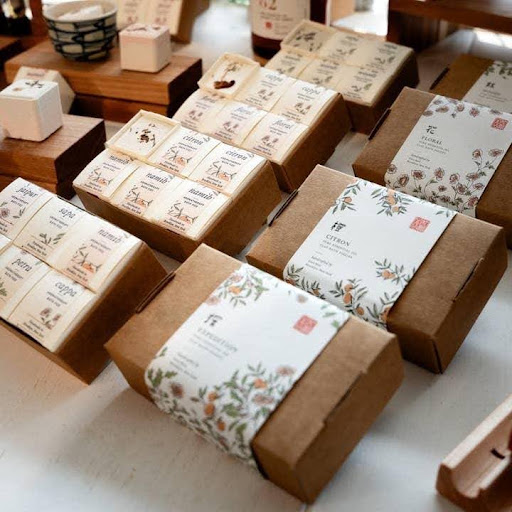
The best format depends on how customers encounter and receive the soap. A retail shelf, artisan market, gift set, and ecommerce shipment can have different requirements.
| Selling environment | Soap boxes | Soap sleeves |
|---|---|---|
| Retail shelves | Offer a structured, enclosed presentation | Keep more of the soap visible |
| Artisan markets | Support detailed branding and product information | Suit minimalist, handmade presentation |
| Gift sets | Can help organize individual bars within a larger package | Can identify individual bars inside a gift set |
| Ecommerce | Can serve as retail packaging but may need an outer shipping package | Usually needs additional protection for parcel delivery |
| Multi-SKU ranges | Provide multiple panels for product differentiation | Work well when each product needs only concise branding |
| Products with delicate surfaces | Offer more coverage, depending on construction | Leave more of the surface exposed |
Retail Display and Product Visibility
A sleeve may be appealing when the soap’s appearance is part of the buying decision. Customers can see more of the bar, which may help communicate its color, shape, or decorative texture.
A box can create a more uniform display and offer additional branding space. If visibility is important, consider a carton design with a window, provided the structure, material, and other requirements are appropriate.
Brands can explore Bluebird Packaging’s custom retail packaging options when the soap needs a coordinated shelf presentation.
Ecommerce and Shipping Protection
For direct-to-consumer orders, neither a sleeve nor a retail carton should be treated as a complete shipping solution without considering the distribution conditions. The outer package may need to protect against compression, rubbing, and movement during transit.
A boxed soap can still require an appropriately sized mailer or shipping carton. A sleeved soap may need an inner wrap and a protective outer package to prevent surface damage and keep the sleeve in place.
The right approach is to test the complete packed order rather than judging the retail packaging in isolation. This is especially important when customers order several bars together or when the packaging is part of a gift experience.
How to Choose the Right Format for Handmade Soap
For handmade soap brands, packaging needs to reflect the product’s identity while meeting practical requirements. A simple sleeve can complement an artisan look, while a carton may offer more room for a growing brand that needs a consistent retail system.
Choose a Soap Sleeve If…
- The soap’s appearance is an important part of its presentation.
- A small amount of branding is enough.
- You want a simple, compact packaging format.
- The exposed surfaces can tolerate the expected handling.
- The sleeve fits securely around the bar.
- You have a suitable plan for storage and shipping.
Choose a Full Soap Box If…
- The bar needs more coverage during storage and handling.
- You need several panels for branding and product details.
- The product belongs to a coordinated retail collection.
- The soap has a surface that marks easily.
- You want a defined structure for gift or specialty presentation.
- The carton fits into your packing and distribution process.
Consider a Combined Packaging Approach If…
A sleeve and a box do not have to be mutually exclusive. Some products may use an inner wrap to protect the soap, a sleeve to provide concise branding, or a carton for a gift set containing multiple bars.
The additional components should solve a real problem. Avoid adding layers that increase assembly time or material use without improving product protection, communication, or presentation.
For more design inspiration, review Bluebird Packaging’s packaging design ideas and its custom packaging options.
Common Soap Packaging Mistakes to Avoid
Choosing between a box and a sleeve is easier when you identify the problems the packaging needs to solve. These are common issues to check before approving a design.
| Mistake | Why it matters | Better approach |
|---|---|---|
| Choosing by appearance alone | The format may not protect the bar adequately | Review the product and handling requirements first |
| Making the sleeve too loose | It may slide or rotate during handling | Test the fit on actual bars |
| Using a carton that is too tight | Packing may become difficult or damage the package | Allow for the complete packed product dimensions |
| Overloading a sleeve with information | Text may become too small or difficult to read | Prioritize essential information and consider a box if more space is needed |
| Assuming paper packaging is waterproof | Moisture can affect the material and printed surface | Evaluate storage conditions and inner protection |
| Ignoring shipping conditions | Retail packaging may not withstand parcel delivery alone | Test the complete shipping configuration |
| Assuming less material always means a lower total cost | Extra wraps, labor, or protective packaging may offset the saving | Compare total cost per packed unit |
| Making broad environmental claims | Claims may not reflect the finished package or local recycling options | Verify material specifications and relevant guidance |
| Skipping a physical sample | Fit, color, and assembly issues may appear later | Review a sample when dimensions or presentation are important |
A Practical Checklist Before Ordering Custom Soap Packaging
Use this checklist to compare soap boxes and sleeves for your product:
- Measure the soap bar and any inner wrap.
- Decide how much of the soap should remain visible.
- Determine the level of surface and edge coverage needed.
- Identify the essential branding and product information.
- Choose a print design that fits the available surface.
- Confirm the material, thickness, and finish.
- Test whether the sleeve stays in place or the carton closes securely.
- Consider the retail display, gift presentation, and shipping journey.
- Account for assembly time and additional packaging components.
- Compare supplier quotes using equivalent specifications.
- Verify environmental claims against the finished packaging.
- Review a physical sample or proof before approving production, when appropriate.
Small businesses should also consider how the packaging fits into their daily workflow. Bluebird Packaging’s packaging guidance for small businesses can provide additional context when evaluating customization and production needs.
Frequently Asked Questions About Bar Soap Boxes vs. Soap Sleeves
1. Are bar soap boxes better than soap sleeves?
Boxes generally provide more coverage and more space for branding, while sleeves use a simpler, partially enclosed design and leave more of the soap visible. The best choice depends on the product’s protection needs, design, selling environment, and budget.
2. Are soap sleeves cheaper than full soap boxes?
They can be, because sleeves often use less material and may require fewer assembly steps. However, actual costs depend on material, printing, quantity, labor, and whether additional wraps or shipping protection are needed.
3. Do soap sleeves protect bars from damage?
A sleeve can help keep branding attached to the bar and may reduce direct contact in the area it covers. It leaves other surfaces exposed, so it generally offers less overall coverage than a well-fitted carton.
4. Are soap sleeves suitable for handmade soap?
Yes. Sleeves can suit handmade soap when a minimalist presentation is desired and the exposed surfaces can tolerate normal handling. The sleeve should fit securely, and the soap should be protected appropriately during storage and transport.
5. Can custom printed soap sleeves include ingredients and product details?
They can include product information that fits the available space, but a narrow sleeve may not provide enough room for everything the brand wants to communicate. Check the labeling requirements that apply to your product and consider a carton or another suitable format if additional space is necessary.
6. Which packaging is better for ecommerce soap orders?
Neither format alone guarantees safe delivery. A carton may provide more coverage than a sleeve, but both can need a suitable outer shipping package. Test the complete packed order under realistic handling conditions.
7. Do soap boxes use more paper than sleeves?
A full carton often uses more material per unit than a simple band, but the difference depends on the dimensions, board specification, and additional components. Compare the entire packaging system rather than just the box or sleeve.
8. Can I use a sleeve inside a soap gift box?
Yes. A sleeve can identify individual bars inside a larger gift box, while the outer package organizes the set and supports the overall presentation. Make sure the combination fits securely and does not add unnecessary packaging.
9. Which format is better for premium soap branding?
Both can look premium. Boxes offer more room for multi-panel graphics and selected finishes, while sleeves can create an understated, product-forward presentation. The material, design, and execution matter more than the format alone.
10. Are paper soap boxes and sleeves recyclable?
Some paper-based formats may be accepted by local recycling programs, but coatings, laminations, adhesives, and mixed materials can affect acceptance. Check the finished package and local guidance before making a recycling claim.
11. How do I select the right size for a soap box or sleeve?
Measure the finished bar, including any inner wrap. For a box, confirm the required internal dimensions and closure. For a sleeve, measure the wrap path and overlap needed to hold the band securely without making application difficult.
12. Where can I order custom bar soap boxes?
You can explore Bluebird Packaging’s bar soap packaging options and submit your dimensions, quantity, design preferences, and packaging requirements through its request-a-quote page.
Conclusion: Should You Choose Bar Soap Boxes or Soap Sleeves?
Bar soap boxes and soap sleeves both have a place in effective soap packaging. A full carton is often the stronger starting point when you need more coverage, multiple branding panels, or a structured retail presentation. A sleeve can be a practical alternative when you want a simple design, more product visibility, and potentially lower material use.
Before deciding, consider the bar’s surface, the handling environment, the amount of information you need to print, assembly requirements, shipping protection, and total cost. If neither format meets every requirement on its own, a combination of an inner wrap, sleeve, carton, or outer shipping package may be more appropriate.
Bluebird Packaging offers custom packaging options for businesses developing or updating their soap ranges. Compare the format against your actual product and intended use, then request a packaging quote to discuss dimensions, materials, printing, and finishing.
The best packaging is not necessarily the one with the most material or the simplest design. It is the one that presents your soap clearly, protects it appropriately, and fits your brand and production needs.