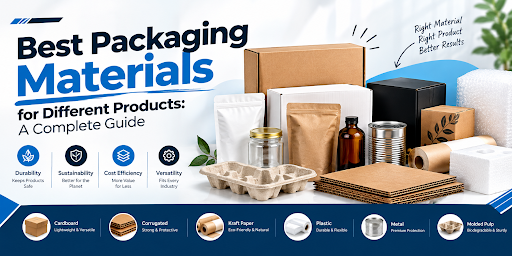
Choosing the best packaging materials is an important decision for any business that manufactures, sells, or ships physical products. The right material can help protect products, improve presentation, support efficient shipping, and create a consistent brand experience. The wrong choice may lead to damaged goods, unnecessary packaging costs, or a package that does not suit the product.
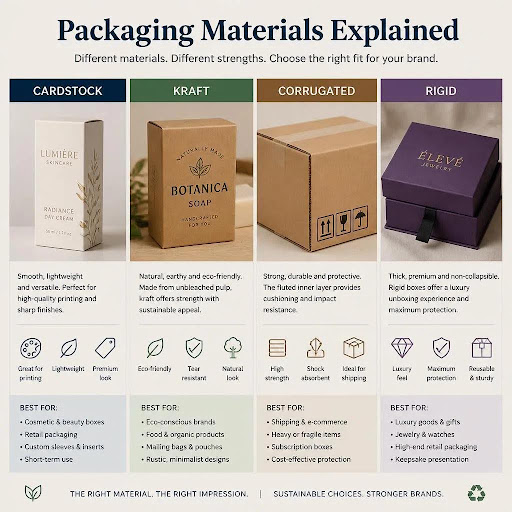
But there is no single material that works best for every application. Paperboard is often suitable for retail cartons, corrugated board is commonly used for shipping boxes, Kraft paper offers a natural-looking packaging option, and rigid board is frequently selected for premium gift packaging. Fragile products may also require protective inserts or cushioning.
Quick answer: The best packaging material depends on the product’s weight, fragility, storage conditions, shipping method, presentation requirements, and budget. Paperboard works well for many retail cartons, corrugated board is often appropriate for shipping, Kraft-based materials suit selected paper packaging applications, and rigid board supports premium presentation. For food, cosmetics, and electronics, material selection must also account for product compatibility and protection requirements.
This guide compares common packaging materials, explains their advantages and limitations, and shows how to choose a suitable option for your business.
What Are Packaging Materials?
Packaging materials are the substances used to manufacture containers, boxes, wrappers, inserts, cushioning, and other components that protect or present products. They may be paper-based, plastic-based, metal, glass, textile, or combinations of different materials.
Businesses select packaging materials according to several practical requirements:
- Product protection: Preventing damage, contamination, movement, or exposure to unsuitable conditions.
- Structural performance: Supporting the product’s weight and expected handling.
- Product presentation: Communicating brand identity and displaying product information.
- Shipping and storage: Making packages easier to stack, transport, store, and handle.
- Cost efficiency: Balancing material use, manufacturing, assembly, and transportation expenses.
- Sustainability: Considering sourcing, recycled content, reuse, recyclability, and local waste-management systems.
Understanding the available types of packaging is a useful starting point because each packaging format has different material requirements.
Types of Packaging Materials: Comparison Table
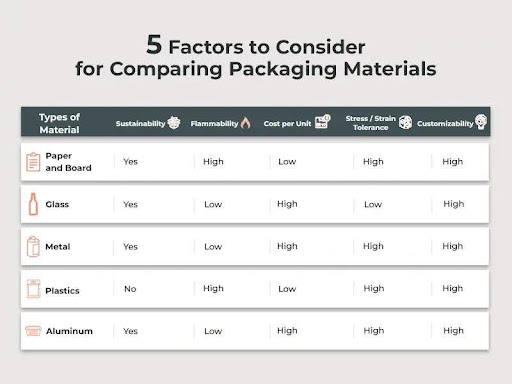
The following table provides a practical overview of commonly used packaging materials. Actual performance depends on the grade, thickness, construction, package design, and intended application.
| Packaging material | Strength and protection | Relative cost considerations | Sustainability considerations | Common applications |
|---|---|---|---|---|
| Paperboard | Suitable for many lightweight products and retail cartons | Depends on grade, printing, and quantity | Often recyclable where accepted; coatings may affect recovery | Cosmetics, retail cartons, small consumer products |
| Corrugated board | Can provide rigidity, cushioning, and stacking performance | Depends on board construction and box size | Often recyclable if accepted locally and kept suitable for collection | Shipping boxes, e-commerce, distribution |
| Kraft paper and board | Performance varies by weight and construction | Depends on material grade and design | Some options use recyclable paper-based materials | Bags, sleeves, selected boxes, natural-style packaging |
| Rigid board | Strong structure for premium presentation; protection depends on design | Often higher due to board construction, wrapping, and finishing | Recycling depends on coverings, adhesives, inserts, and local systems | Luxury gifts, jewelry, premium products |
| Paper-based protective materials | Can fill voids, wrap items, or separate products | Depends on amount and protective performance | Recovery varies by material and contamination | Inserts, void fill, wrapping, cushioning |
| Plastic films and flexible materials | Can offer sealing, moisture barriers, or flexible containment when correctly specified | Depends on resin, layers, barrier requirements, and quantity | Recycling availability varies significantly by construction and location | Pouches, wraps, bags, selected food products |
| Foam and other cushioning materials | Can absorb impact when correctly designed | Depends on density, design, and volume | Recovery and recycling options vary by material and location | Fragile products, electronics, specialized shipping |
Important: Cost comparisons are relative, not fixed price rankings. A material that costs more per unit may reduce product damage or shipping expenses, while a cheaper material may require additional protective components.
1. Paperboard Packaging Materials
Paperboard is a paper-based board used in many folding cartons and retail packages. It can be cut, creased, folded, and printed to create packaging in different shapes and sizes.
Paperboard is commonly chosen when brands need a compact package with a clean printed surface. It is suitable for many lightweight consumer products, although the correct grade and construction must be selected for the product’s dimensions and weight.
Benefits of paperboard packaging
- Supports a wide range of folding carton designs.
- Can accommodate printed branding and product information.
- Works well for many retail display applications.
- Can be designed to fit a product’s dimensions.
- May be recyclable where local systems accept the complete construction.
Potential limitations
Paperboard does not automatically provide the cushioning or stacking strength required for every shipping application. Heavy, fragile, or moisture-sensitive products may require a different construction, inserts, protective materials, or a combination of packaging types.
Best uses for paperboard
Paperboard is commonly used for selected cosmetics, personal care products, retail cartons, lightweight consumer goods, and product boxes.
Businesses looking for printed retail packaging can explore custom retail boxes.
2. Corrugated Packaging Materials
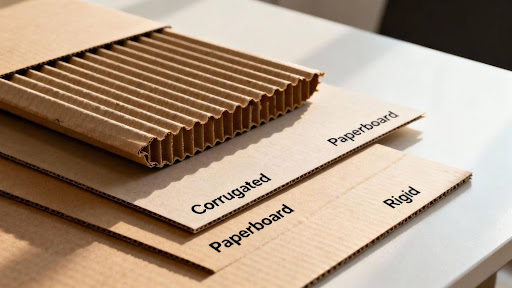
Corrugated board is constructed from fluted paper sandwiched between liner sheets. The fluted structure gives the board rigidity and can help absorb impacts, depending on the design and board grade.
Corrugated packaging is commonly used for shipping, distribution, storage, and e-commerce because it can be designed to meet different handling and stacking requirements.
Benefits of corrugated board
- Offers a range of structural options.
- Can be suitable for shipping and distribution.
- Can be produced in different box sizes and configurations.
- Can support printed branding, depending on the board and printing method.
- May be recyclable through local paper and cardboard collection systems.
Potential limitations
Not every corrugated box provides the same protection. Board grade, flute construction, dimensions, closure, moisture exposure, stacking load, and transport conditions all affect performance.
A lightweight box that works for one product may be unsuitable for a heavier item or a long shipping journey.
Best uses for corrugated packaging
Corrugated board is often suitable for shipping cartons, e-commerce packages, product distribution, and protective outer packaging.
Explore corrugated boxes to see a packaging format designed for these kinds of applications.
3. Kraft Paper and Kraft Packaging
Kraft paper is commonly associated with its natural brown appearance, although paper-based packaging products can vary in color, weight, construction, and finish.
Kraft materials are often selected by businesses that want a simple, understated, or natural-looking package. Depending on the product and material specification, Kraft-based packaging can be used for bags, sleeves, wraps, and certain box styles.
Benefits of Kraft packaging
- Offers a distinctive natural-paper appearance.
- Can support minimalist branding.
- Is available in different grades and constructions.
- Can be combined with printing and selected finishing options.
- May be recyclable where the material and local collection system allow it.
Potential limitations
Kraft packaging is not automatically stronger, cheaper, or more environmentally friendly than every alternative. Performance depends on the actual material specification, coatings, and structural design.
For products that need substantial cushioning or moisture resistance, additional components may be required.
Best uses for Kraft packaging
Kraft-based materials may suit artisan products, selected retail packaging, gifts, paper bags, and brands that prefer a natural visual style.
For relevant options, explore Kraft boxes.
4. Rigid Box Packaging Materials
Rigid boxes use a substantial board structure that is often wrapped with printed paper or another decorative covering. They are frequently used when the package itself contributes to the product’s premium presentation.
Depending on the design, rigid boxes can include magnetic closures, drawer-style openings, lift-off lids, internal inserts, and decorative finishes.
Benefits of rigid packaging
- Creates a substantial, premium-feeling structure.
- Supports high-impact branded presentation.
- Can accommodate custom inserts for product organization.
- Offers different opening styles and decorative options.
- May be suitable for gift sets and products where presentation is important.
Potential limitations
Rigid boxes can require more material, finishing, assembly, and storage space than simpler folding cartons. Their overall cost depends on dimensions, board construction, wrapping material, inserts, order quantity, and finishing.
The full package also needs to be assessed for transport protection and end-of-life handling.
Best uses for rigid packaging
Rigid packaging is commonly used for luxury gifts, jewelry, premium cosmetics, promotional kits, and selected electronics accessories.
Explore custom rigid boxes or luxury rigid boxes for premium packaging applications.
5. Paper-Based Protective Packaging
Protective packaging materials help reduce movement, separate components, or cushion products inside an outer box. Paper-based options may include wrapping paper, crumpled paper, paper pads, molded-pulp inserts, and engineered paper cushioning.
The appropriate material depends on the product’s fragility, weight, shape, and shipping conditions.
Benefits
- Can fill empty spaces within a package.
- May help separate multiple items.
- Offers alternatives to certain plastic cushioning products.
- Can be designed to fit specific products.
- Some options can be recovered through local paper recycling systems.
Limitations
Paper-based cushioning does not provide the same performance in every application. Very fragile items or products exposed to challenging shipping conditions may require testing or additional protection.
Best uses
Paper-based protective materials may suit books, selected retail goods, gifts, and e-commerce products that need wrapping, separation, or void fill.
Explore packaging inserts for ways to organize and support products within a package.
6. Plastic Films and Flexible Packaging Materials
Plastic films and flexible packaging materials are used in bags, pouches, wraps, liners, and other flexible formats. Depending on their construction, they can provide sealing, moisture resistance, or barriers against oxygen and other external factors.
The correct material must be selected for the product and its storage conditions. Food and other sensitive products may have specific packaging performance and regulatory requirements.
Benefits
- Can provide flexible package shapes.
- May offer useful sealing and barrier properties.
- Can be lightweight for suitable applications.
- Supports a range of packaging formats.
Limitations
Recyclability varies by polymer, layer structure, attached components, contamination, and local recycling infrastructure. Multi-layer structures may be difficult to recover in some systems.
Best uses
Flexible materials may be suitable for products that require pouches, bags, wraps, or particular barrier properties. They are not a direct substitute for every cardboard box or rigid package.
7. Foam and Other Protective Materials
Some products need more than an outer box. Foam, molded components, paper cushioning, and other protective materials can help control movement and reduce impact during handling and shipping.
The material should be selected based on the product’s fragility, weight, geometry, and required level of protection.
Best uses
These materials may be used for electronics, delicate components, specialized equipment, and fragile products that need additional cushioning.
When selecting a protective solution, consider the complete package rather than judging the outer box alone.
Best Packaging Materials for Different Products
Different products require different combinations of presentation, protection, and material performance. Use the following table as a starting point, then confirm the details with your packaging supplier.
| Product type | Materials to consider | Key decision |
|---|---|---|
| Cosmetics and skincare | Paperboard cartons, rigid boxes, selected inserts | Brand presentation, fit, and product compatibility |
| Electronics | Corrugated outer boxes, suitable inserts or cushioning | Impact protection and movement control |
| E-commerce products | Corrugated boxes, mailers, paper-based cushioning | Shipping conditions and package dimensions |
| Luxury gifts | Rigid board, decorative paper, custom inserts | Presentation, opening experience, and total cost |
| Bakery and food products | Materials specifically suitable for the intended food application | Food-contact suitability, grease, moisture, and product shape |
| Books and printed materials | Paperboard or corrugated packaging, depending on shipment | Edge protection, weight, and shipping method |
| Heavy products | Appropriately specified corrugated or other engineered packaging | Weight, stacking, handling, and transport testing |
| Retail products | Paperboard cartons, suitable display structures | Shelf presentation, printing, and product dimensions |
| Soap and personal care | Paperboard cartons, Kraft-based boxes, sleeves | Product fit, moisture exposure, and branding |
| Fragile gifts | Suitable outer box with a fitted insert or cushioning | Movement, impact, and presentation |
Packaging materials for cosmetics
Cosmetics packaging often needs to balance appearance, protection, and clear product information. A folding carton may work for a lightweight product, while a rigid box may be more appropriate for a premium gift set.
The outer box must also suit the actual product container and any labeling requirements.
Explore cosmetic boxes for relevant packaging options.
Packaging materials for food products
Food packaging requires careful material selection. Not all paperboard, coatings, adhesives, or printed materials are appropriate for direct food contact.
Consider whether the product is dry, oily, chilled, hot, or exposed to moisture. Confirm food-contact suitability and relevant documentation with the supplier.
For food-related packaging options, see custom food boxes.
Packaging materials for e-commerce
E-commerce packaging must account for the entire delivery journey, including sorting, handling, stacking, and transport. The right outer box may need inserts or cushioning to prevent the product from moving.
A package should be appropriately sized without compromising protection.
Learn more about e-commerce packaging and the considerations involved in selecting a shipping format.
Packaging materials for luxury products
Luxury packaging often prioritizes tactile quality, visual presentation, and a carefully designed opening experience. Rigid board, decorative wraps, inserts, and selected finishes may help achieve the desired result.
However, premium presentation should not come at the expense of product fit, practical handling, or a clearly defined budget.
Paper vs. Plastic Packaging: Which Is Better?
Paper and plastic packaging have different properties, and neither material is universally better. The right choice depends on the product, the required barrier properties, the package’s weight, the supply chain, and local end-of-life systems.
| Factor | Paper-based packaging | Plastic packaging |
|---|---|---|
| Typical formats | Cartons, boxes, bags, paper cushioning | Films, pouches, bags, containers |
| Structure | Can offer rigidity depending on construction | Can be rigid or flexible |
| Moisture resistance | Varies; coatings may be required | Varies by polymer and construction; some offer strong moisture barriers |
| Printing | Supports many packaging print methods | Supports different methods depending on material |
| Shipping protection | Corrugated board can provide structural protection | Depends on format; flexible film alone may offer limited cushioning |
| Sustainability assessment | Depends on sourcing, coatings, recycling, and transport | Depends on polymer, construction, reuse, and local recovery systems |
For some products, a combination of materials is appropriate. For example, a product may need a paperboard retail carton and a protective component selected for its specific performance requirements.
The best comparison considers the complete packaging system rather than the material name alone.
How to Choose the Right Packaging Materials
Before ordering, evaluate the product, its journey through the supply chain, and the packaging’s role in presentation and protection.
1. Identify the product’s requirements
Record the product’s dimensions, weight, fragility, and any sensitivity to moisture, light, temperature, or contamination.
This helps determine whether the package needs a folding carton, a shipping box, an insert, a barrier material, or a combination.
2. Consider the shipping and handling environment
A product sold in a store may need a different package from one shipped across the country. Consider stacking, vibration, drops, storage conditions, and the way orders will be packed.
For shipping applications, explore corrugated packaging.
3. Select a suitable structure
Choose the package style before finalizing the artwork. The structure affects material use, closure, product fit, assembly, and how the package performs during handling.
4. Evaluate branding and printing
If packaging is part of the customer experience, consider how the surface will display your logo, colors, text, and product information.
For more ideas, read about packaging design and custom packaging.
5. Calculate the full cost
Compare material, printing, finishing, inserts, tooling, assembly, storage, and shipping. A low-cost material may not be the most economical option if it increases damage risk or requires additional packaging components.
6. Review sustainability requirements
If sustainability matters to your business, ask about recycled content, material sourcing, package weight, recyclability, and local collection options. Consider whether the full construction—including coatings, windows, adhesives, and inserts—can be managed as intended at the end of its life.
Our sustainable packaging guide provides additional context.
7. Request a sample or proof
Where available, review the packaging dimensions, material, print quality, closure, and fit before approving a larger order. For products that require specific protection, consider appropriate packaging testing.
What Are the Most Cost-Effective Packaging Materials?
Cost-effectiveness depends on the complete packaging requirement, not simply the price of a material.
For example, a lightweight carton may be suitable for a product sold directly in a store, but a product shipped through multiple handling stages may need a stronger outer box. The most appropriate solution balances material use, protection, manufacturing, and shipping.
To compare options, consider:
- The price per package at your expected order quantity.
- The amount of material used.
- Printing, finishing, and setup charges.
- Assembly and packing time.
- Storage and shipping dimensions.
- Potential costs associated with damaged products.
- The availability of repeat orders using the same specifications.
Before requesting a quote, prepare the dimensions, quantity, product type, material preferences, printing requirements, and delivery location.
You can review this custom packaging cost guide for additional pricing considerations.
How Bluebird Packaging Can Help with Custom Packaging Materials
Businesses looking for custom printed boxes can evaluate Bluebird Packaging based on the packaging format, dimensions, material, and design they require.
Bluebird’s website features packaging options for retail products, cosmetics, food, bakery products, rigid boxes, and other applications. Availability, minimum order quantities, and material options should be confirmed for the specific project.
When discussing your requirements, prepare:
- Product dimensions and weight.
- Desired box style and quantity.
- Material and printing preferences.
- Artwork and brand assets.
- Required finishes and inserts.
- Delivery destination and target timeline.
You can explore cardboard boxes, rigid boxes, or custom retail packaging to review relevant options.
Ready to discuss your packaging project? Request a custom packaging quote with your product details and requirements.
Frequently Asked Questions About Packaging Materials
1. What are the best packaging materials for different products?
The best material depends on the product’s weight, fragility, storage conditions, presentation needs, and shipping method. Paperboard is commonly used for retail cartons, corrugated board for shipping boxes, and rigid board for premium presentation. Specialized products may require inserts, cushioning, or barrier materials.
2. What are the most common types of packaging materials?
Common packaging materials include paperboard, corrugated board, Kraft paper, rigid board, plastic films, glass, metal, foam, and paper-based cushioning. Each serves different applications and has its own performance and end-of-life considerations.
3. Which packaging material is best for shipping?
Corrugated board is a common option for shipping because its construction can provide rigidity and cushioning. The correct board grade and box design depend on product weight, fragility, stacking requirements, and shipping conditions.
4. Is cardboard better than corrugated packaging?
Cardboard is often used as a general term, while corrugated board is a specific construction with a fluted layer between linerboards. Paperboard may suit retail cartons, while corrugated board is often selected for shipping. The best choice depends on the application.
5. What is the best packaging material for fragile products?
Fragile products often need an appropriately designed outer box combined with a fitted insert, cushioning, or another protective component. The material and structure should be selected according to the product’s fragility, weight, and transport conditions.
6. Which packaging materials are best for food products?
The best material depends on the food type, temperature, moisture, grease, shelf life, and whether the packaging directly contacts the food. Always confirm that the specific material and construction are suitable for the intended food application.
7. What are the most sustainable packaging materials?
There is no single most sustainable material for every application. Consider sourcing, recycled content, material quantity, durability, reuse, local recycling infrastructure, and whether coatings or mixed materials affect recovery.
8. What is the difference between paperboard and corrugated board?
Paperboard is generally a solid paper-based board used in folding cartons and other packaging. Corrugated board has a fluted layer between liner sheets, which can provide additional rigidity and cushioning.
9. How do you choose the right packaging material?
Start with product dimensions, weight, fragility, and environmental sensitivities. Then consider the shipping method, box structure, branding, budget, and sustainability goals. Confirm the material’s specifications with your supplier and request a sample or test when appropriate.
10. Which packaging materials are most cost-effective?
Cost-effectiveness depends on material price, order volume, printing, assembly, shipping, protection, and product damage risk. Compare complete quotes based on identical specifications instead of choosing solely by the lowest unit price.
Final Thoughts
The best packaging materials are those that match the product’s functional requirements, presentation goals, budget, and distribution environment. Paperboard, corrugated board, Kraft-based materials, and rigid board each offer different advantages, while flexible and protective materials serve applications that boxes alone may not address.
Before making a decision, compare material specifications, evaluate the full package, and confirm that the selected construction meets your product’s requirements.
If you are planning custom boxes for your business, explore Bluebird Packaging’s cardboard boxes or request a custom quote.