
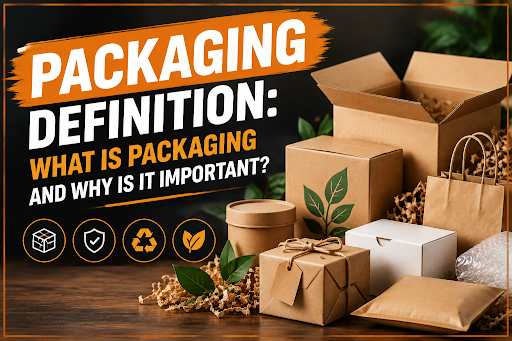
Packaging is the process of designing and producing a container, wrapper, or protective structure for a product so it can be contained, protected, stored, transported, identified, and presented to customers. It can include a product’s immediate container, a retail box, or an outer shipping carton. The type of packaging a business needs depends on the product, its protection requirements, how it will be sold, and how it will reach the customer.
In business, packaging is more than a box or wrapper. It can communicate product information, support branding, improve handling, and help customers understand what they are buying. For example, a skincare product may use a bottle as its primary packaging, a printed carton as its secondary packaging, and a corrugated shipping box as its outer transport packaging.
Understanding the packaging definition helps businesses choose suitable materials, structures, and designs for different products. This guide explains what packaging means, its main functions, the different levels and types, common materials, real-world examples, and how businesses can select appropriate packaging.
Quick Answer: What Is the Definition of Packaging?
Packaging is the combination of materials, containers, and structural designs used to enclose a product for protection, handling, storage, transportation, identification, and presentation.
The main purposes of packaging are to:
- Protect products from damage, contamination, and handling risks.
- Keep products contained and organized.
- Communicate product details, instructions, and required information.
- Support brand recognition and product presentation.
- Make products easier to store, display, transport, and use.
- Help businesses prepare products for retail sales or shipping.
Packaging can be made from paperboard, corrugated cardboard, plastic, glass, metal, textiles, or combinations of materials. The right solution depends on the product’s characteristics, distribution method, customer expectations, budget, and applicable requirements.
For an overview of the broader subject, see what packaging includes and how it is used.
What Does Packaging Mean in Business?
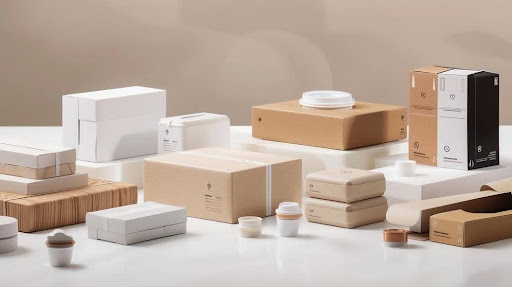
In business, packaging refers to the planned combination of materials, containers, labels, closures, and structural components that hold and present a product throughout its journey from production to the end user.
The business meaning of packaging includes both practical and commercial considerations. A package must fit the product and perform its intended function, but it may also need to reflect a brand identity, provide product information, meet retail requirements, and work efficiently in storage or fulfillment operations.
Consider a business that sells handmade soap. The soap itself is the product, while a paper wrapper or carton contains it, provides space for branding, and may communicate ingredients or usage information. If the soap is sold online, an additional shipping box may be needed to protect the packaged item during delivery.
Businesses therefore evaluate packaging as part of product development, operations, marketing, and customer experience. The decision involves more than choosing a container: it includes dimensions, material strength, printing, labeling, closures, inserts, and the intended distribution environment.
Learn more about the broader role of product packaging and how it supports different stages of the customer journey.
What Are the Main Functions of Packaging?
The main functions of packaging are to contain a product, protect it, provide information, support handling, and present it appropriately to customers. Depending on the product and industry, packaging may also help preserve product quality, improve storage efficiency, and support compliance with applicable labeling requirements.
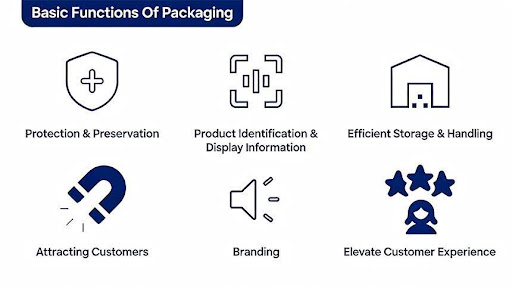
1. Product Protection
Packaging helps reduce the risk of damage during handling, storage, and transportation. Depending on the product, protection may involve cushioning, structural support, barriers against moisture or dust, secure closures, or separation between items.
For example, a shipping carton can protect products from routine handling, while a fitted insert can prevent items from moving excessively inside a box. The correct solution depends on the product’s fragility, weight, dimensions, and shipping conditions.
Packaging does not guarantee that a product will never be damaged. Its protective performance depends on the materials, design, construction, and how the package is handled.
2. Containment and Organization
Packaging keeps products, components, and accessories together. It can prevent loose items from becoming separated and help businesses organize products for storage, distribution, and sale.
A box containing several cosmetic items, for example, may include dividers that separate each product. Food multipacks may use a larger outer package to group individual containers together.
3. Product Identification
Packaging helps customers and supply-chain workers identify products. Printed names, logos, product variants, barcodes, and other markings can distinguish one item from another.
Clear identification is especially useful when a business sells several sizes, colors, flavors, or product variations.
4. Information and Instructions
Packaging can communicate ingredients, dimensions, directions for use, care instructions, warnings, manufacturer details, and other relevant information. The information required depends on the product and applicable regulations.
For regulated products, businesses should verify labeling requirements for the markets in which they sell. Packaging space and design should accommodate necessary information without making it difficult to read.
5. Branding and Product Presentation
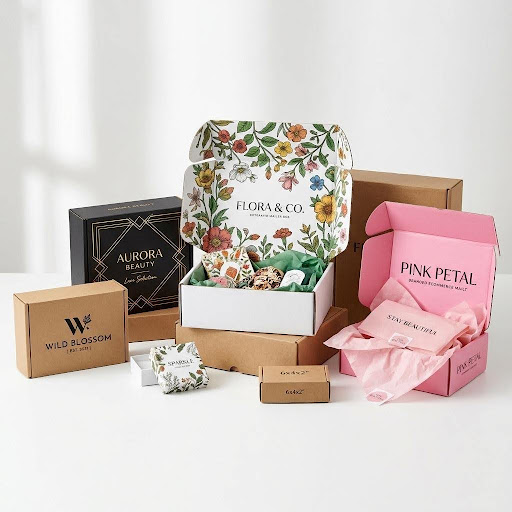
Packaging is often one of the first physical elements a customer notices. Colors, typography, logo placement, imagery, and finishes can help communicate a brand’s identity and distinguish its products from competitors.
A minimalist kraft carton may suit an artisan brand, while a rigid gift box with foil-stamped branding may suit a premium collection. These are design choices, not guarantees of product quality or customer preference.
Explore practical packaging design ideas when planning the appearance of a new product package.
6. Convenience and Handling
Well-designed packaging can make a product easier to open, carry, store, dispense, or reseal. Handles, tabs, secure closures, compartments, and clear opening instructions can improve usability.
Convenience matters to customers as well as retailers, warehouse teams, and delivery operations. A package should be practical for the people who handle it at every relevant stage.
7. Storage and Distribution
Packaging can support stacking, sorting, palletization, and efficient use of storage space. Standardized dimensions and suitable outer cartons may help businesses organize inventory and prepare shipments.
However, a package that is too large can waste storage space and increase shipping costs. Good packaging design balances protection with an appropriate size and structure.
What Are the Three Levels of Packaging?
The three commonly described levels of packaging are primary, secondary, and tertiary packaging. Primary packaging directly contains the product, secondary packaging groups or presents one or more primary packages, and tertiary packaging supports bulk handling, storage, or transportation.
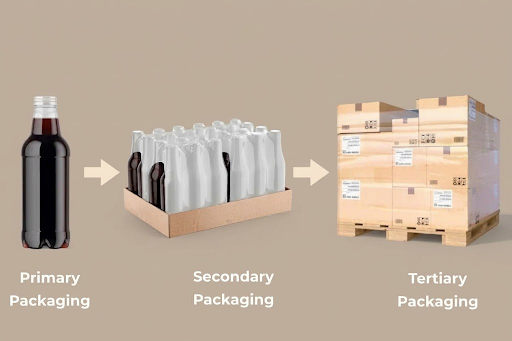
Primary Packaging
Primary packaging is the layer that directly contains or encloses the product. It may provide a barrier, hold the product, or support dispensing and use.
Examples include:
- A bottle containing shampoo.
- A jar holding skincare cream.
- A wrapper around an individual food item.
- A carton or box directly containing a product, where that is the immediate package.
Primary packaging requirements vary considerably. Food, cosmetics, pharmaceuticals, and industrial products may need different material properties and specific compliance checks.
Secondary Packaging
Secondary packaging groups, protects, or presents primary packages. It can also provide extra branding and information.
Examples include:
- A printed carton around a cosmetic bottle.
- A retail box containing a packaged accessory.
- A larger carton holding multiple individually packaged products.
- A gift box containing a collection of products.
Secondary packaging is often important in retail because it provides a larger surface for branding, product details, and visual presentation.
Tertiary Packaging
Tertiary packaging is used primarily to handle, store, or transport products in larger quantities. It may combine several retail packages into a shipping unit or protect them during distribution.
Examples include:
- Corrugated shipping cartons containing retail boxes.
- Stretch-wrapped pallets of packaged products.
- Bulk containers used to move products through a supply chain.
Not every product requires all three levels. A product sold directly to a customer may use a single package, while a fragile product shipped through several distribution stages may require multiple protective layers.
What Is the Difference Between Packaging and Packing?
Packaging generally refers to the container, materials, and design used to enclose and present a product. Packing often refers to the act of placing products into packaging or preparing goods for storage and transportation. In everyday business use, the two terms can overlap.
For example, designing a printed retail carton is a packaging task. Placing that carton inside a shipping box, filling empty spaces, and preparing the parcel for dispatch are packing activities.
The distinction is useful in operations:
- Packaging design: Selecting the structure, materials, artwork, and dimensions.
- Product packaging: The actual container or wrapping around the product.
- Packing: Preparing the product and its packaging for storage, order fulfillment, or shipping.
- Shipping packaging: The materials used to protect an item during transportation.
For a closer look at the steps involved, read about the packaging process.
What Are the Different Types of Packaging?
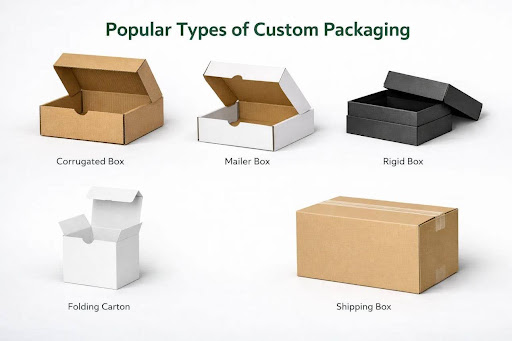
Packaging types can be classified by structure, material, purpose, or industry. Common options include folding cartons, corrugated boxes, rigid boxes, flexible packaging, sleeves, trays, pouches, and protective inserts.
The most suitable type depends on whether the package needs to contain the product directly, support retail presentation, protect an order during shipping, or perform several functions at once.
Paperboard and Folding Cartons
Paperboard cartons are formed from paper-based board that can be cut, creased, printed, and folded into a structure. They are used for many retail products because they can accommodate graphics, product information, and a variety of shapes.
Common applications include cosmetics, personal care items, small consumer products, and selected food products where the material is suitable for the intended use.
Corrugated Boxes
Corrugated boxes use a fluted layer between liner sheets to create a structured board. They are commonly used for shipping, storage, and distribution because the construction can provide strength and cushioning relative to its weight.
Businesses can explore corrugated boxes for shipping and transport applications. Box strength and performance still depend on board specifications, dimensions, closure, contents, and handling conditions.
Cardboard Boxes
“Cardboard” is commonly used as a general term for box-making board, although packaging specifications may distinguish paperboard from corrugated fiberboard. Businesses should confirm the exact material and construction rather than relying on the word alone.
Boxes made from suitable board grades can be used for retail products, storage, gift packaging, and shipping. See cardboard packaging for more context about common applications.
Rigid Boxes
Rigid boxes use thick, firm board that maintains its shape. They are often selected for premium presentation, gifts, electronics accessories, cosmetics, and other products where a substantial package is desirable.
The structure may be paired with wrapped paper, inserts, specialty printing, or decorative finishes. A rigid box is not automatically shipping-ready; an appropriate outer package may still be needed.
Explore rigid boxes for products that benefit from a firm presentation structure.
Kraft Packaging
Kraft packaging uses kraft paper or kraft-based board and is often associated with a natural, understated look. It may be used for retail boxes, shipping cartons, bags, sleeves, and other packaging structures.
Its environmental performance depends on the specific material, coatings, adhesives, printing, and local recycling infrastructure. See kraft packaging for more information about the material and its uses.
Mailer Boxes
Mailer boxes are designed for products that are packed and shipped in a box structure, often with integrated flaps and locking tabs. They can provide a practical balance between protection and presentation for e-commerce orders, subscription products, and promotional kits.
The required strength depends on the product, dimensions, weight, and delivery environment. Explore mailer boxes when evaluating packaging for direct-to-customer shipments.
Display Packaging
Display packaging is designed to present products in a retail environment. It may use an open front, window, tray, or countertop structure so products are easier to see and access.
Display packaging needs to consider product visibility, stability, replenishment, available shelf space, and how customers interact with the product. Businesses can explore display boxes for retail presentation applications.
What Materials Are Used in Packaging?
Packaging materials are selected according to the product’s physical properties, protection needs, appearance, cost, and distribution environment. Common materials include paper and paperboard, corrugated fiberboard, plastics, glass, metals, textiles, and combinations of these materials.
Paper and Paperboard
Paper and paperboard are used in boxes, cartons, labels, sleeves, and inserts. They can support printed branding and may be suitable for recycling when the material and local facilities allow it.
Paper-based materials vary in thickness, stiffness, surface finish, and resistance to moisture. The correct grade should be chosen for the package’s purpose rather than assuming all paper packaging performs the same way.
Corrugated Fiberboard
Corrugated fiberboard is commonly used for shipping cartons and protective outer packaging. Its fluted structure helps create a board that can withstand certain handling and stacking demands.
Businesses should consider the contents, box dimensions, board grade, and distribution conditions when selecting corrugated material.
Plastics
Plastics are used in films, pouches, bottles, trays, closures, and protective components. Their properties vary by polymer and construction, so barrier performance, flexibility, durability, and disposal options should be evaluated for the specific application.
Some products require properties that paper-based materials alone may not provide. Material selection should be based on actual product requirements and verified specifications.
Glass
Glass is used for products such as beverages, fragrances, and some cosmetic formulations. It can provide a rigid container and may be suitable for certain product compatibility requirements, but it is heavier and can break if inadequately protected.
A glass product may therefore require cushioning, dividers, or an appropriately designed outer carton during shipping.
Metals
Metal packaging includes cans, tins, and containers used in applications that require specific barrier or durability properties. The suitability of a metal package depends on the product, its contact requirements, and the intended use.
Mixed Materials
Some packaging combines paperboard, plastic windows, foam inserts, metal components, adhesives, or laminated layers. Mixed materials may help meet functional requirements but can make separation and recycling more complicated.
For this reason, material selection should consider the whole package rather than only the most visible component. Businesses looking for a wider material overview can review packaging materials and their uses.
Why Is Packaging Important for Businesses?
Packaging is important because it helps protect products, communicate information, support distribution, and present a product to the customer. It can also influence how efficiently a business stores, handles, and ships its products.
The value of packaging differs by industry. For a food producer, material suitability and product integrity may be central. For an e-commerce brand, shipping protection and a practical unboxing experience may matter most. For a retailer, product visibility and shelf presentation can be significant.
Key business benefits include:
- Reduced handling damage: Appropriate structures and inserts can help keep products secure.
- Clearer product communication: Packaging provides space for identification, instructions, and other required details.
- Brand consistency: A repeatable design can support a recognizable visual identity.
- Retail readiness: Suitable packaging can make products easier to display, label, and organize.
- Distribution support: Standardized cartons can help businesses prepare and handle shipments.
- Customer convenience: Accessible closures and clear product information can make packages easier to use.
Packaging alone does not guarantee customer loyalty or sales growth. Its impact depends on product quality, price, market fit, customer expectations, and the broader buying experience.
For more detail on these advantages, see the benefits of packaging and why packaging matters.
Examples of Packaging Across Different Industries
Packaging requirements change according to the product being contained and the way it will be sold or distributed.
Food and Bakery Products
Food packaging may need to support containment, handling, hygiene, and product-specific requirements. Boxes for cakes, cookies, or pastries may also need to accommodate product dimensions and help prevent movement.
Material suitability is essential for packaging that directly contacts food. Businesses should verify applicable food-contact requirements and supplier specifications.
Cosmetics and Personal Care
Cosmetic packaging can combine primary containers, such as bottles and jars, with secondary cartons that provide branding and product information. Packaging may also need to accommodate delicate closures, glass containers, or multiple items in a gift set.
For brands planning a broader retail range, custom retail boxes can be a useful starting point for exploring box structures and presentation options.
E-Commerce and Consumer Goods
Online orders often need packaging that protects the product throughout handling and delivery. This may involve a product box, fitted inserts, an outer shipping carton, and protective packing materials.
Businesses should consider the entire parcel rather than only the retail package. Correct dimensions, suitable cushioning, and secure closures can help reduce avoidable movement and damage.
Gifts and Premium Products
Gift packaging often prioritizes presentation alongside containment and protection. Rigid boxes, sleeves, inserts, and specialty finishes can help create a coordinated appearance.
The amount of packaging should still be appropriate for the product and the customer’s needs.
Industrial and Bulk Products
Industrial products may require strong cartons, dividers, pallets, or other handling systems. The main concerns can include weight, stacking, moisture exposure, movement, and efficient warehouse handling.
A package designed for a lightweight retail product may not be suitable for a heavy industrial item. Packaging specifications should reflect the actual load and distribution environment.
How Is Packaging Designed and Produced?
Packaging production generally involves understanding the product, selecting the material and structure, preparing the artwork, producing the package, and checking that the finished result meets the intended requirements. The exact process depends on the packaging type, production method, and order complexity.
Step 1: Define Product Requirements
Start by recording the product’s dimensions, weight, fragility, storage conditions, and intended distribution method. Identify any requirements for direct product contact, product information, warnings, or regulatory labeling.
Step 2: Choose the Material and Structure
Select materials and a structure that fit the product and intended use. Consider strength, printability, appearance, assembly, storage, and shipping needs.
Step 3: Prepare the Packaging Design
Develop the artwork, layout, dimensions, closure, and any inserts or internal dividers. Check that important text and brand elements will remain legible on the final package.
Step 4: Create and Review a Sample
When practical, review a sample to confirm fit, usability, artwork placement, and structural performance. For shipping packaging, test the complete pack-out rather than evaluating the inner box alone.
Step 5: Print and Convert the Material
Depending on the design, production may involve printing, cutting, creasing, folding, gluing, laminating, or applying specialty finishes. Not every package uses every process.
Step 6: Inspect the Finished Packaging
Check dimensions, print quality, closures, assembly, and material consistency. Product-specific testing may also be needed where protection, compatibility, or regulatory requirements apply.
Read more about how packaging is made and the packaging process for a deeper look at the stages involved.
How to Choose the Right Packaging for Your Product
The right packaging is the option that meets the product’s functional requirements while fitting the business’s budget, brand, and distribution needs. There is no single material or box structure that is best for every product.
Use this checklist when comparing packaging options:
- Measure the product and identify any fragile or sensitive components.
- Decide whether the package is for direct containment, retail presentation, shipping, or several purposes.
- Select suitable materials and confirm relevant specifications.
- Choose a structure that fits the product without excessive empty space.
- Add inserts or dividers where needed.
- Plan for branding, product details, and required labeling.
- Consider storage, assembly, and shipping dimensions.
- Review material disposal and recycling options where relevant.
- Compare complete quotations, including setup, samples, and delivery.
- Inspect a sample and test the finished package when practical.
If you need packaging for retail products, gifts, food items, or online orders, explore the options available through Bluebird Packaging. Choose a solution based on the product’s real requirements rather than appearance alone.
Sustainable Packaging: What Does It Mean?
Sustainable packaging refers to packaging designed with consideration for material use, product protection, transportation, reuse, and end-of-life impacts. It is not defined by one material alone. The full packaging system and its actual disposal options matter.
Businesses can start by reducing unnecessary material, choosing suitable package dimensions, and evaluating whether components can be reused or recycled in their target markets. Product protection must remain part of the decision: packaging that fails and leads to damaged products can create additional waste.
A paper-based package is not automatically recyclable in every configuration. Coatings, laminations, adhesives, windows, and mixed-material inserts may affect local processing options. Similarly, environmental claims should be supported by the actual materials and relevant conditions.
Useful considerations include:
- Right-sizing boxes to reduce unnecessary space.
- Avoiding decorative layers that do not serve a useful purpose.
- Selecting materials appropriate for the product and supply chain.
- Checking local recycling requirements for the complete package.
- Balancing material reduction with the protection the product needs.
Learn more about sustainable packaging when evaluating material choices and design trade-offs.
Frequently Asked Questions About Packaging Definition
1. What is the simple definition of packaging?
Packaging is the material or container used to enclose a product for protection, handling, storage, transportation, identification, or presentation. It can include a product wrapper, retail box, or outer shipping carton.
2. What is the main purpose of packaging?
The main purpose of packaging is to contain and protect a product while helping it move through storage, distribution, and sale. Packaging can also provide product information, support branding, and make the product easier to handle or use.
3. What are the three levels of packaging?
The three commonly described levels are primary, secondary, and tertiary packaging. Primary packaging directly contains the product, secondary packaging groups or presents primary packages, and tertiary packaging supports bulk handling and transportation.
4. What are examples of packaging?
Examples include bottles, jars, wrappers, paperboard cartons, corrugated shipping boxes, rigid gift boxes, pouches, trays, and protective inserts. The right type depends on the product and its intended use.
5. What is the difference between packaging and packing?
Packaging usually refers to the materials and structure used to enclose a product. Packing commonly refers to placing products into packaging or preparing them for storage and shipment. In some business contexts, the terms overlap.
6. What materials are commonly used in packaging?
Common materials include paper, paperboard, corrugated fiberboard, plastics, glass, metals, textiles, and mixed-material constructions. The best choice depends on product compatibility, protection requirements, cost, appearance, and disposal options.
7. Why is packaging important in marketing?
Packaging can communicate brand identity through colors, typography, graphics, and structure. It can help products stand out and provide information at the point of sale, but it does not guarantee sales or customer loyalty.
8. How do businesses choose packaging?
Businesses consider product dimensions, fragility, material suitability, storage, transportation, branding, labeling requirements, budget, and order quantity. Reviewing a sample and testing the complete package can help validate the choice.
9. Is paper packaging environmentally friendly?
Paper packaging may offer useful environmental advantages in some applications, but its overall impact depends on material sourcing, manufacturing, coatings, transportation, product protection, and disposal. Recyclability should be assessed using the complete package and local recycling rules.
10. Can packaging be customized for a business?
Yes. Depending on the supplier and packaging type, businesses may be able to customize box dimensions, materials, printing, colors, inserts, closures, and finishes. Specifications and minimum order quantities vary, so businesses should confirm them when requesting a quote.
Conclusion
The packaging definition covers much more than a box or wrapper. Packaging is a functional system that contains, protects, identifies, and presents products while supporting storage, handling, distribution, and customer use.
Understanding the differences between packaging levels, materials, and structures helps businesses make informed decisions. A retail carton, a rigid gift box, and a corrugated shipping carton serve different purposes, and the best solution depends on the product and its journey to the customer.
For businesses planning custom packaging, start with the product’s dimensions and protection needs, then consider material, structure, artwork, storage, and shipping. Explore the available options at Bluebird Packaging and request a packaging quote with your product details, desired dimensions, quantity, and design requirements.