
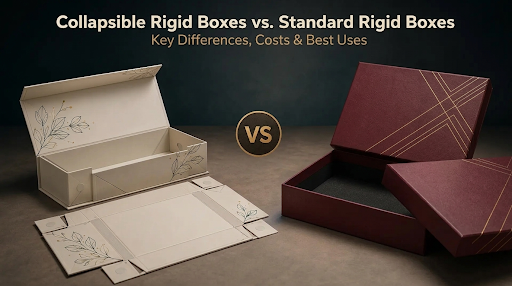
Premium packaging needs to do more than look attractive. It must protect the product, communicate brand value, fit the product correctly, and work throughout storage, fulfillment, shipping, and presentation. That is why many US brands compare collapsible rigid boxes with standard rigid boxes before choosing packaging for cosmetics, jewelry, electronics, gifts, and other premium products.
The main difference is how the boxes are stored and assembled. Collapsible rigid boxes are designed to fold down or collapse for more space-efficient storage and transportation before use. Standard rigid boxes, also called set-up boxes, generally arrive in their assembled three-dimensional form and are ready to pack. Both can offer a premium appearance, sturdy construction, custom printing, and decorative finishes, but their logistics and assembly requirements differ.
For brands ordering packaging in bulk, the decision can affect warehouse space, inbound freight, packing labor, unit cost, and the customer’s unboxing experience. This guide compares both options so you can choose the right rigid packaging for your product, budget, and operations.
Collapsible Rigid Boxes vs. Standard Rigid Boxes: A Quick Answer
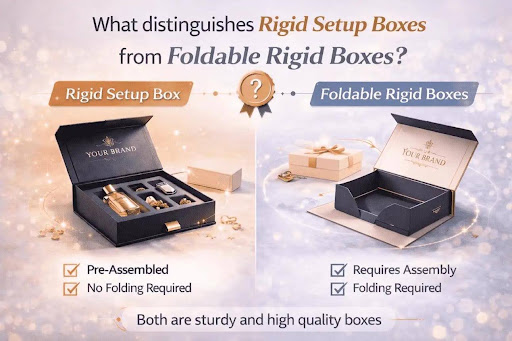
Choose collapsible rigid boxes when saving storage space and reducing the volume of unassembled packaging are important priorities. Choose standard rigid boxes when you want a ready-to-use structure that typically needs little or no box assembly before packing. Neither option is universally better: the best choice depends on the box design, product, order quantity, assembly method, shipping arrangements, and presentation requirements.
| Comparison factor | Collapsible rigid boxes | Standard rigid boxes |
|---|---|---|
| Construction | Designed to fold or collapse | Generally assembled into a fixed box structure |
| Delivery format | Often shipped flat or partially collapsed | Commonly delivered assembled |
| Storage | Usually requires less space before assembly | Usually occupies more space per empty box |
| Assembly | May require folding, corner assembly, adhesive, or another designed mechanism | Usually ready to pack, depending on the style |
| Product presentation | Can provide a premium, rigid-box appearance | Provides an established premium, structured presentation |
| Protection | Depends on board, structure, inserts, and fit | Depends on board, structure, inserts, and fit |
| Shipping efficiency | May improve packaging-volume efficiency before use | Empty boxes can take up more storage and transport volume |
| Packing labor | Assembly adds a step unless the design is preassembled quickly | Often faster to pack because the box arrives assembled |
| Customization | Can support printed wraps, inserts, and selected closures | Can support printed wraps, inserts, and selected closures |
| Best fit | Brands prioritizing space efficiency and premium presentation | Brands prioritizing ready-to-pack convenience and a fixed structure |
Note: Exact construction varies by supplier and box style. Some collapsible designs arrive partially assembled, while some rigid boxes require final setup or accessory installation. Confirm the actual folding mechanism and assembly instructions before ordering.
What Are Collapsible Rigid Boxes?
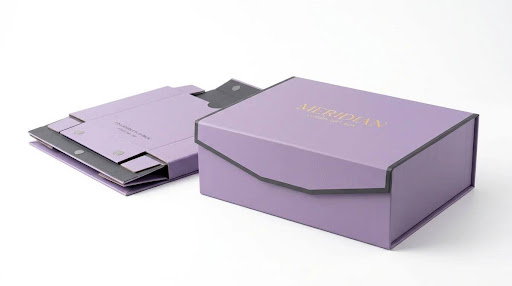
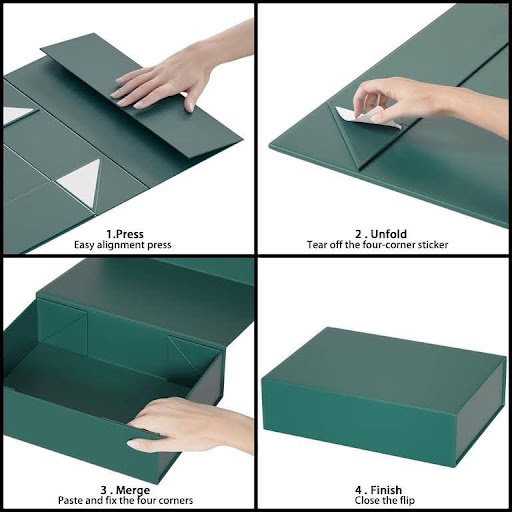
Collapsible rigid boxes are premium packaging boxes engineered to fold down or collapse into a more compact form before use. They typically use a rigid paperboard structure with wrapped outer material and a mechanism that allows the box walls or corners to be brought into their final shape when needed.
Unlike an ordinary folding carton made from a relatively thin paperboard blank, a collapsible rigid box is designed to retain the substantial look and feel associated with rigid packaging once assembled. Depending on the design, it may use folding panels, reinforced corners, adhesive tabs, magnetic closures, or other structural features.
Common applications include:
- Luxury gift boxes and corporate gifting.
- Premium cosmetics and skincare sets.
- Jewelry and accessories.
- Electronics and branded merchandise.
- Subscription gifts and curated product sets.
- Retail packaging for high-value products.
How Do Collapsible Rigid Boxes Work?
A collapsible rigid box is manufactured with a structure that can be folded down for storage or transport and then assembled into a usable box. The specific process depends on its construction. Some styles use pre-attached panels and folding corners, while others require the user to secure corners or engage a designed fastening system.
When choosing a design, ask how it is assembled, whether adhesive is required, how long setup takes, and how securely the box retains its shape. These details matter when hundreds or thousands of boxes must be prepared by a fulfillment team.
A collapsible structure can be especially useful when a business stores packaging at a warehouse and assembles it as orders arrive. However, the space savings should be evaluated alongside assembly labor, packaging dimensions, and the actual quantity being shipped.
For brands exploring this format, Bluebird Packaging’s custom collapsible rigid packaging boxes are a relevant starting point for discussing a tailored structure.
What Are Standard Rigid Boxes?
Standard rigid boxes are premium packaging boxes built around a firm structure that generally retains its assembled shape. They are commonly made from rigid paperboard wrapped in printed paper, decorative paper, or another suitable covering material.
Unlike a collapsible format, a conventional set-up box usually arrives in its three-dimensional form. Depending on the style, it may feature a separate lid, a hinged lid, a magnetic closure, a drawer-style construction, or another opening mechanism.
Standard rigid boxes are widely used for:
- Luxury gifts and presentation sets.
- Premium skincare and cosmetics.
- Jewelry and watches.
- High-end electronics and accessories.
- Corporate gifts and promotional products.
- Collectibles and specialty retail products.
Why Do Brands Choose Standard Rigid Boxes?
The key advantage is convenience at the packing stage. Because the box generally arrives assembled, the team can place the product and any required insert inside without first constructing the box walls.
A fixed structure may also suit products that need a particular presentation format, such as a lid-and-base box or a carefully fitted interior. The actual protection still depends on the complete design, including the board, insert, closure, and product fit.
Standard rigid boxes are not necessarily more durable than collapsible rigid boxes. A properly designed collapsible box can also be rigid and premium after assembly. The important question is whether the selected construction meets the product’s protection and presentation requirements.
For traditional premium packaging, explore Bluebird Packaging’s custom two-piece rigid setup boxes.
How Does Collapsible Box Construction Differ From Standard Rigid Construction?
The central structural difference is whether the box is designed to reduce its volume before use. A standard rigid box generally retains its assembled shape, while a collapsible rigid box incorporates a mechanism that allows it to fold down.
This difference affects more than the physical shape. It can influence manufacturing complexity, assembly steps, storage requirements, transport volume, and how the packaging team handles empty boxes.
Collapsible Construction
A collapsible box may use folding panels, hinged sections, reinforced corners, or other engineered features. The goal is to allow the box to move between a compact storage state and a fully assembled state without compromising the intended presentation.
The folding system needs to be designed carefully. The corners should align, the walls should hold their shape, and the closure should function as intended after assembly.
Standard Rigid Construction
A standard set-up box is built to retain its assembled shape. Its lid, base, walls, and insert are designed around the intended product and opening experience.
This format reduces the need for final box assembly at the packing stage. However, because the empty box generally occupies more volume, a business may need more space to receive, store, and handle inventory.
Does One Construction Protect Products Better?
Not automatically. Protection depends on the board grade, dimensions, corner construction, lid or closure, insert design, product weight, and the conditions the package will experience.
A box that looks substantial can still allow a product to move inside it. Conversely, a well-fitted collapsible box can provide effective support when assembled correctly. Test the finished package with the actual product rather than judging protection by the box category alone.
For broader material terminology and packaging construction choices, see Bluebird Packaging’s packaging materials guide.
Collapsible vs. Standard Rigid Boxes: Storage and Shipping Efficiency
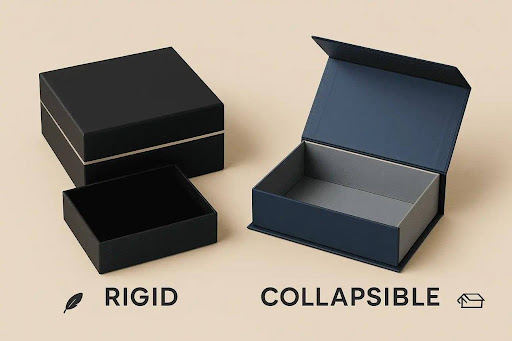
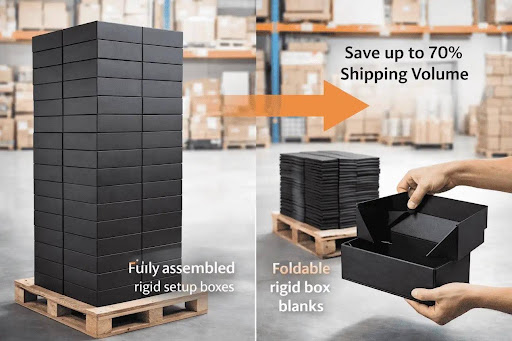
Storage and transport are often the most important reasons to consider collapsible rigid packaging. Because collapsible boxes can be shipped or stored in a reduced-volume format, they may allow more empty boxes to fit into a given storage area or shipment. Standard rigid boxes generally take up more space before packing because they retain their assembled shape.
However, reduced packaging volume does not automatically guarantee lower total shipping costs. The result depends on the supplier’s packed dimensions, shipment weight, freight pricing, pallet configuration, order quantity, and the cost of assembling each box.
Warehouse Storage
Imagine a US skincare brand ordering thousands of premium gift boxes for seasonal sets. If the boxes arrive fully assembled, the warehouse needs enough room to store their full three-dimensional volume. If the boxes arrive collapsed, the business may be able to store more units in the same space.
That can make collapsible packaging attractive for businesses with limited storage capacity or seasonal inventory. Still, the actual space saving should be confirmed using the supplier’s packed dimensions rather than estimated from the assembled box alone.
Inbound Shipping
Shipping cost can depend on dimensional weight, total shipment volume, actual weight, freight class, pallet use, and the carrier’s pricing method. A collapsible box may reduce the volume shipped per unit, but the final savings depend on the logistics arrangement.
Before choosing, compare:
- Number of boxes per carton or pallet.
- Packed dimensions of each shipment.
- Total shipment weight.
- Freight and handling charges.
- Receiving and storage requirements.
- Any assembly materials or equipment needed.
Outbound Shipping to Customers
The packaging format used to transport empty boxes to your warehouse is not the same as the package used to ship a finished product to a customer. Once assembled and packed, a collapsible rigid box may occupy a similar space to a standard rigid box of equivalent dimensions.
For ecommerce, evaluate the complete system: retail box, product insert, protective outer packaging, shipping carton, and fulfillment process. Bluebird Packaging’s ecommerce packaging guide provides useful context for considering protection and presentation together.
Are Collapsible Rigid Boxes Cheaper Than Standard Rigid Boxes?
Neither format is always cheaper. A collapsible rigid box may reduce storage and inbound shipping costs, but it may also require more complex construction or extra assembly labor. A standard rigid box may cost more to transport in its assembled state, yet save time during fulfillment because it arrives ready to pack.
The right comparison is the total cost of packaging ownership, not simply the quoted price per box.
| Cost component | Collapsible rigid boxes | Standard rigid boxes |
|---|---|---|
| Unit manufacturing price | Depends on design and construction complexity | Depends on design, materials, and structure |
| Inbound shipping | May benefit from lower packed volume | May be affected by larger assembled volume |
| Warehouse storage | May require less space | Generally requires more space for empty boxes |
| Assembly labor | May add a setup step | Usually lower if boxes arrive ready to use |
| Packing speed | Depends on assembly time and workflow | Often faster for straightforward packing |
| Damage and replacement | Depends on design, handling, and quality | Depends on design, handling, and quality |
| Total cost | Must include storage, freight, labor, and handling | Must include storage, freight, labor, and handling |
How to Compare Quotes Fairly
Ask suppliers to quote both formats using the same product dimensions, material specification, wrapping paper, printing, insert, closure, and order quantity wherever possible.
Then calculate the estimated cost per packed unit:
- Start with the box price.
- Add inbound freight and handling per unit.
- Include storage costs where relevant.
- Add the labor required to assemble and pack each box.
- Include any additional protective packaging.
- Compare the total under your expected operating conditions.
For example, if a collapsible box costs less to transport but takes longer to assemble, its freight savings could be partly offset by labor. If your warehouse has ample room and packing speed is a priority, a standard rigid box could be the better operational choice.
For a more detailed view of the factors that influence custom packaging prices, review Bluebird Packaging’s custom packaging cost guide.
Which Rigid Box Is More Durable?
Durability depends on the actual construction, not whether the box is collapsible or standard. Both can use rigid paperboard, wrapped surfaces, reinforced corners, and custom inserts. Their performance should be assessed according to the product, handling conditions, and expected distribution environment.
What Affects Durability?
Board quality and thickness: The material specification affects stiffness and resistance to deformation. Thicker board is not always the best solution if the structure or fit is poorly designed.
Corner construction: Corners are important structural areas. A collapsible box must retain its shape when assembled, while a standard rigid box must maintain the integrity of its fixed construction.
Closure and lid design: Magnetic closures, hinged lids, separate lids, and drawer structures have different functional requirements. The closure should stay secure during normal handling and work reliably over repeated use when that is an intended feature.
Insert and product fit: Inserts can help prevent movement and keep a product positioned correctly. Their design should account for the product’s weight, shape, finish, and sensitivity.
Handling and shipping conditions: A premium presentation box may need an outer shipping carton to protect it from crushing, abrasion, moisture, or rough handling during delivery.
Which Format Is Better for Fragile Products?
Both formats can be suitable when engineered correctly. For fragile glass containers, electronics, delicate accessories, or multi-item gift sets, the internal fit and protective components may matter more than whether the outer rigid box collapses.
Request a sample with the actual insert and product dimensions. Check the fit, closure, stability, and ease of packing. Where the package will be shipped directly to customers, test the complete shipping configuration rather than only the empty presentation box.
Which Rigid Box Is Better for Luxury Products?

Both collapsible and standard rigid boxes can deliver a luxury presentation. The decision comes down to the balance between presentation, storage, assembly, and the customer experience.
When Collapsible Rigid Boxes Make Sense for Luxury Brands
Collapsible rigid packaging is worth considering when a brand wants premium presentation but also needs to manage warehouse space or inbound packaging volume. It may be suitable for gift sets, premium skincare, corporate gifts, and other products where the box is assembled as orders are fulfilled.
A collapsible design can still include printed wraps, a magnetic closure, a fitted insert, foil details, and other finishing options, provided they are compatible with the chosen construction.
When Standard Rigid Boxes Make Sense for Luxury Brands
A standard rigid box may be preferable when ready-to-use packaging is important or when the selected presentation relies on a fixed structure. Separate-lid boxes, hinged-lid designs, and other traditional set-up formats can create a deliberate opening experience without requiring the packer to assemble the box first.
For instance, a watch or jewelry brand may prioritize an insert that holds the product securely and a lid that opens in a specific way. A gift brand fulfilling a large number of orders may prefer boxes that can be packed immediately.
What Actually Creates a Premium Experience?
Premium packaging is a combination of factors:
- A structure that suits the product.
- Material and wrapping that match the brand.
- Consistent printing and legible typography.
- A well-fitted insert.
- A closure that functions reliably.
- Finishes used with restraint.
- A smooth and intuitive opening experience.
A more expensive box is not automatically more luxurious. Good proportions, accurate artwork, material quality, and a carefully designed interior can contribute more to the experience than adding multiple decorative effects.
For brands comparing rigid structures, Bluebird Packaging also offers magnetic closure rigid packaging boxes, which can be considered when the opening and closing experience is an important part of the design.
Materials, Printing, and Customization Options
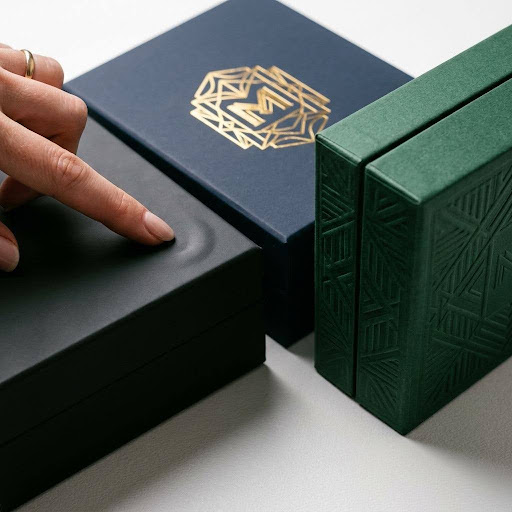
Collapsible and standard rigid boxes can share many customization options, although the exact possibilities depend on the construction, supplier, and selected materials. Both formats can be wrapped in printed or decorative paper and may support custom inserts, brand graphics, and selected finishes.
Printing and Surface Design
The outer wrap is a major part of the visual identity. Brands can use product names, logos, illustrations, photography, patterns, and other graphics to create a recognizable package.
Before approving artwork, confirm the printable area, folding and joining points, bleed requirements, safe zones, and any areas that may be hidden when the box is assembled.
For artwork preparation and print planning, see Bluebird Packaging’s packaging printing guidance.
Popular Finishing Options
| Finish | Typical purpose |
|---|---|
| Matte finish | Creates a soft, low-glare surface |
| Gloss finish | Adds shine and can emphasize color |
| Foil stamping | Highlights logos or selected design elements with a metallic effect |
| Embossing | Creates raised details |
| Debossing | Creates indented details |
| Spot UV | Adds selective gloss to chosen areas |
| Textured wrapping paper | Adds tactile interest and visual depth |
Not every finish is suitable for every material or structure. Confirm compatibility and request a proof or sample when the appearance of a specific finish is critical. For more detail, explore packaging finishes and their applications.
Custom Inserts and Internal Layouts
Inserts can hold products in place, separate multiple items, and create an organized presentation. Common applications include cosmetics, electronics, jewelry, promotional products, and curated gift sets.
The insert should be designed around the product’s dimensions, weight, shape, and surface sensitivity. A box with a premium exterior can still feel poorly made if the product moves around inside it.
When requesting a quote, specify the product and insert requirements together. Changing the insert after the box dimensions have been approved may affect the fit or require structural revisions.
How to Choose Between Collapsible and Standard Rigid Boxes
The best packaging choice starts with your product and fulfillment process. Rather than selecting a box based on appearance alone, assess how it will be stored, assembled, packed, shipped, and presented to the customer.
Use this step-by-step process to compare the options.
Step 1: Define the Product Requirements
Identify the product’s dimensions, weight, fragility, and presentation needs. Determine whether it requires a fitted insert, a separate lid, a magnetic closure, or a multi-item layout.
Step 2: Decide How the Packaging Will Be Stored
If warehouse space is limited or the packaging is ordered in large quantities, a collapsible format may be worth evaluating. If space is readily available and you want boxes ready for immediate packing, standard rigid boxes may be more convenient.
Step 3: Calculate the Total Operating Cost
Compare unit price, inbound freight, storage, assembly time, and packing labor. Use supplier-provided packed dimensions and actual freight estimates rather than assuming collapsible boxes will always be cheaper.
Step 4: Match the Structure to the Customer Experience
Decide how the box should open, how the product should be revealed, and whether the packaging will be reused or retained. These considerations can help determine whether a folding structure or a traditional set-up box is more appropriate.
Step 5: Select Materials and Finishes
Choose the outer wrap, printing, finish, closure, and insert based on your brand identity and budget. Make sure the design is compatible with the selected structure.
Step 6: Request Samples and Confirm Specifications
Before approving production, review the assembled box, folding mechanism if applicable, product fit, closure, artwork, and insert. Confirm the packed dimensions and assembly instructions with your supplier.
If you are still comparing structures, Bluebird Packaging’s custom rigid boxes collection is a useful place to begin evaluating packaging styles.
Are Collapsible Rigid Boxes More Sustainable?
A collapsible box may reduce the volume needed to transport and store empty packaging, which can improve space efficiency. However, that advantage alone does not establish that it has a lower overall environmental impact.
The complete assessment depends on the materials used, manufacturing process, transport distances, packaging weight, durability, and how the finished package is handled at end of life.
Consider these questions:
- Is the box made from paperboard with documented material specifications?
- Does the construction include laminations, magnets, plastics, or other mixed components?
- Can different materials be separated for disposal or recycling?
- Does the packaging’s compact shipping format reduce the number of shipments or storage requirements in your actual supply chain?
- Will the box be reused, recycled, or disposed of after use?
Do not make broad claims such as “100% sustainable” or “fully recyclable” without supporting evidence for the complete finished package. The US Federal Trade Commission’s Green Guides for environmental marketing claims provide useful guidance on communicating environmental benefits accurately.
You can also explore Bluebird Packaging’s sustainable packaging considerations when comparing material and design options.
Common Mistakes When Choosing Rigid Packaging
Avoid these common mistakes when comparing collapsible and standard rigid boxes:
| Mistake | Why it causes problems | Better approach |
|---|---|---|
| Choosing based only on unit price | Freight, storage, and labor may change the total cost | Compare the complete cost per packed unit |
| Assuming collapsible means cheaper | Assembly and construction can add costs | Request actual packed dimensions and labor estimates |
| Assuming standard rigid boxes are always stronger | Structural quality varies by design | Compare the board and construction specifications |
| Ignoring assembly time | Extra labor can affect fulfillment speed | Test assembly using the intended workflow |
| Overlooking product fit | Products may move, become damaged, or appear poorly presented | Approve the box and insert together |
| Selecting finishes too late | Artwork or structure may need to change | Plan finishes before final artwork approval |
| Ignoring outbound shipping | A retail box may not provide enough protection in transit | Test the complete shipping configuration |
| Making unsupported sustainability claims | Material appearance does not prove environmental performance | Verify claims against the actual specification |
A good rigid packaging decision balances the customer’s experience with the realities of storage, fulfillment, and distribution.
Rigid Box Packaging Checklist Before Ordering
Use this checklist when requesting quotes from a packaging supplier.
- Product dimensions and weight are confirmed.
- The required box style and opening mechanism are defined.
- The preferred format is collapsible or standard rigid.
- Internal dimensions account for the product and insert.
- The material and board specification are documented.
- Printing, wrapping, and finishes are clearly specified.
- Assembly instructions and estimated setup time are understood.
- Packed dimensions are available for freight and storage estimates.
- The quote includes the required quantity and customization.
- A sample or proof has been reviewed where appropriate.
- Product protection and outbound shipping have been considered.
- Any environmental claims are supported by evidence.
For more general guidance on specifying package dimensions, see Bluebird Packaging’s guide to measuring a box.
Frequently Asked Questions About Collapsible Rigid Boxes vs. Standard Rigid Boxes
1. What is the difference between collapsible rigid boxes and standard rigid boxes?
Collapsible rigid boxes are designed to fold down or collapse before use, reducing the space they occupy during storage and transportation. Standard rigid boxes generally arrive assembled and ready for packing. Both can provide premium presentation, depending on their construction and materials.
2. Are collapsible rigid boxes cheaper to ship?
They may be cheaper to transport before assembly because their packed volume can be smaller. Actual savings depend on packed dimensions, freight pricing, order quantity, pallet configuration, and the supplier’s packing method. Compare real shipment specifications before deciding.
3. Are collapsible rigid boxes as durable as standard rigid boxes?
They can be, provided the structure, board, folding mechanism, corners, and closure are appropriately designed. Durability varies by product specification and handling conditions, so samples and fit checks are more useful than comparing the names alone.
4. Do collapsible rigid boxes require assembly?
Usually, some assembly is needed to bring the box into its final shape. The amount of work varies by design: some use simple folding mechanisms, while others require securing corners or engaging specific components. Ask the supplier for assembly instructions and test the process before a large order.
5. Which rigid box is better for luxury products?
Both formats can suit luxury products. Collapsible rigid boxes may be preferable when compact storage is important, while standard rigid boxes can be more convenient when ready-to-use packaging is a priority. Printing, inserts, materials, and finishes contribute significantly to the final presentation.
6. Can collapsible rigid boxes have magnetic closures?
Some collapsible rigid box designs can incorporate magnetic closures, depending on their construction and the supplier’s capabilities. Confirm the closure design, assembly method, and functionality on a sample before production.
7. Are standard rigid boxes better for ecommerce?
Not automatically. Standard rigid boxes can simplify packing because they typically arrive assembled, while collapsible boxes may save space before use. For ecommerce, compare the full fulfillment process and ensure that the finished package has suitable outer protection for transit.
8. How do I compare the cost of collapsible and standard rigid boxes?
Request comparable quotes using the same dimensions, board specification, wrap, printing, insert, closure, and quantity. Then include inbound shipping, storage, assembly labor, and other handling costs to estimate the total cost per packed unit.
9. Which rigid box is best for jewelry and cosmetics?
Both can work for jewelry and cosmetics. The right choice depends on the product’s dimensions, fragility, insert requirements, brand positioning, and fulfillment process. A fitted insert and secure closure may be especially important for delicate products.
10. Can both types of rigid boxes be customized?
Both can often be customized with printed or decorative wraps, logos, inserts, and selected finishing options. The exact options depend on the structure and manufacturing process. Confirm the available specifications with your packaging supplier.
11. Do collapsible rigid boxes save warehouse space?
They generally occupy less space when stored in their collapsed form than comparable boxes stored fully assembled. The actual benefit depends on the design, quantity, packed dimensions, and storage method.
12. What should I ask a rigid box manufacturer before ordering?
Ask about the box construction, board specification, dimensions, closure, insert, printing, finishing, packed dimensions, assembly requirements, lead time, minimum order quantity, and sample approval process. Requesting these details makes it easier to compare suppliers accurately.
Further Reading: Packaging Design and Material Selection
Rigid box selection is only one part of a successful packaging project. Your design, dimensions, material, and fulfillment process should work together. Bluebird Packaging’s resources on custom packaging solutions, different types of packaging, packaging design principles, and creative packaging design ideas can help you evaluate the wider requirements before finalizing a box specification.
If you are comparing costs across different packaging formats, the packaging cost overview can help you consider pricing alongside material and design choices. You can also browse the Bluebird Packaging blog for additional packaging guidance.
Conclusion: Which Rigid Box Should You Choose?
Choose collapsible rigid boxes when reducing empty-box storage volume and improving inbound shipping efficiency are important, provided the assembly process fits your fulfillment operation. Choose standard rigid boxes when ready-to-pack convenience, a fixed structure, and straightforward handling are higher priorities.
Both formats can support premium branding, custom inserts, magnetic closures, printed wraps, and selected decorative finishes. Neither format is automatically cheaper, stronger, or more sustainable. Those outcomes depend on the actual construction, material specification, freight arrangements, assembly labor, and product requirements.
Before placing a bulk order, compare the complete cost per packed unit, request packed dimensions, confirm the assembly process, and review a sample with the intended product and insert.
Bluebird Packaging offers custom rigid box options for brands evaluating premium packaging formats. Share your product dimensions, desired style, quantity, artwork, and shipping requirements through the custom packaging quote form to discuss a suitable solution.