
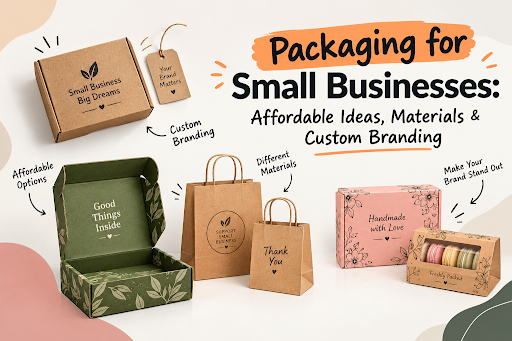
Packaging for small businesses does not have to be expensive to look professional. Start with packaging that fits your product, protects it during delivery, and suits your budget. Then add branding in stages—such as a logo sticker, branded tissue paper, a thank-you card, or a custom printed box—as your business grows.
For many US startups and small online stores, the most practical approach is to use standard packaging for basic protection, invest in a few consistent brand elements, and move to fully custom packaging when order volume and margins justify it.
This article explains how to choose affordable packaging for small businesses, compare materials, reduce packaging costs, create a memorable unboxing experience, and decide when custom packaging is worth the investment.
Packaging for Small Businesses: A Quick Answer
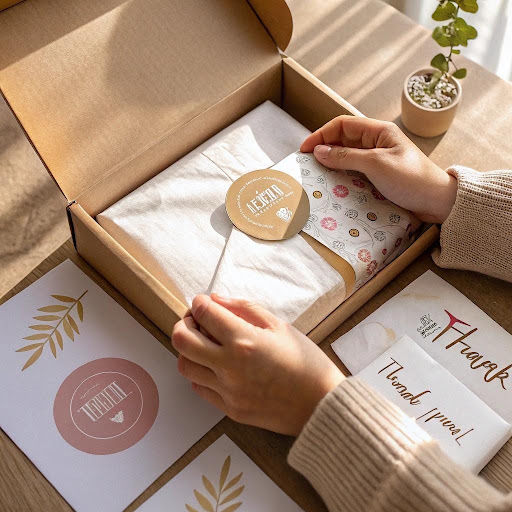
The best packaging for a small business balances four priorities: product protection, total cost, brand presentation, and ease of fulfillment.
- Lowest-cost starting point: Standard boxes, mailers, or bags with a logo sticker or printed label.
- Best for many online stores: A correctly sized shipping box or mailer with suitable protective material.
- Best for stronger brand recognition: Consistent logo placement, brand colors, labels, inserts, and custom printed packaging.
- Best for premium products: A well-designed product box, carefully selected finish, and coordinated interior presentation.
- Best for cost control: Standardize box sizes, avoid unnecessary packaging layers, compare supplier quotes, and order quantities that match realistic demand.
- Best for sustainability goals: Select materials based on verified specifications and local disposal options instead of relying on vague “eco-friendly” claims.
You do not need to customize every part of your package immediately. A simple, consistent packaging system can look professional without the cost of a fully printed box for every product.
Small Business Packaging Options at a Glance
| Packaging option | Best for | Budget approach |
|---|---|---|
| Standard box + logo sticker | Startups and small batches | Brand the outside without fully custom printing |
| Kraft boxes | Handmade, natural, and minimalist brands | Use a simple design and limited colors |
| Corrugated shipping boxes | Online orders and products needing protection | Choose a suitable size and board construction |
| Custom mailer boxes | Direct-to-consumer brands and subscriptions | Customize the main box before adding extra accessories |
| Printed product boxes | Retail products and premium presentation | Reserve advanced finishes for priority products |
Why Packaging Matters for a Small Business
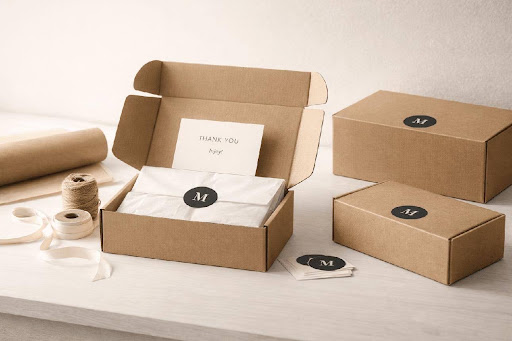
Packaging is more than a container. It protects the product, communicates brand identity, helps organize fulfillment, and shapes the customer’s first physical interaction with an order.
For a small business competing with established retailers, consistent packaging can make products feel more considered and recognizable. It does not guarantee repeat purchases, but it creates another opportunity to present the brand clearly and professionally.
1. It Makes Your Brand Easier to Recognize
Customers may encounter your business through a website, social media post, marketplace listing, retail shelf, or delivered package. Using consistent colors, typography, logos, and messaging helps connect these touchpoints.
You can build that consistency without printing every box. For example, use a standard kraft carton with a branded sticker, or apply a consistent label to several sizes of stock boxes.
As your business grows, you can develop a more coordinated system through custom packaging and branded presentation.
2. It Helps Protect Products During Delivery
A damaged product can lead to replacement costs, customer complaints, and additional shipping work. Packaging should therefore be selected for the product’s weight, fragility, shape, and distribution conditions.
A lightweight apparel item may need a mailer, while glass products or fragile accessories may need a sturdy box, cushioning, or a fitted insert. The goal is not to use the thickest material for everything; it is to use enough protection for the actual risk.
3. It Creates a Better Unboxing Experience
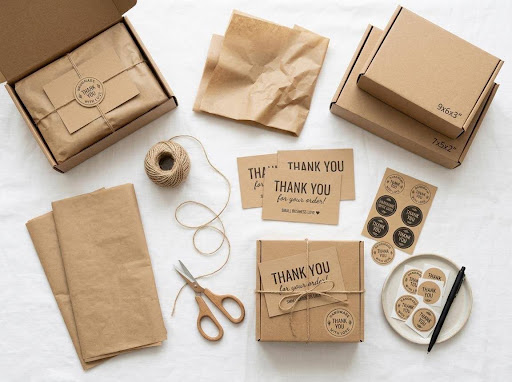
A cleanly packed order, easy-to-open box, and thoughtful insert can make a purchase feel more personal. Small touches such as a thank-you card or a neat layer of tissue paper can improve presentation without requiring a completely custom package.
The key is relevance. A premium gift brand may benefit from a coordinated interior, while a business selling everyday replacement parts may be better served by efficient, protective packaging.
4. It Supports More Efficient Fulfillment
Packaging affects how quickly orders can be packed, labeled, stored, and shipped. Too many box sizes or unnecessary inserts can complicate fulfillment.
A small business can simplify operations by standardizing a few packaging formats, storing them in accessible locations, and documenting how each product should be packed.
How to Create Affordable Packaging for Small Businesses

The most effective way to reduce packaging costs is to make decisions about the complete order—not just the price of an individual box.
A cheap box can become expensive if it causes damage, requires excessive filler, increases shipping dimensions, or takes too long to pack. Similarly, a fully custom box may not be worth the investment if you have very low order volume or frequently change your product range.
1. Start With Standard Packaging and Add Your Branding
Standard packaging is a practical starting point for startups and small brands testing their market. You can purchase suitable stock packaging and personalize it with a logo sticker, product label, stamp, or thank-you card.
This approach allows you to establish a consistent look while avoiding the need to customize every surface.
Consider this progression:
- Start with plain boxes, mailers, or bags that fit your products.
- Add one recognizable brand element, such as a logo label.
- Introduce branded tissue or inserts if they add value to the customer experience.
- Test custom printed boxes for your best-selling products.
- Expand to more packaging styles when sales and product requirements justify it.
2. Use Fewer, More Versatile Box Sizes
A large selection of box sizes can create storage and inventory challenges. A small, carefully chosen range may be enough for many product lines.
Measure your products and group items that can safely use the same box. Avoid making one box fit everything if that creates excessive empty space or insufficient protection.
For sizing help, use Bluebird Packaging’s box measurement guide. Confirm the internal dimensions needed for the product and consider the finished outside dimensions when storage and shipping size matter.
3. Keep the Design Simple
A logo, one or two brand colors, and clear typography can create a professional look. Multiple finishes, complicated artwork, and printing across every surface may increase production costs without improving the customer’s experience enough to justify the expense.
For budget-conscious packaging design:
- Use a clear logo and consistent placement.
- Limit the number of colors when it suits the brand.
- Keep important text readable.
- Use one visual style across related products.
- Avoid decorative features that do not serve a practical or branding purpose.
A minimalist design can work particularly well on kraft packaging, while detailed artwork may benefit from a smooth, printable paperboard surface.
4. Compare the Full Cost of Each Option
When comparing packaging suppliers, look beyond the unit price. Review setup costs, shipping, printing, finishing, order minimums, storage needs, and the amount of packaging required per order.
| Cost consideration | What to check |
|---|---|
| Unit price | Cost per box, mailer, or bag |
| Setup or artwork charges | Any one-time preparation costs |
| Minimum order quantity | Whether the required quantity is manageable |
| Freight and delivery | Total cost to get packaging to your location |
| Storage | Space required for flat or assembled packaging |
| Protection | Whether the material is suitable for the product |
| Packing time | How long it takes to prepare each order |
| Waste | Excess material, damaged boxes, or unused stock |
For more details on the factors that influence packaging budgets, read Bluebird Packaging’s custom packaging cost guide.
5. Order Quantities That Match Your Sales
Bulk purchasing can reduce the unit cost, but only if you can use the packaging before it becomes outdated or takes up too much storage space.
Estimate usage from actual sales, account for seasonal demand, and consider whether your logo, product dimensions, or branding might change soon. New businesses may benefit from smaller initial orders, while established brands with predictable demand can compare larger quantities.
Do not assume that every supplier offers the same minimum order quantity. Ask for the available quantities and compare quotes for the same specifications.
6. Make Inserts and Accessories Earn Their Place
Tissue paper, stickers, ribbons, thank-you cards, and promotional inserts can enhance presentation. But every extra component adds cost and may add packing time.
Use accessories selectively. A gift business may benefit from a premium insert, while a repeat-purchase consumable may need only a clear label and secure packaging.
Best Packaging Materials for Small Businesses
Different products require different materials. The right choice depends on weight, fragility, moisture sensitivity, display requirements, branding, and shipping conditions.
For a broader introduction, see Bluebird Packaging’s packaging materials overview.
Kraft Packaging Boxes
Kraft boxes offer a natural brown appearance that works well for many handmade, artisan, and minimalist brands. They can be paired with simple logos, stickers, labels, and selected print designs.
Kraft is worth considering for candles, soaps, gifts, crafts, and some retail products. The specific grade and construction still need to suit the product’s protection requirements.
Explore Kraft packaging boxes when a natural-looking presentation fits your brand.
Corrugated Shipping Boxes
Corrugated boxes use a fluted layer between liner sheets. Depending on the board construction, they can provide useful protection for shipping, storage, and handling.
They are commonly used for ecommerce orders, larger products, and items that need more structural support than a lightweight retail carton can provide.
Choose a box that fits the packed product, and use cushioning where needed. An oversized shipping box may require more filler and may increase the shipment’s dimensional size.
See corrugated packaging boxes for a relevant packaging option.
Custom Mailer Boxes
Mailer boxes can combine shipping functionality with branded presentation. They are often considered by direct-to-consumer brands, subscription businesses, apparel companies, and gift sellers.
A custom mailer can make the package feel cohesive without requiring separate retail packaging and a separate outer box in every situation. However, whether one box can serve both purposes depends on the product and shipping conditions.
Explorecustom mailer boxeswhen you want to combine product presentation with a practical shipping format.
Cardboard and Printed Product Boxes
Paperboard cartons can suit products that need clear product information, colorful artwork, or a polished retail appearance. Depending on the grade and structure, they can be used for cosmetics, personal care products, gifts, and other retail items.
The term “cardboard” covers different materials, so confirm the actual board specification instead of relying on the name alone.
Bluebird Packaging’s cardboard packaging boxesare a starting point for exploring this type of packaging.
Display Packaging
Businesses selling through physical stores, trade shows, or counters may need packaging that presents products clearly and keeps them organized.
Display boxes can help group products and improve visibility when the design matches the product, retail space, and stocking process.
Explore product display boxes if presentation at the point of sale is important.
Small Business Packaging Ideas That Look Professional
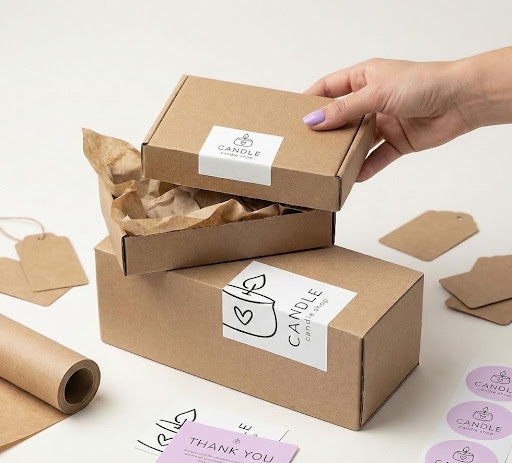
You do not need a large budget to make packaging more distinctive. Start with a small number of design elements that fit your products and repeat them consistently.
Use a Branded Sticker on a Stock Box
A logo sticker is one of the simplest ways to add brand identity to plain packaging. Place it consistently and choose a size that suits the box rather than overwhelming it.
This works well for handmade goods, small clothing brands, candles, soaps, jewelry, and products shipped in standard cartons.
Add Branded Tissue Paper
Tissue paper can add color and create a neat interior presentation. If fully custom printed tissue is not practical yet, use a coordinated stock color and add a small branded sticker or card.
Use tissue where it helps presentation or separates items; do not add it automatically to every order.
Include a Useful Thank-You Card
A short thank-you card can make the package feel personal. It may include your brand name, customer support details, care instructions, or a QR code linking to a relevant resource.
Keep the message concise and make sure any promotion or review request complies with the policies of the sales platform you use.
Use Custom Labels for Product Identification
Labels can carry product names, variants, instructions, or other useful information. For businesses with several product types, a consistent label system can make picking and packing easier.
Use readable text and keep any required product information accurate. The exact labeling requirements depend on the product and the market in which it is sold.
Choose a Consistent Color Palette
A small color palette helps your packaging look intentional across different box sizes and materials. Use your main brand color for the logo or label and a secondary color for supporting elements.
Your packaging does not have to be bright or complicated to stand out. Consistency is often more useful than decoration for its own sake.
Create a Simple Unboxing Sequence
Think about what the customer sees when opening the package. A neat arrangement, a well-positioned insert, and easy access to the product can make the experience feel considered.
The goal is to improve the order experience without adding unnecessary layers, filler, or cost.
Packaging Ideas for Different Types of Small Businesses
The best packaging format depends on what you sell, how customers receive it, and what the product needs for protection.
| Business type | Packaging to consider | Budget-friendly branding idea |
|---|---|---|
| Handmade products and crafts | Kraft boxes, paper bags, protective mailers | Logo sticker and a simple thank-you card |
| Clothing and apparel | Suitable mailers or shipping boxes | Branded label or tissue paper |
| Beauty and skincare | Product cartons, corrugated shipping boxes, inserts where needed | Consistent colors and clear product labels |
| Candles and soaps | Product boxes with suitable outer shipping protection | Kraft-style presentation or a printed product label |
| Jewelry businesses | Small product boxes and protective shipping packaging | Branded insert or compact logo sticker |
| Subscription businesses | Mailer boxes or suitable shipping cartons | Repeatable interior design and a monthly insert |
| Online gift stores | Gift boxes, mailers, tissue, and protective filler | Coordinated colors and a short gift message |
| Food and bakery businesses | Packaging designed for the specific food and handling conditions | Clear labels and consistent branding |
| Local retailers | Paperboard product boxes, bags, or display packaging | A consistent logo and color scheme |
| Small electronics sellers | Suitable cartons, inserts, and protective shipping boxes | Clean product identification and organized inserts |
For businesses selling beauty products, explore Bluebird Packaging’s custom cosmetic boxes. For soap products, see its custom soap boxes. Bakery businesses can explore custom bakery boxes, while food sellers can review custom food packaging boxes.
These are starting points rather than universal recommendations: always confirm that the chosen structure and material suit the specific product and its applicable requirements.
How to Make Custom Packaging Affordable for Startups
Custom packaging for startups can be manageable when you customize the elements that matter most instead of trying to create a completely unique package from day one.
Start With Your Most Important Product
If your business sells many products, choose one or two high-priority items for initial customization. This may be your best seller, a signature product, or an item that customers frequently purchase as a gift.
Keeping the first project focused makes it easier to approve artwork, assess the finished packaging, and decide whether further customization is worthwhile.
Ask About Minimum Order Quantities
A minimum order quantity, or MOQ, is the smallest quantity a supplier will produce or sell for a particular product or specification. It varies by packaging type, manufacturing method, and supplier.
When comparing suppliers, ask:
- What is the MOQ for the exact box style and print specification?
- Are smaller quantities available with a different production method?
- Does the quote include artwork preparation or setup charges?
- Can the same design be used across different product variants?
- What are the production and delivery timelines?
- Can a sample or proof be reviewed before production?
Do not assume that a supplier’s advertised minimum applies to every product. Confirm the actual terms for your selected packaging.
Customize the Parts Customers Notice Most
Not every surface needs printing. Depending on the product, a branded exterior, clean label, or coordinated interior may be enough to create a recognizable package.
For example, a small clothing business could begin with a standard shipping format and a branded insert. A beauty brand might prioritize the product carton because it is visible on a retail shelf. A subscription business may get more value from consistent mailer boxes.
Compare Custom Packaging With Branded Stock Packaging
There are three useful approaches to compare:
Option A: Stock packaging
Use standard boxes, mailers, or bags. This can be practical for testing a product, changing inventory frequently, or keeping initial purchasing commitments low.
Option B: Branded stock packaging
Add labels, stickers, tissue paper, or inserts. This offers branding flexibility without requiring every part of the packaging to be custom manufactured.
Option C: Custom packaging
Customize dimensions, printing, structure, or finishes when these changes solve a real product, branding, or fulfillment need.
The most economical option depends on your product and order volume. Compare total project cost and the number of usable packages you will receive, not just the quoted unit price.
How to Choose a Small Business Packaging Supplier
The right packaging supplier should understand your product requirements, explain available options clearly, and provide a quotation that you can compare against other suppliers.
Questions to Ask Before Ordering
Material and protection
- What material and board grade are being quoted?
- Is the packaging suitable for my product’s weight and fragility?
- Do I need a separate shipping carton or protective insert?
Customization
- What printing methods and finishes are available?
- Can the supplier work with my existing logo and artwork?
- Will I receive an artwork proof or sample before production?
Pricing and ordering
- What is the minimum order quantity?
- Are setup, printing, shipping, and other charges included?
- How does pricing change at different order quantities?
- What happens if I need to reorder the same packaging?
Production and delivery
- What is the estimated production time after artwork approval?
- How will the packaging be shipped and stored?
- Are the delivery terms and specifications clearly documented?
A supplier that explains trade-offs can help you make a more informed decision than one that simply recommends the most elaborate package.
For a wider overview of available formats, visit Bluebird Packaging’s homepage. If you have a product in mind, you can also contact the packaging team to discuss your requirements.
Eco-Friendly Packaging for Small Businesses

Businesses often look for recyclable, recycled-content, or lower-waste packaging, but environmental claims should match the actual material and local disposal conditions.
A paper-based box may be a suitable option for some products, while other products need additional moisture barriers, cushioning, or specialized packaging. These requirements should be evaluated before selecting a material based on appearance alone.
Practical Ways to Reduce Packaging Waste
- Choose box dimensions that fit the packed product.
- Avoid unnecessary layers and excessive void fill.
- Use packaging components that serve a clear protective or presentation purpose.
- Ask suppliers about recycled content and material specifications.
- Check whether the finished package is accepted by relevant local recycling programs.
- Avoid mixing materials unnecessarily when separation is difficult for the customer.
The US Federal Trade Commission’s guidance on environmental marketing claims explains why broad claims such as “eco-friendly” need careful qualification and substantiation. For US brands, this is a useful reference when writing packaging descriptions and promotional copy.
Bluebird Packaging’s sustainable packaging resource can also help you explore material considerations.
Do not label a package recyclable, compostable, or biodegradable solely because it looks like paper or contains a natural-looking material. Verify the relevant specifications and disposal requirements before making such claims.
How to Calculate Your Packaging Cost Per Order
Packaging costs should be evaluated against the complete order. A low-cost box is not necessarily the best value if it requires excessive filler, takes longer to assemble, or leaves the product vulnerable to damage.
Packaging cost per order = Box + Filler + Tape + Labels + Inserts
For a more complete operating estimate, you can also include packing labor, storage, and an appropriate allowance for packaging waste or damage. Keep shipping charges separate when comparing the cost of the packaging materials themselves.
Illustrative Example
The figures below are hypothetical and are not supplier quotes.
| Packaging component | Option A: Basic | Option B: Branded |
|---|---|---|
| Box or mailer | 0.60 | |
| Protective material | 0.20 | |
| Label or branding | 0.08 | |
| Insert | 0.00 | |
| Material total per order | 0.88 |
In this example, the branded option costs $0.27 more per order before labor, storage, and shipping. That additional cost may be worthwhile if the branding supports the product’s positioning or customer experience, but it should be evaluated against the business’s margins and goals.
The important lesson is to compare like-for-like packaging configurations and understand what each additional component contributes.
Common Small Business Packaging Mistakes to Avoid
| Mistake | Why it matters | Better approach |
|---|---|---|
| Choosing packaging based only on price | The package may not protect the product adequately | Compare cost, fit, material, and performance |
| Using oversized boxes | Can increase material use and create unnecessary empty space | Measure the packed product and select an appropriate size |
| Customizing everything too early | Can create excess inventory and lock up cash | Start with priority products and expand gradually |
| Using inconsistent branding | Different colors and logos can make the business look disorganized | Create a simple packaging design system |
| Adding too many inserts | Increases material cost and packing time | Keep only useful components |
| Ignoring storage space | Packaging inventory can interfere with fulfillment | Consider flat-packed formats and manageable order quantities |
| Making unsupported environmental claims | Can mislead customers and create compliance risks | Verify materials and qualify claims accurately |
| Skipping sample review | Fit, print, and structural problems may appear later | Approve the specification and review a sample when appropriate |
A Small Business Packaging Checklist
Use this checklist before choosing or reordering packaging.
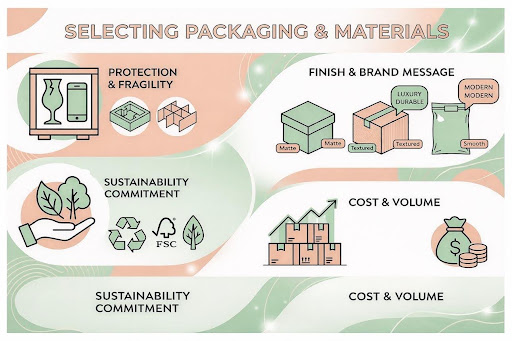
- Identify the product’s dimensions, weight, and fragility.
- Decide whether the package is for retail, shipping, gifting, or multiple uses.
- Choose a suitable material and box style.
- Confirm internal dimensions and required protection.
- Decide which brand elements are necessary.
- Compare stock, branded stock, and custom options.
- Request comparable quotes and confirm MOQ.
- Check setup fees, shipping costs, and production timelines.
- Review artwork, product labels, and relevant claims.
- Evaluate the finished package or sample when needed.
- Plan inventory around realistic demand.
- Reassess cost and packaging waste as the business grows.
Frequently Asked Questions About Packaging for Small Businesses
1. What Is the Most Affordable Packaging for a Small Business?
Standard boxes, mailers, or bags with a logo sticker or label are a practical starting point for many small businesses. The best choice depends on product size, protection requirements, order quantity, and shipping needs.
2. How Can I Make My Packaging Look Professional on a Small Budget?
Use a consistent logo, a limited color palette, readable labels, and packaging that fits the product. Add tissue paper or a thank-you card only when it contributes to the presentation or customer experience.
3. Is Custom Packaging Worth It for a Startup?
Custom packaging can be worthwhile when it solves a specific problem, supports brand identity, or improves product presentation. A startup can begin with branded stock packaging and move to fully custom boxes when demand, margins, and inventory planning support the investment.
4. What Is the Difference Between Stock and Custom Packaging?
Stock packaging uses existing sizes and structures, while custom packaging can be tailored through dimensions, materials, printing, finishes, or other design features. Stock options are useful for flexibility; custom packaging provides more control over fit and branding.
5. What Packaging Is Best for Small Online Stores?
Many online stores use mailers for suitable lightweight products and corrugated boxes for products that need more protection. Fragile, heavy, or irregular items may require additional cushioning or inserts. Choose based on the product and shipping conditions rather than brand appearance alone.
6. How Do I Choose the Right Packaging Size?
Measure the product at its maximum relevant dimensions, account for wrapping and inserts, and determine the necessary internal box dimensions. Also consider the outside dimensions when storage and shipping size matter.
7. Can Small Businesses Order Custom Packaging in Low Quantities?
Some suppliers offer low minimum order quantities, but the available quantities vary by product type, material, printing process, and supplier. Ask for the minimum for your exact specification and compare the total cost at different quantities.
8. What Is the Best Packaging for Handmade Products?
Kraft boxes, paperboard cartons, suitable mailers, and protective shipping boxes can all work for handmade products. Choose the format based on the item’s fragility, size, visual identity, and delivery method.
9. How Can I Reduce Packaging Costs Without Damaging My Brand?
Standardize box sizes, limit unnecessary components, simplify artwork, compare supplier quotations, and purchase quantities that match realistic demand. Maintain the protection required for the product rather than cutting material specifications indiscriminately.
10. Is Eco-Friendly Packaging Always More Expensive?
Not necessarily. Costs depend on the material, structure, order quantity, printing, and supplier. Compare equivalent specifications and verify environmental claims instead of assuming a particular material is always cheaper or more sustainable.
11. Should a Small Business Use Branded Mailer Boxes?
Branded mailer boxes can be useful for ecommerce businesses that want the shipping package to contribute to their brand presentation. Whether they are worthwhile depends on order volume, cost per shipment, protection requirements, and the value branding adds to the customer experience.
12. What Should I Ask a Packaging Supplier Before Ordering?
Confirm the material, dimensions, printing, minimum quantity, setup costs, production time, delivery charges, and sample or proof process. Ask for a written specification so that quotations can be compared fairly.
Conclusion: Build Better Packaging as Your Business Grows
The best packaging for small businesses is not necessarily the most elaborate or the cheapest. It is the packaging that protects the product, fits the budget, supports the brand, and works efficiently during fulfillment.
Start with the essentials: a suitable material, correct dimensions, reliable protection, and clear product identification. Add affordable branding through stickers, labels, inserts, or coordinated tissue paper. When your sales become more predictable, compare custom printed boxes and branded mailers against your actual costs and product needs.
Bluebird Packaging offers a range of packaging options that can help businesses compare formats for retail presentation, ecommerce shipping, and product branding. If you are planning a new product launch or upgrading your current packaging, prepare your product dimensions, estimated quantity, design preferences, and delivery requirements before requesting a quotation.
Ready to explore packaging options for your business? Visit Bluebird Packaging or request a packaging quote to discuss your requirements.
For businesses ready to develop a more consistent visual identity, Bluebird Packaging’s resources on packaging printing methods, packaging finishes, and packaging design ideascan help you compare the presentation options available. If your business needs a more premium format, you can also explore custom retail boxes and custom rigid boxes. For online sellers, the ecommerce packaging guideprovides additional context on packaging for orders shipped directly to customers. You can browse the Bluebird Packaging blogfor more packaging topics as your business develops.
For a consistent look across different products and packaging sizes, Bluebird Packaging’spackaging design guidance can also help you plan a cohesive visual system.