
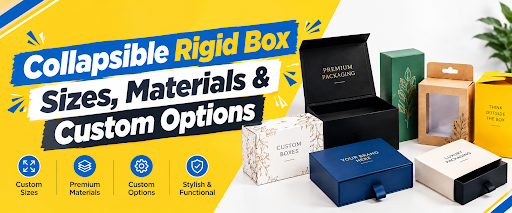
Choosing the right collapsible rigid box size means more than matching a box to a product’s length, width, and height. You also need to account for the product’s weight, protective inserts, board thickness, closure style, and the way the box folds for storage and delivery. The right specification creates a premium presentation while helping the packaging fit the product and the brand’s practical requirements.
Collapsible rigid boxes combine the substantial feel of traditional rigid packaging with a foldable construction that allows the box to be stored and transported in a flat or partially collapsed configuration. They are commonly considered for luxury gifts, cosmetics, skincare sets, electronics accessories, jewelry, and other products where presentation matters.
This guide explains how to choose collapsible rigid box dimensions, compare materials, select closures and inserts, plan printing and finishing, and prepare a specification for a custom packaging quote in the United States.
Collapsible Rigid Box Sizes: A Quick Answer
Collapsible rigid boxes can be made in a range of custom sizes, from compact boxes for jewelry and small gifts to larger formats for cosmetics sets, apparel accessories, and corporate gift collections. There is no single standard size that suits every product. The correct dimensions depend on the packed product, the box structure, the required insert, and the space needed for safe placement and removal.
Start by measuring the product or complete product set. Establish the required internal length, width, and depth, then account for inserts, wrapping, and any components that occupy space inside the box. The manufacturer can use those requirements, along with the selected board and folding structure, to establish the finished external dimensions and flat-pack configuration.
| Box size category | Potential applications | Key sizing consideration |
|---|---|---|
| Small | Jewelry, small accessories, compact gifts | Product fit, insert thickness, and closure clearance |
| Medium | Skincare products, cosmetics, candles, gift items | Space for multiple products and protective inserts |
| Large | Gift sets, apparel accessories, corporate gifts | Structural stability, lid or flap alignment, and product movement |
| Custom multi-product | Bundles, launch kits, subscription gifts | Layout of all items and insert compartments |
| Shallow | Flat accessories, cards, slim gift items | Depth needed for the product and any protective layer |
| Deep | Bottles, jars, grouped products, taller items | Product height, clearance, and insert support |
These are functional size categories, not standardized industry measurements. Your supplier should confirm the exact dimensions and construction for your selected design.
What Are Collapsible Rigid Boxes?
Collapsible rigid boxes are premium packaging boxes built with rigid board and designed to fold or collapse for storage when not assembled. They are often wrapped in printed or decorative paper and may use magnetic closures, tuck-in flaps, ribbons, or other closure designs depending on the structure.
Unlike a conventional folding carton, which is generally made from thinner paperboard and assembled through folds, a collapsible rigid box uses a more substantial board construction to create a sturdy presentation. Its panels and folding joints are engineered so the box can be collapsed and reassembled according to its design.
How Do Flat-Pack Rigid Boxes Work?
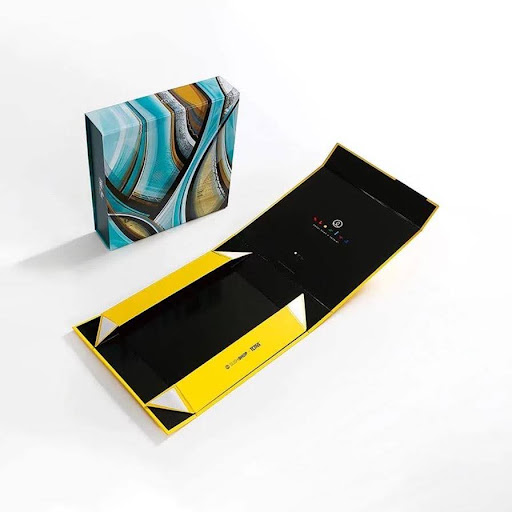
The panels of a collapsible box are connected using a designed folding arrangement, hinges, adhesive areas, or other structural components. When assembled, the panels form a rigid-looking box. When collapsed, selected sides fold inward or flatten so the package occupies less space than a fully assembled box.
The exact folding mechanism varies by design. Not every rigid box is collapsible, and not every collapsible construction folds in the same way. Ask the supplier for a sample or structural drawing if the box will be assembled repeatedly or if the folding method is important to your packing process.
For brands comparing rigid packaging formats, Bluebird Packaging’s Custom Rigid Boxes collection is a useful starting point for exploring other structures and presentation styles.
How to Choose the Right Collapsible Rigid Box Size
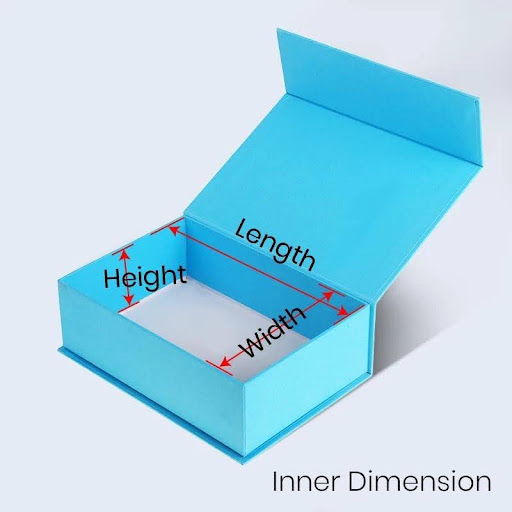
The best size is the smallest practical internal space that comfortably accommodates the complete product configuration, including its wrapper, insert, and protective components. A box that is too tight can make packing difficult or damage the product, while a box that is unnecessarily large can allow movement and weaken the presentation.
Follow these steps before finalizing your dimensions.
Step 1: Measure the Product
Measure the product at its widest, longest, and tallest relevant points. If you are packaging several items together, measure each item and plan how they will be arranged.
For a set containing a bottle, jar, and accessory, for example, do not simply add the dimensions of all three products. Their arrangement inside the box determines the required length, width, and depth.
Step 2: Account for the Insert
If the box will contain a foam, paperboard, molded, or other fitted insert, the insert must be included in the sizing plan. Its outer dimensions, compartment shapes, and thickness can affect how much usable space remains.
A product may fit inside an empty box but fail to fit once the insert is installed. Plan the box and insert as one system rather than specifying them independently.
Step 3: Establish the Required Internal Dimensions
The internal dimensions describe the usable space inside the assembled box. These are the dimensions that matter most when checking whether a product or set will fit.
Confirm whether the supplier’s drawing refers to the inside dimensions, outside dimensions, or a flat component before approving the specification.
Step 4: Confirm External Dimensions
The finished external dimensions depend on the internal space, board thickness, wrapping material, folds, and structural design. They matter for storage, shipping cartons, shelf placement, and the amount of space the package occupies when assembled.
Step 5: Check the Collapsed Configuration
If the main reason for choosing a collapsible rigid box is flat-pack storage, ask for the collapsed dimensions as well. The folded size may differ considerably from the assembled footprint, depending on the design and construction.
For additional measuring guidance, see Bluebird Packaging’s box measurement guide.
Collapsible Rigid Box Dimension Checklist
Before approving a size, confirm these details:
- Product length, width, and height measured.
- Product weight and fragility considered.
- Wrapping, protective layers, and inserts included.
- Internal dimensions clearly specified.
- External dimensions confirmed by the supplier.
- Lid, flap, or magnetic closure clearance checked.
- Collapsed dimensions requested when flat-pack storage matters.
- Sample or structural drawing reviewed where necessary.
Common Collapsible Rigid Box Sizes by Product Type
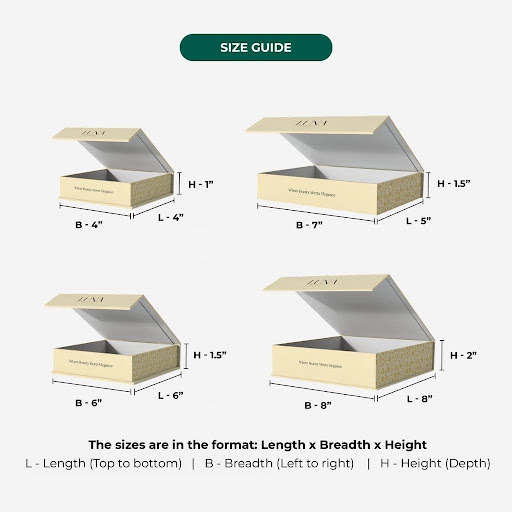
Different products need different internal layouts. A jewelry box may require a compact cavity and a fitted insert, while a skincare set may need separate compartments for multiple bottles and jars. Rather than relying on a generic size chart, use the product’s packed dimensions and intended presentation to develop the specification.
| Product type | Sizing priority | Possible design approach |
|---|---|---|
| Jewelry and small accessories | Compact fit and insert accuracy | Small box with a fitted compartment |
| Skincare sets | Multiple products and protective spacing | Medium or custom multi-compartment box |
| Cosmetics gift sets | Product arrangement and branded presentation | Custom insert with a coordinated outer box |
| Electronics accessories | Component organization and protection | Structured box with fitted compartments |
| Corporate gifts | Mixed products and presentation | Custom dimensions based on the full gift set |
| Apparel accessories | Product footprint and presentation | Shallow or medium-depth format, depending on contents |
| Premium candles or gift items | Product weight and movement control | Size matched to the item, with suitable internal support |
These examples describe design directions rather than guaranteed size specifications. The right dimensions should be confirmed against the actual products and insert drawings.
Materials Used in Collapsible Rigid Boxes
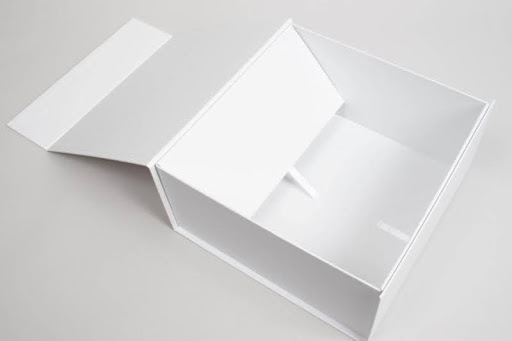
Collapsible rigid boxes commonly use a rigid board core covered with paper or another decorative wrapping material. The core contributes to the box’s structure, while the outer wrap determines much of its visible texture, print appearance, and finishing possibilities.
The material should be selected according to the product’s weight, intended presentation, artwork, and handling requirements.
Rigid Board
Rigid board forms the structural body of the box. The board grade and thickness influence the stiffness, weight, fold design, and overall feel of the finished package.
A thicker board is not automatically the best choice. The appropriate specification depends on the box dimensions, panel size, product weight, and folding mechanism. Larger panels and heavier contents may require a different structural approach from compact boxes holding lightweight products.
Kraft Paper and Natural-Look Wraps
Kraft-style wraps can create a natural, understated appearance. They may suit brands that use earthy colors, minimalist typography, or a restrained visual identity.
The final look depends on the actual wrap material and printing method. Ask for a sample if the natural texture or color is central to the design.
White and Printed Paper Wraps
White or printable wraps are useful when the artwork depends on a clean background, detailed graphics, or more controlled color reproduction. They can support a variety of brand styles, from simple logos to elaborate illustrations.
For a broader overview of paper-based materials, see Bluebird Packaging’s packaging materials guide.
Textured and Specialty Papers
Textured, colored, or specialty papers can add visual and tactile distinction. The selected wrap should be compatible with the box’s folding joints and construction. Not every decorative paper works equally well on every collapsible structure.
How to Compare Materials
| Material or surface | Potential benefit | What to confirm |
|---|---|---|
| Standard paper wrap | Versatile base for branding | Print quality and surface consistency |
| Kraft-style wrap | Natural visual character | Color contrast and print limitations |
| Coated or smooth wrap | Suitable for detailed artwork | Coating compatibility and desired appearance |
| Textured paper | Distinctive tactile quality | Folding performance and graphic legibility |
| Specialty decorative paper | Unique color or finish | Availability, production suitability, and cost |
Material selection should be based on a real packaging sample or supplier specification whenever appearance, folding performance, or product protection is critical.
Customization Options for Collapsible Rigid Boxes
Custom collapsible rigid boxes can be designed around the product, brand identity, and opening experience. The available choices depend on the construction and supplier capabilities, so it is important to confirm compatibility before finalizing the artwork or production specification.
1. Custom Dimensions and Box Structure
Custom dimensions allow a box to fit a particular product or collection rather than forcing the product into a standard package. The structure can be planned around the product layout, the required depth, the closure, and the way the box folds.
Consider a custom size when:
- The product has an unusual shape or footprint.
- Several items need to fit in one box.
- A fitted insert is required.
- The package must fit a particular gift or retail presentation.
- The flat-pack configuration is an important operational requirement.
For a related rigid format, compare the construction of custom two-piece rigid setup boxes. A two-piece rigid box and a collapsible rigid box serve different structural purposes, so the right choice depends on whether foldability is a key requirement.
2. Magnetic Closures
Magnetic closures are commonly used in premium gift packaging because they can create a neat, controlled opening and closing experience. In a collapsible design, the closure must work with the folding panels and assembled structure.
Before choosing this option, confirm the flap dimensions, magnet placement, closure alignment, and how the box behaves after repeated opening. A magnetic closure should be selected because it suits the product and user experience, not simply because it looks premium.
You can compare the related custom magnetic-closure rigid boxes when deciding which rigid structure best suits your project.
3. Custom Printed Graphics and Logos
Branding can be applied through logos, product names, illustrations, color systems, patterns, and supporting information. Depending on the selected wrap and printing method, a collapsible box may accommodate a simple one-color design or more elaborate artwork.
For a consistent brand experience, plan the exterior and interior together. The outside may establish brand recognition, while the inside can carry a message, product information, or a complementary design.
Review Bluebird Packaging’s packaging printing guidance when planning the artwork and production requirements.
4. Finishes and Decorative Effects
Finishing options may include matte or gloss surfaces, foil stamping, embossing, debossing, and selected specialty treatments. Availability depends on the wrap material, structure, and production process.
| Customization | What it can contribute | Planning consideration |
|---|---|---|
| Matte finish | Understated, low-glare appearance | Surface durability and intended look |
| Gloss finish | Shine and visual contrast | Reflection and artwork compatibility |
| Foil stamping | Metallic accents | Foil color, line detail, and placement |
| Embossing | Raised tactile details | Board and wrap suitability |
| Debossing | Recessed branding details | Depth and artwork complexity |
| Interior printing | Coordinated opening experience | Interior surface and printing method |
| Custom insert | Organized product placement | Product fit, retention, and material compatibility |
Use decorative effects selectively. A clearly placed logo and well-designed insert can create a premium presentation without adding unnecessary complexity. For more ideas, see these packaging finishes and their applications.
5. Inserts and Compartments
Inserts help keep products organized and can prevent movement inside the box. They are particularly useful for multi-product gift sets, cosmetics collections, and accessories that need to sit in a specific arrangement.
The insert should be designed around the full product configuration, not just the empty box. Confirm the dimensions of each compartment, the space required to remove the products, and whether the insert adds height or depth to the package.
6. Interior and Exterior Design
The outside and inside of the box should feel like parts of the same design system. A brand may use a restrained exterior with a contrasting interior, or carry the same color and graphics across both surfaces.
Before approving the design, consider what customers will see first, how the box opens, where the product sits, and whether any message or printed detail will be covered by the lid or flap.
Why Brands Choose Flat-Pack Rigid Boxes
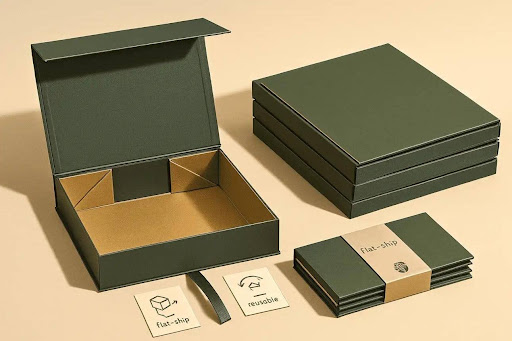
Flat-pack rigid boxes offer a useful combination of premium presentation and a collapsible storage configuration. When properly designed, they can be stored or transported in a collapsed form and assembled when needed.
However, the space savings depend on the specific box construction, the collapsed dimensions, and the way boxes are packed. A collapsible box may still occupy more space than a flat folding carton, and the folding structure may require careful assembly.
Potential Benefits
- Space-conscious storage: Collapsed boxes can take up less space than the same boxes fully assembled.
- Premium presentation: Rigid board can provide a substantial feel compared with many lightweight cartons.
- Custom branding: Decorative wraps and printing can align with the brand’s visual identity.
- Flexible product presentation: Inserts and compartments can organize one or more products.
- Useful for gift packaging: A designed opening and closure can contribute to the overall gifting experience.
What to Consider Before Ordering
- How much space does each collapsed box occupy?
- How long does assembly take?
- Does the box retain its shape after assembly?
- Will the closure align consistently?
- Are the products protected from movement?
- Does the design require special storage or handling?
If the packaging will be used for ecommerce, remember that a premium retail box may still need a suitable outer shipping carton. Review the full distribution route and the product’s handling requirements. Bluebird Packaging’s ecommerce packaging guidance provides additional context for planning packaging for online orders.
Collapsible Rigid Boxes vs. Other Rigid Box Styles
Not every premium product needs collapsible packaging. A conventional rigid box may be appropriate when a fixed structure is preferred, while other formats can suit different opening styles and product presentations.
| Box style | Main characteristic | When to consider it |
|---|---|---|
| Collapsible rigid box | Designed to fold or collapse for storage | Premium packaging where flat-pack storage is useful |
| Two-piece rigid box | Separate base and lid | Gifts and products requiring a traditional presentation |
| Magnetic-closure rigid box | Hinged or flap-style closure with magnetic fastening | Premium sets and products where the opening experience matters |
| Book-style rigid box | Opens like a book, depending on construction | Presentation-led packaging and gift sets |
| Credit card box | Compact format designed around card-sized contents | Cards, small inserts, and compatible compact products |
Explore these related formats when comparing structures: book-style rigid boxes and custom credit card boxes. Confirm the current construction and available options with the supplier before treating one style as a direct substitute for another.
The best format depends on the product, required protection, assembly process, and presentation goal. A collapsible structure is especially relevant when reducing the space occupied by assembled boxes is part of the brief.
How to Prepare a Custom Collapsible Rigid Box Specification
A clear specification makes it easier for a packaging supplier to recommend a suitable construction and prepare a comparable quotation. Instead of requesting a box by size alone, include the product details, dimensions, material preferences, artwork, and practical requirements.
Step 1: Define the Product and Quantity
Describe the product or product set, its approximate weight, any fragile components, and the expected order quantity. If you are packaging several SKUs, identify whether they will share one box size or need separate specifications.
Step 2: Provide the Dimensions
Supply the product measurements and state whether your requested box dimensions are internal or external. Include any wrapping, protective layers, and insert requirements.
Step 3: Select the Structure
Explain whether a collapsible rigid construction is essential, whether you need a magnetic closure, and how the box should open. If flat-pack storage is important, request the collapsed dimensions as part of the quotation.
Step 4: Describe Materials and Finishes
Specify the preferred outer wrap, board appearance, print requirements, and any finishes. If you are undecided, ask the supplier to recommend options based on the artwork and intended use.
Step 5: Provide Artwork or Branding Requirements
Supply your logo and artwork if available. If the design is still in development, describe the intended brand style, colors, printed areas, and product information.
Step 6: Request a Comparable Quote
When comparing quotations, keep the key requirements consistent: dimensions, construction, material, printing, finishing, inserts, quantity, and delivery requirements. This helps you understand whether differences in quoted cost come from the material, structure, or production specification.
For additional budgeting guidance, consult Bluebird Packaging’s custom packaging cost guide. The final cost should be based on a confirmed specification rather than a generic price estimate.
Common Mistakes When Choosing Collapsible Rigid Box Sizes
A premium box can still underperform if its dimensions or construction are poorly matched to the product. These are common issues to address before approving a production run.
| Mistake | Why it matters | Better approach |
|---|---|---|
| Measuring only the bare product | Wrapping or inserts may prevent a proper fit | Measure the complete packed configuration |
| Confusing internal and external dimensions | The usable cavity may be smaller than expected | Label both dimensions clearly |
| Ignoring board thickness | It affects the relationship between internal and external size | Confirm the actual board specification |
| Forgetting closure clearance | Flaps or lids may not align correctly | Check the assembled sample or structural drawing |
| Designing the insert separately | The product and insert may not fit together | Develop the box and insert as one system |
| Assuming every rigid box collapses | Some rigid structures are designed to remain assembled | Confirm the exact folding construction |
| Choosing finishes before selecting the wrap | Certain effects may not suit the chosen surface | Confirm material and finishing compatibility |
| Overlooking assembly requirements | Packing may take longer or require extra handling | Review the assembly method and test a sample |
| Comparing quotes with different specifications | Price differences may not be meaningful | Request quotes based on matching requirements |
For brands developing a broader packaging system, Bluebird Packaging’s custom packaging solutions and packaging design guidance can help frame the relationship between structure, appearance, and function.
Frequently Asked Questions About Collapsible Rigid Box Sizes
1. What sizes do collapsible rigid boxes come in?
Collapsible rigid boxes can be produced in compact, medium, large, and custom configurations, depending on the product and construction. There is no universal size range that applies to every supplier. Confirm the internal dimensions, external dimensions, and collapsed dimensions for your specific design.
2. How do I measure a collapsible rigid box?
Measure the product’s length, width, and height, including any wrapping or components that will go inside the box. Establish the required internal dimensions, then confirm the finished external dimensions with the supplier. If flat-pack storage matters, request the collapsed dimensions too.
3. Are collapsible rigid boxes available in custom sizes?
Yes, custom sizing may be available depending on the manufacturer’s capabilities and the chosen structure. Provide product measurements, quantity, insert requirements, and closure preferences so the supplier can determine a suitable construction.
4. What materials are used in collapsible rigid boxes?
They commonly use rigid board for the structure with a decorative outer wrap, such as printed, coated, Kraft-style, or specialty paper. The exact materials depend on the desired appearance, structural requirements, and available manufacturing options.
5. Are collapsible rigid boxes the same as folding cartons?
No. Folding cartons typically use thinner paperboard and fold into shape, while collapsible rigid boxes use a more substantial board construction designed to collapse through a specific folding mechanism. The two formats differ in structure, assembly, storage, and presentation.
6. Can collapsible rigid boxes have magnetic closures?
Some collapsible rigid box designs can incorporate magnetic closures. Compatibility depends on the folding structure, flap design, and magnet placement, so confirm the closure with the manufacturer before finalizing the box.
7. Can I add inserts to collapsible rigid boxes?
Yes, inserts can be designed to organize and support products inside the box. The insert should be planned alongside the box dimensions because it affects usable space, product positioning, and removal.
8. Are collapsible rigid boxes suitable for luxury packaging?
They can be suitable for premium products because rigid board, decorative wraps, branding, and selected finishes can create a refined presentation. The final result depends on the design, material specification, assembly, and quality of production.
9. Do collapsible rigid boxes save storage space?
They can occupy less space when stored collapsed than when stored fully assembled. The actual space savings depend on the box design and collapsed dimensions. Compare those dimensions with the space required for assembled boxes before making a storage decision.
10. Are collapsible rigid boxes suitable for ecommerce?
They can be used as retail or presentation packaging for ecommerce products, but the complete shipping requirements should be considered. Depending on the product and distribution conditions, an additional outer shipping carton or protective materials may be needed.
11. What affects the price of custom collapsible rigid boxes?
Pricing depends on dimensions, board specification, outer wrap, printing, finishing, closure, inserts, quantity, and production requirements. A meaningful quote should be based on a complete and consistent specification.
12. How can I order custom collapsible rigid boxes in the USA?
Prepare the product dimensions, quantity, preferred structure, material, branding, finish, and insert requirements. Then send the specification to a packaging supplier for review and quotation. You can submit your requirements through Bluebird Packaging’s request-a-quote page.
Conclusion: Choose Collapsible Rigid Box Dimensions Around Your Product
The right collapsible rigid box sizes are determined by the product’s actual dimensions, the complete packed configuration, the insert, the closure, and the box’s folding structure. Material and customization choices then shape the packaging’s appearance, usability, and overall presentation.
Start by measuring the product and defining the internal space it needs. Confirm the external and collapsed dimensions with the supplier, then select the rigid board, outer wrap, closure, printing, finishes, and insert around your intended use. Reviewing a sample or structural drawing before production can help identify fit and assembly issues early.
For more packaging inspiration, browse Bluebird Packaging’s packaging design ideas and types of packaging. If environmental considerations are part of your brief, review the relevant sustainable packaging information and verify the specification of the finished box before making any environmental claims.
When you’re ready to discuss a project, provide the product dimensions, quantity, preferred design, and customization requirements through the Bluebird Packaging quote form. A clear specification makes it easier to evaluate the right construction and compare suitable options.
One additional resource worth reviewing is the Bluebird Packaging product collection for broader packaging options, the packaging cost overview for budgeting considerations, and the contact page for project-specific questions. For environmental material context, the US EPA’s paper and paperboard recycling data is a useful external reference.
Need Custom Collapsible Rigid Boxes?
Share your product dimensions, order quantity, preferred materials, and customization requirements with Bluebird Packaging to discuss a packaging solution tailored to your project.