
Kraft and cardboard can both work well for bar soap packaging, but they create different looks and offer different printing possibilities. Kraft bar soap boxes are a strong choice for natural, handmade, and minimalist branding, while smooth cardboard or coated paperboard boxes are often better for vibrant colors, detailed artwork, and a polished retail appearance. The right option depends on your brand identity, print requirements, soap dimensions, handling conditions, budget, and environmental goals.
For US soap brands, the decision should go beyond choosing brown or white packaging. You also need to consider board construction, surface finish, product fit, moisture exposure, labeling space, production quantities, and how the finished box will look on a retail shelf or in an ecommerce order.
This comparison explains the differences between Kraft and cardboard bar soap boxes, including materials, printing, finishes, durability, recyclability, cost considerations, and the best applications for each.
Kraft vs. Cardboard Bar Soap Boxes: A Quick Answer
Choose Kraft packaging if you want a natural paper appearance, understated branding, and a look that suits many handmade or botanical soap collections. Choose smooth cardboard or coated paperboard if you need more consistent color reproduction, detailed product photography, bright graphics, or a clean, premium retail presentation.
Neither material is automatically better for every soap brand. The correct choice depends on the specific paperboard grade, thickness, coating, box structure, and intended use.
| Comparison factor | Kraft bar soap boxes | Cardboard bar soap boxes |
|---|---|---|
| Appearance | Natural brown or kraft-colored surface | Often white, coated, or printable surface |
| Brand style | Artisan, botanical, rustic, minimalist | Modern, colorful, luxury, or mass retail |
| Printing | Works well with suitable dark inks and selected colors | Often suitable for detailed graphics and broader color reproduction |
| Color appearance | Natural brown substrate can affect printed colors | White or coated surfaces can provide a more neutral printing base |
| Finishing | Can support selected printing and decorative effects | Can support a wide range of printing and finishing options |
| Durability | Depends on board grade, thickness, and construction | Depends on board grade, thickness, and construction |
| Moisture performance | Not inherently moisture-proof | Not inherently moisture-proof |
| Environmental considerations | Depends on fiber source, coatings, inks, and local recycling | Depends on fiber source, coatings, inks, and local recycling |
| Common applications | Handmade, natural, and minimalist soap ranges | Retail, beauty, colorful, and premium soap collections |
Important terminology: Kraft is a type of paper or paperboard associated with a natural fiber appearance and kraft pulping, while “cardboard” is a broad everyday term for several paper-based board materials. Kraft paperboard can itself be used to make a cardboard box. In this article, cardboard soap boxes refers mainly to smooth white or coated paperboard cartons, to distinguish them from natural-looking Kraft cartons.
What Is the Difference Between Kraft and Cardboard Soap Boxes?
The main difference is the paperboard construction and surface appearance, not simply whether one box is made of paper and the other is not. Both options can use paper-based materials, and both can be customized for soap products. The visible surface, print requirements, board specification, and box design determine how each option performs.
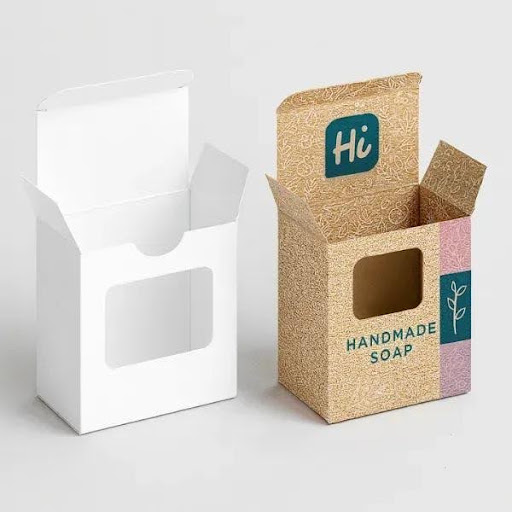
What Are Kraft Bar Soap Boxes?
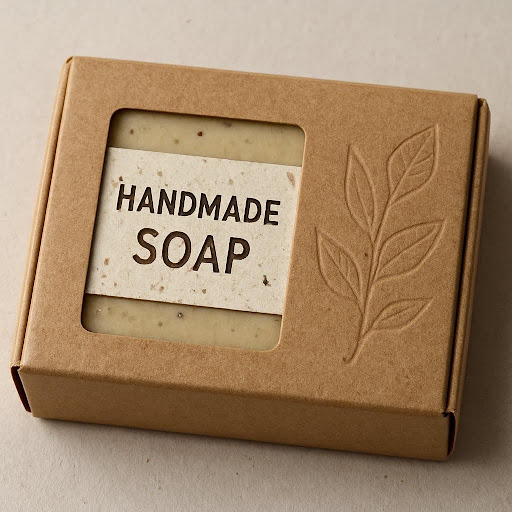
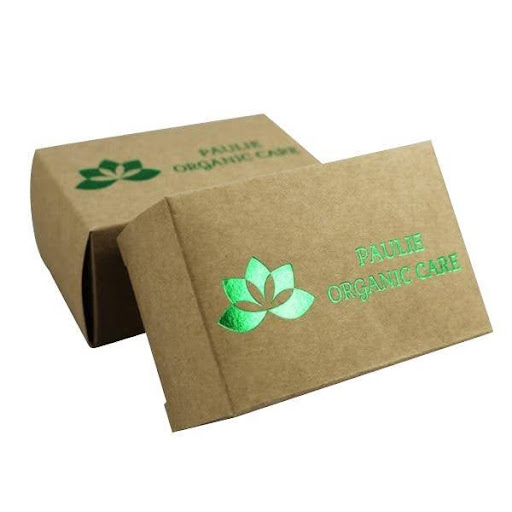
Kraft bar soap boxes are packaging cartons made from Kraft paperboard or a suitable board construction with a natural Kraft-colored exterior. Their brown, earthy appearance can complement brands that emphasize handmade production, botanical ingredients, simple design, or a natural product identity.
Kraft packaging is often paired with black or dark-colored printing, restrained graphics, botanical illustrations, and uncomplicated typography. Depending on the material and printing method, other colors and decorative details may also be possible.
Common uses include:
- Handmade soap bars and artisan collections.
- Botanical, herbal, or nature-inspired product lines.
- Minimalist personal care brands.
- Small-batch and specialty soaps.
- Gift products with a natural design direction.
- Retail soap ranges that use a consistent earthy visual identity.
The natural appearance is not proof that a product is organic, that its ingredients are natural, or that the packaging is fully recyclable. Those claims should be based on the actual product and packaging specifications.
What Are Cardboard Bar Soap Boxes?
Cardboard bar soap boxes are cartons made from a suitable paperboard grade, often with a smoother white or coated surface that supports branded printing. These cartons can be designed with product information, illustrations, photography, color-coded scent variations, and decorative finishes.
They are frequently considered by brands that want more flexibility in graphic design or a clean, consistent look across multiple products.
Common uses include:
- Everyday bath and beauty soaps.
- Facial cleansing bars and specialty personal care products.
- Retail products with detailed product information.
- Soap ranges with multiple scents or formulations.
- Premium collections using selective finishing.
- Brands that want vivid graphics or a white background.
Cardboard is not one standardized material. A lightweight folding carton and a thick, rigid board have different structural properties. For most individual soap bars, a properly specified folding carton may be sufficient; heavier or multi-product gift sets may need a different construction.
For an overview of material terminology and common packaging choices, Bluebird Packaging’s guide to different packaging materials can help you understand how substrate selection affects the final package.
Kraft vs. Cardboard: Which Material Is Better for Printing?
Smooth white or coated paperboard is often the more flexible choice for detailed, full-color soap packaging. Kraft is particularly suitable when the design benefits from a natural background and a restrained color palette. The final result depends on the printing process, ink system, surface, and artwork.
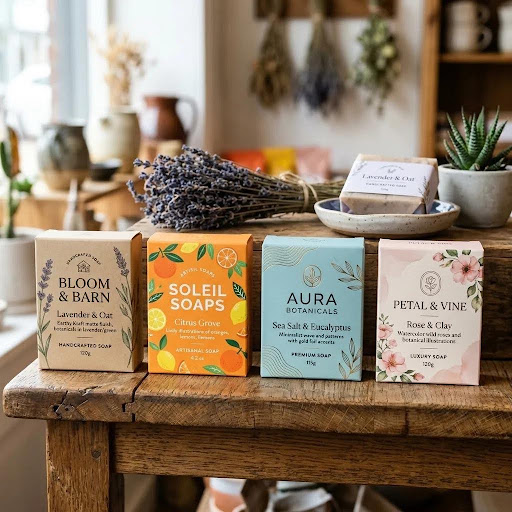
Printing on Kraft Paperboard
Kraft’s brown surface becomes part of the design. It can make dark logos, black typography, simple line illustrations, and earthy color palettes feel cohesive.
However, the substrate affects color appearance. A light pink, pale yellow, or pastel blue printed on brown Kraft may appear different from the same ink printed on a white surface. Fine details and low-contrast text also need careful testing.
Kraft may suit your design if you plan to use:
- Black, dark brown, or other high-contrast text.
- Simple logos and line art.
- Botanical illustrations.
- Limited-color designs.
- Minimalist layouts.
- Natural-looking backgrounds.
If your design relies on pale colors, subtle gradients, or realistic product photography, ask your packaging supplier to confirm how the selected Kraft stock and printing process will reproduce those elements.
Printing on White or Coated Paperboard
A white or coated surface often provides a more neutral base for reproducing brand colors. It can be useful when artwork includes detailed illustrations, photographs, gradients, or several color variations.
Common applications include:
- Full-color product illustrations.
- Bright scent or flavor color systems.
- Detailed ingredient and product information.
- White backgrounds with colorful graphics.
- Premium retail artwork.
- Multiple SKUs that need consistent visual treatment.
A coating can affect the look and feel of the finished package, but it does not guarantee perfect color matching. For important brand colors, confirm the print specification and review an appropriate proof.
For a closer look at how artwork is prepared for packaging, see Bluebird Packaging’s packaging printing options and considerations.
How Do Matte, Gloss, Foil, and Embossed Finishes Compare?
Finishing changes the appearance and feel of a soap carton, but the available options depend on the material, printing method, structure, and production process.
| Finish | Visual effect | Best suited to |
|---|---|---|
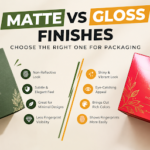
| Matte finish | Soft, understated, low-glare appearance | Minimalist, modern, or premium branding |
| Gloss finish | Reflective surface and stronger visual shine | Bright graphics and bold retail designs |
| Foil stamping | Metallic detail or accent | Premium logos, product names, and gift collections |
| Embossing | Raised design detail | Tactile logos and selected graphic elements |
| Debossing | Indented design detail | Subtle branding and understated packaging |
| Spot UV | Selective gloss over chosen areas | Highlighting logos, patterns, or artwork |
| Soft-touch finish | Smooth, tactile surface | Premium presentation where compatible |
Kraft packaging can support selected decorative treatments, but the brown substrate may influence the visual result. Smooth paperboard may be more suitable when the design depends on strong contrast between printed colors and a clean background.
Finishing should support the design rather than overwhelm it. One carefully selected treatment can communicate a clearer brand identity than several competing effects. For more detail, explore these packaging finishes and their applications.
Which Soap Box Material Is More Durable?
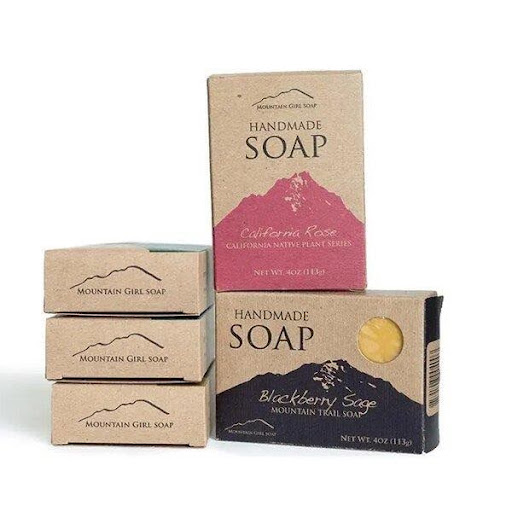
Neither Kraft nor cardboard is automatically more durable. Durability depends on the board’s grade, thickness, stiffness, grain direction, carton design, closure, and the conditions in which the package will be stored and handled.
For a typical individual bar of soap, a well-designed folding carton may provide enough support for storage and retail display. A heavier soap bar, a multi-bar kit, or a product that will travel through a demanding distribution process may need a stronger specification or additional protective packaging.
Factors That Affect Packaging Durability
Consider these five factors before selecting a material:
- Board thickness and stiffness: The selected grade should hold its shape under normal handling and stacking.
- Box structure: Folds, tuck flaps, glued areas, and closures affect how well the carton stays assembled.
- Soap weight and shape: Thick, heavy, or irregular bars may need more clearance or a different structure.
- Moisture exposure: Paperboard can soften or distort when exposed to moisture. Neither Kraft nor ordinary cardboard should be assumed waterproof.
- Distribution conditions: A box designed for a retail shelf may need additional protection when shipped directly to customers.
Soap can contain moisture or oils, and some formulations may be wrapped before being placed inside the carton. The packaging design should account for the actual soap, its wrapping, and the expected storage conditions.
For ecommerce, consider the complete shipping system rather than relying on the retail carton alone. A suitable outer package may be necessary to protect the soap carton from crushing, abrasion, and transit damage. Bluebird Packaging’s ecommerce packaging guidance offers additional context for products sold online.
Are Kraft Soap Boxes More Eco-Friendly Than Cardboard Boxes?
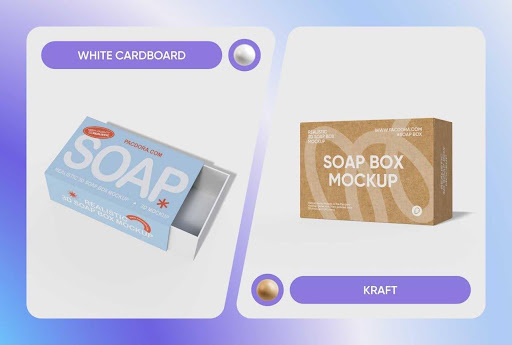
Not automatically. Kraft and cardboard packaging can both be paper-based, but environmental performance depends on the complete material construction, recycled content, coatings, inks, adhesives, manufacturing, transportation, and the recycling facilities available to the customer.
Kraft’s natural brown color does not prove that it contains recycled fibers or that the finished box will be accepted in every recycling program. Similarly, a white or printed paperboard carton is not automatically non-recyclable.
What to Check Before Making Environmental Claims
Review the actual packaging specification and ask:
- Does the paperboard contain recycled fiber, virgin fiber, or a combination?
- Is the box uncoated, coated, laminated, or otherwise treated?
- Are any windows, plastic components, magnets, or mixed materials included?
- Can the finished package be separated into different material components?
- Is the packaging accepted by recycling programs in the markets where it will be sold?
- Are claims such as “recyclable,” “recycled,” or “compostable” supported by evidence?
The US Environmental Protection Agency provides information about paper and paperboard recycling. This is a useful starting point for understanding the material category, although local acceptance and the recyclability of a specific finished carton still need to be checked.
Brands can also review Bluebird Packaging’s packaging recycling information and sustainable packaging considerations when evaluating material choices.
How to Communicate Sustainability Responsibly
Use specific, verifiable statements rather than broad environmental promises. For example, a claim about recycled content should be supported by the supplier’s material documentation. A recyclability claim should account for coatings, laminations, windows, and local recycling infrastructure.
If your brand uses Kraft because it suits the product’s natural visual identity, describe that design choice accurately. Do not assume that a brown carton is necessarily more sustainable than a white carton made from another paperboard grade.
Which Option Is More Affordable?
The cost of Kraft versus cardboard bar soap boxes depends on more than the name of the material. The order quantity, box dimensions, board thickness, printing coverage, finishing, structural complexity, and production requirements all affect the final quotation.
A simple Kraft carton with limited printing may be cost-effective for a brand using a minimalist design. A white paperboard carton with detailed full-color printing may be a better investment when accurate color reproduction and retail presentation are priorities. Either option can become more expensive when additional finishing, unusual structures, or complex artwork are involved.
What Influences the Price of Custom Soap Boxes?
| Cost factor | Why it matters |
|---|---|
| Material and board grade | Different specifications have different costs and performance characteristics |
| Box dimensions | Larger cartons generally use more material |
| Thickness and structure | Stronger or more complex constructions may require additional material or production work |
| Printing coverage | Artwork and color requirements influence the print specification |
| Finishing | Foil, embossing, lamination, and specialty effects can add cost |
| Order quantity | Production setup and unit cost may vary with quantity |
| Inserts and windows | Additional components or cutting operations affect complexity |
| Proofing and sampling | Physical samples or special approval steps may add to project cost |
The most useful way to compare quotes is to request the same dimensions, quantity, structure, printing requirements, and finishing options for both materials. Otherwise, a price difference may reflect different specifications rather than the material alone.
If you are planning a packaging budget, use Bluebird Packaging’s custom packaging cost guide to understand the factors that can affect pricing. You can then compare suitable material options using a consistent specification.
How to Choose the Right Soap Box Material for Your Brand
The best material is the one that meets your product requirements and supports your brand presentation without adding unnecessary complexity.
Use the following decision guide to narrow your options.
Choose Kraft If Your Brand Needs a Natural Appearance
Kraft may be a good fit when:
- Your brand uses botanical, rustic, or minimalist design.
- You prefer a visible natural paper color.
- Your artwork uses dark, high-contrast printing.
- You want a consistent visual style across handmade products.
- Your design does not depend on reproducing pale colors on a white background.
For example, an artisan soap maker selling lavender, oatmeal, or herbal bars may choose a Kraft carton with a simple logo and restrained typography. The material and artwork work together to create a coherent appearance.
Choose Smooth Cardboard If Your Brand Needs Detailed Printing
A smooth white or coated paperboard may be a better fit when:
- You need full-color illustrations or product photography.
- Your brand relies on precise colors across multiple product variants.
- You need a clean white background.
- Your packaging uses detailed patterns or complex graphics.
- Your products compete in a colorful retail environment.
For example, a personal care company with several soap scents may use a consistent carton design while changing the accent colors and artwork for each variety. A printable white surface can help the collection look coordinated.
Consider Both Options Before Deciding
If the design direction is not final, request samples or proofs using the intended artwork. Comparing the same logo, colors, and product information on both materials can reveal differences that are difficult to judge on a screen.
You can also compare other custom retail packaging options if the soap is part of a broader product range.
What Soap Brands Should Consider Before Ordering Custom Boxes
Before approving a production run, make sure the packaging specification accounts for the actual product, its presentation, and the conditions in which it will be sold.
1. Measure the Soap Bar
Record the soap’s length, width, and height at the widest relevant points. If the soap has rounded edges, an irregular shape, or a wrapper, account for the finished dimensions.
Do not assume the dimensions of the bare soap will match the dimensions of the packaged product. Read Bluebird Packaging’s box measurement guide to understand how dimensions should be specified.
2. Decide How the Soap Will Be Packed
Will the bar be placed directly inside the carton, wrapped first, or packed with a label or insert? The complete configuration affects the required internal dimensions and the way the product fits.
A box that is too tight can be difficult to pack, while an oversized box may allow unnecessary movement or look poorly fitted.
3. Plan the Artwork and Product Information
Decide which information belongs on the front, sides, and back. Depending on the product and applicable requirements, the artwork may need the brand name, product name, net weight, ingredients, usage information, warnings, business details, or barcode.
Requirements vary by product and jurisdiction. US soap and cosmetic products may fall under different regulatory frameworks depending on their intended use and claims. Brands should verify the applicable labeling rules for their product rather than assume every bar soap has identical requirements.
4. Match Printing to the Material
Choose colors, illustrations, and finishes with the actual substrate in mind. Artwork designed for a white background may need adjustments for Kraft paperboard.
Confirm the print method, expected color appearance, finish, and proofing process before production.
5. Review a Sample When Needed
A physical sample can help you evaluate fit, opening, closure, board stiffness, color, and finishing. It is especially useful when the packaging uses unusual dimensions, windows, complex folds, or premium decorative treatments.
6. Confirm the Production Specification
Before placing an order, confirm:
- Material and board grade.
- Finished dimensions.
- Box style and closure.
- Printing sides and artwork.
- Finish and special effects.
- Quantity and packaging requirements.
- Proof approval process.
- Delivery requirements and timeline.
This checklist helps prevent avoidable misunderstandings between the design, quotation, and production stages.
Popular Applications for Kraft and Cardboard Soap Boxes
Both material directions can work across several soap categories. The important question is which construction and design are appropriate for the product and brand.
| Soap product or brand | Material direction to consider | Design priority |
|---|---|---|
| Handmade artisan soap | Kraft or printed paperboard | Craft identity and product presentation |
| Botanical or herbal soap | Kraft or muted-color printed cartons | Natural visual language |
| Facial cleansing bars | Smooth printed paperboard or Kraft | Clear product identification |
| Color-coded scent collections | White or coated paperboard | Distinguishable colors and consistent branding |
| Premium bath products | Paperboard with selective finishing or a more substantial structure | Refined presentation |
| Soap gift sets | Paperboard, Kraft, or rigid packaging as appropriate | Organization and gift presentation |
| Ecommerce soap products | A suitable retail carton with appropriate outer protection | Fit and transit handling |
| Promotional or event soaps | Kraft or custom printed paperboard | Personalization and visual consistency |
For individual bars, start by reviewing Bluebird Packaging’s custom Bar Soap Boxes. For broader applications, its Soap Boxes collection provides a starting point for comparing material and customization possibilities.
Brands developing a handmade range can also explore ideas for packaging handmade soap for natural product brands.
How to Create Better Branding With Custom Printed Soap Boxes
Packaging should help customers recognize the product and understand its place within the brand. Material selection is only one part of that process. The design also needs clear information, consistent typography, suitable colors, and a logical visual hierarchy.
Start with the product name and brand identity, then decide which details need to stand out most. A small artisan brand may prioritize the logo, scent, and ingredient story. A larger retail range may need a more structured system that distinguishes several formulas without making the packaging look inconsistent.
For example, a brand selling lavender, charcoal, and citrus soaps could keep the same logo placement and typography across all three products while changing selected colors and illustrations. This creates a family resemblance while making each product easier to identify.
For additional ideas, explore Bluebird Packaging’s packaging design guidance. The key is to make the material, graphics, and finish work together rather than treating them as unrelated decisions.
A Practical Packaging Selection Checklist
Before finalizing your Kraft or cardboard soap boxes, confirm the following:
- The material supports the intended brand appearance.
- The board grade is suitable for the soap’s weight and dimensions.
- Internal dimensions account for the finished, wrapped product.
- The printing method can reproduce the intended artwork.
- Important text remains legible on the chosen substrate.
- Finishes are compatible with the material and design.
- The carton suits retail display, storage, or ecommerce use.
- Environmental claims are supported by the actual specification.
- The quote covers the same requirements being compared.
- Artwork and samples have been reviewed before production.
Explore Soap Packaging Options From Bluebird Packaging
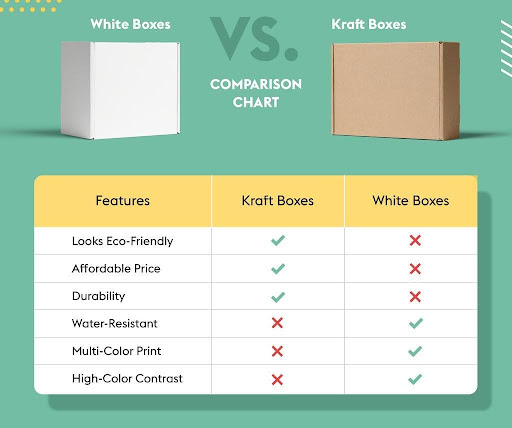
The material comparison is easier when you review options that can be customized for your actual product. Bluebird Packaging lists both Kraft and cardboard materials for soap packaging, along with printing and finishing choices. The final specification should still be confirmed for your selected box style and artwork.
- For a natural paper appearance, explore Kraft packaging boxes.
- For a smooth, customizable printed carton, review cardboard packaging boxes.
- For additional product-specific inspiration, browse soap packaging ideas and design approaches.
- If you are comparing several product categories, the packaging options by industry collection can help you explore other formats.
Frequently Asked Questions About Kraft vs. Cardboard Bar Soap Boxes
1. Is Kraft or cardboard better for bar soap boxes?
Kraft is often a good choice for natural-looking, handmade, and minimalist packaging. Smooth white or coated paperboard is often better for detailed artwork and vivid color reproduction. The best option depends on the design, board specification, product, and budget.
2. Are Kraft soap boxes made from cardboard?
Kraft paperboard can be used to manufacture a carton, so Kraft boxes can also be considered paperboard packaging. In everyday packaging discussions, “Kraft” usually describes the material’s natural appearance or paper type, while “cardboard” is a broad term for several board constructions.
3. Can you print full color on Kraft bar soap boxes?
Full-color printing may be possible, depending on the Kraft stock and printing process. However, the brown surface can change how colors appear, particularly pale colors and subtle gradients. Request a proof using the intended artwork before approving production.
4. Are cardboard soap boxes more durable than Kraft boxes?
Not necessarily. Durability depends on the board grade, thickness, carton structure, closure, product weight, and handling conditions. Compare the actual specifications rather than judging strength from the material name alone.
5. Are Kraft soap boxes more environmentally friendly?
Not automatically. Both Kraft and other paperboard cartons may be suitable for certain recycling streams, but the result depends on fiber content, coatings, laminations, adhesives, additional components, and local recycling rules. Environmental claims should be verified for the finished package.
6. Which soap box material is best for handmade soap?
Kraft is a popular visual choice for handmade soaps because its natural appearance can complement botanical artwork and minimalist branding. Printed paperboard is also suitable when the brand needs colorful graphics, detailed illustrations, or distinct designs for multiple soap varieties.
7. Can Kraft and cardboard soap boxes have matte or gloss finishes?
Depending on the substrate and manufacturing process, both can support selected decorative finishes. Compatibility and appearance should be confirmed with the packaging supplier, especially when combining coatings, foil, embossing, or other effects.
8. Which option is better for luxury soap packaging?
Either can work. A premium look can be created with a carefully chosen structure, typography, material, and selective finishing. Smooth printed paperboard may suit detailed, polished graphics, while Kraft can support understated premium branding.
9. How do I choose the correct size for a soap box?
Measure the soap’s length, width, and height, then account for any wrapper, insert, or other component. Specify the required internal dimensions and confirm the fit with a sample or approved specification when necessary.
10. What affects the cost of custom soap boxes?
Cost depends on material, board grade, dimensions, order quantity, printing coverage, structure, finishes, inserts, windows, and production requirements. Request comparable quotes using the same specifications to make a meaningful comparison.
11. Can I use Kraft boxes for a soap range with different scents?
Yes. A consistent layout can be adapted using different colors, illustrations, product names, and scent identifiers. The printing method and artwork should be chosen to work well with the Kraft surface.
12. Where can I order custom Kraft or cardboard soap boxes?
You can review Bluebird Packaging’s custom Bar Soap Boxes and submit your requirements through its request-a-quote page.
Conclusion: Choose the Soap Box Material That Fits Your Product
Kraft and cardboard bar soap boxes can both support effective packaging, but they serve different design priorities. Kraft is worth considering when a natural surface and understated branding are central to your identity. Smooth white or coated paperboard is often the better starting point for detailed graphics, stronger color reproduction, and coordinated retail product ranges.
Before deciding, compare the actual board specifications, printing results, finishes, product fit, durability requirements, and total quoted cost. Consider recyclability based on the finished package rather than the material name alone.
Bluebird Packaging offers customizable soap packaging options that can be developed around product dimensions, material preferences, printing, finishing, and presentation requirements. If you are preparing a new soap line or updating an existing collection, provide your product measurements, quantity, preferred design, and artwork requirements to request a custom packaging quote.
The right packaging choice is the one that fits your soap, communicates your brand clearly, and performs as intended in its real selling environment.
For a wider view of available packaging solutions, visit the Bluebird Packaging homepage or contact the packaging team to discuss your soap product, material preferences, and production requirements.