

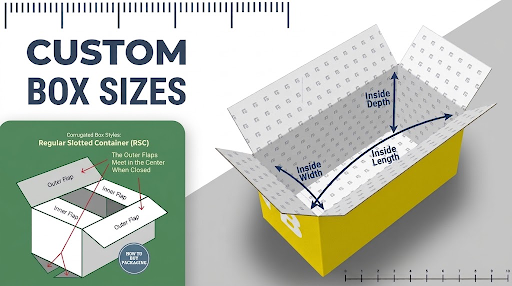
Choosing the right custom box sizes helps protect products, reduce wasted packaging space, improve presentation, and control shipping costs. To find the right fit, measure the product’s length, width, and height, determine whether you need internal or external dimensions, allow room for protective inserts when necessary, and choose a box structure suited to the product’s weight and intended use.
For most custom packaging projects, length × width × height (L × W × H) is the standard way to communicate box dimensions. However, the exact size depends on the product, packaging material, manufacturing method, and whether the box must accommodate cushioning, inserts, or multiple items.
This guide explains how to measure custom box dimensions in inches, centimeters, and millimeters, calculate box volume, avoid common sizing mistakes, and select suitable packaging for retail products, e-commerce orders, and shipping.
Quick Answer: How Do You Choose the Right Custom Box Size?
Follow these steps to determine the correct dimensions for your packaging:
- Measure the product: Record its longest length, width, and height, including any parts that extend outward.
- Check the measurement order: List dimensions as length × width × height, and confirm the supplier’s convention.
- Determine the required internal space: Start with the product’s actual dimensions and account for inserts, cushioning, or multiple items.
- Choose the material: Folding carton board, corrugated board, and rigid board have different thicknesses and structural properties.
- Confirm the finished box dimensions: Ask whether the quoted dimensions are internal or external and whether they refer to the erected box.
- Request a sample or proof: Verify fit, closure, protection, and appearance before approving a large production order.
For custom printed packaging, the goal is not simply to find a box that holds the product. It is to create a package that fits correctly, protects its contents, supports branding, and works with your storage, fulfillment, and shipping processes.
What Are Custom Box Sizes?
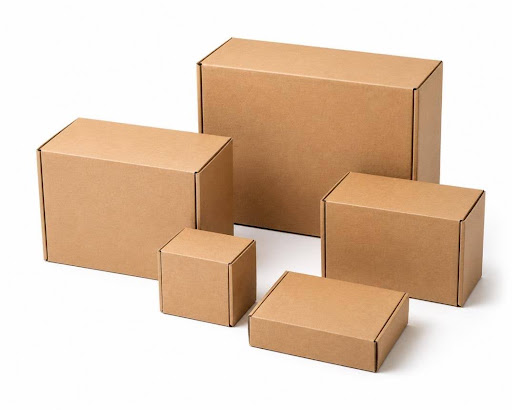
Custom box sizes are packaging dimensions made or specified to suit a particular product, group of products, or packaging requirement. Unlike stock boxes that come in predetermined sizes, custom-sized boxes can be designed around a product’s measurements, presentation requirements, material, and intended use.
For example, a skincare company may need a compact folding carton for one serum bottle, while an online retailer may need a corrugated mailer that accommodates a product, instruction card, and protective insert.
Custom dimensions are useful when standard boxes leave too much empty space, fail to accommodate a product properly, or do not provide the desired retail presentation.
Businesses can explore different types of packaging to understand how box structure and intended use affect sizing decisions.
Custom box sizes vs. standard box sizes
| Feature | Custom-sized boxes | Standard-sized boxes |
|---|---|---|
| Dimensions | Specified for the product or application | Selected from available stock sizes |
| Product fit | Can be designed around the required fit | May require extra void fill or compromise |
| Branding | Can accommodate custom printed artwork | Depends on the stock box and printing options |
| Storage | Can optimize space for repeat shipments | Depends on the available standard sizes |
| Initial setup | May require artwork, tooling, or a production setup | Usually simpler when using ready-made stock |
| Best use | Branded products, recurring orders, and specialized packaging | General shipping, temporary needs, and variable products |
Neither option is automatically better. Standard boxes can be practical for businesses with varied products or low packaging requirements. Custom sizing becomes more attractive when a business needs consistent presentation, a precise fit, or a repeatable packaging process.
How to Measure Custom Box Sizes Correctly
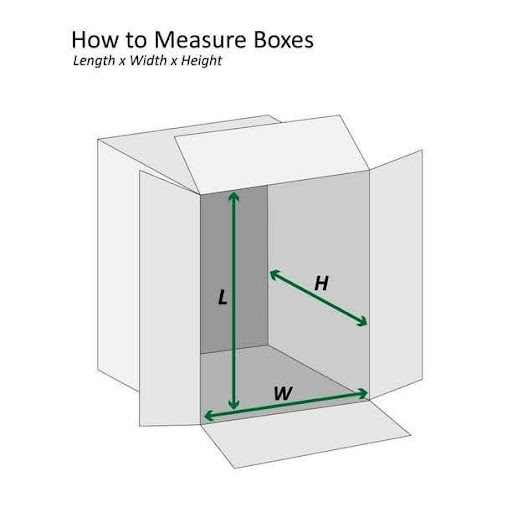
To measure custom box sizes accurately, use a ruler, measuring tape, or caliper appropriate for the product. Place the item on a flat surface, identify its three principal dimensions, and record each measurement using the same unit.
Step 1: Measure the product’s length
Length is generally the longest horizontal measurement of the product when it is positioned for packaging.
For a rectangular product, measure from one end to the other. If the item has protruding parts, handles, or attachments, measure the maximum length that the packaging must accommodate.
Step 2: Measure the width
Width is the measurement across the product, perpendicular to its length.
Do not assume width is always the shorter side. The important thing is to use a consistent orientation and label the dimensions clearly when sending them to a packaging supplier.
Step 3: Measure the height
Height measures the product from its bottom to its highest point in the intended packing orientation.
For bottles, jars, and containers, include caps, pumps, lids, or other components that increase the overall height. If the product will sit inside an insert, measure the space required for the product in that insert as well.
Step 4: Record all measurements
Use a consistent format, such as:
- Length: 6 inches
- Width: 4 inches
- Height: 2 inches
This gives you a starting product size of 6 × 4 × 2 inches. It does not automatically mean that the finished box should have those exact internal dimensions. You still need to account for the fit, material, closure, and any protective components.
For a more detailed measurement walkthrough, see this guide to measuring a box.
Step 5: Decide whether to include clearance
Clearance is the extra space required to place, remove, protect, or position the product inside the package.
A rigid product may need very little clearance if it fits into a purpose-designed insert. A fragile glass product may need additional space for cushioning. A product with irregular contours may require a custom insert instead of simply increasing the box dimensions.
Do not add an arbitrary amount to every measurement. The appropriate clearance depends on the product and packaging structure.
Step 6: Confirm the box structure
A folding carton, corrugated shipping box, rigid gift box, and mailer box can have different construction requirements even when they hold the same product.
Before finalizing your dimensions, confirm the material, board thickness, closure style, and any insert requirements with your packaging supplier.
Box Dimensions in Inches, Centimeters, and Millimeters
Custom box dimensions are commonly specified in inches in the United States. Centimeters and millimeters are also used, particularly when working with international suppliers or detailed manufacturing drawings.
Use one unit consistently throughout the specification. Mixing inches and millimeters without clearly labeling them can cause costly production errors.
| Inches | Centimeters | Millimeters |
|---|---|---|
| 2 in | 5.08 cm | 50.8 mm |
| 4 in | 10.16 cm | 101.6 mm |
| 6 in | 15.24 cm | 152.4 mm |
| 8 in | 20.32 cm | 203.2 mm |
| 10 in | 25.4 cm | 254 mm |
| 12 in | 30.48 cm | 304.8 mm |
These are unit conversions, not recommended standard box sizes. The correct dimensions depend on the product being packaged.
How to convert box dimensions
To convert inches to centimeters, multiply the measurement by 2.54.
Example: 6 inches × 2.54 = 15.24 cm
To convert centimeters to millimeters, multiply by 10.
Example: 15.24 cm × 10 = 152.4 mm
For production specifications, confirm how the supplier rounds decimal measurements and what tolerances apply.
Internal vs. External Box Dimensions: What’s the Difference?
Internal dimensions describe the usable space inside a box, while external dimensions describe the box’s overall outside measurements. The difference is important because the packaging material occupies space between the inside and outside surfaces.
Suppose a box is intended to hold a product measuring 8 × 5 × 3 inches. Those measurements describe the product, not necessarily the outside of the finished box.
The required internal dimensions must accommodate the product and any necessary clearance. The external dimensions will then depend on the material thickness, box construction, and design.
| Dimension type | What it measures | When it matters most |
|---|---|---|
| Product dimensions | The size of the item being packed | Starting point for packaging design |
| Internal box dimensions | Usable space inside the finished box | Product fit, inserts, and cushioning |
| External box dimensions | Outside measurements of the finished package | Storage, shipping, and space planning |
| Flat dieline dimensions | The unfolded packaging layout | Artwork, cutting, folding, and production |
A key rule: specify internal dimensions when product fit is the priority, and confirm external dimensions when shipping or storage limits matter. Always tell your supplier which type you need.
For a broader reference, review this box dimensions guide.
How Much Extra Space Should a Custom Box Have?
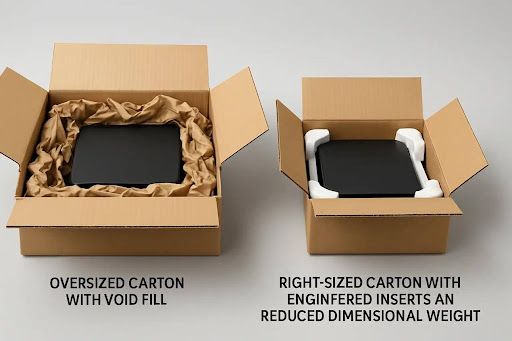
There is no single clearance measurement that works for every product. The right amount of extra space depends on the product’s fragility, shape, orientation, cushioning material, and how the package will be handled.
A snug fit can work for a stable product held in a correctly designed insert. A fragile item may need more space for cushioning, while an item that shifts easily may require dividers or a fitted insert rather than a larger empty box.
Consider these practical examples:
- Rigid, durable products: A close fit may be appropriate when the product can be inserted and removed safely.
- Glass bottles and fragile items: Allow space for a suitable protective system that prevents direct impact against the box walls.
- Multiple products: Consider individual compartments or dividers to prevent items from striking each other.
- Soft or compressible products: Account for how the product sits when packed, rather than relying only on its uncompressed measurements.
- Retail gift sets: Include the dimensions of the insert, decorative components, and any additional items.
Avoid oversized packaging simply because it seems safer. Too much empty space can allow movement, increase material use, and require more void fill. However, an extremely tight box can damage products or make packing inefficient.
For shipping products, compare your proposed dimensions with appropriate corrugated box options and test the complete packed package when protection is important.
How to Calculate Box Dimensions and Volume
Box volume helps businesses compare packaging capacity and plan storage. For a rectangular box, calculate volume by multiplying length by width by height, using the same unit for all three measurements.
Formula: Volume = Length × Width × Height (V = L × W × H)
For example, a box with internal dimensions of 10 × 8 × 4 inches has a volume of:
10 × 8 × 4 = 320 cubic inches
This figure represents the box’s internal rectangular volume if those are its internal dimensions. It does not tell you whether a specific product will fit, because shape, clearance, inserts, and opening dimensions also matter.
Simple custom box size calculator
Use this calculator to estimate the volume of a rectangular box. Enter internal dimensions and select the unit you want to use.
Box volume calculator
Enter the box’s internal length, width, and height.
- Length
- Width
- Height
- Unit: Inches, Centimeters, or Millimeters
Calculated internal volume: 320 in³
This is a mathematical estimate for a rectangular box, not a manufacturing specification.
Volume vs. product fit
Two boxes can have the same volume but different shapes. For example, a long, narrow box may have the same volume as a shorter, wider box but be unsuitable for the same product.
Always compare the actual dimensions and orientation of your product, not volume alone. If you ship many products, a packaging size guide can help standardize the sizes you use across your catalog.
Choosing Custom Box Sizes by Packaging Type
The correct dimensions depend on the type of packaging and its purpose. Different structures need different considerations for product fit, strength, presentation, and production.
1. Custom cardboard boxes and folding cartons
Folding cartons are commonly used for consumer products such as cosmetics, skincare, soap, small retail items, and lightweight packaged goods. Their dimensions should account for the product, the closure style, and the board used.
For retail packaging, precise panel dimensions matter because artwork, folds, and closures need to align correctly. A design that fits the product but does not allow the carton to close properly still needs revision.
Explore cardboard packaging and custom cardboard boxes to understand common options.
2. Corrugated shipping boxes
Corrugated boxes are widely used for shipping, storage, and e-commerce fulfillment. Their sizing needs to consider the product, protective materials, stacking requirements, and the way the box will be handled.
For shipping, internal space must accommodate the item and the intended protection system. External dimensions can also affect storage and carrier calculations, so confirm the carrier’s current dimensional-weight rules when relevant.
Learn more about shipping packaging and available corrugated box styles.
3. Custom mailer boxes
Mailer boxes are often used for subscription products, direct-to-consumer orders, promotional kits, and branded e-commerce shipments. They can combine product protection with a branded unboxing experience.
When selecting dimensions, consider the item, any inserts, printed materials, and how the mailer closes. The product should remain secure without making the package unnecessarily difficult to assemble or open.
See custom mailer boxes for a relevant packaging option.
4. Custom rigid boxes
Rigid boxes are used for premium gifts, luxury retail products, electronics, and selected cosmetics or accessories. Their thick construction and lid or drawer structure influence both internal capacity and external size.
A rigid box may need space for a fitted insert, ribbon, product tray, or multiple components. Ask the supplier to verify the finished internal dimensions and the fit of all components together.
Explore custom rigid boxes for premium packaging applications.
5. Custom food and bakery boxes
Food packaging must be sized around the product’s shape, quantity, presentation, and applicable food-contact requirements. Bakery items may require extra headroom to protect frosting or decorations, while takeaway packaging needs to accommodate the food and its serving arrangement.
The packaging material and construction should be appropriate for the specific food application. Do not assume that every printed paperboard box is suitable for direct food contact.
Businesses can review custom food boxes and bakery box options when comparing structures.
6. Custom display boxes
Display boxes need to fit the product while making it visible and accessible at the point of sale. Dimensions should account for the product arrangement, the display opening, shelf space, and the strength required to hold the products.
A display box that holds the correct quantity may still be unsuitable if the front opening hides the product or the structure does not support the intended arrangement.
Explore custom display boxes for retail presentation applications.
How to Measure a Product for Custom Retail Packaging

Retail packaging has to do more than contain the item. It may also need to display product information, protect the finish, support shelf presentation, and accommodate inserts or accessories.
Use this checklist before sending dimensions to a packaging supplier:
- Measure the product at its widest, longest, and tallest points.
- Include caps, handles, closures, and attachments that will remain in place during packing.
- List any accessories, manuals, promotional cards, or bundled products.
- Decide whether the product needs an insert or divider.
- Identify which side should face the front of the finished package.
- Confirm the required internal dimensions and packaging material.
- Review the artwork layout so important text and logos do not fall across folds or cutting areas.
- Request a sample or production proof if the fit is critical.
For example, a skincare set containing a serum bottle, moisturizer jar, and printed insert should be measured as a complete packaging arrangement. Simply adding the individual product dimensions together will not tell you the correct box size. The layout and orientation of each item also matter.
If your packaging needs to carry a consistent brand identity, review packaging design alongside the physical dimensions.
Standard Box Dimensions vs. Custom Packaging Box Sizes
Standard box dimensions can be convenient for general shipping, but the available size may not suit every product. Custom dimensions can improve fit when a business ships repeatable products or needs a specific retail presentation.
There is no universal standard box size that works for all industries. A suitable size for a lightweight accessory may be inappropriate for a glass container, a bakery item, or a multi-product subscription box.
Before choosing between standard and custom packaging, consider:
- Product dimensions and fragility
- Packaging quantity and order frequency
- Space needed for inserts and cushioning
- Storage and fulfillment limitations
- Printing and branding requirements
- Shipping costs and package dimensions
- Material and production requirements
Businesses with multiple products can create a simple packaging size matrix. Group products by size, weight, fragility, and packing method, then determine whether a small set of standard boxes can serve them or whether custom dimensions are worthwhile.
For small businesses, packaging for small businesses offers additional considerations when balancing product fit and budget.
How Custom Box Dimensions Affect Shipping Costs
Custom box dimensions can influence shipping costs because carriers may consider package size, actual weight, dimensional weight, and the destination. The exact calculation and thresholds depend on the carrier and service.
An oversized package can increase dimensional weight or require more cushioning. An undersized package may fail to accommodate the product and protection system safely.
To manage packaging costs:
- Avoid unnecessary empty space while retaining suitable product protection.
- Use accurate external dimensions when estimating carrier charges.
- Compare material requirements for lightweight and heavy products.
- Test the packed product instead of judging the empty box alone.
- Review how efficiently boxes fit on pallets, shelves, or storage racks.
- Standardize sizes where doing so does not compromise protection or presentation.
For a broader look at pricing variables, read this custom packaging cost guide.
If products are shipped directly to customers, consider the complete e-commerce packaging workflow, from storage and packing through delivery.
Custom Box Sizes for E-commerce Businesses
E-commerce packaging must balance product protection, fulfillment speed, customer experience, and shipping efficiency. A box that looks attractive but is difficult to pack or poorly sized for shipping can create operational problems.
Start by grouping products into practical packing categories:
| Product or order type | Key sizing consideration | Packaging approach to evaluate |
|---|---|---|
| Small accessories | Compact fit and presentation | Folding carton or small mailer |
| Clothing and soft goods | Folded product dimensions | Mailer or appropriately sized box |
| Glass or fragile products | Cushioning and movement prevention | Box with a suitable protective insert |
| Multi-item orders | Arrangement and separation | Larger box with dividers or fitted inserts |
| Subscription kits | Product assortment and unboxing | Custom mailer with an organized interior |
| Heavy products | Strength and handling | Appropriate corrugated construction |
These are starting points, not universal prescriptions. Confirm material strength and final dimensions for the actual product and shipping conditions.
A business may also benefit from maintaining a packing specification for each product. This document should record the box size, insert type, product orientation, and packing sequence. It makes repeat orders easier to manage and reduces variation between fulfillment staff.
Custom Box Sizes and Sustainable Packaging
Right-sized packaging can help reduce unnecessary material use, but the smallest possible box is not always the most sustainable choice. Packaging must still protect the product through handling and transportation.
A damaged product may require replacement, additional shipping, or disposal of both the item and the original packaging. The better objective is to use the least packaging that safely meets the product’s needs.
When comparing packaging options, consider:
- Whether the box fits the product without excessive empty space
- Whether the material is appropriate for the product’s weight and fragility
- Whether unnecessary plastic components can be avoided
- Whether the packaging can be recycled through available local systems
- Whether the box design uses material efficiently
- Whether the finished package protects the product during transit
Recyclability depends on the materials, coatings, adhesives, local facilities, and contamination. Avoid describing a package as universally recyclable or environmentally friendly without evidence for the specific construction.
For more context, read about sustainable packaging and the available packaging materials.
Common Mistakes When Choosing Custom Box Dimensions
Even a small measurement error can affect how a package closes, protects the product, or displays printed artwork. These are common mistakes to avoid.
Measuring only the product’s main body
Caps, pumps, handles, corners, and attachments can increase the overall size. Measure the product in the same configuration in which it will be packed.
Confusing internal and external dimensions
A box’s outside measurements do not represent its usable internal capacity. Always specify which dimensions you are requesting.
Ignoring material thickness
Different board grades and structures affect the finished dimensions. Ask the supplier to confirm how the specified dimensions relate to the production dieline and assembled box.
Leaving out inserts and accessories
Inserts, dividers, cards, and other components occupy space. Design the complete packing arrangement rather than sizing the box around the primary product alone.
Assuming the product’s shape fits a rectangular box
Volume alone cannot confirm fit. An unusually shaped item may require a custom insert, a different orientation, or a different packaging structure.
Approving artwork without a physical fit check
A 3D mockup is useful for visualization, but it does not replace checking the actual product against the finished packaging. Review a sample or proof when dimensions, fit, or product protection are critical.
Ordering a large quantity before validating the size
For repeat production, confirm the dimensions, closure, artwork placement, and packing process before approving a large order. Ask the supplier about sampling and proofing options.
How to Prepare a Custom Box Size Specification
Before requesting a quote, prepare a clear specification so your packaging supplier can understand the project.
Include the following information:
- Product name: Identify the item or product set.
- Product dimensions: Provide length, width, and height, including protruding parts.
- Required box dimensions: State the target internal or external dimensions.
- Material: Specify the preferred board or ask the supplier to recommend an appropriate option.
- Structure: Identify a mailer, folding carton, rigid box, display box, or another format.
- Quantity: Provide the anticipated order quantity.
- Artwork: Supply the logo and packaging artwork if available.
- Finishes: Note requirements such as matte or gloss lamination, foil, embossing, or spot UV.
- Inserts: Explain whether the box needs compartments, dividers, or fitted product supports.
- Delivery requirements: Include the desired schedule and destination for the order.
If you do not know the final dimensions, provide the product measurements and explain how it will be used. A packaging specialist can help evaluate the structure and required clearances.
Bluebird Packaging offers custom packaging options across several product and industry categories. You can review the packaging solutions available from Bluebird Packaging and prepare your requirements before requesting a quote.
Need help choosing custom box dimensions?
The right dimensions depend on your product, material, box style, and packing requirements. Share your product measurements and packaging goals so the specifications can be reviewed before production.
Frequently Asked Questions About Custom Box Sizes
1. How do you measure custom box sizes?
Measure length, width, and height using a consistent unit. For product packaging, measure the item in its intended packing configuration, then account for necessary clearance, inserts, and protective materials. Confirm whether the final dimensions should be internal or external.
2. What order are box dimensions listed in?
Box dimensions are commonly listed as length × width × height (L × W × H). However, conventions can differ by supplier or product type, so label each measurement clearly when requesting custom packaging.
3. Is box size measured by length, width, and height?
Yes. Rectangular box dimensions are generally expressed using length, width, and height. These measurements can describe either the inside or outside of the box, so specify which one you need.
4. Should I use internal or external box dimensions?
Use internal dimensions when checking whether the product and its inserts will fit. Use external dimensions when planning storage, stacking, or shipping measurements. Ask your packaging supplier to confirm both when the distinction matters.
5. How much extra space should I leave inside a box?
There is no fixed clearance for every product. Durable products may need only enough space for practical insertion and removal, while fragile products may need a designed cushioning system. Determine the clearance based on the product, protective material, and shipping conditions.
6. How do I measure a product for custom packaging?
Measure the longest, widest, and tallest points of the product, including caps, handles, and attachments. Record the orientation in which it will be packed and include any accessories, dividers, or inserts that need to fit inside the box.
7. How do I calculate the volume of a box?
Multiply its length by width by height, using the same unit for all three measurements. For example, a box measuring 10 × 8 × 4 inches has a volume of 320 cubic inches. Volume does not guarantee that a particular product will fit.
8. What is the difference between box size and product size?
Product size refers to the dimensions of the item being packaged. Box size refers to the packaging dimensions, which may be internal or external. The box generally needs enough internal space for the product and any required protective components.
9. How do I choose the right shipping box dimensions?
Start with the packed product and its protection requirements. Select internal dimensions that accommodate the item and cushioning, then confirm external dimensions for shipping and storage. Test the complete package where product damage or carrier restrictions are a concern.
10. Can I order custom boxes in any size?
Custom boxes can be produced in many different dimensions, but practical limits depend on the material, box structure, manufacturing equipment, and supplier capabilities. Provide your target measurements and ask the supplier to confirm feasibility.
Final Thoughts: Choose Custom Box Sizes That Fit Your Product
The best custom box sizes balance product fit, protection, material, presentation, and shipping requirements. Start with accurate measurements, specify internal or external dimensions, account for inserts and cushioning, and verify the final structure before production.
For businesses that ship or sell products regularly, a well-planned packaging specification can improve consistency and make repeat orders easier to manage. Custom dimensions are especially useful when standard boxes create unnecessary empty space or fail to provide the desired brand presentation.
If you are planning custom printed packaging, explore Bluebird Packaging’s product options and request a quote to discuss your product dimensions, packaging structure, and design requirements.





1 Comments
[…] approving the structure, review the custom box size guide and confirm whether the dimensions refer to the inside or outside of the finished […]