

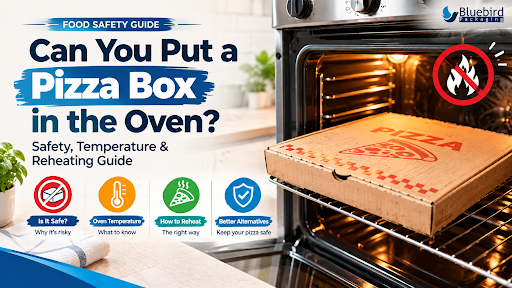
Quick answer: No, you should not put a standard cardboard pizza box in the oven. Ordinary delivery pizza boxes are designed to transport food, not withstand oven heat. Cardboard can scorch, smoke, or ignite, particularly near heating elements or when contaminated with grease. Remove the pizza from the box and reheat it on a baking sheet, pizza pan, or another oven-safe surface.
A cold pizza and a cardboard box might seem like a convenient combination when you want to warm up leftovers. However, putting the entire box in the oven can create an unnecessary fire hazard and may leave you with a soft, unevenly heated crust.
Whether you want to know if a pizza box can go into a warm oven, whether cardboard is safe at 200°F, or how to keep a takeaway pizza hot, this guide explains the risks and safer alternatives.
Can You Put a Pizza Box in the Oven?
No. Do not put a regular cardboard pizza box in a conventional oven, toaster oven, or under a broiler. Standard pizza boxes are not designed or tested to serve as oven cookware. Even if the oven is set to a relatively low temperature, the cardboard can dry out, discolor, scorch, or smoke.
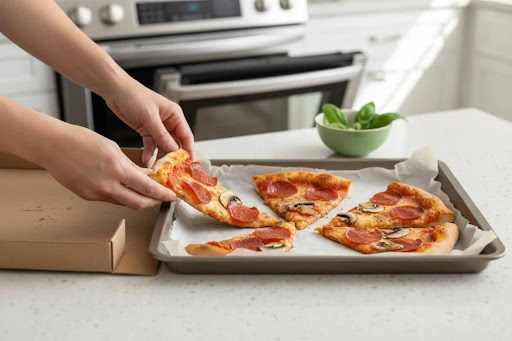
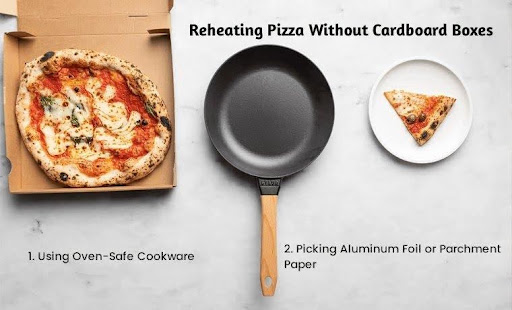
The safest approach is simple: remove the pizza from its packaging before heating it. Place the slices on an oven-safe baking sheet, pizza pan, or oven rack if appropriate for your oven and the food being heated.
There is an important distinction between ordinary packaging and specially designed ovenable food packaging. A package should only be used in an oven if its manufacturer explicitly identifies it as oven-safe and provides suitable heating instructions. Do not assume that a thicker box, a brown kraft box, or a grease-resistant coating makes a standard pizza box oven-safe.
Pizza box safety at a glance
| Question | Short answer |
|---|---|
| Can you put a pizza box in the oven? | No, not unless the specific packaging is explicitly rated for oven use. |
| Can you put a pizza box in the oven at 200°F? | Avoid it. A low setting does not make ordinary cardboard oven-safe. |
| Can you put a pizza box in the oven at 350°F? | No. Remove the pizza from the box first. |
| Can you put a pizza box in the microwave? | Not unless the package is specifically labeled microwave-safe. |
| What is the safest way to reheat pizza? | Use an oven-safe pan, skillet, or air fryer basket. |
| Can you keep pizza warm without the box? | Yes. Use an oven-safe pan and appropriate food-holding temperatures. |
Why Pizza Boxes Are Not Oven-Safe
Most standard pizza boxes are made from corrugated paperboard. This material typically contains flat paper liners and a fluted middle layer that provides structure and helps protect the pizza during transportation.
Corrugated packaging is useful for takeaway food because it is lightweight, stackable, and practical for delivery. However, being suitable for carrying hot food does not mean that it is suitable for direct exposure to oven heat.
If you want to understand the material, read our guide to corrugated packaging and learn more about the different materials used in packaging.
Here are the main reasons to keep an ordinary pizza box out of the oven.
1. Cardboard can scorch or catch fire
Paper-based materials are combustible. When exposed to heat for long enough, cardboard may dry out, darken, char, and eventually ignite. The risk depends on the material, exposure time, airflow, and proximity to heating elements.
An oven’s displayed temperature is not a guarantee that every surface inside it is at that temperature. Heating elements can become much hotter than the selected setting, and a box placed close to an element can receive intense radiant heat.
This is one reason the National Fire Protection Association advises keeping food packaging and other combustible materials away from cooking heat. Its cooking-safety guidance also recommends turning off the heat and keeping the oven door closed if a fire starts inside the oven. Read the NFPA’s cooking safety guidance.
2. Grease can increase the hazard
Pizza often leaves oil, cheese, and other food residue on the inside of its box. If grease soaks into the cardboard, the affected area may discolor or char differently from clean paperboard.
Do not rely on a visual inspection to determine whether a greasy box is safe to heat. The safer choice is to remove the pizza and leave the box outside the oven.
3. Inks, adhesives, and coatings are not proof of oven safety
Pizza packaging may use printing inks, adhesives, or coatings for branding, structural integrity, and grease resistance. These materials are selected for their intended packaging conditions.
A food-contact-compliant material is not automatically suitable for oven exposure. Heating packaging beyond its intended conditions may cause discoloration, unpleasant odors, smoke, or material breakdown.
If the packaging does not explicitly provide oven-use instructions, do not heat it with the pizza.
4. A box can affect the pizza’s texture
Cardboard is not an efficient substitute for a baking tray. Leaving pizza inside the box can trap steam and slow the transfer of heat to the crust.
As a result, the pizza may warm unevenly and become soft instead of crisp. A suitable pan or direct contact with an appropriate oven surface usually gives you better control over the reheating process.
5. Smoke can create an additional problem
Even when cardboard does not burst into flames, overheating it can create smoke and an unpleasant burnt-paper smell. Smoke can trigger alarms and make the kitchen uncomfortable.
There is little benefit to taking this risk when removing the pizza from the box takes only a few seconds.
What Temperature Is Safe for a Pizza Box?
There is no universal oven temperature that makes an ordinary cardboard pizza box safe to use. Do not treat 170°F, 200°F, or any other setting as a guaranteed safe limit.
The behavior of paperboard depends on its composition, moisture, construction, coatings, exposure time, and distance from the heat source. Cardboard may begin to discolor or scorch before it ignites, so the temperature at which a material catches fire is not a suitable operating limit.
Pizza box oven temperature guide
| Oven setting or mode | Typical purpose | Recommendation for a standard pizza box |
|---|---|---|
| Warm setting | Holding food warm | Do not put the box inside. Use an oven-safe pan instead. |
| 200°F | Gentle warming | Not recommended for cardboard packaging. |
| 350°F | Reheating food | Remove the pizza from the box. |
| 375°F | Reheating pizza | Use a baking sheet or another suitable oven-safe surface. |
| 425°F or higher | Baking many frozen pizzas | Follow the food package directions; leave ordinary cardboard packaging out. |
| Broil | Browning toppings | Never use a standard pizza box under the broiler. |
These recommendations are intended for ordinary delivery boxes, not specially manufactured ovenable packaging. Always follow the instructions for your particular appliance and food product.
Can you put a pizza box in the oven at 200°F?
No. Although 200°F is lower than many cooking temperatures, it does not make a regular pizza box oven-safe. The box may be exposed to hotter surfaces, and its condition can vary depending on grease and construction.
If you want to warm pizza gently, place it on an oven-safe pan and use a suitable low setting. Monitor the food rather than using the cardboard box as a warming container.
Can you put a pizza box in the oven at 350°F?
No. A standard pizza box should not be placed in a 350°F oven. Remove the pizza and put it on a baking sheet or another suitable oven-safe surface before reheating.
Can you put a pizza box in a warm oven?
Avoid doing so. A warm setting is not a substitute for an oven-safety rating. To keep pizza warm, use an oven-safe dish or pan and follow appropriate food-holding guidance.
Can You Put a Cardboard Pizza Box in the Microwave?
Do not microwave a standard pizza box unless the manufacturer explicitly labels that particular package as microwave-safe and provides instructions for doing so.
Microwave safety and oven safety are different. A package that is suitable for one heating method is not necessarily suitable for another. Some packaging can deform, scorch, or be inappropriate for direct food heating.
For leftover pizza, place one or two slices on a microwave-safe plate. Heat them in short intervals, checking that they are hot throughout. A microwave is convenient, but the crust will generally be softer than pizza reheated in an oven or skillet.
For more information about food safety, consult the USDA’s guidance on handling and reheating leftovers.
Can You Reheat Pizza in the Box?
No. You should remove pizza from a standard cardboard box before reheating it in an oven or toaster oven. Do not assume the box is safe for microwave use, either.
The best reheating method depends on how much pizza you have, how crispy you want the crust, and which appliances are available.
Before reheating, check that the pizza has been stored safely. The USDA recommends refrigerating perishable leftovers within two hours, or within one hour when the surrounding temperature is above 90°F. It also recommends reheating leftovers to an internal temperature of 165°F, measured with a food thermometer. See the USDA’s leftover food safety recommendations.
Best Ways to Reheat Pizza Without a Pizza Box
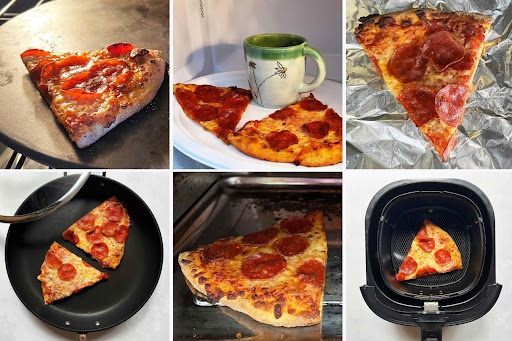
You do not need cardboard to keep pizza warm. Several simple methods can heat leftover slices while helping preserve their texture.
Reheating method comparison
| Method | How to use it | Best for | Expected result |
|---|---|---|---|
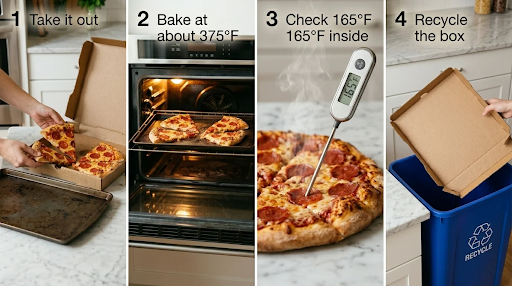
| Conventional oven | Preheat to around 375°F, place slices on a baking sheet, and heat until hot throughout. | Several slices or a larger portion | Crispier crust and even heating when monitored |
| Skillet | Heat a slice in a suitable skillet over medium-low heat. Cover briefly if needed to help warm the toppings. | One or two slices | Crisp bottom and warmed cheese |
| Air fryer | Place slices in a single layer in the basket and heat at a suitable setting, checking frequently. | Small portions | Crisp crust in a short time |
| Toaster oven | Place pizza on the appliance’s designated tray or rack and follow its instructions. | A few slices | Convenient reheating in a small appliance |
| Microwave | Use a microwave-safe plate and short heating intervals. | Fast reheating | Soft crust and quick results |
Cooking times vary with slice thickness, starting temperature, appliance performance, and the number of slices. Use the appliance manufacturer’s instructions and check that leftovers are thoroughly reheated.
Method 1: Reheat pizza in a conventional oven
An oven is a good choice when you want to reheat several slices or a larger portion.
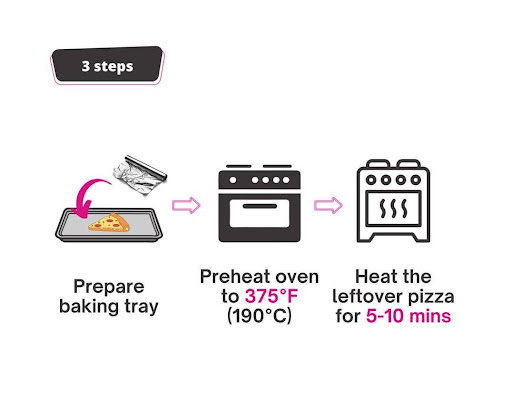
- Remove the pizza from its cardboard box.
- Preheat the oven to around 375°F, adjusting to suit the pizza and your appliance.
- Arrange the slices on a suitable baking sheet or pizza pan.
- Place the pan in the oven and monitor the pizza as it warms.
- Remove it when the cheese and toppings are hot and the crust has reached your preferred texture.
- For food safety, check that reheated leftovers reach 165°F internally.
Do not put the original delivery box, paper inserts, or other unapproved packaging in the oven with the pizza.
Method 2: Reheat pizza in a skillet
A skillet is useful when you only have one or two slices to reheat.
- Place a slice in a suitable skillet.
- Heat it over medium-low heat.
- Allow the bottom to crisp while the toppings warm.
- Cover the skillet briefly if needed to help the cheese melt.
- Check that the pizza is heated thoroughly before eating.
Avoid excessive heat, which can burn the crust before the toppings become hot.
Method 3: Reheat pizza in an air fryer
An air fryer can produce a crisp crust quickly, especially for small portions.
- Remove the pizza from its box.
- Place slices in a single layer in the air fryer basket.
- Choose an appropriate temperature according to your appliance’s instructions.
- Check the pizza after a short interval and continue heating if necessary.
- Make sure the pizza is hot throughout before serving.
Do not overcrowd the basket, and keep loose packaging materials away from the heating element.
Method 4: Reheat pizza in the microwave
A microwave is convenient when speed matters more than crispness.
- Put the pizza on a microwave-safe plate.
- Heat it in short intervals.
- Check the center and toppings for cold spots.
- Continue heating until the leftovers are thoroughly hot.
Use only containers and covers labeled as microwave-safe. Never assume that a cardboard pizza box is suitable just because the heating time is short.
How to Keep Pizza Warm Without Putting the Box in the Oven
If your pizza is ready before everyone is seated, you can keep it warm without exposing cardboard to heat.
- Remove the pizza from the delivery box.
- Place it on an oven-safe baking sheet or pan.
- Use an appropriate low oven setting if you need to hold it briefly.
- Cover it loosely with suitable foil if necessary, making sure the foil is compatible with your appliance and does not touch heating elements.
- Check the pizza regularly so it does not dry out or overcook.
For food safety, the USDA advises keeping hot food at 140°F or above. Perishable food should not remain at room temperature for more than two hours, or one hour when the temperature is above 90°F. These are food-safety guidelines, not a recommendation to keep a pizza box in a warm oven.
For short delivery or transport periods, an insulated food carrier may help retain heat. Follow the carrier’s instructions and avoid placing it on a stove, inside an oven, or near an open flame.
What About Frozen Pizza Boxes and Cardboard Circles?
Frozen pizza packaging can look similar to takeaway packaging, but its instructions may be different. The outer box is generally packaging, not a baking tray. Some products also include a cardboard support or liner that should be removed before cooking.
Always read the instructions on the specific frozen pizza package. If they tell you to remove the packaging and place the pizza directly on an oven rack or a baking sheet, follow those directions.
Do not assume that a cardboard circle or tray is oven-safe simply because it came with the pizza. Use it only if the manufacturer explicitly states that it is designed for oven use and explains how to use it safely.
What Should You Do If a Pizza Box Catches Fire in the Oven?
An oven fire should be treated seriously. If a pizza box or another item catches fire inside your oven:
- Turn off the oven if you can do so safely.
- Keep the oven door closed. Opening it may allow more oxygen to reach the fire.
- Do not pour water into the oven or attempt to carry burning packaging out.
- If the fire does not go out, smoke spreads, or you are unsure what to do, leave the area, close the door behind you if possible, and call your local emergency number from a safe location.
- Do not use the oven again until the fire is fully extinguished and the appliance has been checked if necessary.
The NFPA specifically advises turning off the heat and keeping the oven door closed during an oven fire. Review the NFPA’s cooking safety guidance.
Prevention is much easier: keep cardboard boxes, paper bags, towels, and other combustible materials away from hot cooking surfaces.
Are Pizza Boxes Recyclable?
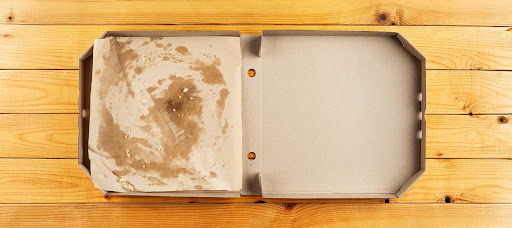
Many clean or lightly grease-marked pizza boxes can be recycled, but acceptance varies by local recycling program. The important steps are to remove leftover food, separate any non-paper components, and follow your local collection rules.
For a typical pizza box:
- Remove leftover crusts, cheese, and other food scraps.
- Take out plastic liners or other components that are not accepted with paper recycling.
- Flatten the empty box if your local program requests it.
- Check local guidance if the cardboard is heavily contaminated with grease or food.
- Compost it only if your local composting service accepts that type of packaging.
Do not assume that all pizza boxes must be thrown away because they have a grease stain. Equally, do not assume that every recycling program accepts every type of food-soiled paperboard.
Businesses considering more sustainable food packaging should evaluate material composition, food-contact requirements, local recycling availability, and the needs of their delivery operations. Explore our guides to sustainable packaging and cardboard packaging for more information.
For Pizzerias: How to Make Pizza Packaging Safer for Customers
Restaurants and food brands can help customers handle takeaway pizza safely by providing clear packaging instructions.
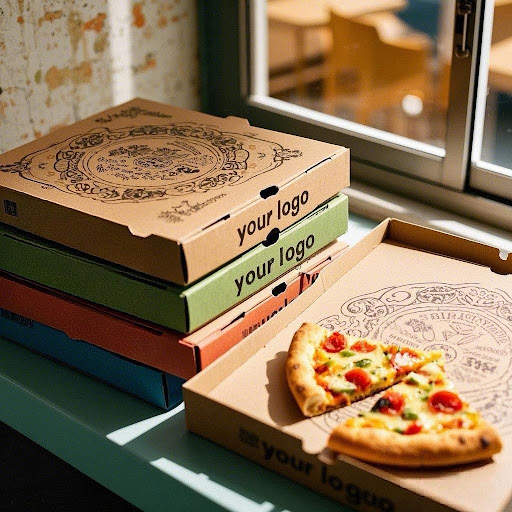
Print a clear heating warning
Consider including a simple message such as:
“Remove pizza from this box before reheating. Do not place this box in an oven or microwave unless the packaging is specifically labeled for that use.”
This helps customers distinguish between a box intended for delivery and packaging specifically designed for heating.
Choose packaging for its intended use
Select packaging based on the pizza’s size, temperature, delivery duration, stacking needs, and expected handling conditions. Corrugated boxes are widely used for takeaway because they provide structure and help protect the product during transport.
For restaurants ordering packaging in larger quantities, bulk food packaging supplies can be a useful starting point for exploring packaging needs. Select packaging based on its intended use, food-contact suitability, and confirmed supplier specifications—not appearance alone.
Standard corrugated pizza packaging should not be represented as oven-safe unless the specific product has been designed and verified for that purpose.
Consider print, ventilation, and branding
Packaging can help communicate brand identity and practical handling information. Depending on the product and supplier, businesses may evaluate print quality, venting, structural design, and the placement of instructions.
Explore our custom food boxes to learn about packaging options for food businesses. For pizza-specific packaging, review our custom pizza boxes, which can help you explore options for takeaway and delivery packaging.
If you are comparing box structures, our cardboard boxes and corrugated boxes pages can help you explore common packaging formats. For other food applications, see our food packaging guide and product packaging guide.
The right box size also matters for product fit, stacking, and delivery. Use our pizza box dimensions guide to explore pizza box sizing considerations before choosing a format.
For businesses offering curated food products or recurring snack deliveries, snack subscription boxes provide another example of how packaging requirements can vary by product type and delivery model.
For a business choosing packaging, the correct option depends on the food product, shipping conditions, packaging specifications, and the supplier’s confirmed capabilities. Review different types of packaging before deciding which structure fits your needs.
Pizza Box Myths vs. Facts
| Myth | Fact |
|---|---|
| “Cardboard is safe as long as the oven is set to a low temperature.” | A low setting does not make a standard pizza box oven-safe. |
| “If the box does not catch fire immediately, it is safe.” | Cardboard may scorch or smoke before igniting. |
| “A thicker pizza box can go in the oven.” | Thickness alone does not establish oven safety. |
| “Grease-resistant packaging is safe for cooking.” | Grease resistance does not mean a box is designed for oven heat. |
| “A few minutes in the microwave cannot hurt.” | Use only packaging specifically labeled microwave-safe. |
| “Frozen pizza cardboard is always safe to bake on.” | Follow the exact cooking instructions on the frozen pizza package. |
| “The pizza reheats better inside the box.” | A suitable pan or other approved cooking surface provides better control and avoids the cardboard hazard. |
Frequently Asked Questions
1. Can you put a pizza box in the oven?
No. A standard cardboard pizza box is not designed for oven use and can scorch, smoke, or ignite. Remove the pizza from the box and reheat it on an oven-safe pan or another suitable surface.
2. What happens if you put a pizza box in the oven?
The cardboard may dry out, darken, scorch, smoke, or catch fire, depending on the material and heat exposure. Grease and proximity to a heating element can add risk. The pizza may also heat unevenly.
3. What temperature is safe for a pizza box?
There is no universal safe oven temperature for a standard pizza box. Do not use an ordinary delivery box in the oven at 170°F, 200°F, or 350°F. Only use packaging that is explicitly designed and labeled for oven use.
4. Can a pizza box catch fire in the oven?
Yes. Cardboard is combustible and can ignite under suitable conditions. Keep standard pizza boxes away from oven heating elements, broilers, burners, and other hot surfaces.
5. Can you reheat pizza in its cardboard box?
No. Take the pizza out of its standard cardboard box before reheating. Use an oven-safe baking sheet, skillet, air fryer basket, or microwave-safe plate, depending on the method.
6. Can you put a pizza box in the oven at 200°F?
It is not recommended. A lower oven setting does not establish that cardboard is safe for heating. Move the pizza to an oven-safe pan if you need to warm it.
7. Can you keep pizza warm in the oven without a box?
Yes. Place the pizza on an oven-safe pan and use a suitable low setting. For food safety, the USDA advises keeping hot food at 140°F or above. Avoid holding pizza for extended periods because it may dry out.
8. What is the safest way to reheat pizza?
Use a baking sheet or suitable oven-safe surface in a conventional oven, a skillet on the stovetop, or an air fryer. A microwave-safe plate is suitable for microwave reheating. Follow the appliance instructions and make sure leftovers are heated thoroughly.
9. Can you put cardboard in the oven for a few minutes?
Do not put ordinary cardboard in the oven just because the exposure will be brief. The material, location, and heating conditions can vary, and a short duration is not a guarantee of safety.
10. Is a pizza box microwave-safe or oven-safe?
Not by default. Standard pizza boxes should be treated as delivery packaging, not cookware. Use a package in a microwave or oven only when the manufacturer explicitly identifies it as suitable for that use and provides instructions.
11. Can you put a pizza box on top of the oven to keep it warm?
Avoid placing the box on top of a hot oven, stove, or near a vent. Heat can damage the cardboard, and combustible packaging should be kept away from hot surfaces.
12. Are pizza boxes recyclable if they have grease on them?
Some recycling programs accept pizza boxes with light grease stains, while local rules vary. Remove leftover food and non-paper components, flatten the box if required, and check your local recycling guidance.
Final Takeaway
Can you put a pizza box in the oven? No—not if it is a standard cardboard delivery box. Ordinary pizza packaging is designed for carrying food, not for exposure to oven heat. Cardboard can scorch, smoke, or ignite, and grease or nearby heating elements can increase the risk.
For safer reheating, take the pizza out of its box and use an oven-safe baking sheet, skillet, air fryer basket, or microwave-safe plate. Follow the food and appliance instructions, and reheat leftovers thoroughly. If you want to keep pizza warm, use an appropriate pan rather than putting the cardboard box in the oven.
For restaurants and food businesses, packaging should be selected for its intended use and should provide clear handling instructions. Explore Bluebird Packaging for custom packaging options, or contact the team to discuss packaging requirements.